
Last checked: August 2026 · Written by the player-led team at Badminton House
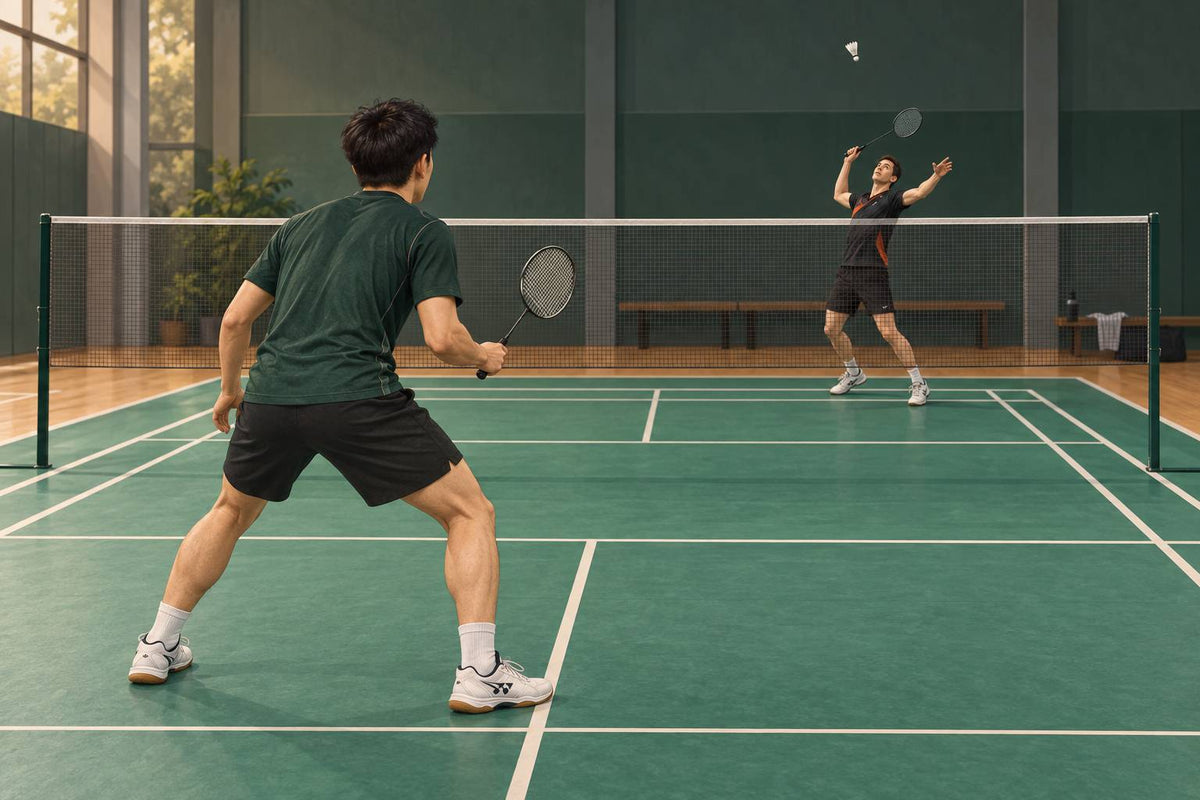
To read deception in badminton, stop searching for one magic tell. Prepare to move, follow the opponent’s action through contact, and let the first shuttle flight confirm the direction when time allows. Every cue changes the odds; none promises the shot.
The three-part answer: stay physically ready, delay the corner-specific push, then confirm with contact and early flight. “Wait longer” never means stand still.
This guide takes the receiver’s view. To understand what the hitter is trying to preserve, compare our guide to creating disguise in badminton. For a narrower serve application, use the serve cue-reading guide.
Why early guesses fail against good disguise
A deceptive action keeps more than one outcome plausible for longer. If you turn an opponent’s gaze, head position, or early body shape into a certain answer, a convincing surface-level story can pull your first step away from the shuttle.
In a filtered-video deception experiment, skilled participants were less accurate on deceptive trials when high-spatial-frequency detail emphasized superficial information than in normal or movement-emphasizing low-spatial-frequency conditions. That result does not make the body irrelevant. It says the visible story must be checked against how the action actually develops.
Replace “What shot is coming?” with two smaller questions: “Which options are still physically plausible?” and “What new information appeared as the racket reached the shuttle?” This keeps anticipation useful without turning it into a bet on one corner.
Use a cue order instead of one favourite tell
Read the action as a sequence. Early information narrows what looks comfortable; movement through contact provides stronger direction; early shuttle flight confirms what was actually sent. Keep the whole chain available rather than staring at one body part.

| Window | What to collect | How to use it |
|---|---|---|
| Before acceleration | Opponent balance, shuttle position, available contact space | Reduce the option set, but do not declare a winner. |
| During the action | Arm, forearm, wrist, racket path, and changing speed | Follow how the possibilities are being narrowed. |
| At contact | Racket direction and the racket–shuttle meeting point | Make the first directional decision without treating the racket face as infallible. |
| Immediately after | Initial shuttle direction, height, and speed | Confirm and adjust while completing the first step. |
A serve-specific gaze and kinematics study found shot-related movement differences at the shoulder, elbow, wrist, and racket. Correct predictions were associated with gaze around the racket and wrist, while participants rarely fixated the shoulder and elbow directly. Across players, accuracy also improved as clips revealed contact and 40 ms of post-contact information.
The useful application is a soft visual anchor near the racket hand and contact area, with peripheral attention available for the larger movement. The experiment studied serves, so use this as a cue-reading principle to test, not a universal map for every rally stroke.
Stay late in the decision without becoming late to the shuttle
As a practical synthesis of the serve-specific information-timing evidence and BWF movement guidance, neutral readiness buys observation time. Load the legs and time the split step before contact, but avoid the large corner-specific push until the action gives you enough reason. You are delaying one decision, not delaying all movement.
The BWF Coach Education Level 1 manual describes the split step as a shallow jump begun just before the opponent strikes, with landing with or just after the hit so a player can respond and change direction. It also notes that a player may bias the landing toward a likely reply, while no split step covers every direction equally.
- Before contact: recover to a base that matches the court picture, keep the racket available, and begin the split.
- At contact: land ready to push, with your centre of mass controlled rather than already falling into one corner.
- After contact: use the smallest first step that gets the body behind the confirmed line.
A mild positional bias can be sensible when court geometry and the opponent’s balance make one reply more plausible. Keep enough control to change the first step if the shuttle proves the prediction wrong.
Two partner drills for reading through contact
These drills adapt information timing and immediate feedback from anticipation research; the exact live formats have not been experimentally validated. Score the first directional response separately from whether the rally eventually succeeds, because a good read can still be followed by a poor shot.
1. Contact-call drill
- The hitter receives a comfortable feed and plays one of two agreed outcomes from the same area, such as straight clear or straight drop.
- The reader times a split step and calls the expected outcome at contact. The hitter completes the stroke so flight gives immediate feedback.
- Record three items: call correct or incorrect, first step correct or incorrect, and shuttle returned or not returned.
- After a short block, add the cross-court versions. Do not add more choices until the hitter can play the current options with a safe, representative action.
2. Split-and-return drill
- Use the same two-option feed, but remove the spoken call and play the rally through the reader’s return.
- The reader may recover and split before contact, but the corner-specific push begins only as the stroke and early flight justify it.
- Award one practice mark for a controlled first move and a separate mark for a playable return. The marks are feedback, not a pass threshold.
- Mix plain and disguised actions. If the reader starts guessing a pattern, change the sequence instead of adding speed.
A three-day experiment with novice players found better deceptive-trial prediction after low-spatial-frequency video training than after normal-video training at post-test and one-week retention. The blurred condition reduced superficial detail, and gaze shifted toward the contact location. That was a screen-based task, not proof that either partner drill guarantees live-match improvement.
Counter the situation, not a mythical tell
When deception keeps winning, review the contact situation as well as the cue you missed. Quality depth, pace, and recovery may make it harder for an opponent to build a comfortable multi-option action. They do not remove deception, and no contact height guarantees the reply.
No-guessing review loop
- Name the exact shot and contact situation that moved you the wrong way.
- Identify the cue you treated as certain.
- Choose one later confirmation to collect next time: movement through contact or initial flight.
- Choose one rally adjustment that may reduce the hitter’s comfort, then test it without assuming success.
The aim is not perfect prediction. It is fewer irreversible guesses, a more balanced first movement, and a review process that tells you what to watch on the next rally.

Leave a comment
This site is protected by hCaptcha and the hCaptcha Privacy Policy and Terms of Service apply.