Last checked: August 2026 · Written by the Badminton House player-led team.
Can you resole badminton shoes?
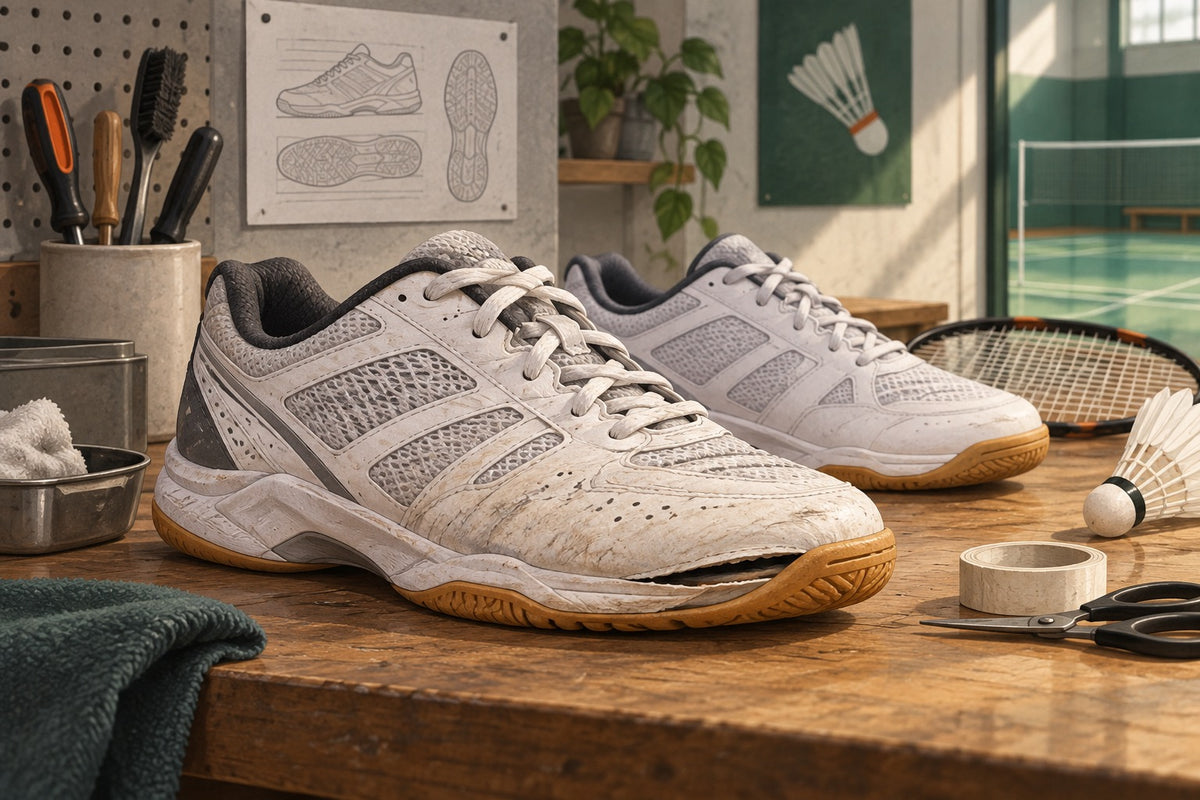
Sometimes. A cleanly separated outsole may be a repair candidate when the midsole, heel counter, upper and pair alignment are still sound. Fresh bonding cannot restore compressed cushioning, distorted support, stretched fit or the original shoe’s full court performance.
Ask about repair: the outsole has separated, but the rest of the shoe feels and looks structurally sound.
Replace: the midsole is deformed, the heel counter is soft or deviated, the upper fit has changed, or the outsole is cracked, crumbling or no longer gripping.
Stay off court: traction or stability is uncertain. Do not use a visual checklist as clearance for competitive play.
A separated badminton shoe sole is not automatically a lost cause, but it is also not automatically a simple glue job. The important question is what failed. If the outsole bond has let go while the cushioning, heel structure and upper remain sound, a qualified repairer may be able to rebond the sole. If the shoe has lost its underlying support or fit, outsole work cannot restore the whole shoe.
This guide gives you a conservative inspection sequence before you pay for an assessment. It applies running-shoe and general-footwear guidance to indoor court shoes. It is not a validated badminton-shoe safety test.
What can a repairer actually fix?
A repairer can sometimes rebond a minor sole separation when the rest of the shoe is sound, but construction and whole-shoe condition determine whether professional work is practical. New Balance cautions that a temporary adhesive repair may not restore full performance or durability.

For construction context, The Village Cobblery recommends assessing the construction and condition of the whole shoe. A National Toxicology Program footwear report describes cemented-sole repair as removing the original sole and bonding a repair sole to the upper through the usual manufacturing process. That does not mean every badminton shoe can be resoled. Ask what construction and material the repairer sees and how they would assess the finished pair. Do not assume a repaired outsole reproduces the original traction, cushioning or support.
Badminton House rule: treat a separated outsole as a request for a construction-specific opinion, not as permission to return immediately to hard court movement.
Three hands-on checks before you ask for a quote
Badminton House screening step: make the checks on both shoes in good light and compare the pair for differences in shape, support and wear. You are looking for clues before a repair quote, not trying to diagnose a tissue or shoe problem from one squeeze or clear the pair for court.
| Check | Look or feel for | What it means |
|---|---|---|
| Midsole | Press the cushioning and compare its feel and shape across the pair. Look for deformation, uneven compression or crumbling. | Uneven or degraded cushioning is a replacement prompt, not a problem a new outsole automatically solves. |
| Heel counter | Squeeze the rear structure and view both shoes from behind. Look for excessive flexibility or deviation to one side. | A distorted heel structure can remain a problem even if the outsole bond is repaired. |
| Outsole, upper and alignment | Check where the sole has separated, then look for cracks, crumbling, worn grip, upper damage, stretching or a pair that no longer sits evenly. | A clean bond failure on an otherwise sound pair is the strongest repair conversation. Multiple failures point toward replacement. |
These checks combine the component inspections described by ASICS and New Balance. Badminton House uses the combined sequence as a practical screening method, not as a validated court-shoe safety test.
Check the midsole before blaming the outsole
Running-shoe guidance treats deformation, uneven compression and loss of cushioning as reasons to consider replacement. If the foam feels permanently flattened or uneven, rebonding the bottom does not rebuild that compressed structure.
Do not turn one subjective squeeze into a pass-or-fail result. Compare the pair, note any obvious asymmetry and ask a repair professional whether the midsole is still structurally worth saving.
Check the heel counter and rear alignment
ASICS identifies excessive heel-counter flexibility or side-to-side deviation as a replacement prompt in running shoes. For an indoor court shoe, use that as a conservative reason to ask a repairer about the pair—not as a badminton-specific clearance test.
If you feel instability or repeated slipping, do not use a repair checklist to clear the pair for court play.
Check what actually separated
Badminton House documentation step: photograph the separation before cleaning or applying anything. Identify whether the bond has opened along one clean section or whether the outsole is cracked, crumbling or worn through. Look at the upper near the bond line for tearing, stretching or other structural damage.
The Village Cobblery advises against applying consumer shoe adhesives before professional repair because residue can make later work more difficult. A household glue job may hold temporarily while still failing to restore the shoe’s original performance or durability.
Repair, replace or retire from court?
Badminton House decision tree: use this as a conservative screen, not a safety clearance. Ask about repair only for a clean separation on an otherwise sound pair; replace when support, fit or grip has deteriorated; keep the pair off court when traction or stability is uncertain.
ASK ABOUT REPAIR—clean separation, sound shoe
This is the best case for a professional opinion: the outsole has separated, but the midsole is even, the heel counter remains firm, the upper still fits as intended and the pair sits normally. Ask what construction and replacement material are available and how the repaired pair should be checked before court use.
REPLACE—support, fit or geometry has deteriorated
Replacement is the conservative choice when the midsole is deformed or crumbling, the heel counter is soft or deviated, the upper has lost its fit, the outsole no longer provides reliable grip or several components are deteriorating together.
RETIRE FROM COURT—traction or stability is uncertain
Badminton House’s conservative house method is to keep an uncertain pair off court rather than testing it during lunges, jumps or fast changes of direction. A non-court retirement decision is not a statement that the shoe is safe for every other activity.
The repair decision is construction-specific. The cited repair sources describe cemented construction and professional assessment, but they do not establish a universal price percentage or a guarantee for badminton shoes. Ask an experienced repairer to assess the actual pair.
Why do badminton shoe soles separate?
Sole separation is a bond failure, but one visible failure does not prove one cause. New Balance and The Village Cobblery identify heat, moisture, storage conditions, natural aging and repeated flexion or use as contributors to deterioration. A shoe left in a hot car, stored damp or repeatedly flexed can experience conditions that weaken adhesives and other materials, but the cause of one pair’s failure cannot be established from appearance alone.
How can you slow shoe deterioration?
Dry, ventilated storage, avoiding direct heat and moisture, regular inspection and rotating pairs when practical can slow deterioration. These are care measures, not a guarantee of a particular lifespan or protection from every adhesive or material failure.
- Let damp shoes dry in a ventilated place rather than sealing them immediately.
- Avoid direct heat, hot-car storage and dryers.
- Keep shoes clean and inspect the outsole, midsole, heel counter and upper regularly.
- Rotate pairs when practical so one pair is not exposed to every session.
These habits follow ASICS and New Balance care guidance. They can slow deterioration; they cannot guarantee a particular lifespan or prevent every bond failure.
Next step: if the shoe passes the basic visual screen but the repair decision is unclear, photograph the pair and ask an experienced footwear repairer or the manufacturer for a construction-specific assessment. If traction, stability, pain or repeated slipping remains a concern, replace the pair and seek qualified assessment when appropriate.
For related maintenance, see our badminton shoe midsole guide, badminton shoe outsole-pattern guide and guide to drying badminton shoes.

Leave a comment
This site is protected by hCaptcha and the hCaptcha Privacy Policy and Terms of Service apply.