
Last checked: August 2026 · Written by the player-led team at Badminton House
Quick answer
Full cork, composite, and foam describe what may sit under a shuttle's outer cover. Read the model specification first; use the actual shuttle's condition and flight to decide whether it is ready to use.
Default
Buy by documentation: select the shuttle model your club or event uses, then confirm its stated construction and speed before reading feel into the base.
Avoid
Do not classify an intact base by pressing it, listening for a particular sound, or cutting open a usable shuttle.
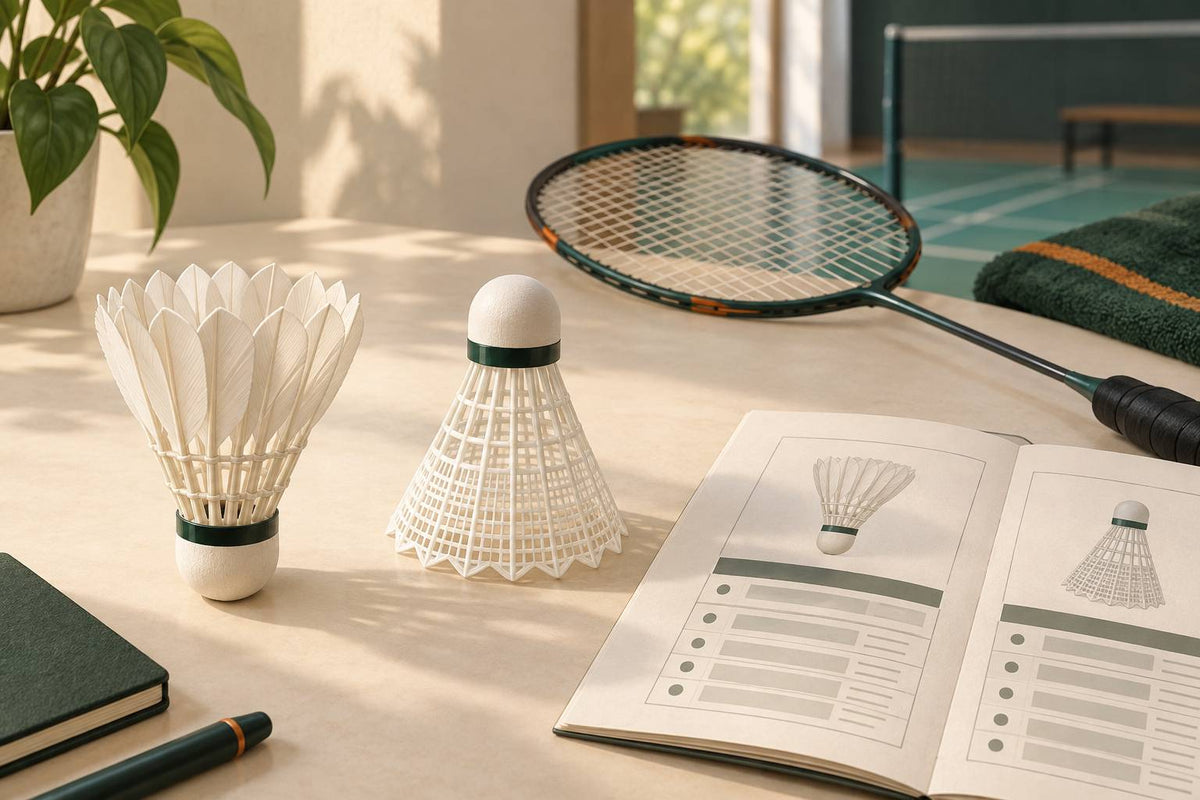
The base is the rounded nose that the racket should contact first. On a feather shuttle, 16 feathers are fixed into it. The BWF Laws of Badminton require a feathered shuttle to have 16 feathers and a rounded base 25–28 millimetres in diameter. They also use a cork base covered by a thin layer of leather as the reference construction for shuttle flight.
What the Laws do not do is prescribe one hidden interior recipe. That is why “composite cork” is not a complete specification on its own. It may describe a real construction difference, but it does not tell you the exact materials, layer count, sound, or service life of a particular shuttle.
Keep the categories separate: this guide compares base construction. For the larger decision between natural-feather and synthetic shuttles, start with feather versus nylon shuttlecocks.
What can the three base labels mean?
Full cork, composite, and foam are useful categories only when a manufacturer identifies them. Think of them as construction descriptions, not a universal ladder from bad to best. A documented model specification is stronger evidence than a seller photo, a finger press, or a claim based on the colour of the cover.

| Base type | What the evidence supports | Practical use |
|---|---|---|
| Full natural cork | A single natural-cork piece is a documented construction. One manufacturer describes natural cork as giving a familiar hitting sensation. | Choose it when the exact model specifies it and its flight suits the session. Do not infer the interior from the cover alone. |
| Composite or sandwich | A documented version sandwiches polyurethane between cork layers. Composite does not prove every maker uses this recipe. | Read the manufacturer's wording rather than assuming a layer count, percentage of cork, or expected lifespan. |
| Foam | Foam is documented as a synthetic-shuttle base, especially in school and recreational nylon designs. | Useful where a resilient synthetic shuttle is the point. Do not assume it is hidden in a feather shuttle. |
| Unspecified | The tube or listing does not identify the interior construction. | Treat the material as unknown. Compare flight and condition instead of inventing a classification. |
A patent application's background describes a documented construction: badminton companies may make a base from one whole natural-cork piece or by sandwiching polyurethane between cork layers. The patent record identifies those constructions, but it is not a universal ranking test.
What does full cork promise?
When a maker says full cork or natural cork, the meaningful question is whether it confirms a single-piece natural-cork base for that model. That is a construction statement, not a guarantee that every shuttle in the tube will survive the same number of rallies or make the same sound.
There is product-specific support for the reason players care. In its 2026 CROSSWIND 70 announcement, Yonex says a natural cork base delivers a refined and familiar hitting sensation. The Yonex announcement supports that statement for this product; it does not establish a universal acoustic or performance law for every full-cork shuttle.
If a shuttle flies poorly, do not diagnose the hidden base from one dull sound or a single dent. Inspect the whole shuttle and compare it with a fresh one from the same tube.
Composite cork means: check the recipe
Composite is a useful warning against overconfidence. The documented cork-and-polyurethane sandwich is one possible construction, but it is not a standard forcing every brand to use the same materials, layer orientation, recycled content, or method. A listing that only says composite leaves important questions unanswered.
Look for a first-party model description. If it names the base plainly, record that information with the model and speed. If it does not, choose based on actual flight, tube consistency, and playing format rather than a supposed hierarchy hidden under the cover.
An intact cap does not expose the interior, so this guide does not treat surface appearance, a soft spot, or a fingernail press as proof of the internal material. Do not cut open a playable shuttle to inspect it.
Foam bases belong in the synthetic conversation
Foam is real shuttle construction, but it is most clearly documented in synthetic nylon shuttles. The patent record notes that nylon shuttles may use either a natural-cork or synthetic-foam base with a plastic skirt. That makes foam a separate base choice, not a synonym for low-quality cork or a default feature of feather shuttles.
A current school-training nylon shuttle gives one practical reason: its manufacturer says the foam base resists being stepped on better than cork. The product description positions that benefit around children and school use. It should not become a blanket claim that foam produces a particular sound, speed, or match feel.
Match the shuttle to the group and conditions first. A robust foam-base synthetic shuttle can suit introductory work. A feather shuttle intended for league or tournament-style play should be selected by model, appropriate speed, and the flight standard your group expects.
How can you check a base without guessing?
Inspect the shuttle to decide whether it is suitable for the next drill or rally, not to perform a materials test at courtside. Separate what you can observe from what remains hidden.
- Read the tube and model listing. Look for an explicit natural-cork, composite, or foam statement from the manufacturer.
- Inspect meaningful damage. Look for a misshapen nose, torn cover, loose feathers, or broken binding rather than judging hardness by thumb pressure.
- Compare with a fresh shuttle from the same tube. This separates normal construction from use-related change better than comparing unrelated models.
- Test flight when accuracy matters. Under the BWF speed test, a full underhand stroke is played from the back boundary line and a correct-speed shuttle lands 530–990 millimetres short of the opposite back boundary line.
- Retire the guesswork. If a shuttle is visibly damaged or flies unpredictably, replace it for controlled practice or match play instead of blaming an unseen layer.
For the parts you can inspect, read badminton shuttlecock anatomy. If feathers are moving at the base, see what loose shuttlecock feathers can indicate. When you are ready to restock, browse shuttlecocks by the exact format and speed your group uses.



Leave a comment
This site is protected by hCaptcha and the hCaptcha Privacy Policy and Terms of Service apply.