

Last checked: August 2026 · Written by the player-led team at Badminton House
Quick Answer: When Opponents Keep Choosing You
Treat repeated pressure as a pair problem, not a verdict on one player. Confirm the pattern across several rallies, agree on one short cue, restore a workable defensive shape, and choose one block, drive, or lift option. Review the result before changing everything at once.
Notice
First: record where the pressure starts and what position both partners occupy.
Name
Use one neutral pair cue such as “level,” “middle,” or “reset.”
Exit
Choose one reachable space for a block, drive, or lift rather than forcing a winner.
Review
Ask whether the pair regained time, space, or attack before keeping the adjustment.
If opponents keep sending the shuttle toward you in doubles, the most useful question is not “Do they think I am weak?” It is “What live court picture keeps making this option attractive?” Your position, balance, reply, and spacing with your partner can change from rally to rally. Respond to the pattern you can observe.
This is the defender-side companion to our guide on reading an opponent without using a permanent weaker-player label. Here, the aim is to give the pressured pair one shared response rather than leave one player trying to solve every shuttle alone.
Scope: “Targeted” here means ordinary tactical routing toward one player's reachable court area. It does not mean deliberate face or body shots, intimidation, or harassment.
Confirm the live pattern without labelling yourself
Look across several rallies for a repeatable situation: the same return sits up, the same defender is late recovering, or the pair leaves the same space. “Several” is a practical observation prompt, not a scientific threshold. One error does not establish a pattern, and a pattern does not define a player.
The BWF Coach Education Level 1 manual frames tactics as awareness and reading followed by decision and reaction. Its tactical-awareness table includes space, your own position and balance, the opponent, pace, and your partner. That supports a local read rather than a fixed identity label.
Between rallies, answer three short questions:
- What arrived? Smash, flat drive, push, drop, or another shot?
- What was our shape? Were both partners ready to defend, or was one still moving from the previous shot?
- What kept repeating? Late contact, a loose return, an open lane, or two rackets reaching for the same shuttle?
Describe only what you saw: “three flat replies reached my backhand while we were staggered” is actionable. “I am the weak one” is not. If the evidence changes, change the plan.
Restore pair shape before trying a heroic shot
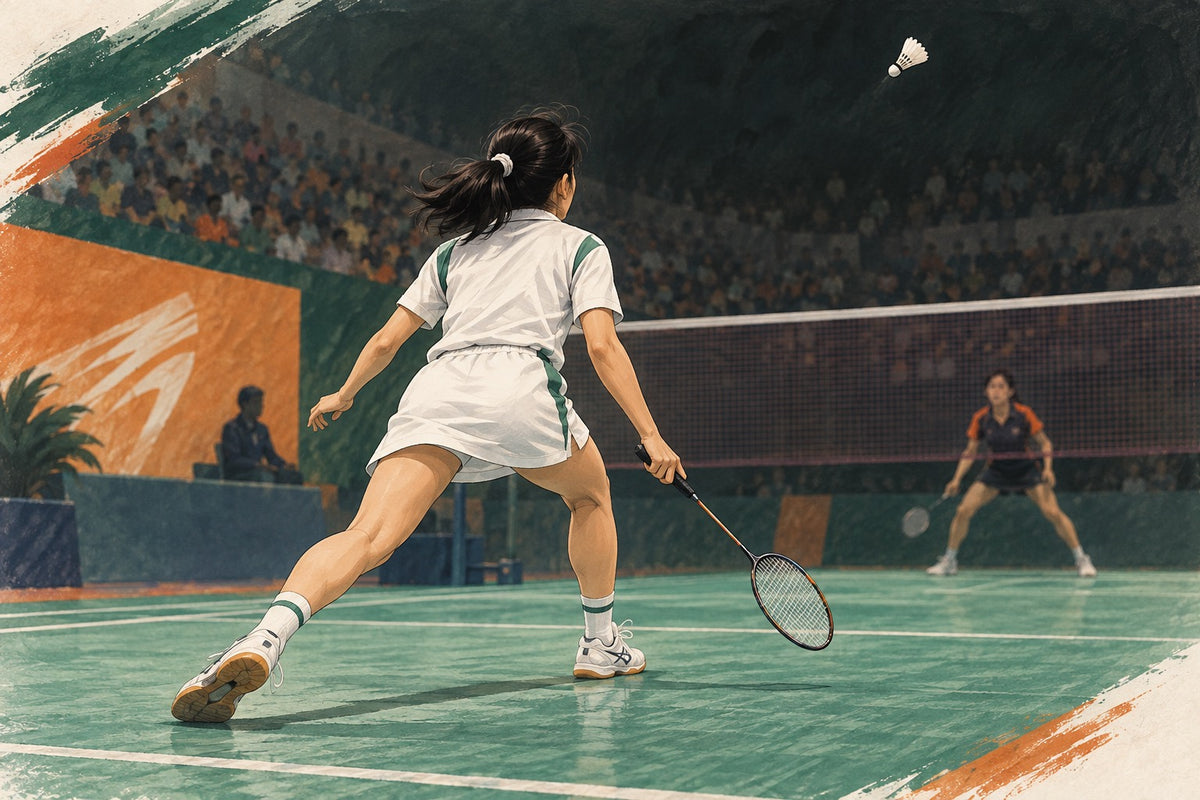
When the opponents have a level-doubles attack, begin by organising the defence side by side rather than asking the pressured player to cover an invented permanent half alone. Use one cue, leave enough racket space between partners, and let the shuttle's direction determine who moves next.
The BWF Level 1 manual describes front-and-back as the attacking formation and side-by-side as the defensive formation in level doubles. That is coaching guidance, not a Law and not a gender-based role assignment. A pair still adjusts its exact spacing to the shuttle, opponent, and each player's reach.
The current BWF Laws of Badminton, Version 5.0 (2) make the legal boundary clear: after the serve is returned, either partner may hit from any position on that side of the net. There is no post-service Law reserving one half for the targeted player and the other for the partner.
Try one neutral call between rallies:
- “Level” means form the agreed side-by-side defensive shape.
- “Middle” means name who takes a shuttle entering the shared seam.
- “Reset” means stop forcing an attacking reply and regain an organised pair position.
These words are examples created for this guide, not official BWF calls. Pick language both partners understand. For spacing and racket ownership, see our guide to preventing racket clashes in doubles.

Choose one pressure exit
A pressured defender does not need to win the rally with the next stroke. Choose one return that the player can contact in balance and that asks the attacking pair to move. A block, drive, or lift can each be appropriate; none is an automatic answer for every shuttle.
The BWF Level 1 manual presents blocks and drives into space as ways a pair can move from defence toward attack. It also describes the blocker moving forward after a useful block, with the partner's movement affected by shot direction, and notes that lifts can move the attacking pair. These are options, not guarantees.
| Option | Use it when | Pair responsibility |
|---|---|---|
| Block to space | Contact is controlled enough to soften the shuttle into a reachable front area. | The blocker reads whether to move forward; the partner responds to the actual direction. |
| Drive to space | The shuttle can be met in front without swinging across a partner's lane. | Both players stay ready for a flat reply instead of admiring the shot. |
| Lift with height | A controlled block or drive is not available and the pair needs time to organise. | Recover into the agreed defensive shape and prepare for the next attack. |
Avoid universal directions such as “always cross-court” or “always lift.” The best available reply depends on contact height, balance, opponent position, partner position, and open space. Name one option for the next rally, then judge what actually happened.
Practise the response without turning one player into a target
Use a controlled four-player exercise in which the attacking pair routes reachable shots toward one defender's agreed court zone. The defenders practise their cue, side-by-side organisation, and one exit option. Rotate the receiving role frequently. This format and its counts are editorial coaching choices, not a BWF drill.
- Agree the zone. Use a reachable court area, never the player's face or body.
- Begin cooperatively. The attackers use controlled placement rather than full-power smashes.
- Call the shape. The defenders use one word before the feed and avoid overlapping racket lanes.
- Choose one exit. Practise only the block, drive, or lift selected for that block.
- Rotate and review. After five rallies, switch the receiving player and describe whether the pair regained time, space, or attack.
Five rallies is a convenient short block, not a validated dose. Make the feed easier when the receiving player loses balance, late contact becomes uncontrolled, or partners crowd the same lane. Stop for pain, dizziness, a slippery surface, a collision, or loose shuttles in the movement path.
Progress one condition at a time: vary the attacking direction, allow the receiving player two exit choices, or begin from a less settled pair position. Do not increase pace, uncertainty, and court coverage together. A useful drill gives the pair a readable decision; it does not rehearse panic.
Keep the response specific to the players
Adapt the court area, feed, movement expectation, and partner cue to the players in front of you. The standard full-court exercise above is not universal. The BWF Laws include half-court and class-specific service provisions in Para badminton, so class rules and qualified coaching should shape any adaptation rather than this generic formation model.
The same Laws say an in-play shuttle touching a player or clothing is a fault, with a wheelchair or crutch treated as part of the player's person in Para badminton. That rule explains an outcome; it is not an endorsement of deliberate body targeting. Keep this practice about space and pair organisation.
Finally, reassess the label. If opponents stop routing toward one player after the pair changes shape, the original issue may have been spacing. If the same contact continues to break down, isolate that stroke in a separate technical practice. If no stable pattern exists, return to normal doubles decisions instead of building a strategy around a story.
For broader movement between attacking and defensive shapes, continue with our doubles attack-to-defence rotation guide.
Your next pair conversation
- Name the repeated court situation without labelling a person.
- Agree on one formation or ownership cue.
- Choose one reachable block, drive, or lift option.
- Review whether the pair regained time, space, or attack.

Leave a comment
This site is protected by hCaptcha and the hCaptcha Privacy Policy and Terms of Service apply.