
Last checked: August 2026 · Written by the player-led team at Badminton House
Quick answer: badminton doubles racket clash
Rackets collide when partners enter the same swing space without a clear owner. Reduce the risk with three habits: the front player keeps the racket high and does not reach backward, the pair agrees on zones, and one player calls mine or yours early.
Space
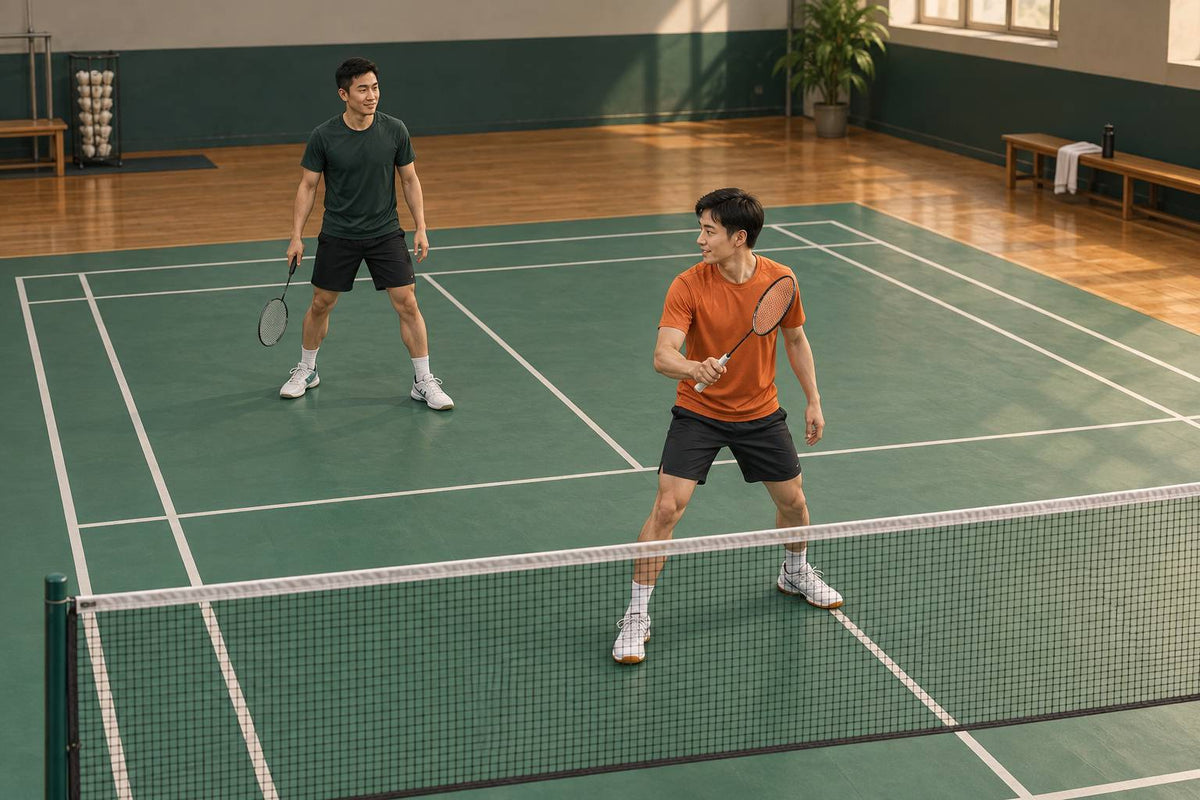
Protect the swing: the front player reaches forward, never backward through the rear player’s stroke.
Call
Say “mine” or “yours” once and early, before both rackets accelerate.
After
Stop, check the frame and your partner, and treat any eye or face impact as an injury rather than a reset.
A racket clash is usually a space problem before it is a technique problem. Two players see one shuttle, both move into the same lane, and both begin a swing before either person has made ownership clear.
The BWF Laws do not list racket-to-racket contact as a separate fault. They do list a fault when the shuttle is hit twice by the same player or successively by a player and partner. Read Laws 13.3.7–13.3.9. A clash can still damage equipment or injure a person, so the practical goal is prevention.
A common visual pattern is a middle shuttle or a shot travelling across a partner’s body. Fix the space first, then use the agreed middle-shot rule from our doubles middle-shot guide instead of debating the same ball during every rally.
Team rules, not Laws: the zone-ownership rule, calling convention, and drill durations below are Badminton House practical guidance. Agree them before play, slow down or stop the drill if either player cannot control the racket, and change the rule after a clash rather than during the next rally.
How should the front player protect swing space?
The front player should keep the racket in front of the body, at a useful ready height, and move toward the shuttle rather than reaching backward. That gives the rear player a visible boundary and keeps both swings moving toward open space.

- Racket high: keep the racket head up enough to intercept a net reply without a large backswing.
- No backward reach: if the shuttle travels behind the front player, let the rear player take it unless the pair has explicitly called otherwise.
- Move forward: step toward a net interception instead of standing still and sweeping across the rear player’s path.
- Freeze on doubt: if the partner has called, stop your swing and protect your face and hands.
Which partner owns the zone?
Use a default before the game starts, then adjust it when the rally changes. Badminton House’s simple starting rule is rear player for the attacking middle and nearer player for the defending shuttle; the pair should say this aloud once before playing.
| Situation | Starting owner | Partner’s job |
|---|---|---|
| Your side is attacking | Rear player takes the attacking middle. | Front player protects the net and does not chase backward. |
| Your side is defending | Player nearer the shuttle takes it. | Partner gives space and prepares for the next shot. |
| Both players are unsure | The first early call owns the shuttle. | Stop the swing and cover the next space. |
When should you call mine or yours?
Call before the racket begins its forward swing. “Mine” means you are taking the shuttle and your partner must stop entering the lane; “yours” means you are giving it up and moving away. A late shout is information, not control, so practise the call earlier.
- Use one word, not a sentence.
- Call once, clearly, before contact.
- If both call, both players stop the swing, then reset the ownership rule after the rally.
- After the rally, discuss the rule rather than blaming the person who reacted second.
Run a five-minute calling block with cooperative feeds. Feed middle, body-line, and cross-body shuttles slowly enough that the partner can visibly stop. Add speed only after the pair can show the stop-and-cover response.
What should you do after a racket clash?
Do not restart automatically. Put both rackets down, check the frame, check fingers and hands, ask your partner about the face and eyes, and decide whether the equipment and people are safe to continue.
- Frame: inspect the head, shaft, grommets, and strings for a new crack, sharp edge, or loose piece.
- Hands: check for cuts, swelling, numbness, or difficulty moving a finger.
- Partner: ask whether the racket touched the face, eye, teeth, or head, even if the mark looks small.
- Decision: replace damaged equipment and stop play when either person is unsure.
Partner-caused eye trauma is documented in badminton. In one 85-patient case series, 73 injuries occurred in doubles, 52 were caused by a partner, and 25 involved a racket. Read the eye-trauma study. The numbers describe that case series, not the risk of every club session, but they justify taking a partner’s eye or face impact seriously.
After a high-speed eye impact, any vision change, severe pain, inability to open or move the eye, or blood from the eye needs urgent medical care. See the NHS eye-injury guidance. For protective-eyewear information, use our badminton eye-injury guide.
What is the fastest reset for a new pair?
Before the next game, stand in your attacking formation and point to the middle, cross-body, and front-court spaces each person owns. Practise three calls at half speed, then play one rally where the only goal is a clean stop when the partner calls.
- Racket high in front for the front player.
- No backward reach through the partner’s swing.
- One early call: mine or yours.
- Stop and inspect after every collision.
A clash-resistant pair is calm because both players know which space they own, when the call must happen, and what to do when the plan fails.

Leave a comment
This site is protected by hCaptcha and the hCaptcha Privacy Policy and Terms of Service apply.