Last updated: June 2026 · Written by the team at Badminton House
Quick Answer: What Shoes Can You Wear for Badminton?
Badminton-specific indoor court shoes are the best choice; other shoes only work if the sole is clean, non-marking, and stable for side-to-side movement.
Badminton
Best choice: non-marking badminton shoes are built low, grippy, and stable for lunges, split steps, and quick direction changes.
Volleyball
Can work short-term if they are non-marking indoor court shoes, though some feel bulkier or higher than badminton models.
Running
Poor choice for regular badminton because running shoes are made for forward motion, not repeated lateral cuts on indoor courts.
Pickleball
Depends on the shoe and court: indoor court pickleball shoes may be acceptable, but outdoor-court soles are usually wrong for badminton gyms.
Non-marking badminton shoes are indoor court shoes that grip polished gym floors without leaving dark scuffs. They matter because many Canadian community centres, school gyms, and badminton clubs protect their floors with strict clean-shoe policies. They also matter for how you move: badminton is full of short sprints, side shuffles, hard stops, and lunges that regular running shoes were not designed to handle.
If you are wondering can you use running shoes for badminton, the honest answer is: maybe once for a casual drop-in, but not as your regular shoe. Volleyball shoes are closer. Pickleball shoes depend on whether they are made for indoor courts. The most reliable default is still a dedicated badminton or indoor court shoe with a clean, non-marking sole.
Need shoes for a Canadian club or community centre? Browse our badminton footwear collection for indoor court shoes built for badminton movement. Free shipping on $200+ across Canada.
In This Guide
What Does Non-Marking Mean?
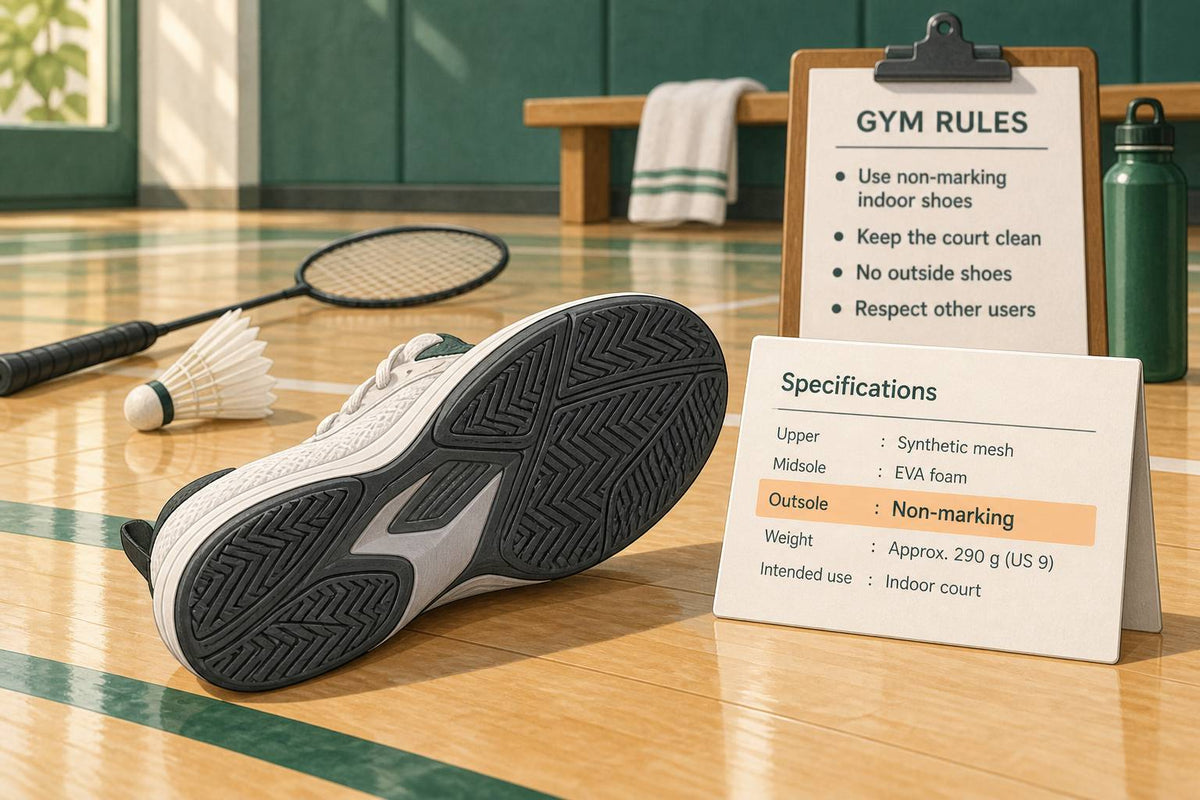
A non-marking sole is designed to avoid leaving visible streaks on indoor gym floors. In badminton, that usually means a light-coloured gum rubber or indoor-court rubber outsole. The important part is not only the colour. It is whether the sole compound, tread, and cleanliness are suitable for polished wood, synthetic sport flooring, or school gym surfaces.
Some shoes literally say "non-marking" on the outsole. Others do not, even when they are made for indoor courts. If a shoe is sold as a badminton shoe, indoor court shoe, volleyball shoe, handball shoe, or indoor squash shoe, it is more likely to be non-marking than a road running shoe or outdoor pickleball shoe.
Plain-English rule
For badminton, "non-marking" is the floor-protection requirement. "Indoor court shoe" is the movement requirement. You want both.
There is one more detail Canadian players often forget: winter. Salt, slush, grit, and parking-lot dirt can make even a proper non-marking shoe behave badly indoors. Keep your badminton shoes as indoor-only shoes and carry them to the gym instead of wearing them outside.
Can You Use Running Shoes for Badminton?
You can sometimes use running shoes for one casual badminton session if the facility allows them, the soles are clean, and you are not moving aggressively. But for regular play, running shoes are a poor match for badminton movement.
Running shoes are usually designed for forward motion: heel-to-toe transitions, cushioning under repeated straight-line steps, and road or treadmill grip. Badminton asks for a different job. You split-step, shuffle sideways, brake hard, pivot, lunge, recover backward, and push off from the edge of the shoe. A tall, soft running shoe can feel comfortable when standing still but unstable when you cut sideways.
Problem 1: Side support
Running shoes often have soft sidewalls that can fold or slide when you plant sideways.
Problem 2: Sole shape
Many running soles are rounded, tall, or rocker-shaped, which can feel awkward during lunges and recovery steps.
Problem 3: Floor rules
Road shoes may carry dirt, leave marks, or fail a club's indoor-only footwear policy.
The practical difference is court control. Shoes built for badminton usually sit lower, grip better on clean indoor floors, and hold the foot more securely during lateral movement. That helps your footwork feel more predictable, especially when rallies get fast.
Badminton Shoes vs Volleyball Shoes vs Pickleball Shoes
The closest substitute for badminton shoes is usually an indoor volleyball shoe, not a running shoe. Volleyball shoes are also built for gym floors and quick movement, so they often have non-marking rubber and better lateral support. The trade-off is feel: volleyball shoes may have more cushioning for jumping and may feel slightly higher, heavier, or bulkier than a badminton shoe.
Pickleball is trickier because shoes are split between indoor and outdoor use. An indoor court pickleball shoe may be reasonable for casual badminton if it has a clean non-marking sole and good lateral stability. Outdoor pickleball shoes are a different story: the rubber and tread may be built for asphalt or outdoor court surfaces, not polished badminton floors.
| Shoe Type | Use for Badminton? | Best Case | Watch Out For |
|---|---|---|---|
| Badminton shoes | Yes, best choice | Regular club play, league nights, tournaments, coaching, and school gyms | Fit can feel snug if you are used to roomy running shoes |
| Volleyball shoes | Usually acceptable short-term | Clean indoor-only pair with a non-marking sole | Higher ride, extra bulk, or cushioning that feels slow for badminton footwork |
| Running shoes | Not recommended for regular play | One casual session with gentle movement, if the facility permits them | Poor lateral support, outdoor dirt, possible floor marks, and unstable side cuts |
| Indoor pickleball shoes | Depends on sole and court | Indoor-only shoe with non-marking rubber and stable lateral support | Some models are optimized for tennis-style movement, not badminton lunges |
| Outdoor pickleball shoes | Usually no | Outdoor pickleball, outdoor tennis-style courts, and abrasive surfaces | Tread and rubber may not suit indoor badminton floors or club rules |
"If the shoe was built for clean indoor court movement, it has a chance. If it was built for roads, treadmills, or outdoor courts, badminton is asking it to do the wrong job."
For a deeper brand comparison, see our guide to Yonex vs Victor badminton shoes. If width is the deciding factor, our wide-feet badminton shoe guide explains how to find forefoot room without losing heel lockdown.
Canadian badminton specialty shop · Free shipping on $200+ · Player-run gear advice
How to Check if a Shoe Is Non-Marking
Before you bring a shoe to a badminton club, check both the label and the sole. A shoe that says "indoor court" or "non-marking" is easier to trust, but the final test is whether it is clean and appropriate for the floor you are using.
- Look for the words "non-marking" on the outsole or product description. This is the quickest check, especially when buying online.
- Check whether the shoe is made for indoor courts. Badminton, volleyball, squash, handball, and some indoor pickleball shoes are more likely to pass.
- Use the clean-floor rub test carefully. On a hidden, acceptable spot, gently rub the sole. If it leaves a dark streak, do not use it on the court.
- Check for outdoor debris. Tiny stones, winter salt, or dried mud can scratch floors even when the rubber itself is non-marking.
- Ask the facility. Many Canadian clubs and community centres have their own indoor-only shoe policy, and their rule is the one that matters.
Community-centre tip
If you play at a school gym or municipal centre, bring shoes in a separate bag and change inside. Staff and volunteers notice clean indoor-only footwear, especially during Canadian winter months.
Fit Checklist Before Buying Badminton Shoes
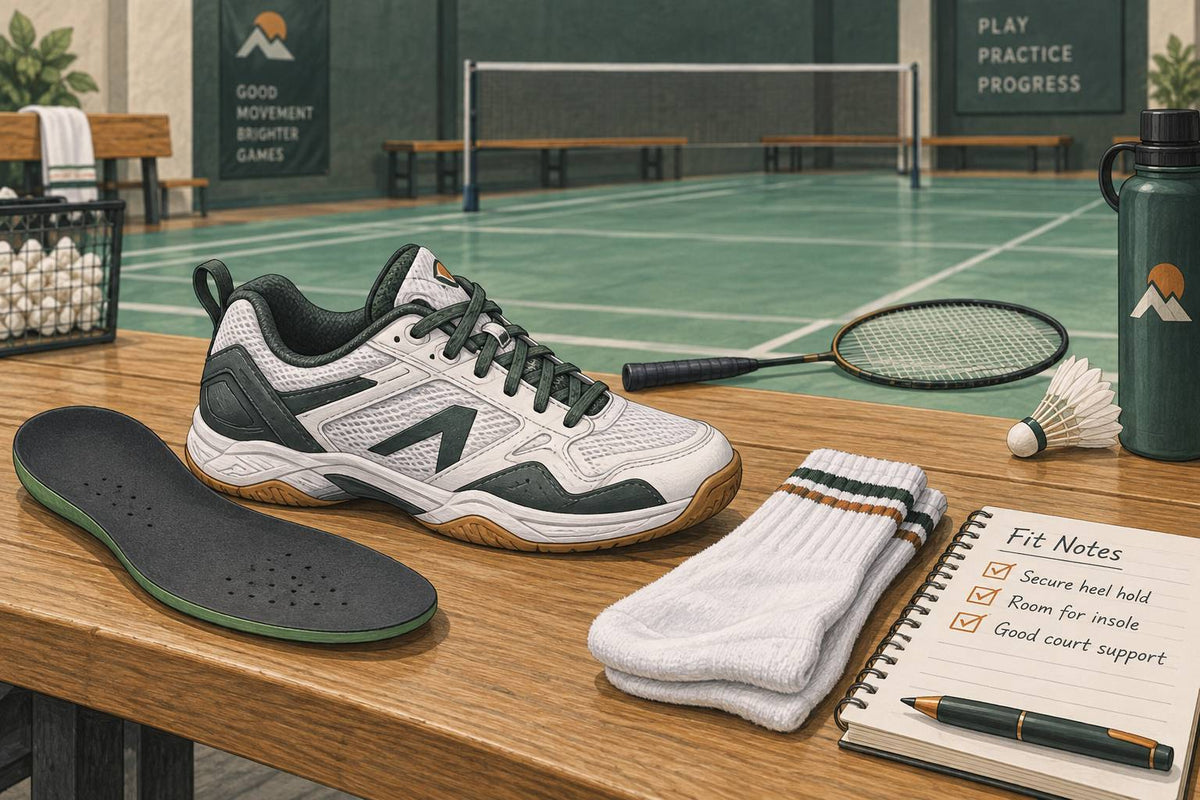
The best indoor court shoes for badminton should feel secure without crushing your toes. Badminton fit is usually more locked-in than running-shoe fit because your foot cannot slide around during lunges, shuffles, and hard stops.
| Fit Check | What You Want | Warning Sign |
|---|---|---|
| Length | A little toe room at the front when standing and lunging | Toes jam forward or the shoe feels long enough to trip over |
| Forefoot width | Toes can spread slightly without side pressure | Pinky toe pressure, hot spots, or needing to over-loosen the front laces |
| Heel lockdown | Heel stays down during gentle lunges and recovery steps | Heel lifts, foot slides forward, or socks bunch at the back |
| Side stability | Shoe feels planted when you shift weight side to side | Upper collapses over the edge or the sole feels tall and wobbly |
| Sock match | Test with the socks you actually wear for badminton | Fit changes completely when you switch sock thickness |
Measure both feet, compare centimetre sizing, and check the brand size chart before ordering. If you are between sizes or shopping across brands, use our size guide before you buy.
Wide foot or high-volume fit? Do not simply size up and hope. Read our badminton shoes for wide feet guide to compare width, heel hold, and forefoot shape.
Canadian Club and Community-Centre Shoe Policies
Across Canada, badminton is often played in shared spaces: school gyms, university courts, YMCA-style facilities, municipal community centres, church halls, and dedicated clubs. Shoe rules protect the floor for everyone who uses it, so policies can be stricter than players expect.
Common rules include indoor-only footwear, non-marking soles, no street shoes, no black-soled shoes that leave scuffs, and no footwear that has been worn outdoors. These rules are especially common in winter, when salt and grit can be tracked in from parking lots and sidewalks.
| Before You Go | Why It Matters |
|---|---|
| Pack court shoes separately | Keeps winter salt, rain, dirt, and sidewalk grit off the playing surface |
| Check the club page or registration email | Some clubs specifically require non-marking indoor court shoes |
| Wipe soles before play | Clean rubber grips better and is less likely to leave residue |
| Keep outdoor court shoes separate | Outdoor soles can carry rough debris and may use tread made for different surfaces |
The easiest habit is simple: badminton shoes go from shoe bag to court, then back into the bag. That keeps your shoes cleaner, preserves grip, and avoids awkward check-in conversations at the desk.
FAQ: Non-Marking Badminton Shoes
Are all badminton shoes non-marking?
Most badminton shoes are designed for indoor courts and are non-marking, but you should still check the product description or outsole label. Also make sure the sole is clean before using it at a club or community centre.
Can you use running shoes for badminton if they are non-marking?
For one casual session, maybe. For regular play, running shoes are still not ideal because the issue is not only floor marking. Badminton needs lateral stability, a lower court feel, and grip made for indoor side-to-side movement.
Are volleyball shoes okay for badminton?
Yes, volleyball shoes can work short-term if they are clean, indoor-only, and non-marking. Dedicated badminton shoes usually feel lower and quicker for badminton footwork, while volleyball shoes can feel more cushioned or bulky.
Can you wear pickleball shoes for badminton?
Indoor pickleball shoes may work if the sole is non-marking and the shoe feels stable during badminton lunges. Outdoor pickleball shoes are usually a poor match for badminton gyms because the tread and rubber are made for different surfaces.
Do black soles always mark badminton courts?
No. Some black soles are non-marking, and some light soles can still cause problems if they are dirty or made for outdoor use. The cleanest approach is to check the label, keep the shoe indoor-only, and follow the facility's policy.
Why do clubs care so much about non-marking soles?
Badminton courts are often shared with schools, community programs, volleyball, basketball, and other activities. Scuffs, salt, grit, and dirty soles make floors harder to maintain and can affect grip for everyone using the space.
What should beginners buy first?
Start with a comfortable pair of non-marking indoor court shoes badminton players can actually move in. If you are choosing between a proper badminton shoe and your usual running shoes, choose the badminton shoe. If you are between sizes, check the Badminton House size guide before ordering.
Ready for clean, club-approved court shoes?
Shop non-marking badminton shoes for Canadian clubs, school gyms, and community-centre courts.
Get Shoe Restock AlertsFree shipping on $200+ · Canadian badminton specialty shop · Expert player-run advice
Get the 2026 Canadian badminton gear checklist + restock alerts
Join the Badminton House list for buying checklists, restock alerts, and practical gear advice for Canadian players.
By subscribing, you agree to receive Badminton House emails and can unsubscribe anytime.


Leave a comment
This site is protected by hCaptcha and the hCaptcha Privacy Policy and Terms of Service apply.