
Last updated: July 2026 · Written by the team at Badminton House
Quick Answer: Drills That Don’t Transfer
If a clean drill disappears in matches, keep the technique but change the practice conditions, then retest it in rallies.
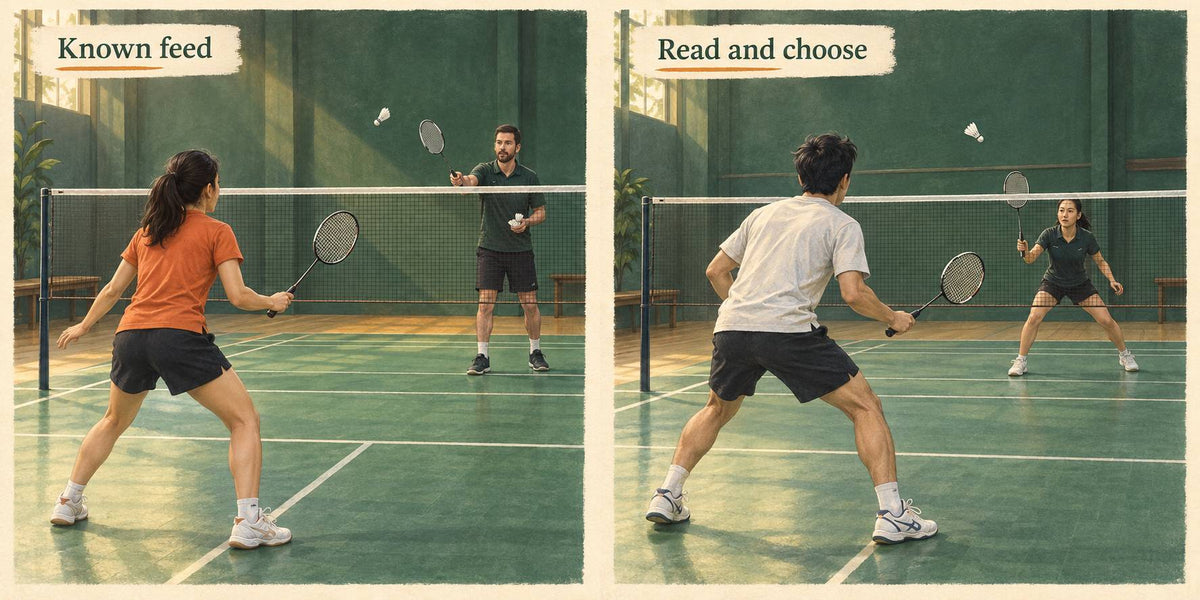
Too predictable
Best fix: move through variable feeds, then two-choice practice so the player must read before selecting the stroke.
Not owned
Use blocked repetition until contact remains reliable through simple, slower feeds.
Pressure only
Progress through constrained rallies, then scored points; keep the stroke and add consequences.
If your drops, clears, or net shots look clean in a basket drill but disappear at 18-all, the drill may be training contact quality without training the decision that makes the shot usable. A predictable feed lets you prepare early, set your feet, and hit the “right” answer. A match asks a different question: read the opponent, split-step on their hit, move, choose, recover, and deal with the next reply.
That is why badminton drills don’t transfer to matches for many hard-working players. The fix is not to abandon technique work. It is to move the same skill through smarter stages: clean repetition first, then variation, choice, constraints, and scored points.
In This Guide
Why badminton drills don't transfer to matches even when they look clean
Badminton drills don't transfer to matches when the drill proves only that you can repeat a known answer. In a blocked feed, the shuttle arrives from the same place, at the same timing, with the same intended reply. Your stroke may look cleaner because the decision, cue reading, and recovery problem has already been solved for you.
This is the classic contextual-interference trap. Shea and Morgan's motor-learning work found that random practice can look worse during practice but produce better retention and transfer than blocked practice, especially when the transfer task becomes more complex. A field-hockey study found a similar warning: closed-skill testing did not separate practice methods well, but game-situation testing gave more support to higher-interference practice.
For badminton, use this as a reason to test the stroke under changing cues and live replies, rather than assuming success in a predictable drill guarantees match transfer. Blocked practice remains useful for acquiring movement. BWF also notes that hand feeding removes the chance to read the shuttle off a racket, so the feed can hide the exact skill the match demands.
Separate technical consistency from transfer
Blocked repetition is not the enemy. It has a specific job: stabilize a technical change before the player is asked to solve match problems. BWF’s learning stages frame this well: in the cognitive stage, the player is still figuring out the movement; in the associative stage, quality must be maintained while complexity and speed increase; in the autonomous stage, the skill can survive game-like pressure while attention shifts to the opponent.
The Challenge Point framework explains why the next step should be difficult enough to create learning information, but not so difficult that performance collapses. That is why progression should move simple to complex, slow to fast, and predictable to unpredictable. KOKACARE makes the same practical caution: random practice helps transfer only after the shot is reasonably owned; if the player cannot yet hit it, random-only work is ineffective. For planning practice blocks across a week, use a badminton practice session plan; here, the job is narrower: diagnose whether the skill is technically consistent, transfer-ready, or breaking under decision pressure.
Build the transfer staircase: blocked reps to scored live points
Think of transfer as a staircase, not a switch. Stay on a step until the backhand net skill still looks sound with the added uncertainty, then climb.
- Blocked repetition: start with a hand-fed backhand net lift so the player can feel contact, racket angle, and recovery without solving a tactical problem.
- Variable feeds: decrease the feed height so the lift must beat the feeder, then vary height, pace, or location without changing the target stroke.
- Two-choice practice: show a visible cue and let the player choose backhand net shot or lift, including a free choice of when to lift.
- Constrained rallies: begin from that net exchange, preserve the lift/net-shot decision, then play the rally out.
- Scored points: use normal rallies with a bonus point when the target shot is used successfully in context.

Diagnose where the skill breaks before changing the drill
Before replacing a drill, identify the first match link that fails. BWF tactics are read-and-react: read space, opponent, pace and partner, then choose. Movement still has to run START, APPROACH, HIT, RECOVER, returning to the base position that best covers the opponent’s likely replies.
| Failure point | What it means | Next test |
|---|---|---|
| Recognition | Player moves after the feed, not after the opponent’s cue. | Add racket-fed two-choice starts. |
| Choice | Stroke is clean but wrong for space or opponent. | Use constrained rallies with one scoring goal. |
| Movement/contact | Timing collapses inside START-APPROACH-HIT-RECOVER. | Slow the feed, keep quality, then add uncertainty. |
| Recovery | Good hit leaves no base for next reply. | Play the rally out after the target shot. |
| Score pressure | Shot works until the point matters. | Use bonus-point games and judge transfer later, not same-day polish. |
Which Drill Step Should You Choose Today?
Pick the step that gives useful pressure without destroying the stroke. If quality drops completely, the task is too hard; if everything is clean and predictable, it may not be testing transfer.
| Choose this step | If this is true right now |
|---|---|
| Too predictable | The stroke survives a fixed feed but breaks when timing changes or a cue demands a choice. Move through variable feeds, then two-choice practice. |
| Not owned | You cannot yet produce the stroke reliably under simple conditions. Use blocked repetition until contact quality holds. |
| Pressure only | The skill survives cues and choices but fails when a rally or score matters. Progress through constrained rallies, then scored points. |
Get 10% off your first order
Join the Badminton House list and we’ll email you a 10% welcome code — plus training guides, technique advice, and badminton updates.
By subscribing, you agree to receive Badminton House emails and can unsubscribe anytime.
If your practice looks clean but the skill disappears under pressure, don’t assume you lack talent. You may just need a better progression from repeatable technique to match decisions. We play badminton and can help you think through a session plan, gear setup, or training bottleneck—send us a note through our contact page.
Running transfer drills with feeds, rallies, and scored points? Keep enough consistent shuttles ready so the session stays focused.
Shop Shuttlecocks for Practice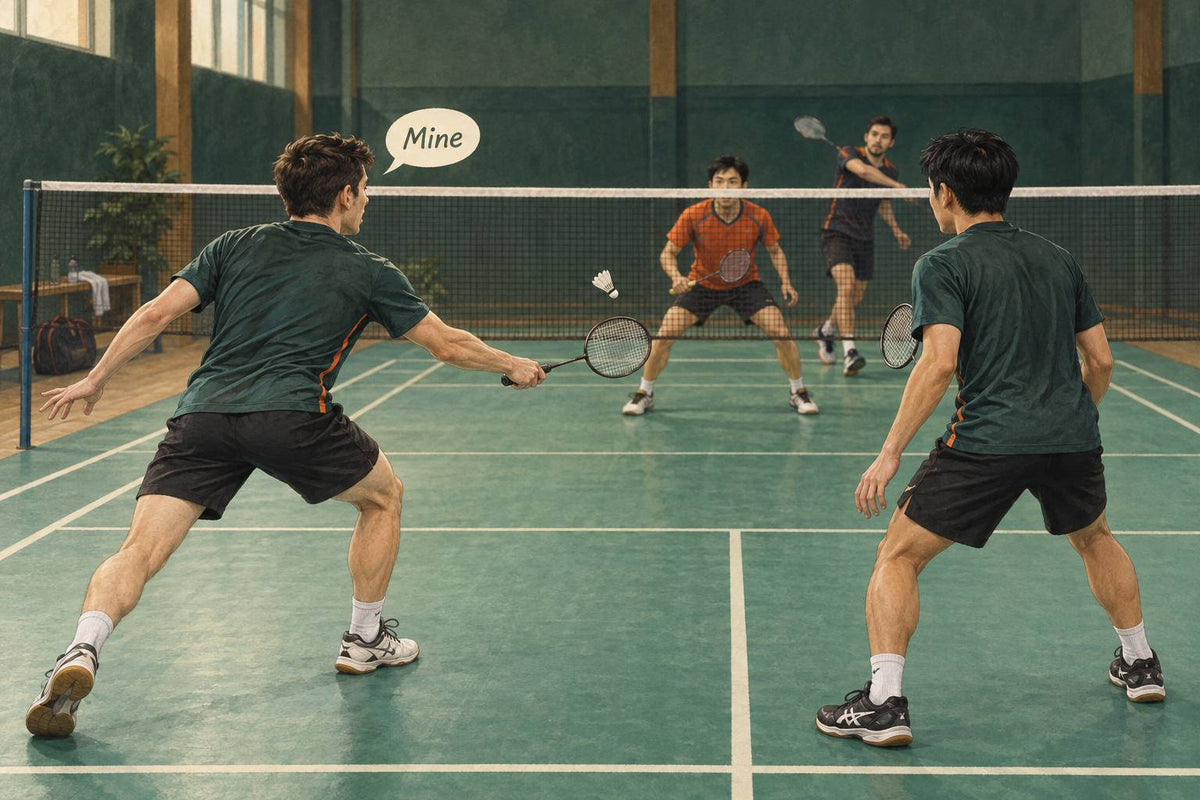

Leave a comment
This site is protected by hCaptcha and the hCaptcha Privacy Policy and Terms of Service apply.