
Last updated: July 2026 · Written by the team at Badminton House
Quick Answer: Middle Shot in Badminton Doubles
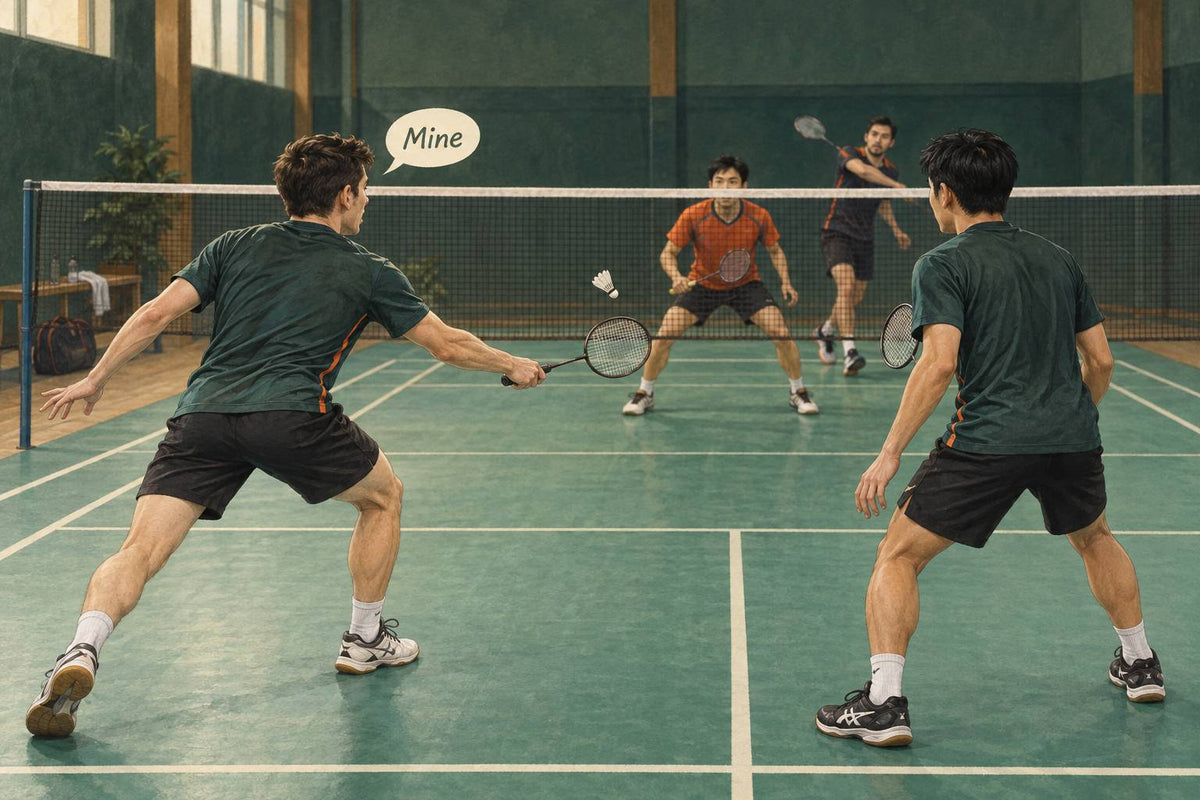
Start with formation, not a blanket forehand rule. Front-and-back attack gives playable interceptions to the front player and deeper shuttles to the rear; side-by-side defence favours the player closest to the lane. If reach is equal, use racket side, handedness, and an early call.
Formation
Best choice: use attack or defence shape to identify the closer player.
Natural reach
When distance is equal, favour the racket that reaches without crossing the body.
Pre-agreed call
For ambiguity, call “mine” or “yours” early and follow your default.
The middle shot in badminton doubles looks simple until both partners pause, swing together, or watch the shuttle split the gap. Opponents aim smashes and drops between defenders precisely because shared distance creates doubt. Good pairs turn that seam into a planned responsibility rather than an argument after the point. This guide shows how ownership changes with attacking and defensive shapes, shot height, player position, handedness, and pair communication.
In This Guide
- Why the Middle Shot in Badminton Doubles Causes Confusion
- Start With Formation: Attack, Defence, and Who Is Actually Closer
- Use Handedness and Natural Racket-Side Reach, Not a Universal Forehand Rule
- Pre-Agree Short Calls So the Middle Never Becomes Contested
- Decision Helper: Which Rule Should Decide the Middle?
Why the Middle Shot in Badminton Doubles Causes Confusion
The middle shot in badminton doubles is awkward because it sits in the shared space between partners. When the shuttle travels down the centre, both players can feel close enough to take it — and that hesitation is exactly what good opponents are trying to create.
In attack, a smash between the defenders is not just a safe target; it is a pressure tactic. The same is true for a drop aimed between the two defenders: the shuttle may not be the fastest shot on court, but it asks a difficult question at high speed — who owns this shuttle?
That is why middle-shot decisions need to be treated as a doubles tactic, not a reflex argument after the point. For more ways to use placement to create this kind of pressure, see our badminton doubles shot placement guide.
Start With Formation: Attack, Defence, and Who Is Actually Closer
The first question is not “forehand or backhand?” It is “what shape are we in?” In doubles, attacking shape is generally front-and-back: one player controls the net while the other works from the rear court. Defensive shape is side-by-side, with the pair splitting the court left and right. That changes who owns the middle.
If you are defending side-by-side, the middle shuttle usually belongs to the player whose side it is actually entering, unless your pair has agreed otherwise. If you are attacking front-and-back, height matters: a loose shuttle near the tape may be the front player’s interception, while a deeper or flatter middle shuttle may be the rear player’s continuation.
So judge distance and role before reaching. The closest useful racket should take it, not the player following a fixed rule. For the bigger movement picture, see our badminton doubles positioning and rotation guide.

Use Handedness and Natural Racket-Side Reach, Not a Universal Forehand Rule
“Stronger forehand takes the middle” is a useful starting agreement, but it is not a law. A cleaner rule is this: the player whose dominant-hand racket can reach the middle without crossing the body should usually take it.
Read handedness from court position, not gender. A right-hander on the left half has their forehand toward the middle; a left-hander on the right half does too. That right-hander-left plus left-hander-right combination gives both partners a middle forehand, so the pair still needs one default owner.
Flip those players — left-hander on the left, right-hander on the right — and both racket hands point toward the sidelines, leaving two backhands toward the middle. With two right-handers, the left-side player has the middle forehand; with two left-handers, the right-side player does. These patterns help only when position and reach are otherwise equal, so shot height, formation, and an early call still override them.

Pre-Agree Short Calls So the Middle Never Becomes Contested
Before the match, agree on your default middle-shot ownership for the formations you use most: who takes the flat drive in side-by-side defence, who covers the soft middle block when one player is forward, and what changes when a left-hander is involved. The goal is not to debate every shuttle in real time; it is to stop the middle from becoming a shared question.
Use short, unmistakable calls: “mine” when you are taking it, “yours” when your partner should play it, “switch” when rotation changes, and “center” as a reminder of the agreed middle responsibility. Long explanations arrive too late in a drive exchange.
This prevents the two classic middle-shot errors: both players leaving the shuttle, or both attacking it at once. The second one is not just messy tactically; racket-body contact hurts, and racket clashes can shorten a frame’s life quickly. For a deeper look at building this kind of trust, read How Elite Doubles Pairs Build Silent On-Court Communication.
Decision Helper: Which Rule Should Decide the Middle?
Use the table to identify the deciding cue when neither player already owns the shuttle through an obvious position advantage.
| Condition | Choose this if... | Why it works |
|---|---|---|
| Formation | Your pair is clearly attacking front-and-back or defending side-by-side. | Position decides who is actually closer to the shuttle before any forehand rule matters. |
| Natural reach | Both players are similarly placed, but one dominant-hand racket reaches the middle without crossing the body. | That player can play the shuttle cleaner and faster, including common forehand-side middle shuttles. |
| Short call | The shuttle is still contested or late. | A quick “mine” or “yours” identifies one hitter so the other partner can cover the next reply. |
Get 10% off your first order
Join the Badminton House list and we’ll email you a 10% welcome code — plus training guides, technique advice, and badminton updates.
By subscribing, you agree to receive Badminton House emails and can unsubscribe anytime.
Middle-shot ownership gets clearer when you rehearse contested shuttles until the first move is decisive and the covering response is automatic. We play badminton and are happy to help you think through doubles setup, racket feel, or training priorities — send us a note through contact us.
Need a quicker doubles frame?
A fast, maneuverable racket can help you meet flat middle exchanges cleanly once your partnership rules are set.
Browse Badminton Rackets


Leave a comment
This site is protected by hCaptcha and the hCaptcha Privacy Policy and Terms of Service apply.