
Last updated: July 2026 · Written by the team at Badminton House
Quick Answer: Why Is Badminton Called Badminton?
The sport takes its name from Badminton House; Poona explains an important Indian strand, not the surviving English name.
Badminton House
Best-supported answer: the Gloucestershire house gave the sport its name by at least 1860.
Poona/Poonah
The game was also named for the Indian garrison town where officers developed it.
Exact moment
Unknown: records do not establish precisely when or why “badminton” replaced earlier terms.
Last updated: July 2026
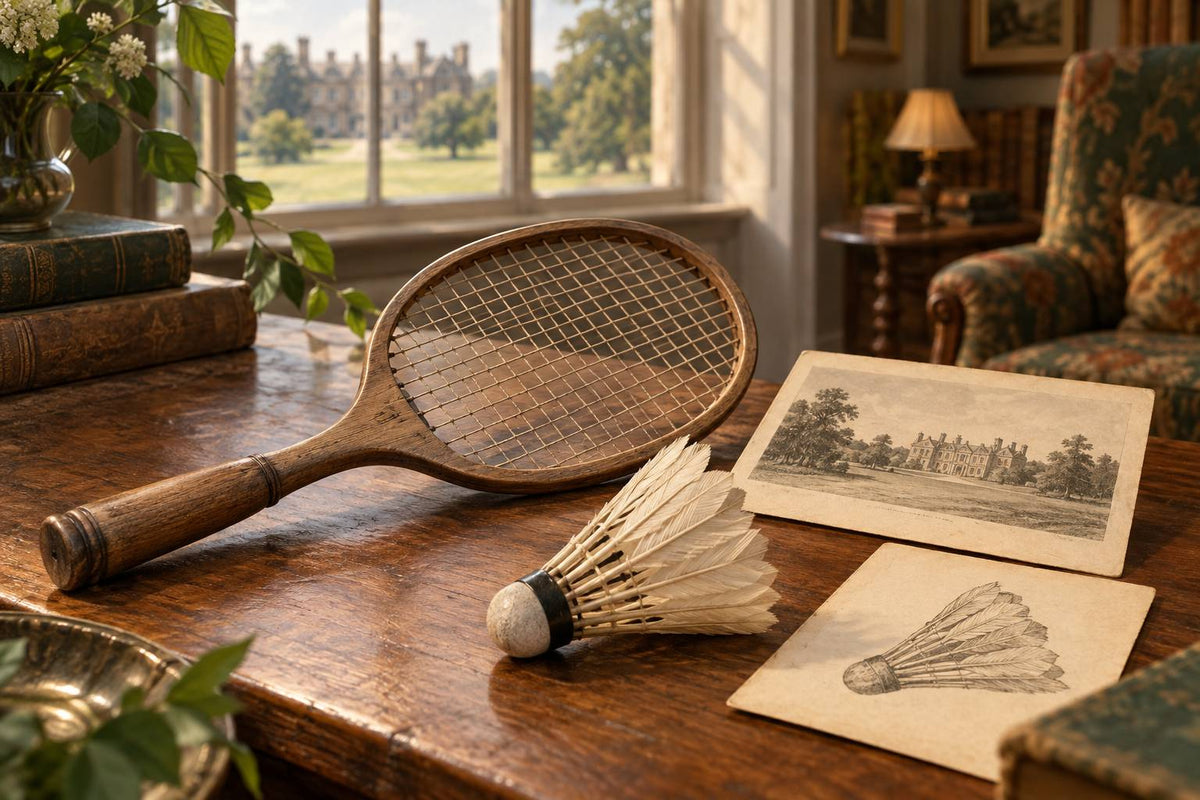
If a clubmate asks why badminton is called badminton, give the careful answer: the sport took its name from Badminton House, the Gloucestershire seat of the Dukes of Beaufort, but nobody has documented the exact naming moment. The printed trail matters. A booklet titled Badminton Battledore — A New Game appeared in 1860, and an 1863 magazine described a sides-based form of battledore and shuttlecock played across a string. Older racket-and-shuttle games, the Indian game called Poona or Poonah, and play at the house all belong to the history. This guide separates those firm clues from the colourful but conflicting stories later repeated about who invented the game, when it happened, and how the house’s name became attached to it.
In This Guide
Badminton House Had the Name First
The direction of naming matters: the sport took its name from Badminton House, not the house from the sport. Located in the village of Badminton in Gloucestershire, England, the country house has been the principal seat of the Dukes of Beaufort since the late 17th century.
The place name is much older still. It appears in the Old English form Badimyncgtun in 972, meaning the estate of a man called Baduhelm. The Domesday Book later recorded the manor as Madmintune in 1086. That puts the location’s recorded name roughly 900 years before badminton emerged as a sport name in the 19th century.
The short answer: badminton is called badminton because an established place name, Badminton House, became attached to the game played there.
What the 1860s Record Actually Proves
The surviving evidence establishes a sequence, not a single documented moment when the modern sport was invented.
1830: An inscription on a battledore at Badminton House records a 2,117-stroke rally with Lady Somerset.
1845: A second inscription records Lady Henrietta Somerset and Beth Mitchell completing 2,018 strokes. Together, these inscriptions place the older pastime inside the house decades before badminton developed into a codified sport.
1860: London toy dealer Isaac Spratt used the title Badminton Battledore – A New Game for a booklet that has not survived.
1863: A magazine article described sides playing battledore and shuttlecock across a string suspended about five feet high, and called the game badminton.
The North Hall measures 13.4 by 6.1 metres, exactly the footprint of a modern doubles court. That striking fit is easier to visualize beside today’s badminton court dimensions and lines, though dimensions alone cannot prove where every rule originated.
From Battledore and Shuttlecock to Poona
Badminton’s deeper ancestry lies in battledore and shuttlecock, played across Europe and Asia for centuries. Players used small rackets called battledores to keep a shuttlecock moving back and forth without letting it fall. That pastime supplied the basic implements, but it was not yet the organized net game familiar today.
In British India during the 1860s, military officers developed a more advanced version by adding a net and adapting how the game was played. It became especially associated with the garrison town of Poona, now Pune, so contemporary accounts called it Poona or Poonah. An increasingly developed form was played through the 1860s and 1870s, with rules framed at Poona in 1873.
These Indian and English strands are complementary rather than competing origin stories: Poona marks a crucial stage in developing and codifying the net game, while Badminton House supplied the name that ultimately endured.
What Gets Repeated—and What Remains Unknown

Several tidy origin stories survive, but they do not fit together neatly.
| Repeated story | What the evidence allows |
|---|---|
| 7th Duke’s daughters | They supposedly played in the 1850s or early 1860s, although the 7th Duke died in 1853. |
| 8th Duke’s children | A winter 1863 hall game fits his tenure, but does not establish the naming moment. |
| 9th Duke, about 1873 | This conflicts with Badminton Battledore from 1860 and magazine usage in 1863. |
| Bored houseguests | Guests supposedly tried Poona before a guest standardized and named it; the story remains folklore. |
| Protecting paintings | A shuttle allegedly replaced a ball to avoid damage, but the account is unsubstantiated. |
The firm conclusion is narrower: Badminton House clearly supplied the sport’s name. Exactly why and when that name attached to the game is undocumented, and 1873 cannot be treated as the naming date when printed uses already existed in 1860 and 1863.
How the House Name Became a Global Sports Name
The name spread because the game itself became more organized. The Bath Badminton Club introduced new rules in 1877. In 1893, representatives of 14 clubs formed the Badminton Association of England and agreed on uniform laws, replacing the significant variations that had developed between clubs.
Standard rules made wider competition practical. The first All England tournament followed in 1899, giving the sport an important competitive showcase. International organization arrived in 1934 with the formation of the International Badminton Federation, now the Badminton World Federation.
By then, badminton no longer referred merely to a pastime associated with an English country house. Clubs, tournaments and governing bodies had carried the name into international use. Consistent rules fixed that name in the sport’s worldwide vocabulary, even though the precise moment when it first attached to the game remains uncertain.
The link between past and present is still visible in the object sent across the net: the shuttlecock.
Which Origin Explanation Should You Choose?
Choose the explanation that matches the question being asked. These three names describe different parts of badminton’s history rather than mutually exclusive origin stories.
| Choice | Choose this when explaining… |
|---|---|
| Badminton House | Why the sport carries the word badminton. The name was already in print by 1860 and in magazine use by 1863. |
| Poona or Poonah | How the net game developed in British India, where rules were framed at Poona in 1873. |
| Battledore and shuttlecock | The older game from which badminton evolved. It explains the ancestry, not the eventual sport name. |
Get 10% off your first order
Join the Badminton House list and we’ll email you a 10% welcome code — plus training guides, technique advice, and badminton updates.
By subscribing, you agree to receive Badminton House emails and can unsubscribe anytime.
The name may have begun in a country house, but its meaning now lives wherever players meet a shuttle across a net. We play badminton ourselves, so if you want straightforward help choosing equipment for your level and style, contact us. We’ll help you narrow the options without overcomplicating the decision.
Keep the game’s oldest object in flight.
Explore our shuttlecocks for practice, club nights, and match play.
Browse Shuttlecocks


Leave a comment
This site is protected by hCaptcha and the hCaptcha Privacy Policy and Terms of Service apply.