
Last updated: July 2026 · Written by the team at Badminton House
Quick Answer: Athlete's Foot Prevention
Keep feet, socks and court shoes dry, and cover your feet on communal wet floors.
Prevention
Default: Dry between toes, change damp socks and fully air shoes between sessions.
Possible fungus
Ask a pharmacist about an over-the-counter antifungal and follow its full directions.
Medical help
Seek clinical advice for spreading symptoms, nail involvement, or a hot, painful, red foot or leg.
A sweaty badminton session can leave your socks damp and your court shoes warm long after the last rally—the exact conditions that help the fungi behind athlete’s foot grow. The infection, called tinea pedis, often shows up as itching, scaling, peeling or cracked skin, especially between the toes. It is not just a hygiene issue: communal floors and shared items can expose careful players too.
Effective athlete’s foot prevention is less about one miracle product and more about breaking the moisture-and-exposure cycle every time you play. This guide gives you a practical post-session foot and sock routine, a safe way to dry shoes between busy club nights, and clear boundaries for over-the-counter treatment versus professional assessment.
In This Guide
- How Athlete's Foot Reaches Badminton Players
- The Foot and Sock Routine After Every Session
- How to Dry Court Shoes When You Play Three Nights a Week
- Using an Over-the-Counter Antifungal—and When to Stop Self-Treating
- Plantar Warts, Blisters and Damaged Toenails Are Different Problems
- Athlete’s Foot: Which Approach Should You Choose?
How Athlete's Foot Reaches Badminton Players


Athlete's foot is tinea pedis: a fungal skin infection, not a worm. Fungi can travel in infected skin scales shed onto locker-room, communal shower and pool floors. Walking barefoot across those surfaces can bring the fungus into contact with your feet; shared towels or footwear can also carry contaminated scales.
Badminton then creates conditions that help infection take hold: sweaty feet remain warm and moist during prolonged court-shoe wear, while tightly enclosed toe spaces can become softened and macerated. Symptoms often feel worse after the shoes have stayed on for a long session.
Common clues include itching, burning, stinging, scaling, peeling or painful fissures in the skin. The most common interdigital pattern appears between the toes, particularly the web space between the fourth and fifth toes, where whitish, softened skin may crack or scale. Odour can occur when bacterial overgrowth accompanies it. These signs suggest athlete's foot, but other foot conditions can look similar.
The Foot and Sock Routine After Every Session

Make this sequence automatic whenever you leave the court:
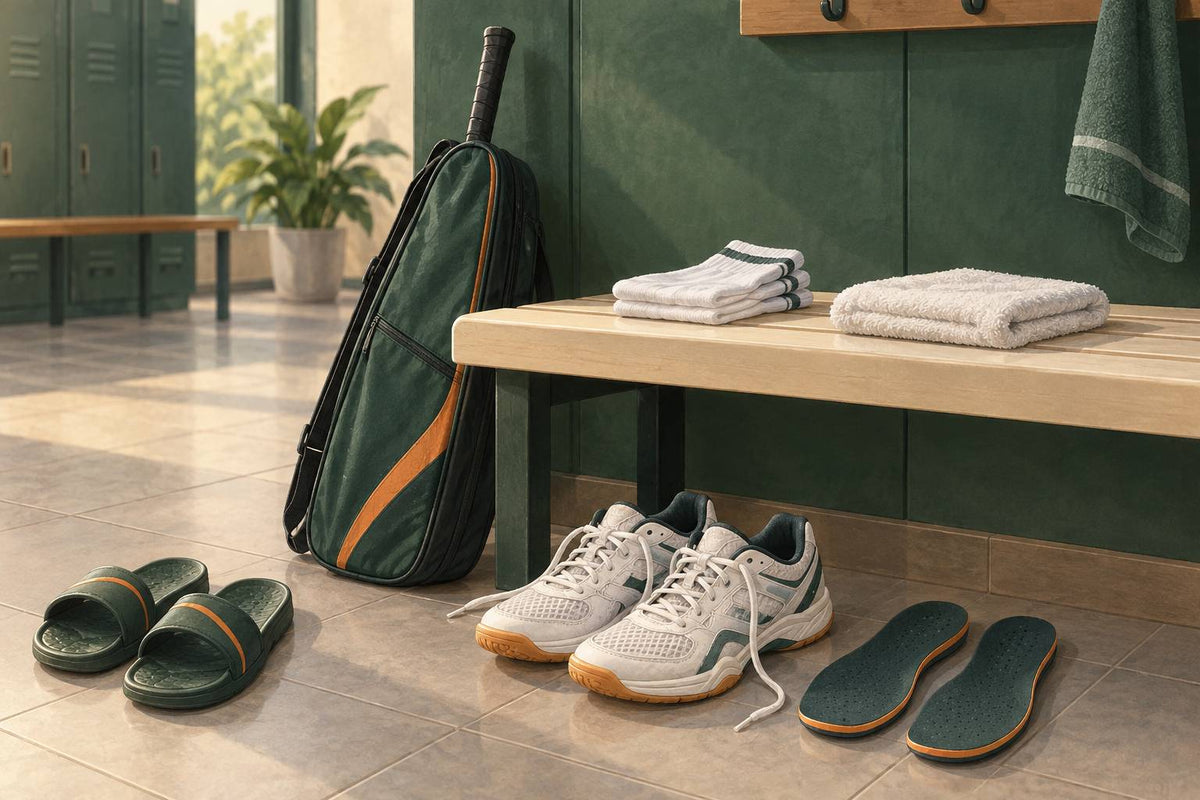
- Keep sandals on in shared areas. Wear them through communal change rooms and showers instead of walking barefoot on damp floors.
- Shower promptly after play. Afterwards, dab rather than rub your feet completely dry. Take time over every space between the toes, where trapped moisture is easy to miss.
- Use a dedicated foot towel. Wash it regularly, and never share towels or footwear with another player.
- Replace damp socks immediately. Choose moisture-controlling socks: absorbent cotton or wool, or moisture-wicking synthetics. Heavy sweaters may need a fresh pair during the day or between two sessions.
Regularly launder used socks, towels and athletic clothing rather than leaving damp kit in your bag. Pack a spare pair of socks before longer club nights or tournaments so changing promptly is easy.
How to Dry Court Shoes When You Play Three Nights a Week
If you play on consecutive nights, use a two-pair rotation so each pair gets at least 24 hours to dry. Wear Pair A for the first session, Pair B for the next, then return to Pair A only after it has aired fully.
As soon as you get home, loosen the laces completely, remove the insoles and pull the tongue forward to open the shoe. Leave the shoes and insoles separately in a dry, ventilated area or near a cold-air fan. This exposes the damp interior instead of trapping moisture beneath the insole.
Optional shortcut: Pack dry newspaper loosely into the toe and replace it after about an hour as it absorbs moisture.
Avoid radiators, space heaters, clothes dryers, direct sunlight and prolonged hair-dryer heat. Concentrated heat can shrink or crack shoe materials and weaken the adhesives holding the sole and upper together.
Using an Over-the-Counter Antifungal—and When to Stop Self-Treating


Topical antifungal creams, sprays, liquids and powders treat fungal skin infections such as athlete’s foot. Treatment courses vary by product, typically from about one to six weeks. Follow the label for application frequency and complete the full course even if itching and scaling fade quickly. Some products must be continued for one or two weeks after the rash clears to reduce the chance of recurrence.
Do not use a corticosteroid cream by itself on suspected athlete’s foot. It can weaken the skin’s response to the fungus, allow the infection to spread and disguise the rash, making diagnosis harder.
Stop self-treating and seek clinician assessment if a toenail is involved, the rash spreads, treatment fails, or the foot or leg becomes hot, painful and red. Get medical advice promptly if you have diabetes or a weakened immune system, because cracked infected skin can permit a more serious infection.
Plantar Warts, Blisters and Damaged Toenails Are Different Problems
Plantar warts can follow the same barefoot communal-floor route as athlete’s foot, especially around warm, damp change rooms and showers. However, they are caused by human papillomavirus (HPV), not fungus. Small cracks or wet, softened skin can make entry easier. Never cut or scrape a suspected wart off at home; doing so can cause bleeding, bacterial infection and further spread.
A court blister is a separate skin injury, although broken skin weakens the foot’s protective barrier. See Badminton Foot Blisters: Prevention and Safe Care for appropriate blister care.
Athlete’s foot can spread to the toenails, but fungus is not the only explanation for a thickened or discoloured nail. Repeated contact with the front or side of a court shoe can also deform, discolour or lift the nail. Because trauma and fungal infection can look similar, avoid diagnosing by appearance alone; the separate guide to Badminton Toe and Toenail Injuries explains the injury patterns and next steps.
Athlete’s Foot: Which Approach Should You Choose?
Match your next step to what you see and feel; problems acquired through the same barefoot route do not necessarily need the same care.
| Choice or condition | Choose this if… |
|---|---|
| Prevention routine | You have no symptoms. Dry between every toe, wear sandals in communal wet areas, change damp socks promptly and rotate fully dried shoes. |
| OTC antifungal | Skin is itchy, burning, cracked, scaly or peeling—often between the fourth and fifth toes. Follow the product’s complete course rather than stopping when symptoms fade. |
| Wart assessment | A firm lesion has tiny black dots or hurts when squeezed from the sides. Plantar warts involve HPV, not fungus; never cut or scrape one off. |
| Professional assessment | The foot or leg becomes hot, painful and red, the rash spreads, treatment fails, or you have diabetes or a weakened immune system. |
For an open or painful blister instead, use the separate badminton foot-blister care guide.
Get 10% off your first order
Join the Badminton House list and we’ll email you a 10% welcome code — plus training guides, technique advice, and badminton updates.
By subscribing, you agree to receive Badminton House emails and can unsubscribe anytime.
We play badminton too, and we know prevention has to fit the rhythm of late matches, damp socks and tightly packed training weeks. If you are unsure how to build a practical shoe-rotation or care routine around your schedule, contact us for straightforward gear advice.
Give each pair time to dry. If back-to-back sessions leave one pair damp, consider a second pair to rotate.
Browse Indoor Court Shoes

Leave a comment
This site is protected by hCaptcha and the hCaptcha Privacy Policy and Terms of Service apply.