
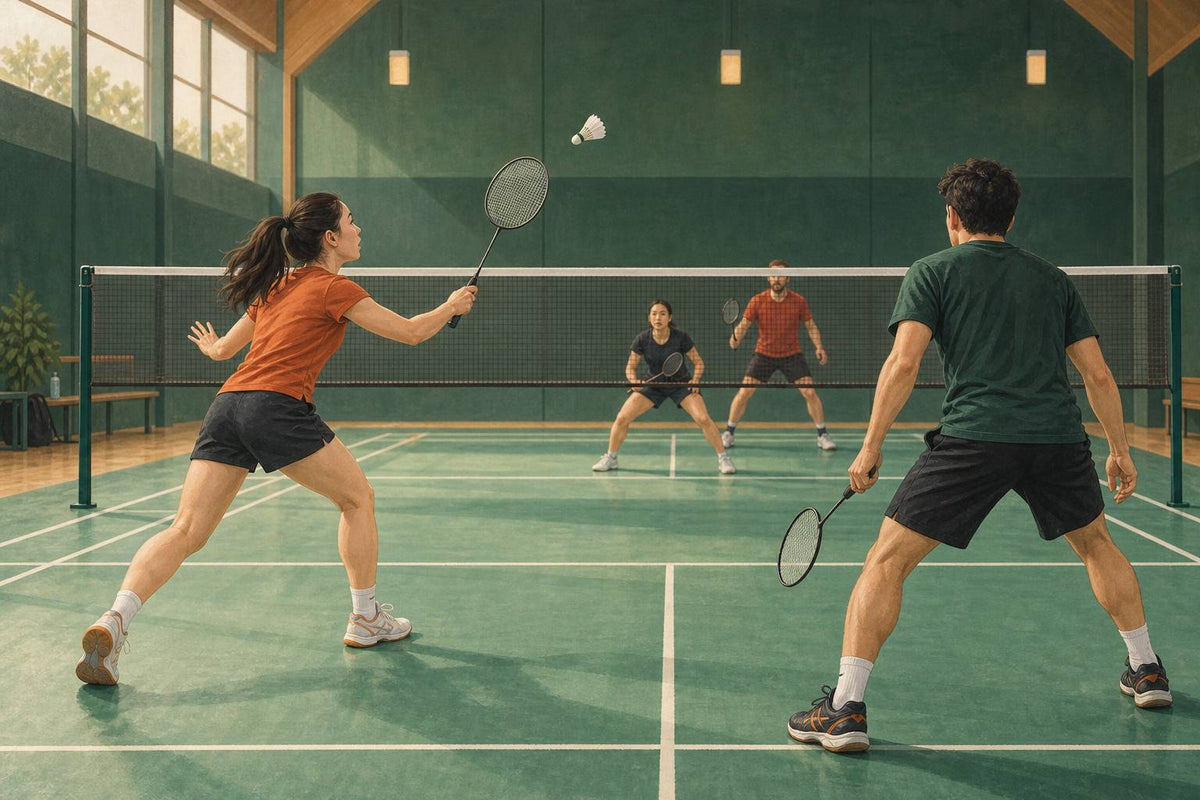
Last updated: July 2026 · Written by the team at Badminton House
Quick Answer: Badminton Double Hit Rule
In doubles, your side gets one racket contact per turn; only one player’s continuous frame-and-string contact in a single stroke escapes the double-hit fault.
Frame graze
Fault: if the graze touched the shuttle, your partner cannot hit it next.
Both touch
Fault: two partner contacts are not a let, even when nearly simultaneous.
Body/clothing
Fault immediately: the rally ends on contact, before any partner follow-up.
You hear a faint tick off your partner’s racket, the shuttle stays up, and you are close enough to finish the return. Should you play it? No. In doubles, your side gets one stroke before the opponents’ turn; once your partner has contacted the shuttle, your follow-up is a fault, even when the first touch was accidental.
The confusing part is deciding whether there were actually two contacts. A rough frame hit is not automatically illegal, and one continuous stroke can be legal even when contact looks messy. But separate touches by partners, or an earlier touch off a player or their clothing, end the rally. This guide applies the badminton double hit rule to the close calls that cause the most arguments, so you can make the right call quickly and keep the game moving.
In This Guide
What the Badminton Double Hit Rule Says
In doubles, the two sides must alternate turns hitting the shuttle. Law 11.2 allows either partner to play your side’s turn, but once one partner touches the shuttle, the other partner cannot return it before an opponent does.
Laws 13.3.7 and 13.3.8 make successive hits by the same player or by both partners a fault. The opponents win the rally immediately; it is not replayed as a let.
The key exception: One continuous stroke may legally contact both the racket head and stringed area. The follow-through may also pass over the net, provided the initial shuttle contact occurred on the striker’s side. That is one legal stroke, not an extra turn for the player or their partner.
Case 1: A Frame Graze, Then Your Partner Hits
A frame contact is not automatically a fault. If the shuttle touches the racket head and strings during one continuous stroke, play continues. The quality of the contact does not matter; a mishit can still be a legal return.
The decision changes when there are two separate contacts. If your racket grazes the shuttle and your partner then makes a clean return, your side has hit it successively. That is a fault, even if the first touch was accidental or barely changed the shuttle’s flight.
Simple test: frame plus strings in one stroke is legal; your graze plus your partner’s stroke is not. If the graze fails to send the shuttle toward the opponents’ court, it is already a fault. Frequent mishits? See Badminton Racket Frame Hits.
Case 2: Both Partners Swing and Touch the Shuttle
If both partners swing and their rackets make separate contact with the shuttle during the same side’s turn, it is a fault against that side. This remains true when the contacts happen so close together that they appear simultaneous. The practical test is not which partner made the cleaner hit; it is whether the shuttle contacted two rackets from the same side before crossing to the opponents.
Correct call: fault, rally over, and the point goes to the opponents, not a replay.
Law 13.3.8 covers a shuttle hit by a player and that player’s partner successively. The fact that both players committed to the shot does not create a let. Partner contact during a rally does not appear in the Laws’ list of let situations, so “we both touched it—let’s replay” is not a valid rules argument.
Case 3: The Shuttle Touches a Player or Their Clothing

A shuttle touching your arm, leg, shirt, shorts, hair, or any other part of your body or clothing is a fault. Under Law 13.3.4, the fault occurs at the moment of contact. The shuttle is then out of play, so your partner cannot rescue the rally by returning it, even if their shot lands perfectly.
Call the touch, not a replay. In a self-officiated game, opponents may not see a light brush against loose clothing. If you felt it, call the fault against your own side and award the rally to your opponents. A body or clothing touch is not a let, so replaying the point is not the correct outcome.
That honest self-call is part of good club play. See Badminton Court Etiquette for more guidance on handling calls fairly when there is no umpire.
How to Avoid Double-Contact Confusion

The simplest prevention habit is to call the shot early with a short cue such as “mine”. Keep one voice responsible for each shuttle: once one partner calls, the other should stop their swing rather than making a last-second reach into the same contact zone.
In self-officiated games, call your own touch immediately, even when nobody else saw it. A quick, clear call prevents the discussion from becoming a guess about whose racket, body, or clothing the shuttle contacted first. If neither player touched it, continue the rally rather than stopping because a swing looked close.
Questions about a shuttle being caught, held, carried, or slung involve a different fault. See Badminton Hold Shot Carry Fault for that distinction.
If repeated frame contacts are the practical problem rather than the rule, compare badminton rackets and check live availability.
Decision Helper: Which Call Fits?
Judge the sequence of contact, not how awkward the swing looked. If your side has already touched the shuttle, your partner cannot take another turn.
| Situation | Call | Decision test |
|---|---|---|
| Single continuous stroke | Play on | Frame-and-string contact within one stroke is legal. A follow-through may cross the net when initial contact was on the striker’s side. |
| One partner, then the other | Fault | Sides must alternate; the second same-side contact ends the rally. |
| Both partners contact | Fault | Two partner contacts are not a let, however close together they appear. |
| Body or clothing touch | Fault already occurred | The shuttle is out of play at that touch, so a later racket contact cannot save the rally. |
In self-officiated play, call a touch honestly against your own side. A double contact is a fault with the point awarded to the opponents, not an automatic replay.
Get 10% off your first order
Join the Badminton House list and we’ll email you a 10% welcome code, plus training guides, technique advice, and badminton updates.
By subscribing, you agree to receive Badminton House emails and can unsubscribe anytime.
We play badminton too, and we know how quickly a strange contact can turn into a rules debate. If you want help separating a legal mishit from a fault (or choosing a setup that feels cleaner at impact), contact us for practical advice.
If frame contacts are the problem, not the rule, compare racket options by weight, balance, and feel.
Explore Badminton RacketsCheck live availability and find a setup suited to your game.

Leave a comment
This site is protected by hCaptcha and the hCaptcha Privacy Policy and Terms of Service apply.