
Last updated: July 2026 · Written by the team at Badminton House
Quick Answer: Badminton Achilles Tendinopathy
If Achilles pain builds gradually after lunges, rear-court push-offs, or jump landings, reduce badminton load and start progressive, supervised tendon loading instead of waiting for rest alone to fix it.
Default
Best choice: Treat it as load irritation: cut the hardest sessions, keep tolerable movement, and progress eccentric calf work with a physiotherapist.
Rest
If pain spikes during play, stop the session and use rest or ice for symptoms, but do not make complete rest the whole plan.
Return
Build back through drills before matches; badminton has high Achilles load, and fatigue can change landing mechanics.
If your Achilles feels stiff when you first step on court, warms up, then complains after rear-court rallies, treat it as a load-management problem—not something to “stretch out” between games. Badminton Achilles tendinopathy usually builds gradually from repeated push-offs, lunges, and jump-stroke landings, especially when your calf is doing hard work while you decelerate or reload for the next shot. Rest can calm symptoms, but long-term care normally means rebuilding tendon capacity progressively, not avoiding badminton forever. This guide focuses on badminton-specific causes, risk moments, loading-based rehab ideas, and practical return checks.
In This Guide
Why the Achilles Matters So Much in Badminton

The Achilles tendon is built for huge forces: it is the body’s largest, thickest and strongest tendon, about 12–15 cm long, formed from the gastrocnemius and soleus tendons and inserting on the calcaneus, or heel bone. That anatomy makes it central to every calf-driven action in badminton: pushing out of the rear court, recovering from a lunge, jumping, landing, and changing direction.
Its strength does not make it invincible. The Achilles is also the most commonly injured tendon, and badminton places it under repeated lower-leg load. Injury studies report that badminton injuries occur most often in the lower extremities, especially around the Achilles tendon. In one group of 66 highest-level Swedish elite players, 32% reported a disabling painful condition in the Achilles region during the previous 5 years, 17% had ongoing pain, and most painful cases were in the midportion of the tendon. That is why badminton Achilles tendinopathy deserves attention before it becomes a season-limiting problem.
What Causes Badminton Achilles Tendinopathy?

Badminton achilles tendinopathy is usually a gradual loading problem, not the same event as an acute rupture. Tendinopathy builds when the tendon is asked to absorb and produce force again and again, especially from rear-court push-offs, recovery steps, lunges, and change-of-direction work.
A rupture is different: a forceful push-off or lunge with a strong calf contraction can stress the Achilles enough to tear. That is why jump-landings matter so much in rear-court play. The landing after a scissor jump or jump smash loads the tendon eccentrically, then immediately asks it to push off again. Fluoroquinolone antibiotics such as ciprofloxacin and levofloxacin weaken tendon collagen and raise rupture risk, so tell a clinician about any recent course if new Achilles pain appears.
Over time, repeated dominant-leg loading can create side-to-side tendon adaptations in serious players. Repeated match play also raises blood flow inside the tendons themselves: in one study of elite players the clear increase was in the patellar tendon, with only a weaker trend at the Achilles, so accumulated stress is not just felt in the calf.
High-Risk Moments: Landings, Foot Position, and Fatigue

The riskiest Achilles moment is not simply “jumping”; it is the first contact after a jump stroke, when the tendon absorbs a fast eccentric load and then helps drive the next movement. Biomechanics modelling of badminton landings estimated Achilles tendon forces at or above previously reported cadaveric failure-limit ranges of 4,635–5,579 N, with the single highest estimate, from a recreational player landing with unrefined technique, reaching 8,632 N. That does not mean every hard landing causes injury, but it explains why repeated rear-court jump-stroke landings deserve attention.
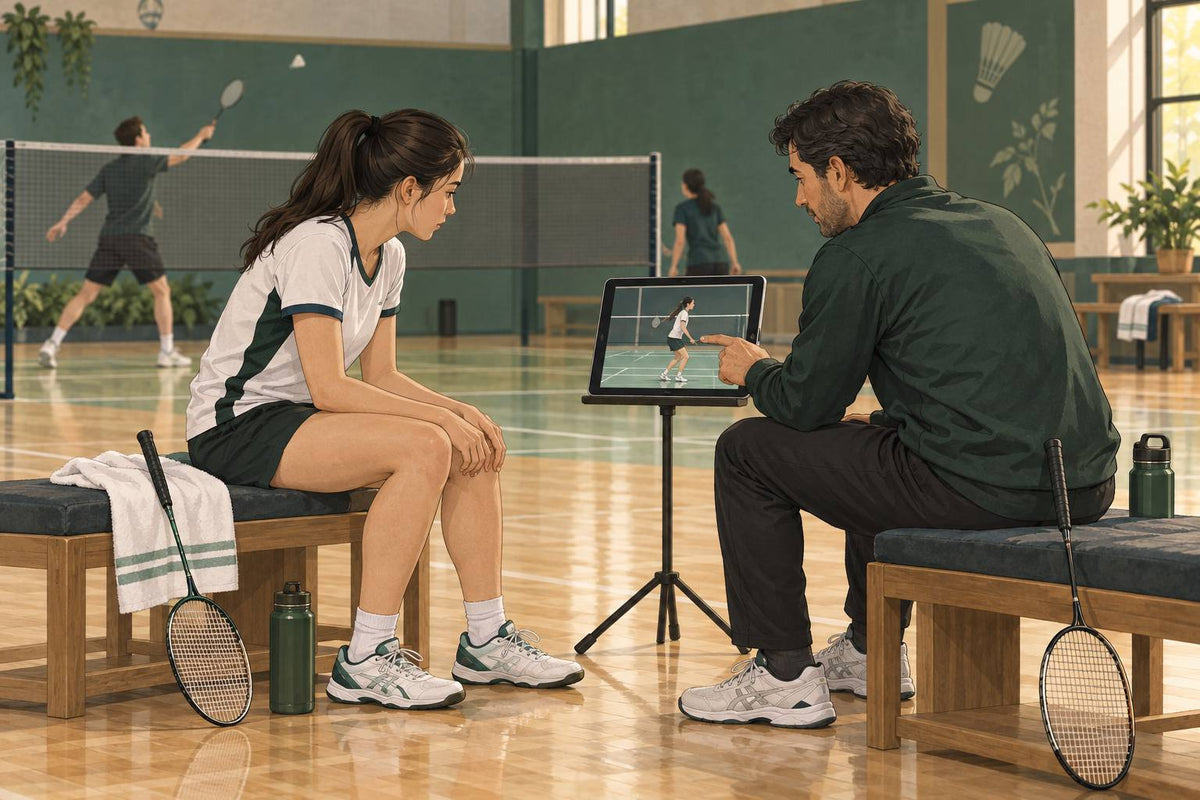
Technique changes the load. After forehand jump strokes, landing with the non-racket leg less externally rotated increased Achilles load. A practical coaching cue is to rotate the upper body fully through the stroke so the landing leg and foot can arrive in a more externally rotated position rather than collapsing into a straighter, overloaded line. Watch this cue especially late in games: fatigue may alter landing technique and increase tendon load.
Care: Loading-Based Rehab, Not Rest-Only Recovery

Care for badminton Achilles tendinopathy is usually not “do nothing until it feels better.” Ice packs can calm pain after play or rehab work, but the central stimulus for recovery is progressive loading: gently asking the tendon to do more so it adapts.
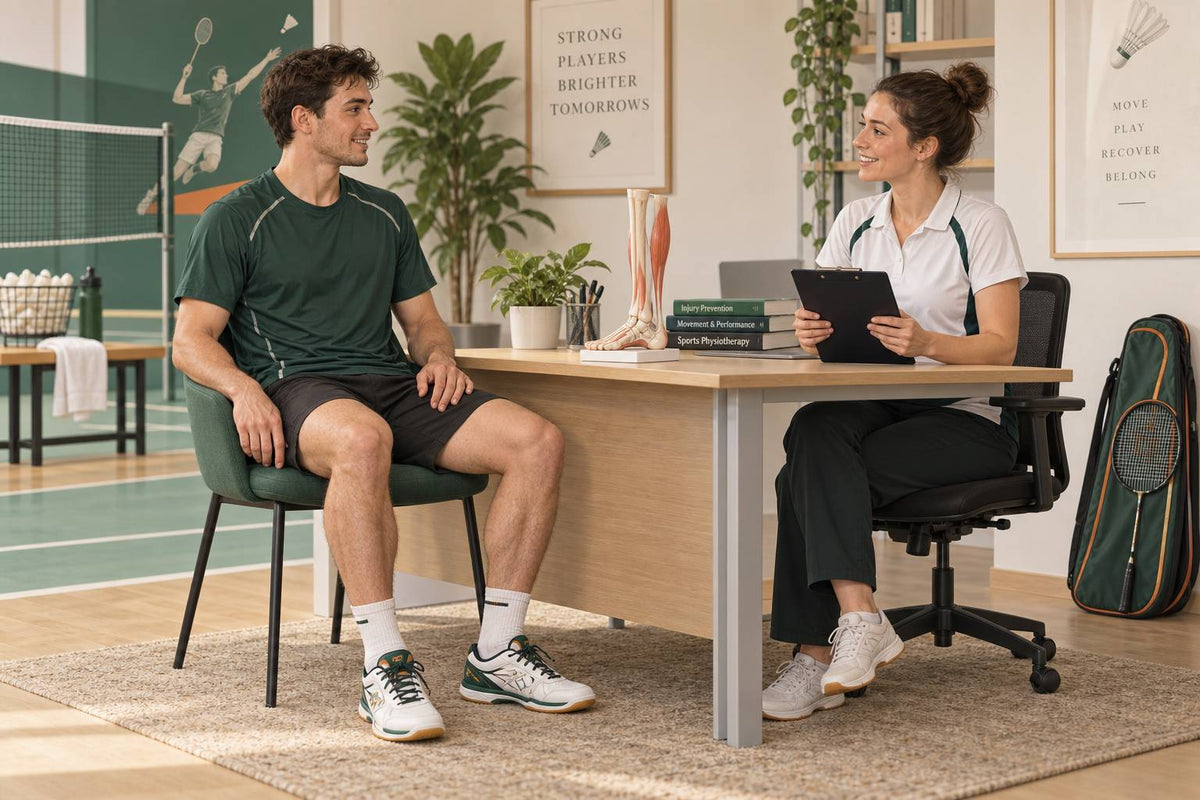
The best-known approach is eccentric calf work under the supervision of a physiotherapist. “Eccentric” means the muscle is lengthening while it contracts — the same type of demand your calf-Achilles unit faces when you land, decelerate, or absorb a lunge. The point is controlled overload, not chasing soreness or proving toughness.
Repair collagen takes about three months to lay down and mature, so expect a long horizon — but spend it loading the tendon progressively rather than resting it, cutting only the sessions that flare symptoms. Use that window to manage total training stress, sleep, and recovery habits in the badminton recovery guide, then rebuild court movement gradually. Finish sessions with easy mobility from the cool-down stretches guide rather than aggressive stretching into pain.
Return-to-Play and Prevention Checklist

Return-to-play for badminton Achilles tendinopathy should be individualized and progressive, not based on a fixed calendar date. There are no universally accepted return-to-play outcomes after Achilles injury, so use symptoms, load tolerance, and movement quality to guide each step.
- Progress loading first: build from rehab exercises to controlled footwork, then short rallies, then harder rear-court movement.
- Watch fatigue: stop the session when landings get noisy, balance fades, or push-offs become rushed.
- Land with intent: keep the landing leg stable and avoid collapsing into a narrow, poorly rotated foot position after forehand jump strokes.
- Avoid sudden spikes: do not jump straight from light drills to repeated jump smashes, deep lunges, or long match blocks.
- Get checked if pain lingers: if soreness persists beyond a few weeks of reduced load, or returns once you resume full training, book a physiotherapist assessment instead of guessing at a fix.
Which Path Should You Choose?
| Situation | Choose this approach |
|---|---|
| Gradual Achilles soreness linked to rear-court push-off load | Treat it like tendinopathy: reduce badminton load and rebuild with supervised progressive loading, not complete rest alone. |
| Pain flares after jump strokes or late in sessions | Prioritize landing quality and fatigue control; less externally rotated landing positions have been linked with higher Achilles load. |
| Rest helps briefly, but symptoms return | Ask a physiotherapist about eccentric calf work, which is used to progressively strengthen the tendon during recovery. |
| Planning your return to court | Use an individualized, progressive return rather than a date-only target; accepted return-to-play criteria are not universal. |
| Sudden sharp pain during one lunge or jump, not a gradual buildup | Treat this differently from tendinopathy — a forceful push-off can tear the tendon outright; stop play and get an urgent medical assessment rather than self-managing it as overuse pain. |
Get 10% off your first order
Join the Badminton House list and we’ll email you a 10% welcome code — plus training guides, technique advice, and badminton updates.
By subscribing, you agree to receive Badminton House emails and can unsubscribe anytime.
Badminton Achilles tendinopathy is a load problem, not a toughness test. We play the sport too, so our advice is simple: respect pain, build capacity gradually, and get qualified help when symptoms linger or worsen. If you want player-to-player guidance on court shoes or setup choices, contact us and we’ll help you think it through.
Footwear for Safer Court Movement
The right badminton shoe cannot replace rehab, but it can support cleaner landings, push-offs, and cushioning as part of a broader prevention plan.
Check Badminton FootwearCheck live availability.

Leave a comment
This site is protected by hCaptcha and the hCaptcha Privacy Policy and Terms of Service apply.