
Last updated: July 2026 · Written by the team at Badminton House
Quick Answer: Badminton Rear Court Footwork Scissor Jump
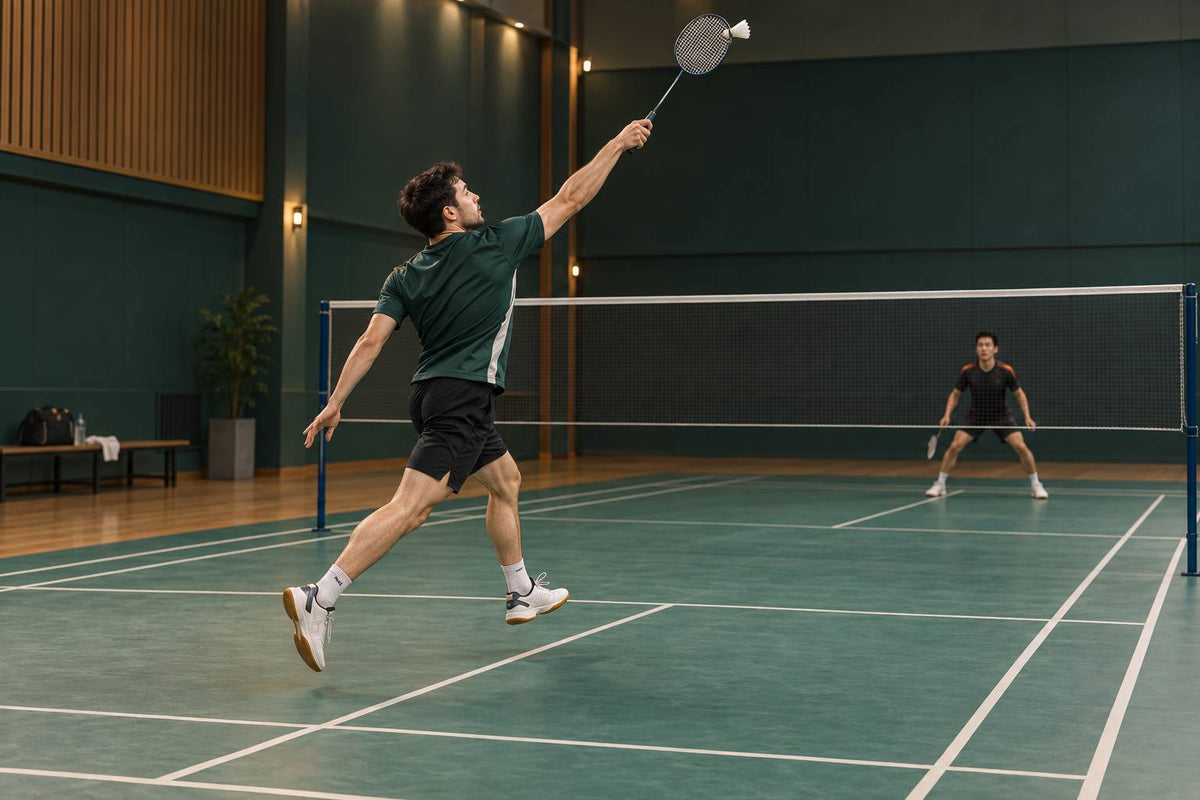
Use the scissor jump when you have enough time to get behind the shuttle, rotate through an overhead, and let your landing momentum carry you back toward base.
Default
Scissor jump: best for rear-court overheads when you can split step, pivot, switch the legs like scissors as you hit, then land bent and balanced for a fast recovery.
Less time
Use a non-racket-leg jump-out pattern instead when the lift is flatter and you do not have time to set up a full scissor jump.
Too far
If the pivot or mini jump does not cover enough distance, add an extra chassé step so you reach the shuttle without pausing on the back leg.
If you can hit an overhead in practice but still get stuck at the back of the court during games, the problem is often not your arm. It is your travel and recovery pattern. Rear-court footwork is what lets you reach the shuttle early, stay balanced through contact, and get back toward base before the next shot arrives.
The badminton rear court footwork scissor jump is a rear-court movement pattern in which you split step, pivot sideways, and switch your legs in mid-air like scissors as you strike the overhead, so the landing redirects your momentum back toward base. It turns a late, stretched overhead into a stronger shot, and it is most useful when you have time in the rear court, especially the round-the-head corner.
Below: how to travel from base, how the split-pivot-switch-hit sequence works, how to land without getting stranded, and how to practise the pattern safely on Canadian club courts.
Footwork starts from the floor up. If your shoes slide or feel unstable on hard rear-court landings, browse badminton footwear with CAD pricing. Badminton House ships across Canada.
In This Guide
- Why Does Rear-Court Footwork Matter After the Basics?
- Badminton Rear Court Footwork Scissor Jump: The Travel Pattern
- Scissor Jump Mechanics: Split, Pivot, Switch, Hit
- How Should You Land and Recover Back to Base?
- When Should You Use the Scissor Jump — and What Should You Avoid?
- Practice Drills, Landing Strength, and Shoe Support
- Which Rear-Court Footwork Should You Choose?
Why Does Rear-Court Footwork Matter After the Basics?
Once you can move through the basic six corners, the next jump in level is not simply “getting faster.” It is learning how to travel to the rear court, hit an overhead on balance, and recover without getting stranded behind the doubles service line.
If you are still building the foundation, start with Badminton Footwork Basics first. The scissor jump is an advanced rear-court pattern layered on top of that base: split, move back, rotate, strike, land, and return to the middle for the next shot.
Efficient rear-court footwork gives you five practical advantages:
- You meet the shuttle earlier. Better travel to the back lets you contact overheads before the shuttle drops too low, which opens stronger clears, drops, and smashes.
- You stay balanced through the shot. Instead of reaching backward with your arm only, your legs and body rotation support the hitting action.
- You save energy over long rallies. Clean movement uses fewer emergency steps, so you are not constantly fighting to regain position.
- You extend your usable court reach. Cross steps, chassé movement, and rear-court rotation help you cover shuttles that would otherwise force a weak backhand or late clear.
- You recover faster to base. A good scissor jump carries your momentum forward after the hit, helping you reset toward the centre instead of landing flat and stuck at the back.
That travel-and-recover pattern is what separates players who can reach the rear court from players who can actually control the rally after reaching it. The goal is not a dramatic jump for its own sake; the goal is to arrive early, hit with structure, land under control, and be ready for the reply.
Badminton Rear Court Footwork Scissor Jump: The Travel Pattern

Think of the scissor jump as part of a full travel-and-recover route, not as a single jump at the back of the court. You start from your central base, read the lift or clear, travel into the rear corner, hit the overhead, then let the landing send you back toward the middle.
From base, the route can change depending on how far the shuttle is travelling and how early you see it. Players commonly move back using cross steps, a chassé, crossover steps, or a combination of those steps. The goal is simple: arrive behind or beside the shuttle with enough time to rotate into the shot instead of reaching late with your arm only.
Base-to-rear-corner pattern
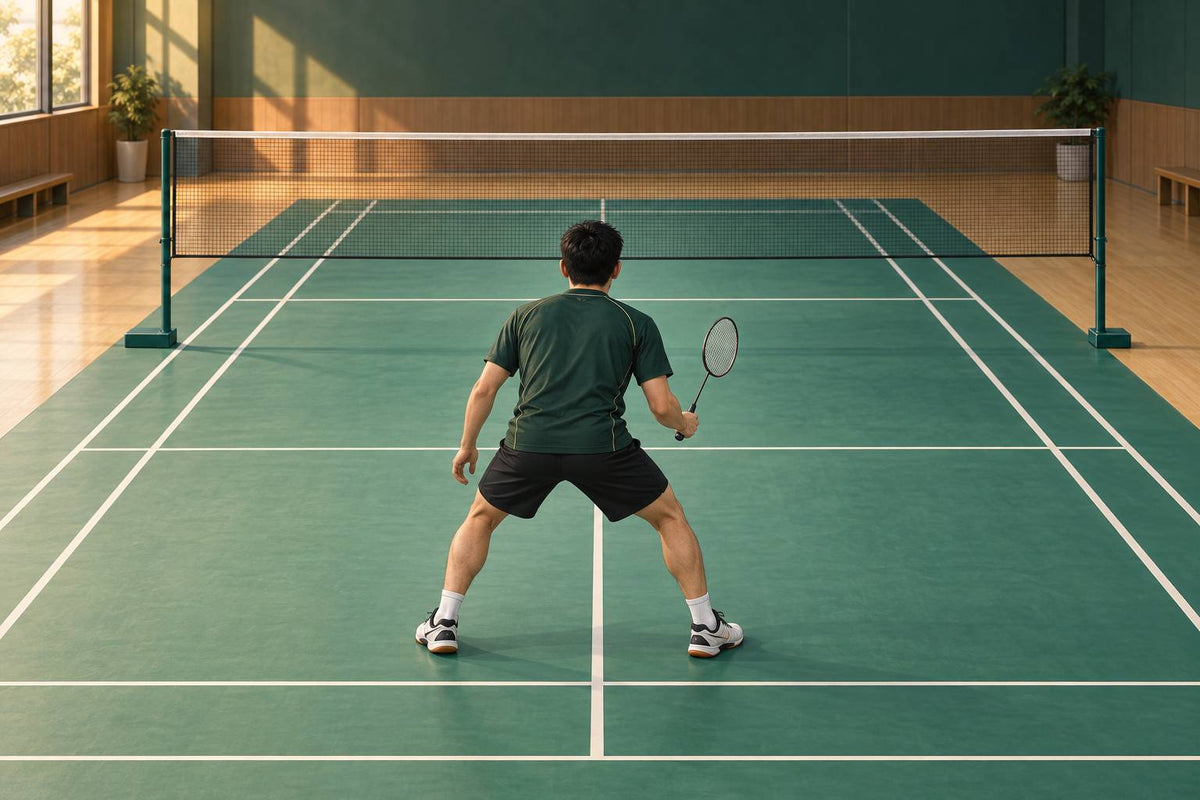
- Start from base: stay balanced in the middle area so you can push in either direction.
- Travel back: use cross steps, a chassé, crossover steps, or a blend of them to get into the rear corner.
- Set the body sideways: the pivot or mini jump helps turn your hips and shoulders so your overhead can use body rotation.
- Add distance if needed: if the pivot or mini jump does not cover enough ground, add an extra chassé step before you hit.
- Recover forward: after the scissor action, your momentum should carry you back toward the middle instead of leaving you stranded at the back line.
The scissor kick is most often used in the round-the-head corner, also called the backhand rear-court side. That is where many players are tempted to give up early and play a weaker backhand. When your first movement is sharp and your travel pattern is clean, you can often get around the shuttle and play a stronger overhead instead.
On the forehand rear corner, the same idea still matters: get your feet there early enough that your body can rotate through the hit. The scissor jump is one rear-court option among a wider footwork toolkit that includes chassé steps, lunges, crossover steps, and recovery steps back to mid court. If you are still building that foundation, the Badminton Footwork Basics guide is the best place to connect the rear-court pattern with the rest of your court movement.
The key cue: do not drift backward
A common mistake is to keep moving backward while the shuttle is already dropping. That usually forces a late contact point and a rushed recovery. Instead, use the travel steps to get into position, then let the scissor action switch your legs and redirect your momentum forward.
You should feel the pattern as a loop: base → rear corner → overhead contact → forward recovery → base. If the loop breaks and you land flat-footed at the back, the next shot becomes much harder to cover.
Shoe check for rear-court footwork. Scissor-jump landings and lateral push-offs are demanding on indoor court shoes. The Yonex SHB65Z4M Men’s Badminton Shoes — White is built with Power Cushion support and grip for exactly that kind of load. You can browse the badminton footwear collection for current availability.
Scissor Jump Mechanics: Split, Pivot, Switch, Hit

The scissor jump is not just a jump at the back of the court. It is a timed sequence: split, push, pivot, switch, rotate, then strike. If one piece is late, the whole movement feels rushed, and that is when many players end up taking the shuttle behind the body or getting forced into a weaker backhand.
Key cue: make the split step directional. Your non-racket leg should be slightly behind you so your body is already loaded to turn and move into the rear court.
| Phase | What to do | Why it matters |
|---|---|---|
| Split | Use a directional split step as your opponent hits, with the non-racket leg slightly behind and both knees bent. | This loads your legs early so you can move back with balance instead of reacting late. |
| Push | Push off the racket leg quickly and explosively. | That push-off is where you gain speed into the rear court, especially when the shuttle is already dropping. |
| Pivot | Pivot or make a small jump on the non-racket leg, turning the foot sideways. | The sideways position lets your hips and shoulders rotate into the overhead instead of reaching with only the arm. |
| Switch | Switch the legs in the air like scissors as the hitting side rotates through. | The leg switch helps transfer momentum forward, which supports both shot power and recovery. |
| Hit | Contact the shuttle as the body turns, not after the rotation has already finished. | Good timing keeps the shuttle in front enough to hit a clear, drop, or smash with control. |
1. The split step decides whether you attack or survive
The first mistake is often not the jump itself. It is the split step before it. If you split late, split straight up without direction, or stay too tall, you lose the small timing window that lets you turn around the shuttle. By the time you reach the rear backhand-side corner, the shuttle may already be behind you, which often leaves only a defensive backhand option.
A better starting shape is lower and more directional: knees bent, weight ready to push, non-racket leg slightly behind. That small stagger gives your body a head start into the rotation.
2. Push off the racket leg, then pivot on the non-racket leg
After the split, think “push fast” rather than “jump high.” The racket leg drives you into the rear court. Then the non-racket leg becomes the pivot point, either as a small turn or a mini jump, depending on how far away the shuttle is.
- If the shuttle is close: use a smaller pivot so you do not overrun the contact point.
- If the shuttle is further back: make the pivot or mini jump bigger to cover more distance.
- If you still have not covered enough ground: add an extra chassé step before the hit instead of reaching off balance.
This is also why rear-court footwork connects with the basics. If your chassé, crossover, and recovery steps still feel unclear, review Badminton Footwork Basics before trying to make the scissor jump faster.
3. Switch the legs as the body rotates
The “scissor” part is the leg switch in the air: the dominant side swings forward while the other leg moves back. At the same time, the torso turns into the overhead. The switch should feel connected to the shot, not like a separate jump after the swing.
A useful cue is: turn, switch, strike. If you jump first and only rotate later, the contact becomes late. If you rotate too much, the shuttle can be struck off to the side, which makes control harder and can send the shot wide.
Common timing errors
- No split step: you react late and often get pushed into a backhand from the rear corner.
- Slow split step: you technically split, but too late to use it for acceleration.
- Straight legs: you cannot push explosively from a tall, locked position.
- Pausing on the back leg: the movement loses flow, and the hit becomes mistimed.
- Over-rotating: the contact point drifts sideways, making mishits more likely.
For Canadian players training on busy club nights, this is a good pattern to shadow before games: split, push, pivot, switch, hit, then reset. Keep the first few reps smooth and balanced before adding speed. If you are practicing repeated rear-court jumps, proper indoor court shoes matter; Badminton House carries badminton footwear in CAD.
How Should You Land and Recover Back to Base?

The scissor jump is not finished when you hit the shuttle. It is finished when you land under control and start moving back toward base. That recovery is the whole point of the movement: instead of hitting from the rear court and getting stranded there, the leg switch sends your momentum forward so you can cover the next shot.
Landing cue: land wide, bent, and slightly sideways. If your feet face straight forward or your knees stay stiff, you are more likely to fall backward and need an extra recovery step.
What a balanced scissor-jump landing looks like
Aim to land with your legs slightly wider than shoulder width, with both knees bent so your legs absorb the impact. Your feet should be at a slight sideways angle rather than pointing straight toward the net. That sideways angle matters because it keeps your body from tipping backward after the overhead shot.
A good landing should feel like a spring, not a stop sign. The racket-side leg comes forward in the scissor action, the non-racket leg moves back, and your body continues flowing toward centre court. If you land tall and flat-footed, you lose that forward flow. If you land too narrow, you lose balance. If you over-rotate, your contact point and recovery line both suffer.
| Landing detail | What to feel | Common problem |
|---|---|---|
| Feet slightly wider than shoulder width | A stable base you can push out of immediately | Landing too narrow and wobbling before recovery |
| Knees bent | Soft impact absorption and a ready push-off | Landing stiff, then pausing before moving |
| Feet at a slight sideways angle | Body weight stays forward enough to recover | Falling backward and needing an extra step |
| Momentum toward centre | Your first recovery step feels natural | Landing behind the shot and getting stuck in the rear court |
Recover with a running step or a chassé
Once you land, push off the non-racket leg to move back toward base. If you are balanced and already reading a likely straight block or straight reply, recover with a running step. This is the faster option because your momentum is already carrying you forward.
If you are less balanced, use a chassé instead. The chassé is usually a safer reset because it keeps your hips and shoulders more controlled while you regain court position. This connects directly with the broader footwork toolkit: ready position, chassé, lunge, scissor kick, crossover step, and return to mid court all work together rather than as isolated moves. For a refresher on those foundations, see Badminton Footwork Basics.
"The best scissor-jump landing does not stop your movement — it redirects it back toward base."
Why landing strength and shoe support matter
Rear-court scissor jumps are demanding because the landing phase loads the lower body while you are trying to recover quickly. A July 2025 peer-reviewed study on scissor-kick jump landings noted that the joint loads during landing may contribute to lower-limb injury risk. The same study reported that the triceps surae muscles absorbed 41% of the total eccentric joint work during the landing phase, which highlights how important the calf complex is when managing impact.
That does not mean you should avoid the scissor jump. It means you should land with control, build lower-leg strength progressively, and use proper indoor court footwear rather than soft running shoes. If you are unsure why court shoes matter for badminton-specific movement, read Badminton Shoes vs Running Shoes and Badminton Ankle Sprain: Prevention & Recovery in Canada.
Court-shoe options for scissor-jump landings
For rear-court footwork, prioritize grip, lateral support, and cushioning that can handle repeated push-offs and landings on Canadian indoor courts.
| Shoe | Why it fits this section |
|---|---|
| Yonex SHB65Z4M Men's Badminton Shoes – White | Power Cushion support and grip for lateral push-offs and hard scissor-jump landings. |
| Babolat Shadow Tour Men's Badminton Shoes – Orange | A court-shoe option for support and cushioning during rear-court footwork. |
Browse badminton footwear for current availability and sizing.
A simple recovery checkpoint
After every scissor jump in practice, ask one question: could you move to the next shuttle immediately? If the answer is no, the issue is usually one of three things: you landed too upright, your feet faced too far forward, or you paused on the back leg instead of letting the weight transfer continue.
The clean version is simple: land wide and bent, keep the feet slightly sideways, let the scissor action carry you forward, push off the non-racket leg, then recover with a running step when balanced or a chassé when you need more control.
When Should You Use the Scissor Jump — and What Should You Avoid?
Use the scissor jump when you have enough time to get behind the shuttle and hit an overhead with your body rotating through the shot. That usually means the lift has enough height or depth for you to split, pivot, switch the legs, strike, and land with your momentum moving back toward the middle.
If the lift is flatter and you are late, do not force a full scissor jump. In that situation, a non-racket-leg jump-out movement is the better choice because it lets you reach and hit without trying to complete a big leg switch under pressure.
Simple rule: if you can get behind the shuttle, scissor. If the shuttle is already rushing past you, jump out, stay balanced, and recover. For the foundation behind this, see our badminton footwork basics guide.
Good scissor-jump moments
- High lift to the rear court: you have time to turn sideways, load the legs, and rotate through the overhead.
- Round-the-head corner: the scissor jump is most often used on the backhand rear-court side when you are choosing a forehand overhead instead of a backhand.
- Attacking overheads: the leg switch helps add rotation and makes it easier to recover forward after a clear, drop, or smash. If you are building the hitting side of the movement, pair this section with our badminton jump smash guide.
Avoid these common errors
- Pausing on the back leg: this is the big one. The weight transfer should flow continuously into the hit. If you stop on the back leg, your shot timing breaks down and you lose the forward recovery that makes the scissor jump useful.
- Over-rotating: rotating too far can pull your contact point out of line, causing mis-hits or sending the shuttle out the side.
- Skipping or slowing the split step: the movement should begin with a directional split step. If the split is late, you are more likely to be forced into a weak backhand instead of getting around the shuttle.
- Pushing off passively: after the split, both legs should be bent and the push-off should be quick and explosive. A slow push-off gives the shuttle time to drop behind you.
- Trying to scissor from the wrong distance: if your pivot or mini jump does not cover enough ground, add an extra chassé step rather than reaching awkwardly and losing balance.
A quick shoe check for scissor-jump practice
Because scissor jumps include hard rear-court landings and lateral push-offs, use badminton court shoes with proper grip and cushioning rather than running shoes. If you are comparing options, start with our badminton shoes vs running shoes guide.
The Yonex SHB65Z4M Men’s Badminton Shoes – White brings Power Cushion support and grip for the lateral push-offs and scissor-jump landings covered in this guide. The Babolat Shadow Tour Men’s Badminton Shoes – Orange is a lighter, budget-friendly alternative with lateral support for the same movements.
You can also browse the full badminton footwear collection for current sizing and availability.
Practice Drills, Landing Strength, and Shoe Support
Once the scissor jump pattern feels natural, train it as a repeatable rear-court recovery drill rather than a one-off jump. The goal is not to jump as high as possible; it is to arrive on time, simulate a strong overhead, land under control, and recover back to base without drifting or standing upright.
Rear-court scissor-jump drill
- Start: begin from your central base in a ready position.
- Move: travel to the rear backhand corner or rear forehand corner.
- Hit: simulate a clear or smash, using the scissor action to rotate through the overhead.
- Land: land balanced, with the legs bent enough to absorb the impact.
- Recover: push back toward base with proper recovery footwork rather than walking or jogging out of the corner.
- Volume: do about 6 reps each side across 3 sets, keeping every landing controlled.
Quality matters more than speed at first. If you start landing tall, falling backward, or needing an extra panic step to recover, reduce the pace and rebuild the split-step, travel, switch, landing, and recovery sequence. A clean rep should feel like the landing sends you forward toward the middle, not deeper into the back court.
For foot speed and spacing, pair this drill with badminton agility ladder and cone drills. For the strength side, especially the calves, quads, glutes, and single-leg control needed to absorb repeated landings, add work from badminton leg strength training.
Shoe support note. Repeated lateral push-offs and hard scissor-jump landings are much easier to manage in proper badminton court shoes with grip, support, and cushioning. See our badminton footwear collection: the Yonex SHB65Z4M Men's Badminton Shoes – White brings Power Cushion support built for this kind of landing, while the Babolat Shadow Tour Men's Badminton Shoes – Orange is a lighter alternative with lateral support. Check the collection for current sizing.
Treat the drill like conditioning for your technique: stop before sloppy reps become your habit. When your landing stays quiet and balanced for all 3 sets, then add pace, sharper recoveries, or a feeder calling forehand and backhand corners at random.
Which Rear-Court Footwork Should You Choose?
Use the scissor jump when you have time to turn, switch the legs, strike, and let your landing carry you back toward centre. If the shuttle is flatter, faster, or you are already late, choose the safer travel pattern instead of forcing a big rotation.
| Situation | Choose this | Why it fits | Avoid this mistake |
|---|---|---|---|
| You have time in the rear court, especially round-the-head or backhand rear-court side | Scissor jump | The split step, pivot, racket-leg push-off, leg switch, and strike help generate power and control while directing momentum back toward centre. | Do not pause on the back leg; the weight transfer should flow as one continuous movement. |
| The lift is flatter and you have less time | Non-racket leg jump-out | This is the better option when there is not enough time to set up a full scissor-jump rotation. | Do not force the scissor jump when you are already late; it can leave you off balance for the next shot. |
| Your pivot or mini jump does not cover enough distance | Add a chassé | A chassé after the pivot helps you reach the shuttle when the first movement does not get you far enough. | Do not stretch the jump so far that you lose the sideways landing angle and need an extra recovery step. |
| You land balanced and expect a straight block | Running-step recovery | After landing, push off the non-racket leg and recover quickly when your balance is good. | Do not jog or walk back; recovery footwork should return you to base with purpose. |
| You land less balanced after the shot | Chassé recovery | A chassé is the safer recovery choice when you need more control after landing. | Do not land upright; land slightly wider than shoulder width with bent legs to absorb impact. |
Because scissor-jump landings create real lower-limb load, your footwear matters as much as the pattern. If you need a supportive badminton court shoe for grip, lateral push-offs, and hard landings, the Yonex SHB65Z4M Men’s Badminton Shoes – White is built with Power Cushion support for exactly this kind of movement — check the footwear collection for current availability.
Get 10% off your first order
Join the Badminton House list and we’ll email you a 10% welcome code, plus subscriber-only restock alerts, giveaways, and honest gear advice from players.
By subscribing, you agree to receive Badminton House emails and can unsubscribe anytime.
A clean scissor jump should feel like one connected movement: split, travel, rotate, strike, land, and recover. We play badminton ourselves, so if you are not sure whether your shoes, grip, or setup is helping your rear-court movement, contact us and we will help you choose gear that fits your game.
Need better support for rear-court footwork?
Browse badminton footwear built for indoor court grip, lateral push-offs, cushioning, and repeated scissor-jump landings.
Shop Badminton FootwearShips across Canada · Canadian badminton specialty shop

Leave a comment
This site is protected by hCaptcha and the hCaptcha Privacy Policy and Terms of Service apply.