
Last updated: June 2026 · Written by the team at Badminton House
Quick Answer: Badminton Leg Strength Training
For most Canadian club players, start with two controlled lower-body strength sessions per week, then build gradually as your knees, ankles, tendons, and landing mechanics adapt.
Default
Best choice: build around squats, split squats, lunges, calf raises, and ankle-stability work so your legs can handle repeated lunges, jumps, quick stops, and direction changes.
Home
No gym needed: use bodyweight squats, lunges, calf raises, and simple balance drills first, then progress only when your control stays clean.
Ankles
Do not skip ankle mobility and balance work: ankle sprains are a major badminton injury concern, and limited ankle dorsiflexion deserves specific attention.
If your legs feel heavy in the third game, your lunges collapse under pressure, or your knees and ankles complain after club night, the problem is not always footwork technique. Often, the base is not strong enough to keep absorbing badminton’s repeated lunges, jumps, quick stops, and direction changes.
That matters because the lower body takes a huge share of badminton stress: lower-extremity injuries account for 43%–86% of all badminton injuries, with the ankle and knee among the most commonly affected areas. For Canadian players training around school gyms, club nights, leagues, and tournaments, badminton leg strength training is not just about jumping higher — it is about building a stronger, more durable base that holds up late in matches.
This guide focuses on practical strength work: squats, split squats, lunges, calf raises, ankle stability, and a progressive home version you can do without equipment. The goal is simple: stronger legs, cleaner deceleration, better court coverage, and joints that are better prepared for the demands of real badminton.
Build strength on a stable base. Leg training helps your body absorb court forces, but supportive indoor footwear still matters for lunges and landings — browse Badminton House badminton shoes before your next training block.
In This Guide
- Why Leg Strength Is the Durability Base
- Strength Is Not Stamina or Jump Training
- Foundation Exercises: Squat, Split Squat, Lunge, Calf Raise
- Dedicated Ankle Stability and Mobility Work
- A Progressive Home Version With No Equipment
- Warm Up, Cool Down, and Supportive Gear
- Which Leg Strength Plan Should You Choose?
Why Leg Strength Is the Durability Base

Badminton leg strength training starts with a simple reality: the sport keeps asking your lower body to absorb force, create force, and change direction under pressure. Every rally stacks together deep lunges to the front court, recovery steps, split steps, jump landings, quick stops, sideways pushes, and sudden re-accelerations. If your legs are not strong enough to handle those repeated loads, your technique usually breaks down before your effort does.
That is why leg strength is not just a “performance extra” for players who want a bigger jump smash. It is the durability base that helps your knees, ankles, hips, calves, and tendons tolerate the way badminton is actually played. The lower extremity accounts for 43% to 86% of all badminton injuries, with the ankle and knee joints commonly involved. For a broader overview of where injuries tend to cluster, see our common badminton injuries prevention guide.
Think of strength as shock absorption you can control. Stronger legs help you brake into the lunge, stabilize the knee and ankle, and push back to base without collapsing into sloppy footwork.
The biggest mistake is treating leg strength as something separate from court movement. In badminton, strength shows up in small moments: holding your shape when you reach late for a net shot, landing from a jump without your ankle rolling inward, staying low through a defensive exchange, or pushing off cleanly after a wide forehand. These moments do not always look dramatic, but they decide whether you can keep moving well over a full session.
The lunge is a good example. It is one of badminton’s most frequent movements, and the sudden, repeated lunge is closely tied to both overuse and acute injury patterns. During heel contact in a lunge, the knee can experience high loading, especially when the player arrives too upright, lands heavily, or lacks the strength to decelerate smoothly. Over time, repeated loading can contribute to knee issues such as patellar tendinosis or patellofemoral pain syndrome.
The ankle faces the same problem from a different angle. Badminton uses many single-leg landings and quick changes of direction, and the ankle is often the first joint to meet the floor after a jump or hard step. Ankle sprain is the most common lower-limb injury type in badminton, and sprains account for 36.06% of all reported cases in one badminton injury analysis. That is why a good leg program cannot stop at squats alone; it also needs calf strength, balance, controlled landing habits, and ankle mobility.
- Stronger quads and glutes help control knee position when you brake, lunge, and push back to centre.
- Stronger hamstrings and hips support deceleration and help you recover from low, stretched positions.
- Stronger calves and feet improve push-off, landing control, and repeated split-step quality.
- Better ankle control helps you stay stable when the rally forces you into awkward, off-balance contacts.
For Canadian players training through league nights, school practices, winter gym sessions, and weekend tournaments, the goal is not to build “gym legs” that feel heavy on court. The goal is to build a stronger base that keeps your movement crisp when the rally gets long and your legs start to fatigue. Strength lets your technique last longer.
The rest of this guide builds from that idea: develop lower-body strength progressively, then layer in badminton-specific stability and movement quality. If you do it patiently over weeks, your muscles, tendons, and joints have a better chance to adapt together instead of being shocked by sudden volume or intensity.
Strength Is Not Stamina or Jump Training
For this guide, badminton leg strength training means load-tolerance work: building the legs, hips, calves, and ankles so your body can handle repeated lunges, stops, landings, and direction changes with better control. It is not a cardio plan, and it is not a dedicated vertical-jump program.
That distinction matters because many players mix every type of fitness into one bucket. A long on-court session may improve your ability to keep moving, but it does not automatically build the strength needed to absorb a hard front-court lunge. Jump drills can help explosiveness, but they should sit on top of a strength base rather than replace it.
| Training focus | Main job | What it feels like in practice |
|---|---|---|
| Leg strength | Build load tolerance for knees, ankles, hips, and calves. | Controlled squats, split squats, lunges, calf raises, and ankle-stability work where position quality matters more than speed. |
| Stamina | Help you repeat rallies, recover between points, and maintain intensity over a session. | Intervals, court conditioning, aerobic work, and rally-based fitness. Use the separate badminton stamina guide for that plan. |
| Explosive power | Improve fast push-offs, jumps, and reactive movement. | Plyometrics, jump progressions, and speed-focused drills. Use the separate badminton explosive power guide when that is the goal. |
Think of strength as the chassis. Stamina is the engine that keeps running, and explosive work is the turbo. If the chassis is weak, more rallies or more jumps can simply add stress to the same knees and ankles that already take the punishment during lunges and landings.
Strength also helps late in play because fatigue changes how cleanly you move. When players get tired near the end of a match or training session, it becomes harder to hold stable ankle and knee positions during landings, cuts, and recovery steps. The answer is not to turn every strength session into cardio; it is to build enough control that your mechanics hold up longer.
Gear supports the strength base, but it does not replace it. Stable indoor badminton shoes help during lunges and landings; Badminton House currently has the Yonex SHB65Z4M Men’s Badminton Shoes – White in stock at $184.99 CAD, with more options on the badminton footwear collection. Canadian orders over $200 qualify for free shipping.
Foundation Exercises: Squat, Split Squat, Lunge, Calf Raise

A practical badminton leg strength training plan does not need to be complicated. Build it around four movement families: squats, split squats and lunges, calf raises, and gradual progressions that let your joints and tendons adapt alongside your muscles.
For Canadian club players, the goal is not to turn every gym session into a max-effort workout. The goal is to make your base stronger so you can brake, push off, recover, and repeat those actions without your knees and ankles taking the full hit every rally.
| Exercise | Why it belongs in badminton leg strength training | How to progress it |
|---|---|---|
| Squat | Builds the general leg strength you need for ready position, pushing up from low shots, and absorbing repeated court loads. | Start with controlled bodyweight reps, then increase range, control, or resistance gradually. |
| Split squat | Trains one leg at a time, closer to the way badminton loads the body during split steps, pushes, and recoveries. | Keep the stance stable first, then slowly increase depth or add load only if the knee tracks cleanly. |
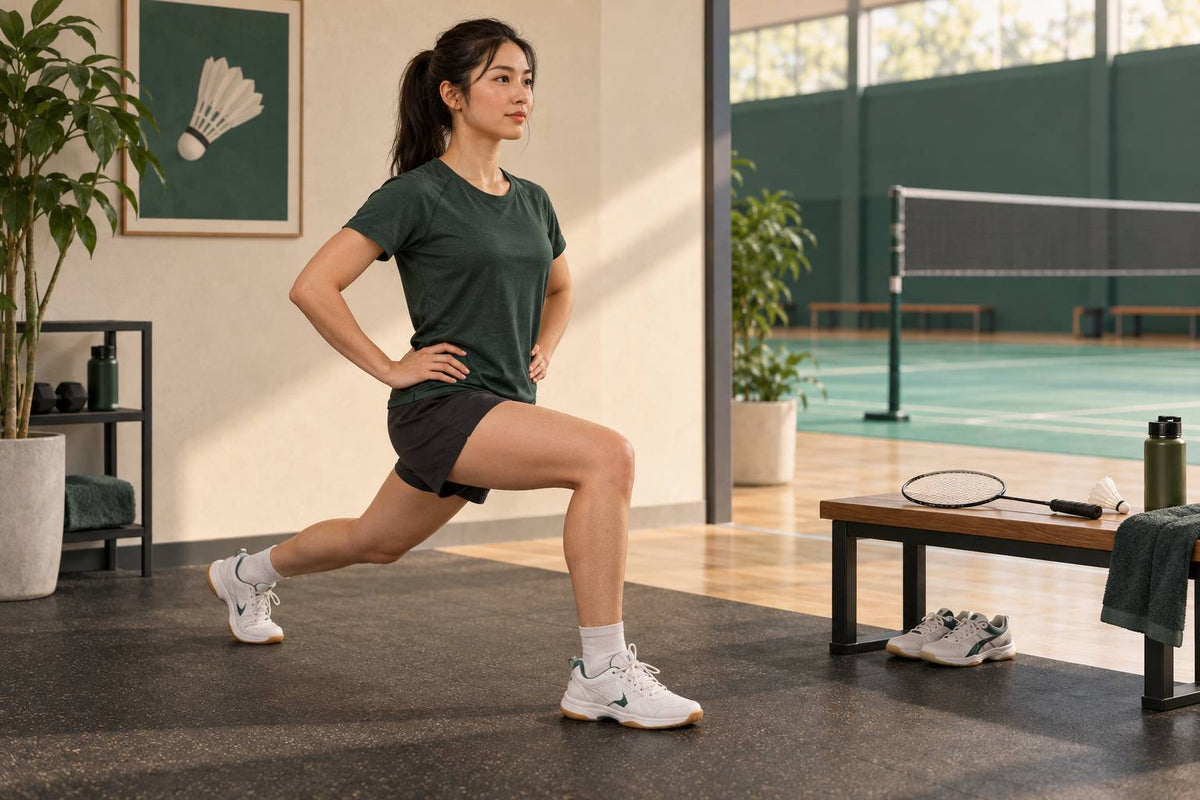
| Lunge | Prepares the exact low, reaching position that shows up constantly at the front court and wide corners. | Progress by controlling distance, foot position, and recovery speed before chasing deeper or faster lunges. |
| Calf raise | Strengthens the lower-leg push that supports split steps, quick first steps, and repeated landings. | Begin with two-leg control, then progress toward slower reps or single-leg versions when ready. |
Squats: your general strength builder
The squat is the simplest place to build the strength base. It teaches you to bend through the hips, knees, and ankles together instead of collapsing into one joint. That matters in badminton because your body rarely absorbs force in a perfectly upright position; you are usually reaching, braking, or recovering while slightly off balance.
- Use a controlled descent. Do not drop into the bottom position and bounce out of it.
- Keep the whole foot connected to the floor. If your heels lift early, reduce depth and work on ankle mobility in the next section.
- Progress slowly. Add range, control, or resistance over weeks, not all in the same session.
Split squats: the bridge between gym strength and court movement
Split squats are valuable because badminton is rarely symmetrical. You push from one leg, land on one leg, and recover from stretched positions. A split squat lets you train that single-leg demand without the moving step of a lunge.
Start with a stance you can control. If the front knee caves inward, the back foot wobbles, or you need to push off your hands to stand up, make the movement smaller. Good split squats should feel steady before they feel heavy.
Lunges: the exercise that deserves extra attention
A badminton rally asks you to enter and exit lunge-shaped positions again and again, especially on net shots, late forecourt pickups, and wide defensive reaches. That is why lunges should be trained carefully, not casually.
The important detail is the first contact. Large vertical and horizontal loads at heel contact during lunges can create high torque at the knee. Repeating that pattern, especially when tired, can contribute to overuse knee problems such as patellar tendon irritation or patellofemoral pain.
Small changes matter. A longer reach, a narrower landing, or a foot that points in a slightly different direction can change how much load the knee takes. Use that knowledge in training: do not jump straight to maximum-distance lunges. First learn to land quietly, keep the knee tracking in line with the foot, and recover without twisting out of the position.
Knee getting sore after lunges? Do not just add more reps. Check your landing, range, and recovery mechanics, and read our knee pain badminton prevention guide before pushing volume higher.
Calf raises: small exercise, big role in repeat movement
Calf raises are easy to underestimate until your legs feel heavy late in a match. The calves help with split steps, first-step acceleration, and repeated landings. Stronger lower legs also support the ankle work covered in the next section.
- Use full control. Rise smoothly, pause, and lower without dropping.
- Train both straight-knee and slightly bent-knee positions. Badminton uses the lower leg from many angles.
- Earn single-leg work. Move to single-leg calf raises only when two-leg reps are stable and pain-free.
How to progress without irritating your knees or ankles
The safest progression is boring in the best way: improve control first, then add difficulty. Beginners can start with fewer strength sessions while learning the basic movements, then build gradually as the legs adapt.
- Week-to-week consistency beats one hard session. Tendons and joints need time to adapt, especially if you already play multiple club nights.
- Stop adding range if form changes. A deeper lunge is not better if the knee collapses inward or the heel slams down.
- Separate strength from exhaustion. If every rep turns into a conditioning test, you are no longer building clean strength.
- Respect soreness patterns. Muscle fatigue is expected; sharp joint pain or next-day knee irritation is a signal to reduce range, volume, or speed.
Support the work with proper court shoes
Strength training prepares your legs for lunges and landings, but footwear still matters on court. The in-stock Yonex SHB65Z4M Men's Badminton Shoes – White are $184.99 CAD, and you can browse our badminton footwear collection for current availability. Badminton House offers free Canadian shipping on orders over $200, so a small add-on can help this shoe order qualify.
Dedicated Ankle Stability and Mobility Work

Do not treat ankle work as a two-minute add-on after squats and lunges. In badminton, the ankle has to manage court contact first on landings, then help control the knee and hip as you brake, push off, or recover from a deep lunge. That is exactly why ankle stability deserves its own block in a badminton leg strength training plan.
Sprains are the most common injury type reported in badminton injury data, making up just over one-third of all cases. The pattern makes sense on court: repeated lunges, jumps, single-leg landings, and quick direction changes all ask the ankle to absorb force while the body is moving fast and often off-balance.
Already had a rolled ankle? Read the dedicated badminton ankle sprain prevention guide for return-to-play habits, warning signs, and practical court adjustments.
The Two Qualities to Train: Control and Range
Good ankle training is not only “strong calves.” You need two linked qualities:
- Stability and proprioception: your ability to sense ankle position and make small corrections before the foot collapses inward, rolls outward, or lands awkwardly.
- Mobility, especially dorsiflexion: your ability to let the knee travel forward over the foot with control. Limited dorsiflexion has been identified as a characteristic of the sprain group, so it is worth training directly.
Proprioceptive training improves neuromuscular control and joint stability, which is exactly what you need when you land slightly late, reach for a net shot, or change direction under fatigue.
Simple Ankle Block for Badminton Players
Add this after your warm-up or at the end of a strength session. Keep it controlled; the goal is clean foot and knee alignment, not exhaustion.
| Exercise | How to Do It | Badminton Carryover |
|---|---|---|
| Single-leg balance | Stand on one foot for 20–40 seconds. Keep the arch active, knee soft, and hips level. | Builds awareness for landings, split steps, and recovery steps after lunges. |
| Single-leg balance with reach | Balance on one foot and reach the free foot forward, sideways, and diagonally back. Move slowly. | Mimics the unstable positions you hit during net lunges and defensive recovery. |
| Knee-to-wall dorsiflexion | Face a wall, keep the heel down, and glide the knee toward the wall over the toes. Stay pain-free and controlled. | Helps the ankle accept deeper lunge positions without forcing the knee or foot to compensate. |
| Slow calf raises | Rise up for one count, pause, then lower for two to three counts. Start two-legged, then progress to single-leg. | Strengthens the lower-leg support needed for push-offs, recovery steps, and repeated jumping. |
| Controlled lateral hops | Hop side to side over a line and “stick” each landing for one second before moving again. | Trains the ankle to stay organized during the side-to-side direction changes that happen constantly in rallies. |
Progress It Like Strength Work
Start with stable, slow work before adding speed. A practical progression is: two-leg balance, single-leg balance, single-leg balance with reaches, then small hops with controlled landings. If your knee caves inward, your arch collapses, or you cannot land quietly, stay at the current level longer.
For Canadian club players training on busy evenings or cold gym floors, this block is especially useful before high-intensity footwork. It wakes up the lower leg without turning the session into a full conditioning workout.
Footwear still matters. Strength work helps your body control force, but supportive indoor court shoes help you use that strength safely. See our badminton shoes for ankle support guide, or browse badminton footwear. The in-stock Yonex SHB65Z4M Men’s Badminton Shoes – White are $184.99 CAD.
A Progressive Home Version With No Equipment
You do not need a gym to start badminton leg strength training. For most players, the better first step is to repeat the same movement families you use on court — squat, split-squat or lunge, calf raise, and single-leg ankle control — with clean bodyweight form.
If you are new to strength work, start with fewer sessions, such as two per week, while you learn the basic movements. The goal is not to make the first week feel heroic. It is to let muscles, tendons, ankles, knees, and hips adapt together over several weeks so your base becomes more reliable during rallies.
Simple rule: finish every set with form still under control. If your knee caves inward, your heel lifts unintentionally, or your balance disappears, reduce the range, reps, or speed before adding difficulty.
The 6-Week No-Equipment Progression
Use this as a starting template. Keep at least one easy day between sessions, especially if you are also playing matches, drop-in, lessons, or league nights.
| Phase | Frequency | Main Work | Progress When... |
|---|---|---|---|
|
Weeks 1–2 Learn the shapes |
2 sessions per week | Bodyweight squat, assisted split squat, two-leg calf raise, single-leg balance | You can move slowly without knee collapse, heel lift, or wobbling through every rep. |
|
Weeks 3–4 Add control |
2 sessions per week | Slower squat, deeper split squat, reverse lunge, single-leg calf raise, balance with reach | You can pause at the hardest point and still stand up smoothly. |
|
Weeks 5–6+ Make it badminton-specific |
2 sessions per week, or carefully add a third short session if recovery is good | Squat-to-reach, forward and lateral lunge, slower single-leg calf raise, single-leg balance with controlled direction changes | Your landings, lunges, and recoveries feel stable late in sessions, not just when fresh. |
Session Template: 20–30 Minutes at Home
- Squat pattern: 2–3 sets of controlled bodyweight squats. Start with a comfortable depth, then gradually sit lower as long as your heels stay planted and your knees track cleanly.
- Split-squat or lunge pattern: 2–3 sets per side. Begin with a stationary split squat, using a wall for balance if needed. Progress to reverse lunges, then forward or lateral lunges when control improves.
- Calf raise pattern: 2–3 sets of two-leg calf raises. Progress by slowing the lowering phase, then try single-leg calf raises once both sides feel even.
- Ankle-control pattern: 2–3 rounds per side of single-leg balance. Progress by reaching the free foot forward, sideways, and backward while the standing foot stays quiet.
How to Progress Without Adding Equipment
Bodyweight training gets harder when you increase control, range, or single-leg demand — not only when you add more reps. Choose one progression at a time:
- Slow it down: take 3 seconds to lower into the squat, split squat, lunge, or calf raise.
- Add a pause: hold the bottom position for 1–2 seconds before standing up.
- Increase range carefully: lunge a little farther only if the knee and ankle stay aligned.
- Move from two legs to one: two-leg calf raises become single-leg calf raises; regular balance becomes balance with reaches.
- Add badminton directions: once forward lunges feel clean, add lateral lunges to prepare for side-to-side court movement.
Because badminton injuries often cluster around the knee and ankle during lunges, landings, and direction changes, do not rush the single-leg work. A stable slow lunge is more useful than a fast sloppy one.
A Simple Weekly Layout
Here is an easy way to place the home program around Canadian club nights or drop-in play:
- Option A: strength on Monday and Thursday, badminton on other days.
- Option B: short strength session after an easy practice, then a second session 2–3 days later.
- Option C: during busy weeks, keep only one light maintenance session instead of forcing tired legs through heavy volume.
If you train at home through winter, pair this strength work with footwork that does not require a court. Our badminton drills at home guide gives you court-free ideas that fit small spaces.
Keep the Knees and Ankles Honest
Use these checkpoints on every rep:
- Foot: keep the big toe, little toe, and heel connected to the floor.
- Knee: let it track in the same direction as the toes, especially in split squats and lunges.
- Hip: stay tall rather than folding forward to escape the hard part of the movement.
- Landing control: if you add any small hops later, land quietly and stop if you cannot hold your balance.
For more detail on the two areas most players worry about, read our guides to knee pain in badminton and badminton ankle sprain prevention.
Warm Up, Cool Down, and Supportive Gear
Treat badminton leg strength training as one part of a complete session, not something you jump into cold after sitting all day. Your legs may be strong, but your ankles, knees, hips, tendons, and nervous system still need a gradual ramp-up before squats, split squats, lunges, calf raises, and ankle-stability work.
Before strength work, use a badminton-specific warm-up that raises your temperature and rehearses court movement patterns. If you want a ready sequence, follow our badminton warm-up exercises guide first, then move into your strength routine while your joints feel mobile and your footwork feels sharp.
Support the strength work with proper court footwear. Stable, cushioned badminton shoes help your feet stay planted through lunges, landings, and direction changes. The in-stock Yonex SHB65Z4M Men's Badminton Shoes are available at $184.99 CAD. Badminton House offers free Canadian shipping on orders over $200, so this shoe sits just under the threshold and may qualify with a small add-on.
A simple session order
- Warm up first: do dynamic movement before loading your legs. Cold Canadian gyms make this especially important in winter.
- Strength second: complete your main leg exercises while your technique is fresh. Quality reps matter more than rushing through volume.
- Ankle stability after main lifts: balance and control drills work best when you can still focus on foot position, knee tracking, and quiet landings.
- Cool down after play or training: once the hard work is done, use easy mobility and stretching to settle the body. Our badminton cool-down stretches guide covers that part in detail.
If you wear knee support, choose it for the right reason. A sleeve or brace can give warmth, compression, or confidence, but it should not be used to hide sharp pain or replace strength work. For a practical breakdown, read our badminton knee support guide. If knee pain is persistent, one-sided, worsening, or affecting daily movement, check with a physio or a trusted pro shop before increasing training load.
The goal is simple: arrive at each strength session warm, move with control, wear shoes built for indoor court movement, and cool down enough that you can train again consistently. That consistency is what turns leg strength into a durable badminton base.
Which Leg Strength Plan Should You Choose?
Choose the version that matches your current weak link, not the most intense version on paper. For most Canadian club players, the best starting point is a simple strength base first, then more ankle, knee, or jump-specific work once the movements feel controlled.
| Choose this focus | Best if... | What to prioritize |
|---|---|---|
| Beginner strength base | You are new to training or returning after a break. | Start with fewer sessions, such as two per week, and focus on learning the basic movements before adding intensity. |
| Knee-load control | Your knees feel irritated after deep reaches, hard stops, or repeated low positions. | Use controlled squats, split squats, and varied lunge positions to build tolerance gradually. Large heel-contact forces during lunges can increase knee torque, and repeated loading can contribute to overuse problems such as patellar tendinosis or patellofemoral pain. For more detail, see our knee pain badminton guide. |
| Ankle stability and mobility | You feel unstable on one foot, struggle with ankle range, or want more confidence on landings. | Prioritize balance, proprioceptive drills, calf strength, and dorsiflexion mobility. Limited ankle dorsiflexion has been identified as a feature of sprain-group players, while proprioceptive training improves neuromuscular control and joint stability. If footwear stability is part of the issue, our badminton shoes for ankle support guide is the better next read. |
| No-equipment home plan | You train at home, do not have a gym, or need a simple winter routine between court sessions. | Use bodyweight progressions: slow squats, vertical jumps, step or bench jumps, then broad “frog” jumps only when control is consistent. Keep the goal progressive rather than exhausting. |
| Explosive add-on | Your basic strength work is already consistent and you want more court speed and take-off power. | Add plyometric work carefully. Sport-specific plyometric exercises can improve agility, muscle strength, and performance, but they should sit on top of a strength base, not replace it. For a separate power-focused progression, read our badminton explosive power training guide. |
| Gear check | Your strength work is improving, but your court shoes feel loose, unstable, or worn down. | Training builds the body; footwear supports it on court. Badminton House currently has the Yonex SHB65Z4M Men’s Badminton Shoes – White in stock at $184.99 CAD, and you can also browse the current badminton footwear collection. |
If you are unsure, start with the beginner strength base for a few weeks, keep your warm-up consistent, and add the ankle or knee emphasis that matches what you feel most during play. For the bigger injury-prevention picture, see our common badminton injuries prevention guide and badminton warm-up exercises.
Get Canadian badminton gear advice + restock alerts
Join the Badminton House list for buying checklists, restock alerts, and practical gear advice for Canadian players.
By subscribing, you agree to receive Badminton House emails and can unsubscribe anytime.
Leg strength work is one of the best investments you can make in a more durable badminton base, but the right progression should still match your body, court time, and injury history. We play badminton ourselves, so if you are unsure how to pair your training with shoes, strings, or general gear setup, contact us and we will help you choose a practical path.
Build your base from the ground up with proper indoor badminton footwear.
Shop Badminton Shoes10% off first order · Free shipping on $200+ · 14-day returns · Canadian badminton specialty shop


Leave a comment
This site is protected by hCaptcha and the hCaptcha Privacy Policy and Terms of Service apply.