
Last checked: August 2026 · Written by the player-led team at Badminton House
Quick answer
- Call an outside-post return a fault: it did not pass over the net.
- Check the landing separately; landing in does not repair an invalid crossing.
- A low, wide shot can be legal when it still crosses over the net between the posts.
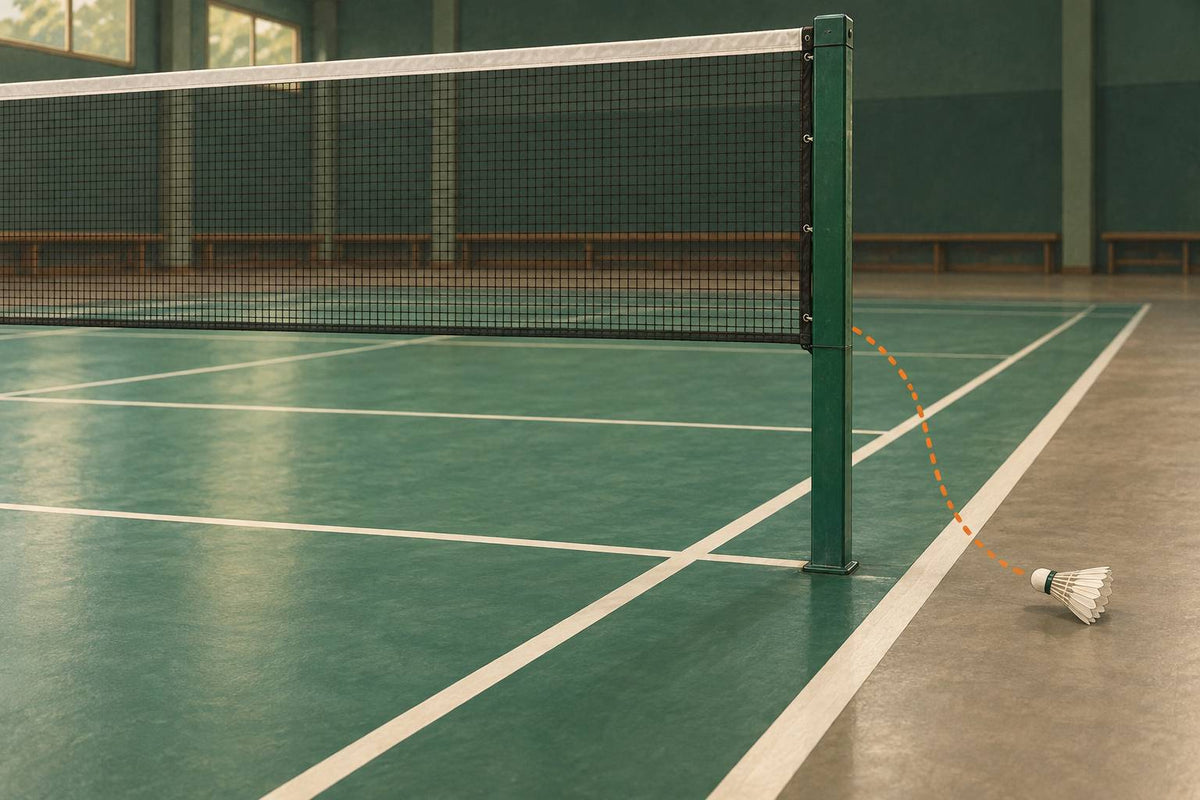
No. Under the current BWF Laws, a badminton shuttle must pass over the net. A shuttle that travels around the outside of a net post and then lands in the court is a fault. A low shot near the sideline can be legal only when it still crosses over the net within the net span.
Related reading: Can your racket cross the badminton net?
The confusion comes from combining three questions: where the shuttle lands, whether its path passes over the net, and whether the racket may follow across. Those tests are separate. This guide uses the BWF Laws in force from 26 April 2025, checked on 15 August 2026.
Can a badminton shuttle legally go around the net post?
Do not count an around-post return as legal. The current Laws fault a shuttle that fails to pass over the net. Travelling outside the end of the net is not passing over it, even when the shuttle later drops inside the singles or doubles boundary.
Court geometry reinforces the reading. The posts stand on the doubles sidelines, and the net must have no gap between its ends and the posts. BWF Laws 1.5 and 1.11 define that continuous net-and-post setup.
The Laws do not use a separate phrase such as “around the post.” The ruling is the direct practical inference from their over-net requirement and the absence of an exception. “It landed in” answers only the boundary question; it does not answer how the shuttle crossed to the other side.
| Path and result | Call | Reason |
|---|---|---|
| Over the net and lands in | Legal | Both crossing and landing tests pass. |
| Outside the post and lands in | Fault | The shuttle did not pass over the net. |
| Under the net and lands in | Fault | The same over-net test fails. |
| Over the net and lands out | Fault | The crossing passes, but the boundary test fails. |
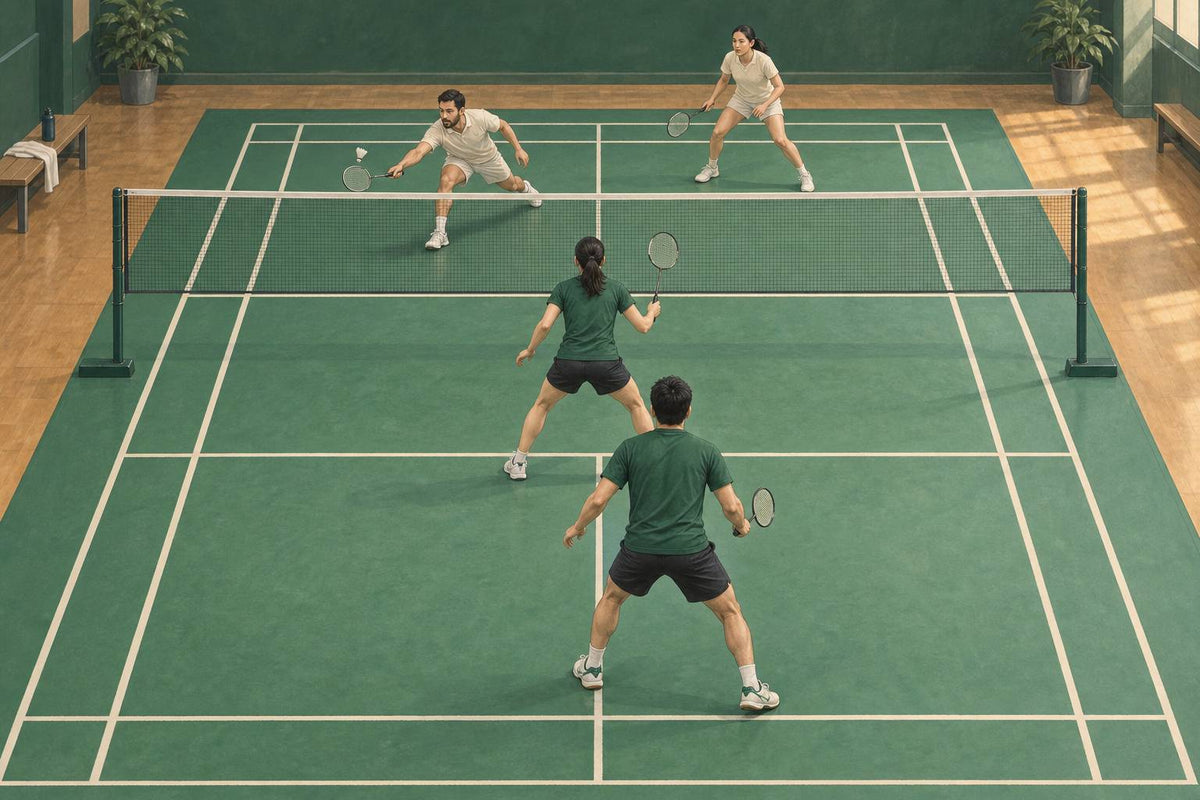
Singles makes the two tests especially easy to confuse. The posts remain on the wider doubles sidelines even when singles is played. A shuttle can cross over the net just inside a post, then land in the strip between the singles and doubles sidelines. In that case the crossing was valid but the singles landing was out. During doubles, the same landing strip is part of the rally court. The court dimensions and lines guide shows which floor boundary applies.
When watching from the side, judge the crossing at the net plane before following the shuttle to the floor. Ask whether the shuttle passed above the net inside its two ends, then make the line call using the correct singles or doubles boundary. A dramatic curve after the crossing can distract from that order. If a player or post blocks the only view, do not turn the landing point into proof of a path nobody saw. Use the same order for every unusual sideline flight.
In an officiated match, the umpire applies the Laws to the observed flight. In a social game, use the same two-part test. If nobody had a clear view and both sides agree, replaying the point is a local courtesy, not an official around-post exception.

What does the current BWF Law actually say?
The decisive fault wording is simple: a shuttle in play is faulted if it fails to pass over the net. A neighbouring clause separately faults a shuttle that lands outside the court. Read together, they require a valid crossing and a valid landing; neither test replaces the other.
BWF Law 13.3 places the two faults in separate subclauses: Law 13.3.1 covers an outside landing, and Law 13.3.2 covers failure to pass over the net. An in-bounds landing therefore cannot cure an outside-post route.
The post marks the end of the net equipment, not a legal side gate. The practical court-side question is the shuttle’s flight: did it cross over the net, or did it bypass the net outside the post? You do not need to estimate the shuttle’s exact height in centimetres to make that distinction.
Racket follow-through is a different rule. Law 13.4.2 permits the striker’s racket to follow the shuttle over the net after initial contact on the striker’s side. That permission concerns the player and racket; it does not allow the shuttle to travel around the post.
Use two questions in order
First: did the shuttle pass over the net? Second: did it land on or inside the correct boundary? Both answers must be yes for the path-and-landing part of the return to be legal.
Does a low shot below net height make it illegal?
No. A shuttle contacted below net height can rise and pass legally over the net, and a tight net shot can skim close above the tape. The deciding path question is not whether the contact started low; it is whether the shuttle eventually crossed over the net rather than under it or outside its end.
A legal low net shot and an outside-post shot can look similar from one angle. Track the crossing point instead of the dramatic finish. If the shuttle crosses within the net span, then lands on or inside the applicable boundary, its low trajectory is not a fault.
The same distinction applies to a flat drive or defensive block. It may travel close to net height and remain legal. A shuttle travelling under the net is a fault, even if its projected landing would be in. A shuttle outside the post fails the same over-net requirement.
Do not substitute the racket’s position for the shuttle’s path. The racket may finish across the plane after a legal first contact on the striker’s side, subject to the other net and obstruction rules. The racket-over-net guide explains that separate question.
How do you play the legal low-angle alternative?
Play the legal version through the net span: contact the shuttle on your side, use a compact push or brush, and aim inside the opponent’s sideline with enough height to cross over the net. Keep the target conservative first; the wider the angle, the less margin remains for both the crossing and landing.
Start from balance. The opportunity is easiest when the shuttle is in front of the body near a sideline. Reach with a stable lunge and keep space to control the racket face. If the shuttle is already behind you, choose a safer return instead of forcing an extreme angle.
Use a visible target. Place a flat marker comfortably inside the opponent’s sideline. The first practice goal is not to brush the post; it is to send the shuttle over the net and into the target while recovering. Move the marker outward only after the ordinary version is repeatable.
Keep the swing compact. A short push or brush gives the racket face a clearer direction than a large lifting swing. Let the shuttle travel low without deliberately sending it toward the outside of the post. These are Badminton House practice cues, not a promise that the angle beats a ready opponent.
Recover after contact. A wide shot pulls you away from the centre. Return toward a balanced base instead of watching the shuttle. If the opponent reaches it early, be ready for a counter toward the open middle or behind your outside shoulder.
| Practice result | First adjustment | Check |
|---|---|---|
| Clips the tape or falls short | Use a slightly firmer forward contact. | It still crosses within the net span. |
| Lands wide | Move the target farther inside. | The landing, not closeness to the post, is the goal. |
| Opponent reaches it early | Use a safer net shot or push. | You remain balanced for the next reply. |
The badminton obstruction rule covers whether a player blocks an opponent’s legal stroke. It does not change the shuttle’s required route over the net.
Court-side rule
- The shuttle must pass over the net.
- It must land on or inside the correct boundary.
- A low trajectory can be legal; an outside-post path is not.
- Racket follow-through permission does not change the shuttle-path rule.

Leave a comment
This site is protected by hCaptcha and the hCaptcha Privacy Policy and Terms of Service apply.