
Last updated: July 2026 · Written by the team at Badminton House
Quick Answer: Badminton Racket Over the Net Rule
If the shuttle is already on your side, your racket may cross the net only as the follow-through of that same stroke.
Legal
Best call: contact the shuttle on your side first; your racket can continue over the net afterward if it avoids the net.
Early
Reaching across to hit the shuttle before it crosses to your side is a fault.
Net
Even a legal follow-through becomes a fault if your racket, body, or clothing touches the net while the shuttle is in play.
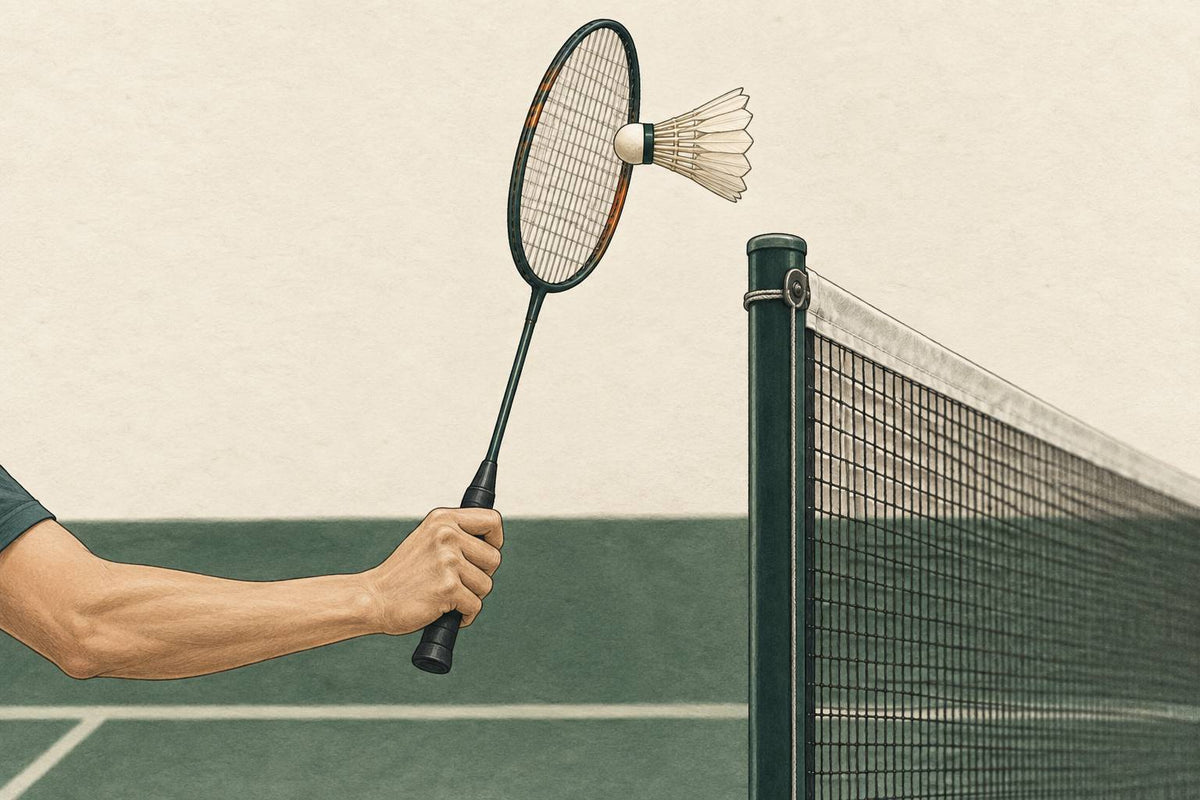
At the net, you often have a split second to decide whether to pounce or wait. If the shuttle is still on your opponent’s side, do not reach over and hit it. Let it cross first, then strike on your side and allow your racket to continue forward naturally. That follow-through can pass over the net plane, but only after contact has happened on your side of the court.
The common beginner mistake is treating “racket over the net” as always illegal. It is not. BWF Law 13.4.2 makes the timing the key part of the badminton racket over the net rule.
In This Guide
The badminton racket over the net rule, in plain English

The badminton racket over the net rule is mostly about timing. Under BWF Law 13.4.2, it is a fault to invade an opponent’s court over the net with your racket or person, except that the striker may follow the shuttle over the net with the racket during the stroke after the initial contact with the shuttle is on the striker’s side of the net.
So the core answer is: your follow-through may cross the net plane after legal contact, but you may not reach over and hit the shuttle before it crosses to your side.
If you are unsure during a tight net exchange, focus on one question first: where was the shuttle at the exact moment of contact? If contact happened on your side, the racket continuing forward is part of the stroke. If contact happened before the shuttle reached your side, it is not legal.
Legal follow-through vs. reaching over early

Think of the net as a line your racket cannot cross to make contact early. Under BWF Law 13.4.2, the key question is where the shuttle is when you hit it.
Legal: your opponent plays a tight net shot, the shuttle has already travelled onto your side, and you strike it there. If your racket then continues over the net plane as part of that same stroke, that follow-through is allowed, as long as there is no net contact while the shuttle is in play or another fault.
Fault: the shuttle is still on your opponent’s side, and you reach across the net to hit it before it comes over. That is invading the opponent’s court over the net, not a legal follow-through.
A real match example is Peter Gade’s net kill against Taufik Hidayat: Gade’s racket passed over, but no fault was called because the shuttle had already travelled to Gade’s side before contact.
Net contact and other faults still apply

A legal follow-through over the net only solves one question: where your racket is allowed to travel after you strike the shuttle on your side. It does not cancel the other net-area faults.
- Net contact: under BWF Law 13.4.1, it is a fault to touch the net or its supports with your racket, person, or dress. That applies while the shuttle is in play, including an otherwise legal follow-through.
- Going under the net: Law 13.4.3 makes it a fault to invade the opponent’s court under the net with your racket or body if it obstructs or distracts them.
- Obstruction: Law 13.4.4 covers preventing an opponent from making a legal stroke where the shuttle is followed over the net. A racket collision does not automatically make the striker at fault; judge whether either player prevented the opponent’s legal stroke.
For the wider match framework, see our badminton rules and scoring guide.
Why beginners get confused at the net

A lot of newer players phrase this as a forum-style question: “If the shuttle is just above the tape, can I lean my racket over and hit it before it comes across, or do I have to wait?” The plain answer is: you have to wait until the shuttle reaches your side before you make contact. If you strike it while it is still on your opponent’s side, you are reaching over early, not playing a legal net shot.
The confusion makes sense because the net is low enough that both rackets can be very close to the same space: the top is 1.524 metres at centre and 1.55 metres over the doubles side lines. For more court-layout context, see our badminton court dimensions and lines guide. In a close net exchange, judge the shuttle first, not where the racket finishes.
A simple way to call it during play
In a fast net exchange, do not judge the stroke by where the racket finishes. Judge the first contact point. If the shuttle was still on the opponent’s side when it was hit, call a fault. If the shuttle had already crossed to the striker’s side, the racket may continue over the net as part of that same stroke.
Quick court checklist
Ask four questions: where was the shuttle at contact? did the racket cross only after contact as follow-through? did the player’s racket, body or clothing touch the net or its supports while the shuttle was in play? did the player obstruct the opponent from making a legal stroke? If the answer is clean on all four, play on.
Which Call Should You Make?
Use the moment of shuttle contact as your decision point. The racket crossing the net is not automatically illegal; the key question is whether the shuttle was first struck on the striker’s side.
| Situation | Call | Why |
|---|---|---|
| Shuttle is contacted before it reaches the striker’s side | Fault | The striker has invaded over the net too early. |
| Shuttle is struck on the striker’s side, then the racket follows over | Play on | That follow-through is allowed as part of the stroke. |
| Player touches the net during play or obstructs an opponent’s legal stroke | Fault | Net contact and obstruction rules still apply. |
Get 10% off your first order
Join the Badminton House list and we’ll email you a 10% welcome code — plus training guides, technique advice, and badminton updates.
By subscribing, you agree to receive Badminton House emails and can unsubscribe anytime.
We play badminton, so we know these net calls can feel awkward until you have seen them a few times. If you are unsure about a rule situation, racket setup, or what to buy next, contact us and we will help you think it through in plain language.
Need a racket that suits your game at the net and from the rear court?
Browse Badminton RacketsCheck live availability and compare options before your next session.

Leave a comment
This site is protected by hCaptcha and the hCaptcha Privacy Policy and Terms of Service apply.