
Last checked: August 2026 · Written by the player-led team at Badminton House
Quick answer
- Commit only after a low or late reply leaves two reachable interception lanes.
- Recover rear coverage on the first lift or drive over the advancing pair.
- Stay front-back after a loose shot or when the opponent remains balanced.
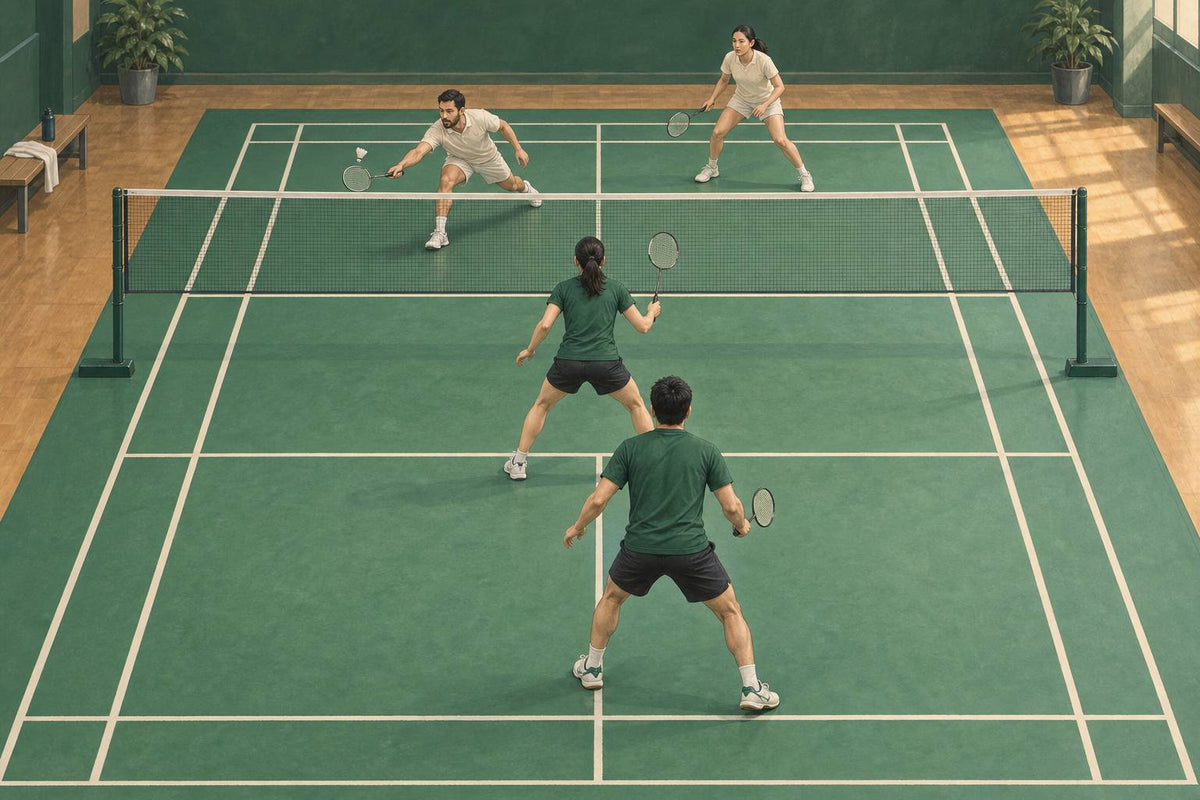
Temporary double-front pressure is a short attacking commitment, not a permanent doubles formation. Both partners move forward only after a shot has made a low or late reply plausible. One owns the near interception, the other seals a second lane, and the player who advanced from the rear is ready to drop back if the shuttle goes over them.
Related reading: Badminton doubles front-court net play
What is double-front pressure?
Double-front pressure means both partners temporarily advance toward the front and midcourt to close low replies. The pair tries to intercept a net shot, block, or push before the opponents recover. It is a brief pressure shape between ordinary front-back attack and the next recovery decision.
The ordinary reference point still matters. BWF Schools Badminton Lesson 21 teaches doubles decisions through awareness of space, self, opponent, and partner. Its positional exercise puts an attacker at the rear, a partner at the net, and the opponents side by side in defence. The same lesson also describes one player moving forward to take the attack while the partner retreats into defence.
Double-front pressure deliberately departs from that normal coverage for one anticipated exchange. The green light is not simply “we are attacking.” It is “the opponent appears restricted enough that both of us can threaten separate low-reply lanes.” The reset begins when that reading changes.
| Court picture | Temporary choice | Immediate job |
|---|---|---|
| Rear partner is attacking; defenders are balanced. | Stay front-back. | Rear player attacks; front player covers net and midcourt. |
| A fast or steep shot forces a low, late contact. | Consider double-front pressure. | Close two named lanes and prepare the reset. |
| The opponents lift or drive over the advancing player. | Recover immediately. | One drops diagonally while the other holds the front briefly. |
If both players run toward the tape without naming the next lanes, the rear court opens and collision risk rises. Pressure is useful only when the initiating shot, opponent’s contact, partner’s movement, and exposed space all support the same short decision.
What triggers the forward commitment?
Look for three green lights together: your initiating shot removes time, the opponent contacts low or while reaching, and your partner can arrive with the racket up to close a separate lane. If one signal is missing, keep ordinary front-back spacing or prepare to defend instead of assuming the reply will stay low.
1. The shot creates pressure. A tight push, fast body shot, or steep drop can take time away. Judge the result, not the shot name: did the opponent arrive balanced with choices, or reach late with a restricted swing?
2. The contact is constrained. A low racket, reaching lunge, late contact, or body turned away from a clean overhead action can make a block, net reply, or short push more plausible. It never guarantees one. Continue reading the racket and shuttle after moving.
3. Two lanes are actually reachable. Before the second player advances, the pair should know who owns the straight reply and who closes the middle or cross lane. If the supporting player cannot arrive under control, one player keeps rear-court responsibility.
A limited 2017 analysis of 35 international doubles matches defined a first attack around inducing an opponent’s under-return and found a different scoring pattern when a first attack was attempted. The study abstract supports treating first-attack creation as a real match question, but its broader definition and observational design do not validate this double-front tactic or prove it causes points.
Stop on either red light. First, do not advance together after a loose shot that gives the opponent time. Second, do not advance when the opponent is balanced with a clean lift or drive lane. In either picture, keep rear coverage and make the opponent prove they are under pressure.
Two short calls
Agree on “close” when both players commit and “back” when the advancing player must retreat. The words do not replace reading the shuttle; they stop each partner from assuming the other has the open rear court.
Who takes which interception?
As a simple starting rule, give the initiating player the near straight reply and the supporting player the middle or cross-side lane. The initiator stays connected to the pressure shot; the supporter advances with the racket up, leaves safe space between partners, and calls early when the shuttle enters their lane.
Initiating player: cover the straight net or push reply in the lane your shot created. Do not chase a shuttle that has clearly passed your outside shoulder toward the middle. Holding the lane gives your partner a stable reference.
Supporting player: close toward the centre or cross lane without crossing blindly in front of the initiator. If the reply remains straight, hold the second lane and prepare for the next contact rather than lunging at the same shuttle.
Middle shuttle: agree on a priority rule before adding speed. The player with the earlier, more balanced contact calls it. If neither calls, both should avoid reaching through the same space. Pause the drill and clarify ownership.
Reply over the top: make the player who advanced from the rear the default recovery player. They turn out and retreat diagonally toward the open rear lane. The partner who was already in front holds the net for one beat, then widens only after rear coverage is established.
These are starting conventions, not permanent player roles. Track who moved from the rear, who held the front, and where the counter travels. For the wider change after a lift, use the doubles attack-to-defence rotation guide.

How do you practise the commitment and recovery?
Use two pairs and make the trigger predictable before making the rally live. One attacking player starts at the front and one at the rear; the defenders start side by side. Rehearse a low reply, two-lane closure, and immediate diagonal recovery before adding pace or deception.
Phase one: script the pressure. A defender sends a predictable low block. The front attacker plays a controlled net shot or push, and the rear partner advances with the racket up. The defenders return softly into the straight or middle lane. Stop after one or two contacts, name the owner, and reset.
Phase two: expose the rear court. The defenders now choose a low block or a lift. On the block, both attackers close their lanes. On the lift, the advancing player calls “back” and retreats diagonally while the original front player holds the net. Watch whether the retreat starts with the opponent’s contact, not after the shuttle has already passed.
Phase three: make the trigger live. Start with a serve or controlled drive. Give the defenders a point when both attackers advance after a loose shot and leave the rear court open. Give the attackers a point for a clean low interception followed by the correct recovery. This local scoring condition makes the decision visible; it is not evidence that the tactic wins matches.
| Observer question | Useful sign | First correction |
|---|---|---|
| Was the opponent low or late? | Both advance only after a constrained contact. | Stay front-back when the opponent is balanced. |
| Did each player own a lane? | Straight and middle remain separate. | Agree ownership before adding speed. |
| Did rear coverage return? | The rear advancer retreats on the counter. | Call “back” at contact, not after the next shot. |
Finish by reviewing one failed decision: was the first shot strong enough, did the opponent still have a clean lift, who owned the next lane, and who should have recovered? Those answers separate shot quality, reading, communication, and movement instead of labelling the whole tactic good or bad.
Double-front checklist
- Create time pressure before moving together.
- Read the opponent’s contact; do not assume a low reply.
- Assign the straight and second lanes.
- Use one call for commitment and one for recovery.
- Restore the rear court on the first lift or counter over the top.


Leave a comment
This site is protected by hCaptcha and the hCaptcha Privacy Policy and Terms of Service apply.