
Last checked: August 2026 · Written by the Badminton House player-led team.
Quick answer: your first badminton rally
Start from the correct service court, send the serve diagonally, return the shuttle over the net, then recover your balance and racket before the next shot. The rally ends when the shuttle lands or a fault or let is called.
Serve
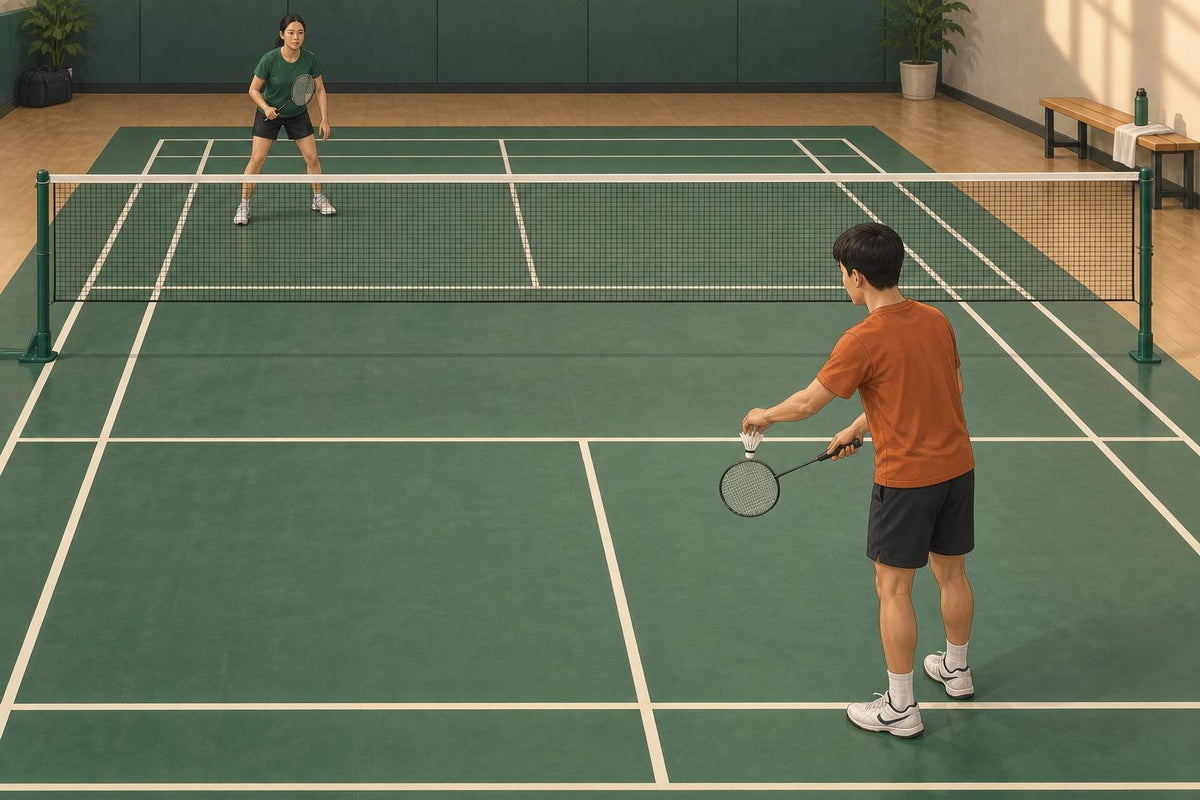
Start the rally: at 0–0, serve from the right service court into the diagonal service court.
Return
Keep it alive: send the shuttle over the net and inside the correct court; a boundary line counts as in.
Reset
Prepare again: finish balanced, face the play, and bring the racket back in front for the next shot.
Build one layer at a time. Use the serving guide for stroke mechanics and the rules and scoring guide for a complete match overview. This page stays with the first-rally workflow.
What counts as a badminton rally?
The rally begins when the service is delivered and ends when the shuttle hits the court or a fault or let occurs. Under the rules currently in force, the side that wins the rally also wins a point, whether or not it served.
The BWF Laws of Badminton, Version 5.0 (2), define the rally and set the current standard match as best of three games to 21. At 20–20, a side needs a two-point lead; at 29–29, the 30th point wins the game.
Date boundary: this article applies the standard 21-point Laws current in August 2026. BWF Version 6.0 changes the standard game target to 15 when it comes into force on 4 January 2027. Until then, a 15-point match is used only when arranged under BWF’s current Alternative Laws; that existing alternative is not the same as treating Version 6.0 as already in force.
Step 1: serve from the correct court
For general non-Para play at 0–0, start in the right service court because the serving side’s score is even. The receiver stands in the diagonally opposite right court. When the serving side’s score is odd, service comes from the left. That right-for-even, left-for-odd rule applies in standard singles and doubles; Para classes playing half-court use the service courts specified for their class.

The current BWF general non-Para service law has more detail than “hit it underarm.” The serve must travel upward toward the diagonal service court. Server and receiver stand inside their service courts without touching the boundary lines, and part of each foot stays planted and still from the start of service through delivery. The server releases the shuttle without adding spin, initially hits its base while the whole shuttle is below 1.15 metres, and continues the racket forward once service starts. The receiver must be ready.
Service-law scope: the 1.15-metre height and foot-position summary above is the general non-Para test, not a universal rule. Under BWF’s Alternative Service Laws, the whole shuttle is below the server’s waist and the racket shaft and head point downward at impact. Section 4.1 assigns both alternatives to Standing Para classes; Wheelchair uses below-armpit contact plus the downward-racket condition and stationary-wheel provisions. It also permits medically justified exceptions to the usual foot-contact requirement for listed Para players. Follow the event and class rules instead of blending these tests.
Beginner coaching choice: use a gentle low backhand serve while learning because the short action is easy to repeat. That is a practice recommendation, not a rule requiring every rally to begin with a low serve.
Step 2: return the shuttle before it lands
The receiver’s immediate job is simply to send the shuttle back over the net before it touches the floor. Under the current BWF Laws, singles players hit alternately from anywhere on their own side. In doubles, once the service is returned, either partner may make that side’s next hit while the two sides continue to alternate.
Beginner coaching choice: aim a gentle return high enough to give both players time to prepare, and use a large central target instead of chasing a sideline. BWF’s Shuttle Time teachers’ manual uses progressive rally activities and explains that a higher defensive lift allows more recovery time. It is a coaching source, not the current lawbook.
Do not stop because the contact felt awkward. If the shuttle crosses the net and remains in, keep playing. Clean technique can be refined later; the first goal is to recognize the flight, make one contact, and prepare for the reply.
Step 3: reset for the next shot
Reset means recovering enough balance to react again. It is not a BWF Law, and it does not mean running to the exact centre after every shot. Your useful recovery point changes with the shot you played, your opponent’s position, and whether you are playing singles or doubles.
- Finish balanced: control the end of the stroke before rushing elsewhere.
- Face the play: keep your eyes on the opponent and shuttle.
- Racket in front: recover it from the finished stroke instead of leaving it behind you.
- Weight ready: soften the knees and keep the body poised to move in more than one direction.
Those cues match the ready-position and recovery ideas in Shuttle Time. For the movement patterns that come next, use the beginner footwork guide.
How does a badminton rally end?
Most beginner rallies end because the shuttle lands, goes out, or fails to cross the net. Under the current BWF Laws, every line forms part of the area it marks, so a shuttle touching the correct line is in.
| What happened? | Current ruling | Beginner reset |
|---|---|---|
| Shuttle lands inside or on the correct line | The side where it landed loses the rally. | Call the score and prepare the next server. |
| Shuttle lands outside or does not pass over the net | Fault by the side that last hit it. | Retrieve the shuttle without practising through another court. |
| Shuttle touches the ceiling or side wall, or touches a player or clothing | Fault. Authorized local by-laws may address structural obstructions in a building. | Stop immediately and apply the venue’s stated rule if an obstruction is involved. |
| Player touches the net, carries the shuttle, or makes an illegal double hit | Fault by that player or side. | Name the one fault, then restart without a technique lecture. |
| A let is called | The rally does not count and the last server serves again. | Return to the same score and service turn. |
Try this first-rally practice
This is a Badminton House cooperative drill, not a match rule. Use one indoor court, confirm that neighbouring players are clear, and agree that both partners are trying to extend the rally rather than win it.
- Serve: begin at 0–0 from the right court and send a gentle legal serve diagonally.
- Return: play a controlled shot toward a large central area.
- Reset: both players recover their balance, face the shuttle, and bring the racket in front.
- Count: say the contact number quietly and continue until the shuttle is out of play.
- Restart: identify only the reason the rally ended, then serve again.
First aim for 3 legal contacts, then 5, then 7. If the serve is the repeated problem, pause the rally count and practise that one job. If returns keep falling short, move closer or use a higher cooperative flight. These progressions simplify the task; they do not change the Laws.
Your next indoor session
- Confirm right court at 0–0 and serve diagonally.
- Choose a large return target and cooperate for 3 contacts.
- Reset the racket and balance after every shot.
- Name why each rally ended, then restart calmly.
A first rally does not need speed, deception, or a perfect stroke. Make the serve legal, give your partner a return they can reach, and prepare again. When that loop begins to feel familiar, the one-hour first-lesson plan adds grip, movement, and a shortened-court game.

Leave a comment
This site is protected by hCaptcha and the hCaptcha Privacy Policy and Terms of Service apply.