

Last checked: August 2026 · Written by the player-led team at Badminton House
Quick Answer: Badminton Box Drill
Use a real indoor court and net, choose four reachable locations, then keep the sequence easy enough that the worker can arrive, play, recover, and reset with control.
Start
Recommended: use a known sequence and cooperative feeds before adding unpredictability.
Progress
Change one demand at a time: sequence, feed placement, response, or role organisation.
Regress
Slow, shorten, or remove a choice when balance, recovery, or safe spacing disappears.
A badminton box drill can be a useful way for a small group to rehearse moving among front- and rear-court locations. “Box drill” is an informal label, though, not an official BWF drill with a prescribed diagram, set length, cone distance, or four-week result. Treat the layout as a coaching option. The objective is observable quality: the worker gets to the intended area, plays an appropriate return, regains a usable base, and remains safe enough to repeat it.
This guide uses four location labels—front forehand, front backhand, rear forehand, and rear backhand—because they make a shared plan easier to discuss. They are not four magic points. A player may need a different starting base, smaller travel range, or simpler task. For a foundation before adding feeds, see our guide to rear-court movement and recovery.
Use court landmarks first. Cones can remind a group where to travel, but they must sit outside the active path and never substitute for court lines, a net, or a coach’s judgment.
What a badminton box drill is—and is not
A box drill is a repeatable practice layout in which one worker moves between agreed front and rear locations while a partner or partners provide manageable feeds. It can isolate a movement pattern or add a read-and-respond demand, but it does not certify technique, replace match play, or give a universal conditioning prescription.
The useful distinction is between the map and the task. The map is simply the four named areas on the worker’s side of the court. The task tells the group what happens next: perhaps front forehand, rear backhand, front backhand, rear forehand; perhaps a partner calls one of two locations; perhaps a feeder sends a predictable lift or net feed. Keep the map stable while learning the task.
The BWF Laws govern the court and net, not your practice sequence. The current Laws put the posts on the doubles sidelines and specify a net at least 6.1 m wide, 760 mm deep, 1.524 m high at centre, and 1.55 m high over the doubles sidelines. Use those landmarks when an indoor court is available rather than inventing a miniature court around cones. See the current BWF Laws of Badminton for the court-and-net specification.
The four labels are also not an instruction to hit every shuttle from a literal corner. A safe, useful starting position may be inside the lines, close to the service line, or at a player-specific reach point. State the location in plain language—“front backhand area, controlled net reply”—instead of arguing about whether a shoe touched an imaginary cone.
Use the normal court lines as the shared reference whenever possible. The centre line begins at the short service line and runs toward the back boundary; it does not run from the net. That detail matters if anyone draws a practice map. Keep the net, posts, and markings visible, then describe an area rather than placing equipment where a player needs to plant a foot.
Before the first shuttle
- Name the worker’s starting base and the first location.
- Agree whether feeds are cooperative or competitive.
- Decide the worker’s return: a shadow swing, a controlled lift, a clear, or an agreed safe reply.
- Name the stop cue before starting: unsafe proximity, uncontrolled stop, pain, or repeated loss of the task.
Set up the box on an indoor court
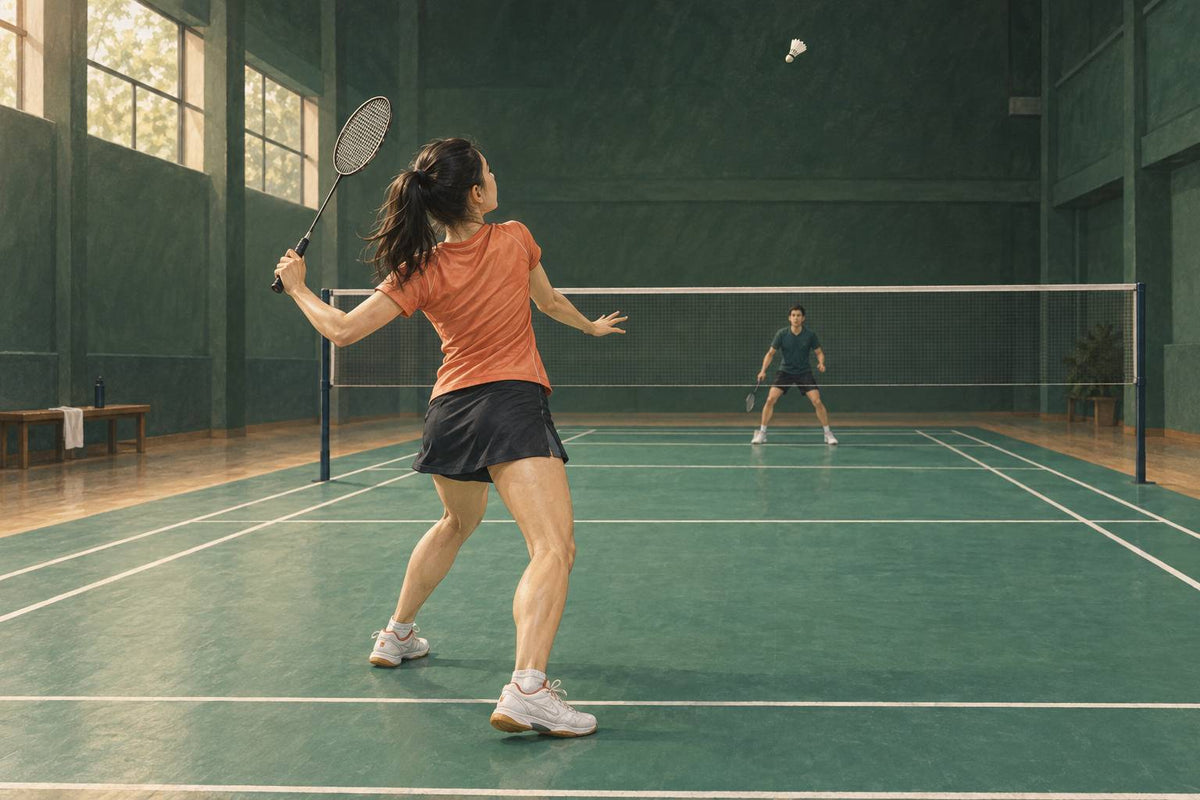
Set the drill on one half of an indoor badminton court with the net in place, clear space behind and beside the active player, and only the people needed for the current repetition near the path. The first setup should make stops and recoveries easy to observe, not make the worker cover the largest possible area.
Start by walking the path without a shuttle. Let the worker point to the four agreed locations: a forehand-side front area near the net, a backhand-side front area near the net, then corresponding rear areas. If you use cones, place them beyond the travel or landing line as visual references. A cone underfoot is a trip hazard, not a training target.
Check the environment before every block. The coaching manual How to Coach Badminton calls out the floor, surrounds, lighting, net, and player organisation as safety checks. It also advises warning players when the available space outside court lines is tight. That matters more than preserving a planned drill. Move the layout inward, remove a rear-court option, or use shadow movement when the hall is crowded.
| Role | Practical responsibility | What to avoid |
|---|---|---|
| Worker | Moves, plays the agreed response, and says when the task is too fast or unsafe. | Chasing a feed after balance or space has gone. |
| Feeder | Delivers the agreed location and waits for the worker’s reset when learning. | Turning every feed into a winner or increasing pace without agreement. |
| Observer or second feeder | Watches one visible cue or handles the next shuttle away from the path. | Standing behind the worker or crossing the court during play. |
For groups without a coach, keep the observation brief: one person watches whether the worker can stop under control before the next feed. Do not diagnose biomechanics from one drill. If pain, dizziness, a fall, or an unsafe court condition appears, stop rather than trying to “finish the set.”
Keep loose shuttles, bags, and spare rackets out of the worker’s recovery route. Decide where used shuttles will go before beginning, then collect them only when the block has paused. If the feeder must cross the court to retrieve every shuttle, the group has chosen a setup that interrupts learning and creates unnecessary traffic. A smaller, cleaner pattern is usually more useful than a complicated layout that cannot be reset safely.

Two-player and three-player box-drill options
With two players, make the feeder’s job cooperative and specific; with three, add a second feeder only when roles and safe positions are obvious. Neither format is inherently better. Choose the one that lets the worker receive a clear feed while every other person remains outside the active path.
Two players: one feeder, one worker
Place the feeder on the opposite side of the net or at a safe agreed spot. Use a small, known sequence such as front forehand to rear backhand, then pause for a reset. The feeder can hand-feed, toss, or hit only if both players can keep the shuttle controlled. The worker’s reply may be a shadow swing first, then a gentle return once the route is clear.
This option is useful when the group needs to see one movement problem at a time. If the worker reaches the first location late, do not add the second. Bring the feed closer, slow the release, or return to a walk-through. The point is not to accumulate exhaustion; it is to make the next attempt interpretable.
Three players: worker plus two organised partners
Give each partner a non-overlapping job. One simple option is a feeder and a shuttle handler who stands away from the worker’s recovery line. Another is two feeders on the opposite side who take turns only after the worker returns to base. If the group calls this two-versus-one, define it as a practice organisation, not a game: the pair’s job is to supply the agreed pattern, not to use numbers to surprise the worker.
The feeder can control the task through placement and rate. World Badminton’s feeder guidance makes the same practical point: vary rate and placement while keeping the pace and shots within the trainee’s capability. Start with one variable, then agree before changing it.
Progress the task without pretending there is one perfect plan
Progress a box drill by changing one clearly named demand after the current version stays controlled, not by following a universal calendar or set count. The progression below is a Badminton House coaching menu. Select one row, watch it, and return to the earlier row when the player cannot arrive, recover, or communicate safely.
| Option | How it changes the task | Stay, progress, or regress? |
|---|---|---|
| 1. Walk the route | No shuttle. The worker names and visits two locations, then returns to base. | Progress only when stops are controlled and the route is understood. Regress if surrounding space is unclear. |
| 2. Fixed feed | One feeder repeats a known location and response. | Stay if contact and recovery remain organised. Regress if the worker rushes the preparation or cannot reset. |
| 3. Known sequence | Link two or more named locations in an agreed order. | Progress if each arrival remains deliberate. Regress to two locations when the last movement becomes a scramble. |
| 4. Limited choice | The feeder chooses between two pre-agreed locations after the worker resets. | Stay when the worker reads the feed without guessing early. Regress when choices create collisions or wild reaching. |
| 5. Rally-like block | Use agreed returns and a small range of locations, with a partner observing one cue. | Use only if control survives the added choice. Regress immediately if safety, skill quality, or communication slips. |
A four-week block can still be useful as a diary, not a promise. In week one, record the simplest version the player can perform comfortably. In later sessions, note which single demand changed and what was observable: “two-location sequence stayed controlled,” “rear feed caused a late stop,” or “limited choice was too fast.” That record gives a coach and player something real to discuss without inventing a benchmark.
What to watch, when to stop, and how to simplify
Watch one visible feature at a time: readiness before the feed, a controlled arrival, racket preparation, the intended return, or recovery to a usable base. A box drill becomes noisy when a group tries to correct all five at once. Pick the earliest breakdown, simplify the task, and ask the player what they noticed.
- Recovery breaks first: reduce the sequence to one location, allow a complete reset, and make the next feed predictable.
- Racket preparation breaks first: keep the travel range but use a slower cooperative feed or a shadow return.
- Shot quality breaks first: lower the feed difficulty and agree on a broad, controlled response instead of demanding a winner.
- Spacing breaks first: move the extra player, clear loose shuttles, or stop the drill. Do not solve a crowded-court problem by telling the worker to be faster.
Two club habits commonly make this layout worse: feeds that become harder than the worker can read, and blocks that continue after the useful pattern has disappeared. Neither failure needs a heroic fix. Reduce the feed, shorten the sequence, add recovery time, or return to shadow work. The coaching manual’s movement examples emphasise controlled stops, posture, balance, and changes of direction; those are better quality checks than a stopwatch alone.
Finish with a short debrief: What route was clear? Where did the worker lose control? What single change will the next block test? A coach can turn that answer into the next practice. A cone layout cannot.
A simple next session
- Inspect the indoor court and clear the worker’s route.
- Choose two locations and one cooperative response.
- Watch one cue: controlled arrival, prepared racket, or recovery.
- Only add a second demand after the group can describe what changed and why.


Leave a comment
This site is protected by hCaptcha and the hCaptcha Privacy Policy and Terms of Service apply.