
Last checked: August 2026 · Written by the player-led team at Badminton House
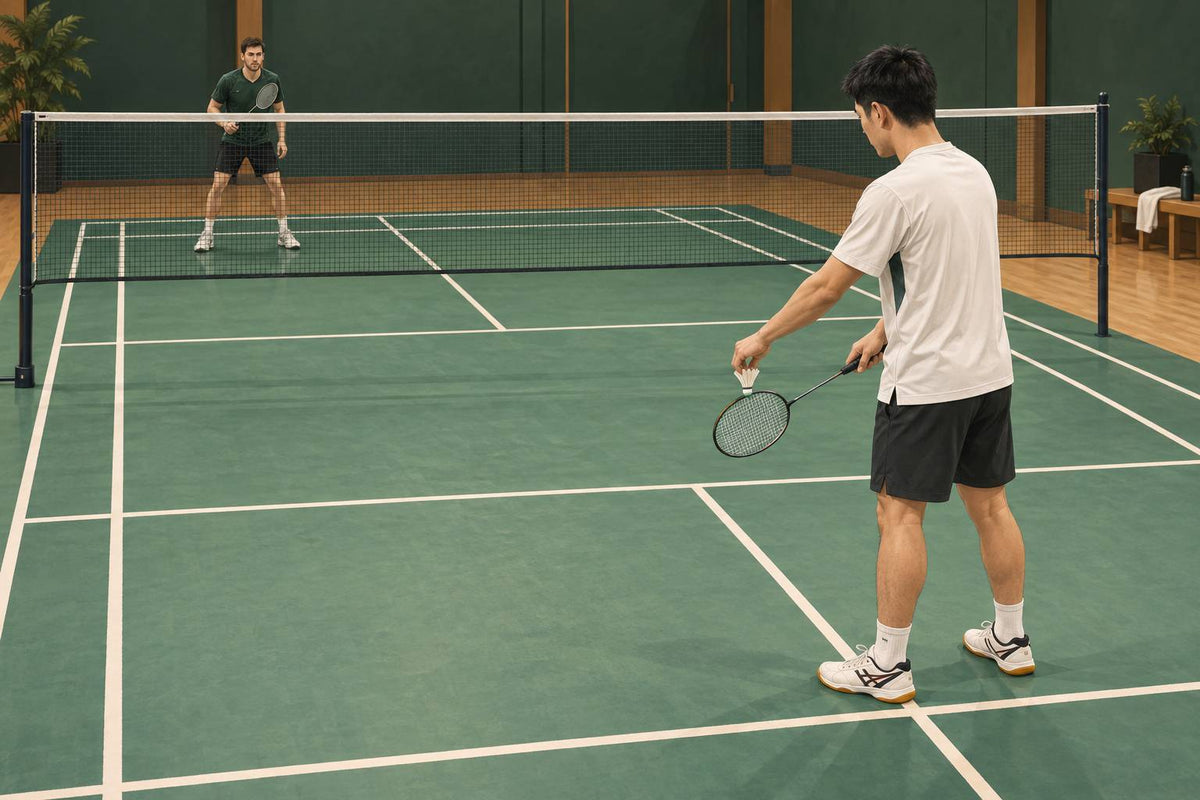
A badminton drive serve is a quick, direct-looking serve used to test a receiver who has committed hard toward the short serve. “Flat” describes its appearance, not a special rule: under the standard BWF law, it must still travel upward, meet every service requirement, and head into the correct diagonal service court.
Build the base first: compare the drive option with the low and flick serves, then use the same preparation only where it stays comfortable and legal.
What a drive serve is—and when it is worth testing
Think of the drive serve as a tactical trajectory between a tight low serve and a high, arcing flick. It reaches the receiver quickly on a more direct line. It is most useful as a read: test a specific receiving posture, observe the reply, and decide whether the option earned another look.
The BWF Laws do not create a separate legal category called “drive serve.” It is coaching vocabulary, also used in Badminton Ontario’s public coaching resources. A drive, low, or flick serve must pass the same service test under whichever law the event has adopted.
| Receiver picture | Drive-serve question | Reason to choose another serve |
|---|---|---|
| Weight and racket committed very far forward | Can a legal fast serve pass the first interception point or jam the racket path? | The receiver has already shown a compact block or drive from that line. |
| Racket leaves the body or one corridor exposed | Can you reach that legal target without changing your preparation early? | Your contact becomes rushed, high, or inaccurate when you try. |
| Balanced stance with racket in front | Is there evidence the receiver dislikes the pace, or are you simply hoping? | An alert receiver is meeting the shuttle cleanly and making you defend immediately. |
There is no responsible “once per game” formula. A successful surprise can become predictable, and a failed attempt may still reveal a useful receiving habit. Judge the contact quality, legality, target, and first reply—not whether the serve looked aggressive.
Is a fast, flat-looking drive serve legal?
For non-Para play, it can be legal under the BWF Laws in force on August 17, 2026, but speed does not excuse any service condition. The decisive questions concern position, feet, release, first contact, height, forward movement, and flight—not the label a player gives the serve.

Under BWF Section 4.1, dated 26 April 2025, the service must fly upward from the racket, pass over the net, and—if not intercepted—land on or inside the receiving service-court lines. That is why “flat” cannot mean horizontal or downward.
| Non-Para standard-law check | What to verify |
|---|---|
| Courts | Server and receiver are in diagonally opposite service courts and are not touching their service-court boundary lines. |
| Feet | Some part of both players’ feet remains stationary and in contact from the start of service through delivery. |
| Release and contact | The server releases without adding spin, and the racket initially hits the shuttle’s base. |
| Height | The whole shuttle is below 1.15 m from the court surface at impact. |
| Racket path | The racket continues forward from the start of the service until delivery; the server does not miss in the attempt. |
| Flight | The shuttle travels upward over the net toward the correct service court. |
Important rule scope: For non-Para play using BWF’s Alternative Service Laws, the whole shuttle is below the server’s waist and the racket shaft and head point downward at impact. BWF Section 4.1 also assigns class-specific tests: Standing Para classes use alternatives (a) and (b), while Wheelchair uses a below-armpit test plus alternative (b). Do not blend those tests with the general non-Para 1.15 m test.
For any sanctioned match, check the event regulations and applicable class provisions, then follow the referee’s application. For a fuller explanation of the general non-Para rule, see the 1.15 m service-height guide.
How to build the serve without chasing speed
Use a repeatable low-serve setup, then create the firmer trajectory with a compact acceleration and clear target. The goal is not the flattest possible flight. The goal is a legal serve that reaches the chosen corridor without an early preparation change that gives the option away.
- Choose the rule first. Confirm the applicable event and class provision: the general non-Para 1.15 m test, the alternative waist/downward-racket test, or the specified Para combination.
- Set the same calm picture. Use a balanced stance and preparation you can also use for your low serve; do not force sameness if it makes the contact illegal or unreliable.
- Name one legal target. Try the racket-side/body corridor, the opposite corridor, or legal depth. “At the player” is too vague for practice.
- Release and strike cleanly. For general non-Para play, release without added spin, contact the base first below 1.15 m, and keep the racket moving forward.
- Recover immediately. Bring the racket in front and expect a fast block, push, or drive. Your partner should be ready for the next shot too.
| Result | Likely adjustment to test |
|---|---|
| Shuttle hits the net | Give the flight a little more upward margin; “drive” does not require net-tape height. |
| Shuttle rises into an easy attack | Reduce excess lift, refine the target, or return to the low serve rather than swinging harder. |
| Contact height or release is doubtful | Stop adding pace. Use the applicable height reference or ask a coach or official to apply the event’s exact test before restoring speed. |
| Receiver blocks it early every time | Change serve or target. Surprise is not a substitute for a favourable first three shots. |
How to receive a drive serve without guessing
A receiver needs a base that covers the short serve without abandoning the faster line. Keep the racket in front, watch the release and first racket movement, then make the smallest useful response. There is no universal receiving distance because reach, stance, and the server’s options differ.
Under BWF Law 9.4, the server must not serve before the receiver is ready—but a receiver who attempts a return is considered ready. Set your feet and attention before signalling readiness; do not swing at a serve and then rely on a late “not ready” claim.
- Body or racket shoulder: use a compact block or push. Create space with the racket face instead of taking a large backswing.
- Wide corridor: move behind the contact enough to control direction; do not reach across the body and donate the next shot.
- Legal depth: turn and intercept only when balanced. A controlled reply is better than a rushed winner attempt.
- Doubtful legality: in an officiated event, leave the service decision to the appointed officials and ask which published test applies through the event’s official process. In practice, pause and review the agreed checklist rather than arguing from old wording.
The receiver’s partner should read the reply, not stare at the serve. A short block invites forward coverage; a flat push or drive needs the pair ready for the next fast exchange. Our doubles return-of-serve guide covers the broader positioning choices.
A practice test that trains both sides
Use three people when possible: server, receiver, and law-and-outcome observer. The observer does not make an official fault ruling or declare technique “good.” They record whether the action appears to meet the agreed practice checklist, the target, contact point of the return, and who controlled the next shot. Rotate roles before fatigue changes the action.
- Server announces only the intended target to the observer, not the receiver.
- Receiver uses the normal ready position and may block, push, or drive.
- Play through the next two shots instead of stopping at the return.
- Observer records: checklist met or needs review; target reached or missed; receiver contacted early, level, or late; server side or receiver side controlled the exchange.
- After a short block of low, flick, and drive serves, change one variable only: target, trajectory margin, or receiver base.
Keep the drive serve only when it survives all three tests: the action is legal under the event’s rule, the target is repeatable, and the serving side is ready for the reply. A point won by a doubtful contact is not a useful practice success.
Drive-serve decision loop
- Read the receiver’s actual position and racket—not a stereotype.
- Confirm the event’s service law and choose one legal target.
- Serve with upward margin and recover for the fast reply.
- Review legality, target, and the next exchange before using it again.


Leave a comment
This site is protected by hCaptcha and the hCaptcha Privacy Policy and Terms of Service apply.