
Last updated: July 2026 · Written by the team at Badminton House
Quick Answer: Badminton Doubles Return of Serve
Start close to the service line with forward pressure, racket up above net height, and choose the reply based on whether the serve is loose, tight, or a flick.
Default
Best choice: against a good low serve, take it early and play a controlled push or flat drive so you avoid the automatic lift and keep the rally at least neutral.
Loose
If the serve sits up, punish it immediately with an aggressive push, dab, or downward reply before the server’s partner can settle into defence.
Flick
Keep your back heel ready to push off: smash if you read the flick early, drop if you are slightly late, or clear if you are off balance and need to stay in the rally.
If your badminton doubles return of serve feels rushed, you are not alone. The serve comes low, the server is waiting, the net player is hunting, and one soft lift can hand the attack to the other pair before the rally has really started.
That is why the return matters so much in Canadian club, drop-in, and league doubles. A large share of doubles rallies are decided in the opening exchanges: pro doubles analysis has found 30–40% of rallies ending within the first four shots, rising to 40–50% for intermediate players. In practical terms, your first move after the serve often decides whether your pair gets to attack or defend.
This guide focuses on the receiver’s job: stand close enough to pressure the server, keep your racket threatening, choose the right reply for the serve quality, and stay ready for the flick. The goal is simple: turn the return from a nervous reaction into a repeatable attacking habit.
Start with stable court movement. A sharp return starts with grip on the floor, not just racket skill. Browse badminton shoes for indoor court support, with free shipping in Canada.
In This Guide
Why the Return Decides So Many Doubles Rallies
In doubles, the rally often turns before anyone gets to play a full attacking pattern. The serve is short, the receiver is close, and both pairs are fighting for the same thing: who gets the first downward or flat shot. That is why the badminton doubles return of serve is not a small technical detail — it is one of the main ways a receiving pair either creates pressure immediately or gives the attack away.
At pro level and at intermediate club level, the serve-and-return phase is often where the rally is won, lost, or shaped. If your return is late, passive, or automatically lifted, the serving pair usually gets the first chance to attack. If your return is early, flat, and well placed, you can make the server and their partner defend before they have settled into formation.
Think of this guide as the receiving half of the serving sequence. If you are still building a consistent low serve, start with our badminton serving guide; once both sides of the exchange make sense, return practice becomes much more realistic. You are no longer just “getting the bird over” — you are asking whether your first touch steals the net, forces a weak lift, or keeps the rally neutral.
Key idea. A good return does not need to win the rally outright. Its job is to stop the serving pair from attacking first — by taking the shuttle early, keeping it low, and making the next shot uncomfortable.
How Should You Stand to Receive a Doubles Serve?

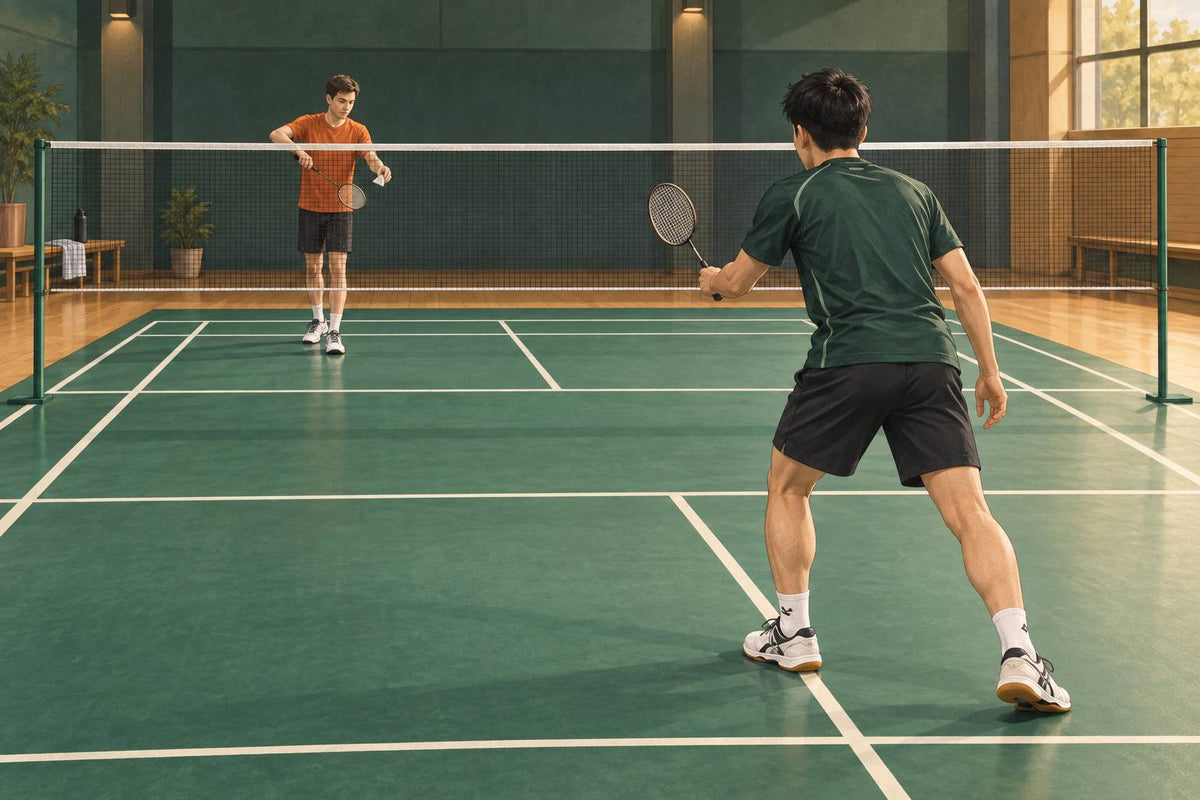
A strong badminton doubles return of serve starts before the server even hits the shuttle. Your stance should make the low serve feel uncomfortable for the server: you are close to the service line, leaning forward, knees bent, and ready to take the shuttle early. But it cannot be a reckless lunge. If you are so far forward that a flick serve beats you immediately, the stance has failed.
Use your non-racket leg in front and your racket leg behind you. Most of your weight should sit over the front leg, with both feet active on the toes or balls of the feet. The front foot can point generally forward toward the net with a slight angle, giving you a stable base without locking your hips.
- Front leg: non-racket leg forward, taking most of your weight.
- Back leg: racket-side leg behind you, loaded enough to push back for a flick.
- Knees: bent so your centre of gravity is low and reactive.
- Feet: on the toes or balls of the feet, not flat and heavy.
- Court position: as close to the short service line (1.98 m from the net) as you can manage while still reacting to a flick serve.
The head-forward cue
A simple way to feel the right forward pressure is this: put your non-racket foot forward and lean until your head is slightly in front of your front foot. When you do that correctly, your back heel naturally lifts off the floor. That raised back heel matters because it keeps the rear leg springy instead of stuck.
Think of the stance as a coiled position, not a frozen pose. You are threatening the low serve with your body position, but your back leg is still alive. If the server flicks, you should be able to push back and turn quickly rather than needing to stand up first.
Close to the line, but not trapped
Standing close to the service line helps you take the shuttle earlier. That is the whole point of the aggressive doubles receiving stance: shorten the distance to the shuttle, reduce the server’s comfort, and make your first reply more threatening.
The common mistake is confusing “forward” with “falling forward.” If your shoulders drift so far ahead that your first step is a stumble, you will struggle against a good flick. The better feeling is controlled forward pressure: weight forward, knees loaded, back heel up, eyes steady, and no commitment until the serve is struck.
| Stance cue | What it should feel like | Common error |
|---|---|---|
| Weight forward | You can attack the low serve without a big first step. | Standing upright and reacting late. |
| Back heel lifted | The rear leg stays springy for a flick serve. | Back foot flat, making the first backward move slow. |
| Knees bent | You can push forward or backward without standing up first. | Locked legs and a delayed split-step. |
| Close to service line | You take tight serves early and make the server feel pressure. | Starting too far back and giving the serve time to drop. |
How this stance connects to the next rotation
Your return stance is not just about hitting one good shot. In doubles, the receiver’s first movement often decides whether your pair can take the attack or has to defend. A forward stance helps you threaten the low serve; a balanced rear leg helps you survive the flick; and your recovery after the return sets up the next front-back or side-side shape.
For the next part of the rally, connect this receiving position with your pair’s movement pattern in our badminton doubles positioning and rotation guide. The goal is simple: return with pressure, then recover into the rotation that gives your partner a clear next shot.
Where Should Your Racket Be When Returning Serve?

In doubles, your racket position is your first warning sign to the server: if the racket is low, you are inviting a tight serve and a late lift. Hold the racket around net height or slightly above it, out in front of your body, so your first movement can be forward into the shuttle rather than down and then up.
The key is to look threatening without becoming stiff. Keep the racket arm relaxed but ready, with the elbow away from your ribs. If the elbow is tucked in, you lose reach and take the shuttle later. If the arm is fully locked, you lose the small adjustments needed for serves that drift toward the body, T, or tramline.
Simple ready-position cue
- Racket head: up around or above net height, not hanging below the tape.
- Contact point: in front of your lead shoulder, early enough to push, block, dab, or drive.
- Elbow: free from the body, but not locked straight.
- Hand: relaxed until the moment you decide, then quick and compact.
For the grip, start with a bevel grip: place the thumb on the ridge rather than flat on the wide back face of the handle. That thumb-on-ridge cue gives you a neutral starting point, so you can adapt quickly if the serve comes tight to the T, wider across your body, or high as a flick. A very strong forehand or backhand grip can make one reply feel powerful, but it often makes the next serve harder to cover.
Think of the return as a front-court skill, not just a serve-receive skill. The same compact hand speed that lets you take the serve early also helps you control spinning blocks, tight tumbling replies, and quick net interceptions. If you want to build that touch after the return, work through the technique cues in our badminton net shots guide.
What it should feel like
Your ready position should feel springy, not tense. You are not trying to guess every serve before it happens; you are giving yourself a racket position that keeps every reply available. From there, a loose serve can be attacked downward, a tighter serve can be pushed or guided flat, and a flick can still be chased because your arm and grip are not overcommitted.
| If your racket is... | What usually happens | Better cue |
|---|---|---|
| Below net height | You arrive late and are more likely to lift. | Start around or above net height. |
| Too close to your chest | You take the shuttle later and lose forward pressure. | Keep the elbow out and the racket in front. |
| Locked fully straight | You struggle to adjust to body serves or last-second changes. | Stay long but loose, with a small bend in the arm. |
| Held in an extreme grip | One return feels easy, but other serves become awkward. | Use a bevel grip with the thumb on the ridge. |
Choose the Reply Based on Serve Quality

A strong badminton doubles return of serve is not one automatic shot. It is a quick read: Was the serve loose, tight but still reachable above the tape, or so good that I have to take it below net height? Your answer should change your reply.
The goal is simple: attack bad serves, stay neutral against good serves, and survive excellent serves without handing your opponents an easy first attack.
Return rule of thumb: if you can contact the shuttle above net height, think forward and flat. If you must contact it below net height, accept that the shuttle has to travel upward and choose the safest reply.
1. Loose serve: punish it immediately
A loose low serve is any serve that sits high enough or far enough from the tape that you can contact it early and above net height. In doubles, this is the return you should be ready to attack.
- Kill it downward if the shuttle is clearly above the tape and close enough to reach without lunging wildly.
- Dab or tap into open space if a full kill is risky but you can still play the shuttle down.
- Drive or push flat if the serve is loose but not quite high enough for a clean downward finish.
Do not over-swing. You are already close to the net, so a compact punch is usually enough. Big racket preparation gives the server and server’s partner time to react.
2. Tight serve, taken above net height: apply pressure without gambling
This is the most important category for club and league doubles. The serve is good enough that you should not force a reckless kill, but you are still early enough to keep the shuttle flat, fast, or controlled. Your job is to make the serving side move first.
| Reply option | Best use | Why it works |
|---|---|---|
| Push into the server’s body | When the server stays forward after serving | It jams the racket and hip area, forcing a rushed lift, block, or awkward drive. |
| Push to the rear corners | When you take the shuttle early and see the rear player leaning forward | It sends the shuttle past the front player and can force the rear player to hit from a stretched position. |
| Straight block or straight net shot | When the serve is tight and you want control over power | It keeps the shuttle near the tape and asks the server to move forward immediately after serving. |
| Guide to the forecourt tramlines | When the server is covering straight too aggressively | It moves the server laterally and can open the middle for your partner’s next shot. |
| Push to the mid-court tramlines | When the opponents are unsure who should take the side channel | It can create hesitation between the server and the rear-court partner. |
For more ideas on changing rhythm without becoming predictable, see our badminton change of pace tactics guide.
3. Tight serve, taken below net height: choose survival first
If the serve is so tight that you contact it below net height, the return cannot travel downward. It has to rise to clear the tape, which means the serving side may get the next attacking chance. That does not mean you have failed; it means the server produced a high-quality serve.
In this situation, avoid the panic swipe. Use one of three safer choices:
- Straight net shot: the safest soft reply when you can keep the shuttle tight enough that the server cannot pounce.
- Net shot to the trams: useful when you can guide the shuttle wide and make the server move sideways before playing up.
- Lift to stay alive: not ideal in doubles because it concedes the attack, but it is better than feeding an easy net kill when you are late or off balance.
This is where discipline matters. Many developing doubles players lift too often by habit. A lift is sometimes the right choice, but if every tight serve makes you lift, the opponents get a predictable attacking pattern.
Quick decision tree
Loose
Attack first: kill, dab, or play a compact downward reply.
Above net
Pressure: push to the body, rear corners, forecourt trams, mid-court trams, or play a controlled straight block.
Below net
Survive: straight net, net to the trams, or lift if you are late and need to reset.
How to Handle Flick Serves
A flick serve should not make you abandon your forward receiving stance. It should remind you that “forward” does not mean frozen. Your weight can lean toward the net, but your back leg must stay active, with the heel lifted, so you can push back quickly if the server sends the shuttle over you.

Keep the response simple: if you read the flick early, attack it; if you are slightly late, use a controlled drop; if you are late and off balance, clear high enough to stay in the rally.
Flick Serve Decision Tree
Early read
Smash or steep attack. If you anticipated the flick and can get behind the shuttle, punish it before the serving pair can settle into defence.
Slightly late
Drop. If you cannot hit down with control, a drop keeps the shuttle moving downward and can stop the server’s partner from getting an easy counter-attack.
Off balance
Clear. If you are reaching backward or falling away, clear to buy time. A cross-court clear can be useful when it gives you more space to recover.
The stance mistake that gets players flicked
Many developing doubles players hear “stand close and attack the low serve” and shift everything forward. The problem is that a forward lean only works if the rear foot is still loaded. If your back heel drops, your hips sit back, or your racket arm reaches too far forward, the first step to the rear court becomes slow.
- Front foot: stable enough to pressure the low serve.
- Back foot: light enough to push you backward immediately.
- Racket: still up, because it is quicker to adjust from a high ready position than from a low, dangling racket.
- First move: turn and push back, rather than popping upright first.
A good cue for Canadian club-night doubles is: pressure the low serve with your body, but protect the flick with your feet. If the server flicks and you are already balanced on the balls of your feet, the shot becomes a normal overhead choice instead of an emergency scramble.
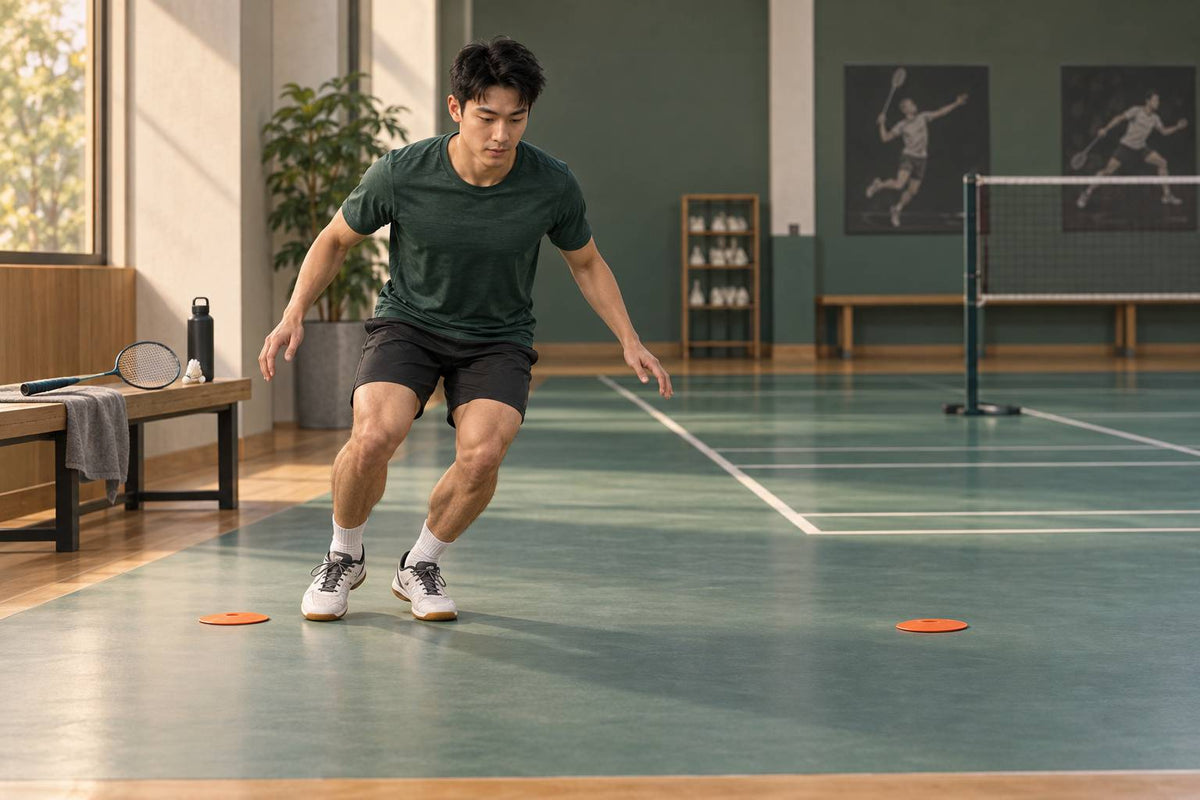
Practice the recovery, not just the shot. Add a receive-then-retreat pattern to your next session: start in your doubles return stance, have a partner mix low serves and flicks, then recover into front-back doubles shape. For footwork ideas, see our badminton footwork basics guide.
Gear That Supports Fast Serve Returns
A good badminton doubles return of serve is mostly timing, stance, and decision-making — but the right gear can make that first movement easier to repeat. The priority is not maximum power. It is getting off the mark quickly, staying balanced after the split-step, and recovering if the server flicks over you.
Shoe callout for faster first steps. Court shoes help with the explosive split-step and push-off you need to attack a short serve early while still being able to chase a flick. One current option is the Babolat Shadow Tour Men’s Badminton Shoes – Orange, built with a Michelin Premium Rubber Outsole for grip on that first step. Badminton House ships within Canada, with free shipping on qualifying orders.
For rackets, many doubles receivers like a fast, control-oriented feel because the return window is tiny: you are blocking, pushing, driving, or changing direction from a short preparation. If you are browsing options, start with the badminton rackets collection and look for a head-light, control-oriented profile rather than treating any single listed frame as a fixed recommendation.
The practical test is simple: your shoes should let you load and push without sliding, and your racket should feel quick enough that you can hold the shuttle, change your reply, and recover for the next shot. If either piece of gear makes you late, heavy, or hesitant, it will show up immediately on return of serve.
Which Return Should You Choose?
The best badminton doubles return of serve is not one fixed shot. Choose the reply based on how early you contact the shuttle, whether it is above or below net height, and whether the server has forced you backward with a flick.
| Serve you receive | Choose this return | Why it works |
|---|---|---|
| Loose serve sitting up | Kill, dab, or another downward reply | A loose serve should be punished immediately. Because you are close to the net, a kill can be directed almost anywhere and has a high chance of ending or dominating the rally. |
| Tight serve you can take above net height | Controlled push to the server’s body, rear corners, forecourt tramlines, or mid-court tramlines | Taking the shuttle early keeps you threatening without over-hitting. Body pushes and tramline pushes can create hesitation between the front and rear defenders. |
| Excellent serve you must take below net height | Straight net shot, net shot to the trams, or lift | Once the shuttle is below net height, it has to travel upward to clear the tape. A lift keeps the rally alive, but it usually gives up the attack. |
| Flick serve you read early | Smash if you are set, or play a drop | If your forward stance still lets you push back quickly, the flick becomes an attacking chance instead of a panic shot. |
| Flick serve you read late | Clear, ideally cross-court, if you are off balance | A late, off-balance return is not the time to force a winner. A clear gives you a safer recovery option than reaching and dumping the shuttle into the net. |
| Server starts reading your pattern | Vary the target and tempo | Even a good return becomes easier to cover if you repeat it every point. Mix body pushes, net shots, tramline targets, and rear-court pressure. |
For Canadian club play, remember that serve judging may vary between settings, especially where the older lowest-rib service standard is still used instead of the fixed 1.15 m BWF height. Your job as receiver stays the same: stand close enough to take the shuttle early, keep the racket up, and choose the highest-percentage reply for the serve quality in front of you.
Gear should support this decision, not replace it. If your return breaks down because your first step slips or your push-off feels slow, the Gear That Supports Fast Serve Returns section covers a court-shoe option worth a look, the Babolat Shadow Tour Men’s Badminton Shoes – Orange. If you are comparing racket balance for faster doubles returns, start with the head-heavy vs head-light racket guide and check the live badminton rackets collection for current availability.
Get new badminton guides by email
Join the Badminton House list for occasional emails with new guides, technique tips and news from our club in Moncton.
By subscribing, you agree to receive Badminton House emails and can unsubscribe anytime.
A sharper badminton doubles return of serve comes from small details repeated well: forward stance, racket up, early contact, and a clear reply before the shuttle crosses the tape. We play badminton ourselves, so if you are unsure whether your racket, strings, grip, or court shoes are helping or slowing down your first-three-shot game, contact us and we will point you in the right direction.
Free shipping across Canada · 14-day returns · Canadian badminton specialty shop


Leave a comment
This site is protected by hCaptcha and the hCaptcha Privacy Policy and Terms of Service apply.