
Last updated: July 2026 · Written by the team at Badminton House
Quick Answer: Badminton Growth Spurt Training
Measure standing height every three months; adjust training when growth jumps, not at a birthday.
Fast growth
More than 7.2 cm/year; about 1.8 cm in three months. Reduce repeated jumping and sprinting while keeping skill work.
Moderate growth
3.5–7.2 cm/year. Continue planned training, but monitor coordination, landing quality and total weekly load.
Slow growth
Below 3.5 cm/year. Progress normally unless pain appears below the kneecap or at the heel/Achilles attachment.
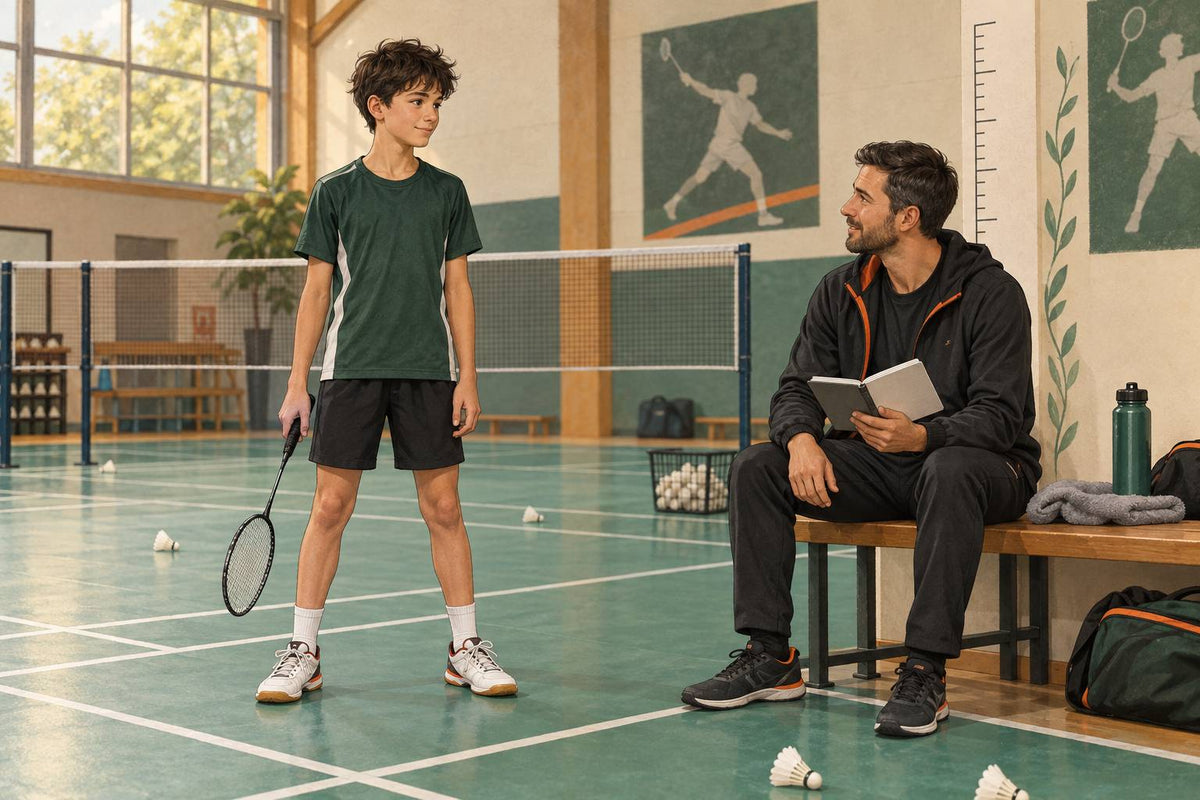
A junior who suddenly mistimes overheads, arrives late to the shuttle or loses balance after a familiar lunge may not be lazy or going backwards. During the adolescent growth spurt, changing limb lengths can temporarily disrupt coordination, posture and force production just as badminton’s jumps, landings and rapid changes of direction keep loading the knees and heels. Treat that rough month as a coaching problem, not a character verdict: record height every three months, watch the player’s movement and soreness, and adjust the session when growth accelerates. Calendar age alone cannot tell you who is at peak height velocity. Good badminton growth spurt training preserves skill learning while lowering unnecessary repetitive impact and protecting the player’s confidence.
In This Guide
Track Growth Rate, Not Birthdays
Peak height velocity (PHV) is the fastest period of adolescent height growth. It occurs on average near age 12 for girls and 14 for boys, but individual timing varies widely. For badminton growth spurt training, the useful trigger is a rising growth rate—not a birthday.
Measure every three months, barefoot, using the same wall-mounted stadiometer and measurer. Take three readings; they must agree within 0.3 cm before averaging.
| Date | Barefoot height: 1 / 2 / 3 / average | 3-month change | Annualized rate | Heel or knee soreness | Training action |
|---|---|---|---|---|---|
| ____ | ____ / ____ / ____ / ____ cm | ____ cm | change × 4 | None / heel / knee | Maintain / modify / refer |
Flag roughly 1.8 cm per quarter—the fast-growth band—for closer monitoring and training adjustment. Refer an unusual growth pattern to a medical professional.
Why Badminton Can Look Different During a Growth Spurt
During peak height velocity, the arms and legs can lengthen faster than the trunk. The player’s familiar motor programme must adapt to new lever lengths, so coordination, postural stability and force production may temporarily dip. A previously sharp player might mistime the shuttle, lose balance or produce less power. That change should not automatically be read as poor effort or intent.
Badminton exposes this adjustment quickly. Lunges require controlled braking, rapid direction changes demand precise foot placement, and most jump-smash landings load one leg. Reactive or unpredictable feeding can create higher landing loads than anticipated patterns because the player has less time to organize the landing. As fatigue builds, landing quality can also decline. The result may be a session in which movement looks inconsistent: a clean first repetition followed by increasingly unstable contacts, recoveries or landings. Coaches should view that pattern as useful information about the player’s current coordination and load tolerance—not as proof that the athlete has forgotten the technique.
How to Adjust Badminton Growth Spurt Training


Keep the player’s usual session frequency when recovery allows, but lower the impact dose inside each session. Replace blocks of repeated jump smashes, hard landings and intensive sprints with controlled footwork, balance tasks, movement re-learning and racket skills. This preserves practice rhythm without treating every visit as a high-load day.
- If landing practice is necessary, schedule it early, after the warm-up, before fatigue changes mechanics.
- Use short sets with full attention to braking, alignment and balance; stop the block when landings become noisy, unstable or inconsistent.
- Move the saved time to slower court routes, split-step timing, single-leg balance and clean stroke contact.
For technical coaching, choose one clear cue for the session rather than stacking corrections while the player is recalibrating changed limb lengths. An outcome cue such as “land quietly” or a simple analogy can reduce body-part instructions. External focus is often useful for simple tasks, but reactive open-skill decisions may need more specific guidance. See External Focus Cues for Badminton Coaching for examples.
Screen Heels, Knees and Total Load Every Session
Before warm-up, take one minute to ask about symptoms and activity since the previous session. Check for:
- Pain just below the front of the knee, including tenderness around a noticeable lump.
- Soreness where the Achilles tendon meets the heel, especially after running, jumping or lunging.
- The complete workload: club training, school sport, other sports, strength work and weekend competition.
This is a screen for how the player is responding to load—not a diagnosis. If soreness appears or increases, first reduce the stress provoking it: fewer repeated jumps, hard lunges and high-impact court movements, with more recovery between exposures. Do not assess the badminton session in isolation; several individually manageable activities can create an excessive combined load. Persistent or worsening symptoms need assessment by a qualified health professional. See Growth Plate Injuries in Young Badminton Players for warning signs and next steps.
What Not to Do During a Bad-Form Month
A temporary performance dip is not a reason to force progress or rewrite a junior’s long-term potential.
- Do not chase lost smash power. Longer limbs can temporarily disrupt timing and force production. More maximal hitting adds load without solving the coordination change.
- Do not pile on new strength volume. Properly supervised, age-appropriate resistance training does not impair linear growth. The problem is adding excessive volume or intensity to an already demanding mid-spurt programme.
- Do not remove the player from the squad after one poor month. Selection can mistake a temporary size advantage for greater skill and undervalue a later-maturing player.
Players in one birth year can differ in biological maturity by as much as five years. Bio-banding may help coaches manage those differences, but evidence that it reliably reduces selection bias remains incomplete.
Junior player: your coordination and performance dip is temporary and normal. You have not suddenly lost your ability.
Which Growth-Rate Band Should Guide Training?
Use the player’s annualized height change—not age or current performance—to choose the starting approach. The bands guide monitoring and session planning; they do not diagnose maturity or injury.
| Growth condition | Choose this approach |
|---|---|
| Slow: under 3.5 cm/year | Continue systematic, individualized progression while maintaining regular height and well-being checks. |
| Moderate: 3.5–7.2 cm/year | Watch coordination, soreness and cumulative sport exposure closely; adjust recovery or repetition when quality changes. |
| Fast: over 7.2 cm/year | Use the most cautious plan: reduce repetitive high-impact work, allow more recovery and reinforce movement skills. |
Symptoms still override the band: new heel or knee pain warrants prompt load modification and appropriate professional assessment.
Get 10% off your first order
Join the Badminton House list and we’ll email you a 10% welcome code — plus training guides, technique advice, and badminton updates.
By subscribing, you agree to receive Badminton House emails and can unsubscribe anytime.
We play badminton ourselves, and we know a sudden change in movement can be frustrating for a junior, parent or coach. If you want help thinking through an age-appropriate training or equipment decision, contact us and tell us what has changed.
Recheck shoes whenever you re-measure height. Feet can spurt before stature, so confirm that court shoes still fit properly and retain suitable cushioning before the next training block.
Check Live Footwear Availability

Leave a comment
This site is protected by hCaptcha and the hCaptcha Privacy Policy and Terms of Service apply.