
Last updated: July 2026 · Written by the team at Badminton House
Quick Answer: Deeper Badminton Lunges
If your front heel lifts or your hips pinch at lunge depth, train ankle dorsiflexion and active hip control 2–4 times weekly, away from rushed pre-match warm-ups.
2–4x
Best choice: short sessions after training or a warm-up, pairing knee-to-wall ankle work with controlled hip drills for usable range.
Ankle
Choose this first if your knee-to-wall test fails or your heel pops up in low lunges.
Hip
Choose this first if your ankle passes but your stride feels blocked, pinchy, or unstable in Cossack or split-squat positions.
If your front heel pops up when you chase a tight net shot, or your back hip feels locked before you can push home, the fix is not simply “stretch more.” A deeper badminton lunge needs usable range from the ankle and hip together: enough dorsiflexion to let the knee travel while the heel stays grounded, and enough hip control to stay low without collapsing forward. Treat mobility like skill practice: test the limiter, train it consistently for weeks, then convert the new range into controlled lunges and recoveries.
Gear note for later. Mobility is trained by your body, not bought. Once your range improves, check live availability of badminton footwear if your current shoes feel unstable during deep court movements.
In This Guide
- Why Hip and Ankle Mobility Matter for Deeper Lunges
- Test Your Ankle and Hip Limiters Before You Add Drills
- Ankle Dorsiflexion Drills for Lower, Softer Lunges
- Badminton Hip Mobility Drills for Usable Range
- How to Schedule Mobility Work Without Replacing Your Warm-Up
- Which Mobility Focus Should You Choose?
Why Hip and Ankle Mobility Matter for Deeper Lunges

A badminton lunge is not an occasional stretch position. You use it repeatedly to reach drop shots, take tight net shots, cover side saves, and recover quickly back to base. The lower you can arrive with control, the less you need to collapse through the trunk or take an extra step before pushing out again.
Deep lunging depends on a coordinated flexion chain: the hip, knee, and ankle all have to bend together as you lower. If ankle dorsiflexion is restricted, landing research shows hip and knee flexion also drop, which can push the body toward stiffer, higher-load mechanics instead of a soft court landing.
Dorsiflexion also helps cushion the lunge by giving the ankle room to absorb impact before you brake and rebound. Under fatigue, both ankle dorsiflexion angle and hip flexion range can fall, so better baseline mobility gives your footwork more margin late in rallies.
Test Your Ankle and Hip Limiters Before You Add Drills

Before adding drills, get one repeatable baseline. For the Knee-to-Wall test, stand facing a wall with one foot forward. Keep the heel flat, drive the knee toward the wall over the toes, and move the foot back until you find the farthest distance where the knee touches without the heel lifting. Record the distance for each ankle, using the same wall, shoes-or-barefoot choice, and measuring method each time.
Use the number as context, not a pass/fail verdict. Dorsiflexion — pulling the foot toward the shin — is often roughly 16–17° in healthy adults, while a deep squat can demand about 38.5°. A low badminton lunge may therefore expose gaps that normal walking never shows.
If the knee-bent version improves but a knee-straight calf position still feels blocked, the gastrocnemius is likely limiting you. If you feel a hard pinch at the front of the ankle instead of a calf stretch, treat it as a joint-mobility clue. Reassess every 3–4 weeks.
Ankle Dorsiflexion Drills for Lower, Softer Lunges

Start ankle work with a simple progression, not a random calf stretch. Your goal is usable dorsiflexion: the shin can travel forward while the heel stays down, so the lunge absorbs impact instead of bouncing you upright.
- Half-kneeling knee-to-wall mobilization: set the front foot a short distance from a wall, keep the heel flat, and drive the knee toward the wall in line with the toes. Increase distance only when the heel stays grounded.
- Standing toes-up-on-wall progression: place the toes on the wall and lean in. This adds more load through the calf, Achilles, and plantar fascia, so treat it as the next step, not the starting point.
Dose it like training: 2–4 sets of 30–60-second holds, or 6–12 reps with a 3–5-second end-range hold, 2–4 times weekly. Then reinforce the new range with dorsiflexion strength work, such as controlled toe raises or end-range isometric holds.
Badminton Hip Mobility Drills for Usable Range

For deeper lunges, think of mobility as actively controlled usable range, not how far you can sink into a passive stretch. These badminton hip mobility drills should make the new position feel owned: you can brace, breathe, and push out of it.
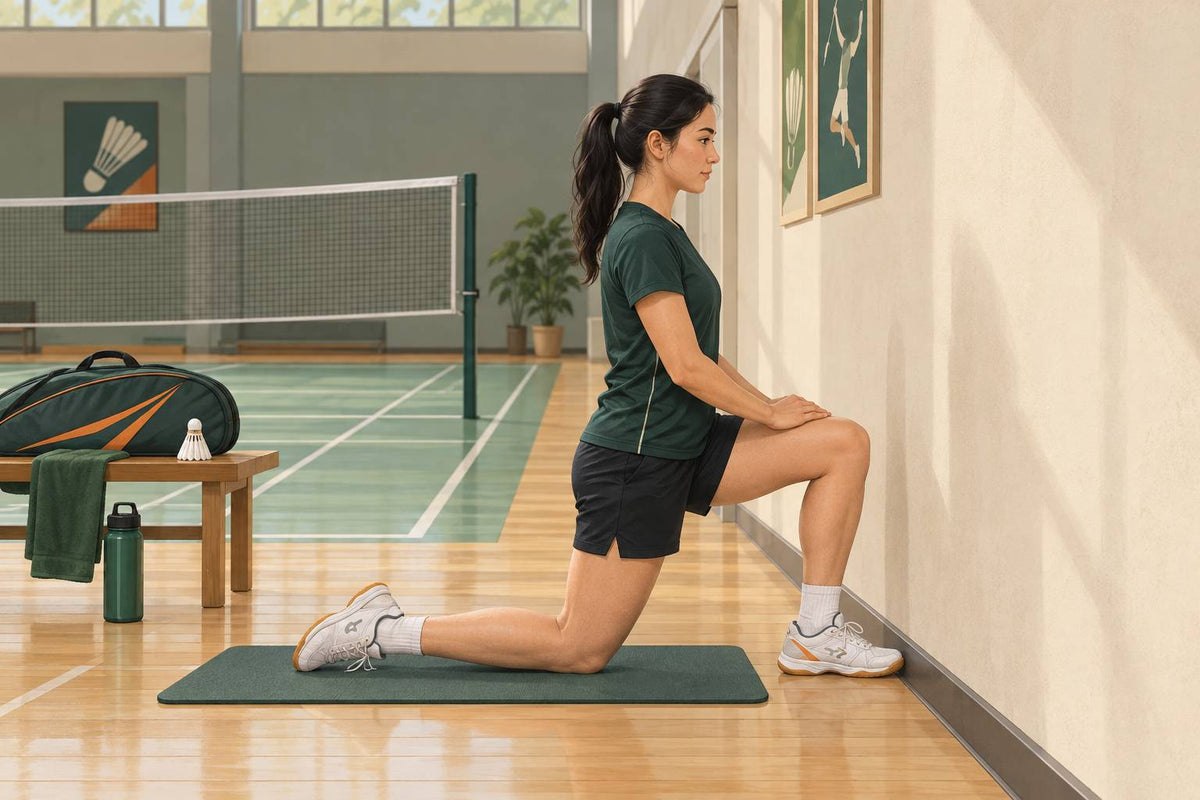
- Active half-kneeling hip-flexor stretch: set the back knee under the hip and the front knee over the heel. Tuck the hips and tailbone, squeeze the back glute, brace the abs, then shift forward slightly until the hip flexor stretches without losing spine position. This builds hip extension you can keep when your rear leg trails in a lunge.
- Contract-relax holds: in that same stretch, gently contract into the floor for a few seconds, then relax and move into the next small range. The contraction helps your nervous system allow range instead of guarding it.
- Cossack squats: shift side to side with one knee bending and the other leg long. Stay controlled rather than collapsing; the drill dynamically stretches and strengthens the hip complex in a pattern that carries over to wide defensive lunges.
How to Schedule Mobility Work Without Replacing Your Warm-Up

Treat this as a weeks-long mobility block, not something you cram in five minutes before a match. Your pre-court routine should raise temperature, wake up footwork, and sharpen reactions; use a separate badminton warm-up for that job. Longer static holds belong away from immediate performance, because static stretching over about 60 seconds per muscle group right before activity can briefly reduce strength and power.
For ankle range, expect useful change over about 3–6 weeks of consistent work. Two to four short sessions per week usually beats one marathon stretching session, especially if you pair end-range holds with controlled strength through the new range. Track the knee-to-wall number monthly so you know the plan is working before you change anything else.
After hard sessions, keep recovery separate from mobility development: use easy breathing, gentle range, and the badminton cool-down stretches guide to bring intensity down without turning it into another training block.
Which Mobility Focus Should You Choose?
Use your test result to pick the smallest useful intervention. Do not add every drill at once; the goal is to remove the limiter that is actually changing your lunge shape.
| What you notice | Choose this focus | Reason |
|---|---|---|
| Heel lifts or knee cannot reach the wall | Ankle dorsiflexion work | Dorsiflexion is directly involved in lowering into a lunge and helps landing cushioning. |
| Knee-straight calf stretch is limited, but knee-bent feels fine | Gastrocnemius-biased calf work | That pattern points to the straight-knee calf muscle needing more attention. |
| Hard pinch at the front of the ankle | Joint mobilization focus | A pinching block suggests the joint needs mobilization, not just calf stretching. |
| You can reach low, but cannot control the position | Hip mobility plus strength | Mobility means actively controlled, usable range, not passive flexibility. |
Get 10% off your first order
Join the Badminton House list and we’ll email you a 10% welcome code — plus training guides, technique advice, and badminton updates.
By subscribing, you agree to receive Badminton House emails and can unsubscribe anytime.
Keep the progression patient: deeper lunges come from repeatable range, strength, and control, not forcing a stretch before games. We play badminton ourselves, so if you want help matching your training goals with court setup, contact us.
Support the range you are building.
Mobility work comes first; badminton footwear is the simple gear check for stable, cushioned lunges on court.
Check Badminton FootwearCheck live availability and choose shoes that fit your foot, floor, and playing style.

Leave a comment
This site is protected by hCaptcha and the hCaptcha Privacy Policy and Terms of Service apply.