
Last updated: July 2026 · Written by the team at Badminton House
Quick Answer: Common Badminton Injuries
The most common badminton injuries are knee injuries (18.7% of all reported injuries), ankle sprains (13.4%), lower-back pain (10.9%), shoulder pain (6.5%), and foot or Achilles problems. Prevention comes down to preparing your body before play, controlling lunge and jump load, and using shoes built for sideways court movement.
Default
Best choice: use a short badminton-specific warm-up before every session, then build volume gradually instead of adding hard matches, jump smashes, and deep lunges all at once. Start with these badminton warm-up exercises.
Footwear
Running shoes and non-specialized footwear often lack the lateral stability and anti-torque support badminton needs, especially for ankle and Achilles protection. Compare badminton shoes if you play regularly.
Get Help
If pain keeps returning, changes your movement, appears after an awkward landing, or includes warning signs like night shoulder pain or Achilles tenderness, see a physiotherapist early.
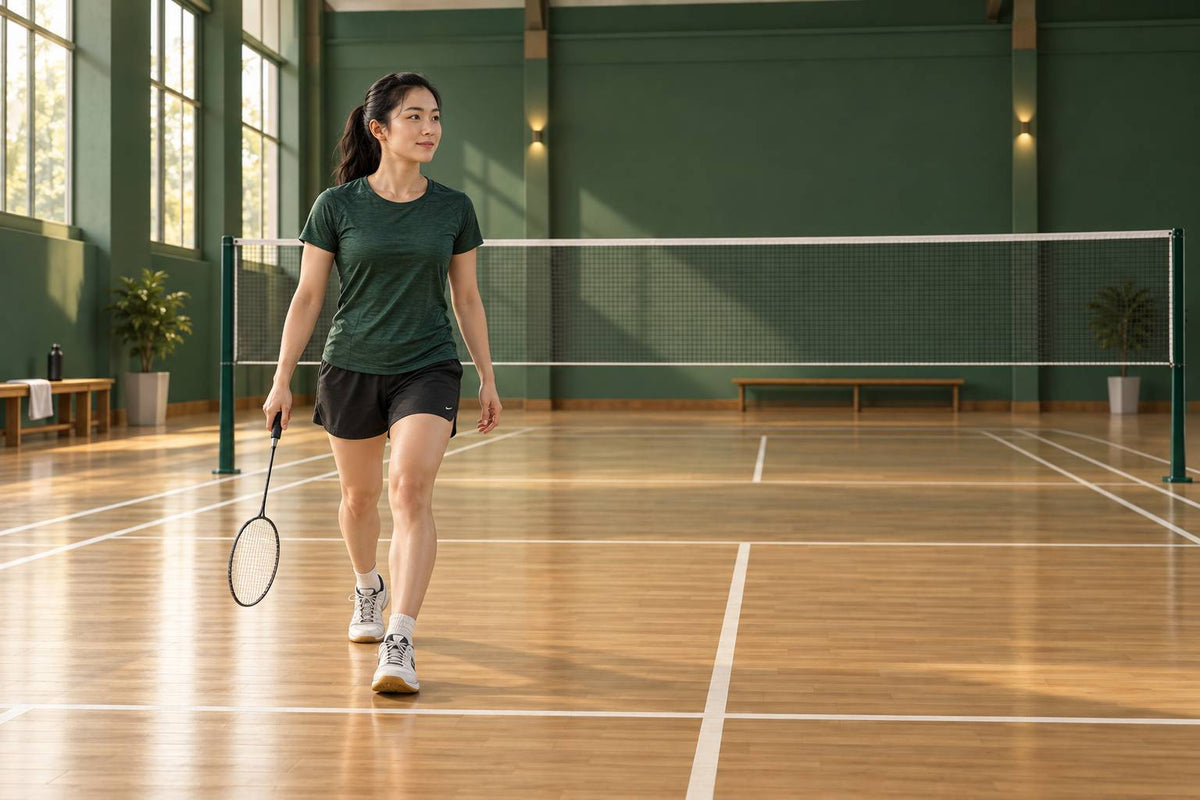
Badminton is quick, repetitive, and harder on the body than it can look from the sidelines. One rally can ask you to split-step, lunge, twist, jump, brake, and reach overhead. Then do it again 20 seconds later. That is why many common badminton injuries show up not from one dramatic collision, but from repeated court movements, tired footwork, or gear that does not support sideways play.
For Canadian club players, league players, juniors, and committed beginners, the big trouble spots are predictable: the knee and ankle lead the list, lower-limb injuries dominate overall, and shoulder or Achilles pain often builds when training load, technique, and recovery get out of balance. This guide explains what to watch for, how these injuries usually happen, and the practical prevention habits that help you keep playing.
Use this as an educational guide, not a diagnosis. If pain is severe, worsening, or not settling with rest and load reduction, pause play and get professional care.
Start with stable court footwear. If you are still playing in running shoes or shoes that feel loose on sideways cuts, browse our badminton shoes for indoor-court options with lateral support. Badminton House ships across Canada.
In This Guide
- Why Do Common Badminton Injuries Happen?
- Ankle Sprains: Landing, Cutting, and Sideways Stability
- Knee Pain: Lunges, Technique, and Overuse Load
- Shoulder Pain: Smashes, Overhead Repetition, and Warning Signs
- Achilles Pain: Fatigue, Rear-Court Push-Offs, and Load Management
- A Simple Prevention Plan: Warm-Up, Footwear, and When to Get Help
- Which Prevention Focus Should You Choose?
Why Do Common Badminton Injuries Happen?
Badminton looks light because the shuttle is light. The body load is not. Every rally asks you to brake, lunge, jump, rotate, recover, and repeat, often on one leg and often while reaching outside a comfortable stance. That is why common badminton injuries are usually less about one dramatic accident and more about repeated high-speed loading.
In a survey of 711 badminton players aged 7–22, 60.3% reported at least one badminton-related injury. Injury location data also points clearly toward the lower body: the knee was the most common injury site at 18.7%, followed by the ankle at 13.4%, lower back at 10.9%, shoulder at 6.5%, and plantar region at 6.1%.
The pattern in one minute
- Knee and ankle lead the list: badminton footwork loads the lower limb on lunges, split steps, side steps, jump landings, and recovery steps.
- Lower-limb injuries dominate: published badminton injury summaries report the lower limb accounting for 58–92.3% of injuries, primarily around the knee and ankle.
- Overuse is the big theme: overuse injuries make up about 74% of badminton injury cases and occur roughly 3× more often than traumatic injuries.
- Lunges matter: repeated lunging is specifically linked with overuse problems such as patellar tendinopathy and Achilles tendinopathy.
That does not mean ankle sprains, slips, and awkward landings are rare. It means the broader prevention plan has to cover both sides: acute control for sudden movements and load management for the repeated stress that builds across sessions, leagues, tournaments, and back-to-back club nights.
Think of this guide as the hub overview. The next sections break the big problem areas into practical patterns: ankle sprains from landing and lateral instability, knee pain from lunges and overuse load, shoulder pain from repeated overhead hitting, and Achilles pain from fatigue and rear-court push-offs. For deeper follow-up, see our focused guides on badminton knee pain prevention, badminton shoes vs running shoes, and badminton warm-up exercises.
The practical takeaway for Canadian players is simple: if you play often, prevention is not just stretching for two minutes before the first rally. It is a combination of progressive warm-up, better landing and lunge mechanics, sensible weekly load, proper indoor court footwear, and getting help early when pain changes how you move.
Ankle Sprains: Landing, Cutting, and Sideways Stability

Among common badminton injuries, ankle sprains are the acute, traumatic one to respect. In youth badminton players, 90.1% of ankle injuries were acute, which fits the way they often happen on court: one bad landing, one sharp change of direction, or one defensive lunge where the ankle rolls before the player can recover.
The classic badminton ankle-sprain pattern is a lateral ankle sprain. A forefoot landing with the ankle plantarflexed and internally rotated can incite this type of sprain, especially when the movement combines sideways and backward steps. In real play, that can show up as an awkward smash-jump landing, changing direction at the net, or lunging wide to defend a fast shot.
- Watch your landing shape: try to land quietly and under control, rather than letting the ankle collapse outward after a jump or split step.
- Train the sideways-and-backward pattern: many risky moments happen when you move diagonally back, then push off or land on the forefoot.
- Do not rush the comeback: previous ankle injury was associated with about 3× higher odds of a later ankle injury, so full rehab matters before you return to hard games.
Footwear is part of the prevention picture. Running shoes and non-specialized shoes can lack the lateral stability and anti-torque protection badminton players need for repeated side cuts, jump landings, and fast net recoveries. If you are still playing in runners, start with our badminton footwear collection, and read the comparison guide on badminton shoes vs running shoes before your next club night.
Knee Pain: Lunges, Technique, and Overuse Load
Knee pain deserves special attention because the knee is the most frequently injured site in badminton for both sexes, with reported injury rates of 18.8% in males and 18.6% in females. For Canadian club players, the usual pattern is often repeated lunges, hard deceleration, and weekly court load adding up, rather than one dramatic moment every time.
The prevention lever is technique. Elevated knee flexion and extension moments, along with higher quadriceps forces and tibial shear forces, suggest that less-skilled athletes may face a higher overuse-injury risk. In plain language: if your lunge mechanics are rough, your knee may be doing more work than it needs to.
- Watch your lunge shape: work on controlled braking, stable knee tracking, and recovering smoothly instead of collapsing into the front leg.
- Manage weekly load: avoid stacking intense matches, jump-heavy drills, and long club nights without recovery.
- Use footwear as support, not a cure: proper badminton shoes can help with court grip and impact handling, but they will not replace better movement mechanics.
Want the deeper knee guide? Read our full knee pain badminton prevention guide for causes, movement fixes, and gear considerations. If pain is persistent, worsening, or affecting daily movement, book a qualified clinician; in most Canadian provinces you can book a physiotherapist directly, though your benefits plan may require a referral for claims.
Shoulder Pain: Smashes, Overhead Repetition, and Warning Signs
Badminton is lower-limb heavy, but the shoulder takes the greatest load in the upper limb. Most overhead strokes place the shoulder in abduction and external rotation, then add very rapid arm motion. That combination creates severe joint load, especially when a player is smashing often, late to the shuttle, or trying to generate power mostly with the arm.
At smash contact, the shoulder can be in full abduction and external rotation. In that position, the rotator cuff tendons can be compressed against the acromion. Repeated smashing may irritate the tendon, progress toward impingement, and eventually contribute to tearing if the problem is ignored.
Early warning signs to take seriously
- A deep shoulder ache during overhead clears, drops, or smashes
- Noticeable weakness when lifting the arm or hitting overhead
- Night pain after play, especially if it keeps returning
Prevention is partly strength and partly technique. Add band-resisted external rotations and scapular stabilization drills to your warm-up or strength routine, and practise driving overhead shots through your legs and core instead of muscling every shot with the shoulder. In cold Canadian gyms, give your shoulder time to warm up before high-speed smashes.
If your symptoms feel more like forearm, elbow, or wrist pain than shoulder pain, read our related guide: Badminton Elbow Pain in Canada: Is Your Racket to Blame?
Achilles Pain: Fatigue, Rear-Court Push-Offs, and Load Management

Achilles injuries in badminton are not just a “bad step” problem. They are usually a mix of load, fatigue, and how you push off or land after rear-court movements. The classic badminton Achilles-rupture profile was a 36-year-old player injured at the rear line during a sudden forward movement, even after limbering up. In a Swedish series of 31 badminton Achilles ruptures, 97% were recreational players or beginners, and 94% happened in the middle or at the end of the planned game, a strong reminder that the risky moment often comes when your legs are tired.
Watch for the slow-building version too. Achilles tendonitis usually comes on gradually, is more common over age 40, worsens with activity, and is tender to touch. In elite badminton, Achilles-region pain has also been linked with higher weekly training loads, so more court time is not automatically better if your tendon is already irritated.
Practical rule: if your Achilles warms up, then hurts more as the match goes on, treat it as a load warning, not something to “run off.”
- Manage volume: avoid sudden jumps in weekly play, especially after a break from badminton.
- Train the support system: include strength, endurance, coordination, balance, and sport-specific warm-up work. For a simple starting point, see our badminton warm-up exercises.
- Fix minor problems early: the Swedish rupture series specifically pointed to treating minor injuries and improving strength, endurance, and coordination as prevention priorities.
- Check your rear-court technique: forehand jump-stroke landings with the foot in a neutral position expose the Achilles to higher loads than scissor-kick jump technique with the leg and foot externally rotated.
- Use court-appropriate footwear: running shoes and non-specialized footwear can lack the lateral stability and anti-torque support badminton demands. If your shoes are worn down or not made for indoor court movement, compare badminton shoes vs running shoes or browse our badminton footwear collection.
A Simple Prevention Plan: Warm-Up, Footwear, and When to Get Help

The simplest injury-prevention plan is not complicated: prepare your body before play, build better movement control over time, wear badminton-appropriate footwear, and get help early when pain changes from normal training soreness into a warning sign.
Start with a badminton-specific warm-up rather than a few casual jogs and arm swings. A dedicated program should gradually raise temperature, then include neuromuscular control, balance, core stability, strength, endurance, coordination, and sport-specific movement habits: split steps, lunges, recovery steps, rear-court push-offs, and controlled landings. For a practical routine you can use before club night, see our badminton warm-up exercises for cold Canadian gyms.
The injury-prevention case for warming up is strong: the badminton-specific PreventiBad warm-up reported an Injury Risk Ratio of 0.30, a 70% reduction versus usual warm-up, in a youth trial. That does not mean a warm-up makes you injury-proof, but it does make structured preparation one of the highest-value habits for players who train, play leagues, or attend multiple drop-ins per week.
Footwear is part of injury prevention. If you are still playing in running shoes, browse our badminton footwear collection before your next season or tournament block.
Badminton shoes matter because the sport is built on short sprints, braking steps, lunges, jumps, and sideways recovery. Running shoes are designed mainly for forward movement; badminton shoes need the lateral stability and court grip needed for repeated cutting and landing.
Footwear spotlight: Babolat Shadow Tour Men’s Badminton Shoes – Orange
Sizes 7–11.5 · Approx. 295 g in size 9
- KPRS-X and Kompressor cushioning: dual-density EVA midsole design built to absorb harsh impact forces during extended matches.
- Power Straps midfoot support: integrated structural support that wraps the foot for aggressive sideways lateral movement and helps prevent twisting.
- Michelin rubber outsole: built for sudden sprints and rapid lateral movements on court.
Ships across Canada.
Finally, know when to pause and ask for help. If pain is sharp, worsening, affecting your normal walking or stairs, waking you at night, or returning every time you play, treat it as more than “just soreness.” This guide is educational only and is not medical advice; a qualified clinician can assess your specific injury, training load, footwear, mobility, and return-to-play plan.
In most Canadian provinces, players can book a physiotherapist directly without a physician referral. Your extended health benefits plan may still require a referral for reimbursement, so check your plan before submitting a claim.
Which Prevention Focus Should You Choose?
Use this decision table to match the most relevant prevention focus to your current badminton pattern. The goal is not to self-diagnose; it is to choose the next practical lever to reduce common badminton injuries before your next club night, league match, or tournament.

| Choose this if... | Prioritize | Why it matters | Next step |
|---|---|---|---|
| You roll your ankle, feel unstable on sideways cuts, or play in running shoes. | Ankle control and lateral-stability footwear | Badminton ankle sprains are commonly linked to awkward landings, direction changes, and forefoot landings with poor control. | Start with badminton shoes vs running shoes, then review the badminton footwear collection. |
| Your knees ache after lunges, long rallies, or higher-volume training weeks. | Lunge technique and gradual load management | The knee is the most frequently reported injury site, and lunge mechanics are a key overuse factor. | Use the deeper knee pain badminton guide before adding more training volume. |
| Overhead shots cause deep shoulder ache, weakness, or night pain. | Shoulder strength, scapular control, and whole-body overhead technique | The shoulder carries the highest upper-limb load in badminton, especially during repeated overhead hitting. | Build band-resisted external rotations and scapular-stability work into warm-ups, and drive overhead shots through the legs and core. |
| Your Achilles feels tender, worsens with activity, or your calf push-off fades late in games. | Fatigue control, tendon load, and rear-court movement quality | Achilles problems are strongly connected to sudden push-offs, fatigue, and higher weekly training loads. | Reduce sharp load spikes, treat minor tendon pain early, and pay attention to rear-court landing technique. |
| You are returning after a break, playing in cold Canadian gyms, or not warming up consistently. | A structured warm-up first | Badminton prevention programs emphasize neuromuscular, balance, core-stability, and sport-specific warm-up work. | Follow 7 badminton warm-up exercises for cold Canadian gyms. |
If your main decision is footwear, the Babolat Shadow Tour Men’s Badminton Shoes – Orange use lateral midfoot support plus impact-absorbing cushioning designed for aggressive sideways badminton movement.
Get 10% off your first order
Join the Badminton House list and we’ll email you a 10% welcome code, plus subscriber-only restock alerts, giveaways, and honest gear advice from players.
By subscribing, you agree to receive Badminton House emails and can unsubscribe anytime.
We play badminton too, so we know how frustrating it is when a sore ankle, knee, shoulder, or Achilles starts changing the way you move on court. If you want help choosing injury-conscious gear or sorting out the footwear side of your setup, contact Badminton House and we’ll help you think through the next practical step.
Build your prevention plan from the ground up.
Browse badminton footwear with the lateral support and court traction players need for quick stops, lunges, and sideways movement.
Shop Badminton ShoesShips across Canada · 14-day returns · Canadian badminton specialty shop

Leave a comment
This site is protected by hCaptcha and the hCaptcha Privacy Policy and Terms of Service apply.