

Last updated: July 2026 · Written by the team at Badminton House
Quick Answer: Badminton Lower Back Pain
If pain is dull, localized, and eases with rest, manage training load; if it matches the red flags below, seek medical care.
Default
Best choice: reduce smash volume, rebuild core control, and clean up trunk rotation before blaming gear.
Red flags
See the red-flag list below — those symptoms need medical care, not self-care.
Smash pain
Pain during overheads often points to repeated lumbar extension and rotation, especially on jump smashes.
Badminton lower back pain usually shows up in a very badminton-specific way: after jump smashes, deep rear-court clears, late round-the-head shots, or long sessions where every recovery step feels a little stiff. Do not just stretch it once and swing harder. In badminton, the lower back sits in the middle of the overhead power chain: footwork, hip turn, trunk rotation, and reach all meet there. When timing gets late or the torso repeatedly arches on smashes and clears, that area can take more load than it should. This guide keeps the focus on practical prevention: recognizing the pain pattern, improving movement habits, and building control so power does not come from borrowing motion from your spine.
In This Guide
Why Badminton Lower Back Pain Happens

Badminton lower back pain is often a kinetic-chain problem, not just a “tight back” problem. In an overhead shot the trunk is the link that carries force from your legs and the floor up into the racket arm. When you hit, weight shifting, upper-limb rotation, and trunk rotation happen together, so the lumbar spine is repeatedly asked to extend, rotate, and transmit force under speed.
That matters most on clears, overheads, and especially jump smashes. In 44 elite Hong Kong badminton players, spine injuries had a 14% incidence, and facet problems ranked second among all injury types; repetitive lumbar extension during overhead or jumping smashes was identified as the likely contributor. Lower back pain is common in this sport rather than unusual: one survey of players aged 6–18 reported that 35.4% had experienced it. Where badminton players do report pain, the lower back is among the most frequently named sites, close behind the shoulder.
Some reassurance first, because most pages skip it. Most ordinary low back pain is not caused by damage and settles over a few weeks. Staying gently active is better for it than resting completely, and scans are usually not needed early on. The section below is about telling ordinary soreness apart from the smaller number of cases that do need looking at — not about assuming the worst.
Normal Soreness vs. Red Flags

After a hard session, normal badminton-related back soreness usually feels dull, local, and muscular. It may be more noticeable when you cool down, then ease when you rest, change position, walk gently, or reduce the next day’s training load.
Be more cautious when pain behaves unlike simple muscle soreness. Facet-type pain can be aggravated by lumbar hyperextension or rotation, which is why repeated arching and twisting on overhead shots may feel sharper than ordinary fatigue.
Get clinical attention if symptoms are severe, worsening, or include radiating leg pain, numbness, weakness, fever/weight loss, bladder, bowel or saddle numbness, follow a fall or other trauma, wake you at night or persist at rest, or occur alongside a history of cancer, osteoporosis or long-term steroid use. For less urgent but persistent pain, use one practical threshold: no improvement after a few days of self-care. In that case, stop guessing and have a qualified clinician assess what is driving the pain.
Prevention: Core Control, Technique, and Recovery Habits

Preventing badminton lower back pain is less about “strong abs” and more about controlling how your trunk moves over your pelvis and legs. Core stability means keeping trunk alignment organized while force travels from the floor, through the lower limbs, and into overhead strokes. When that control is poor, extra motion can leak into the lumbar spine, knees, shoulders, or hips.
- Train the chain: combine trunk-control work with lower-limb strengthening so jumps, lunges, clears, and smashes are not driven by your back alone.
- Keep mobility honest: youth badminton injury literature highlights hamstring flexibility and static balance ability as useful prevention targets.
- Clean up technique: repeated faulty motion can become an injury mechanism, especially if you arch hard through every overhead shot.
For broader injury patterns, see common badminton injuries and prevention. For post-session mobility details, use the badminton cool-down stretches guide.
Where Equipment Fits—and Where It Does Not

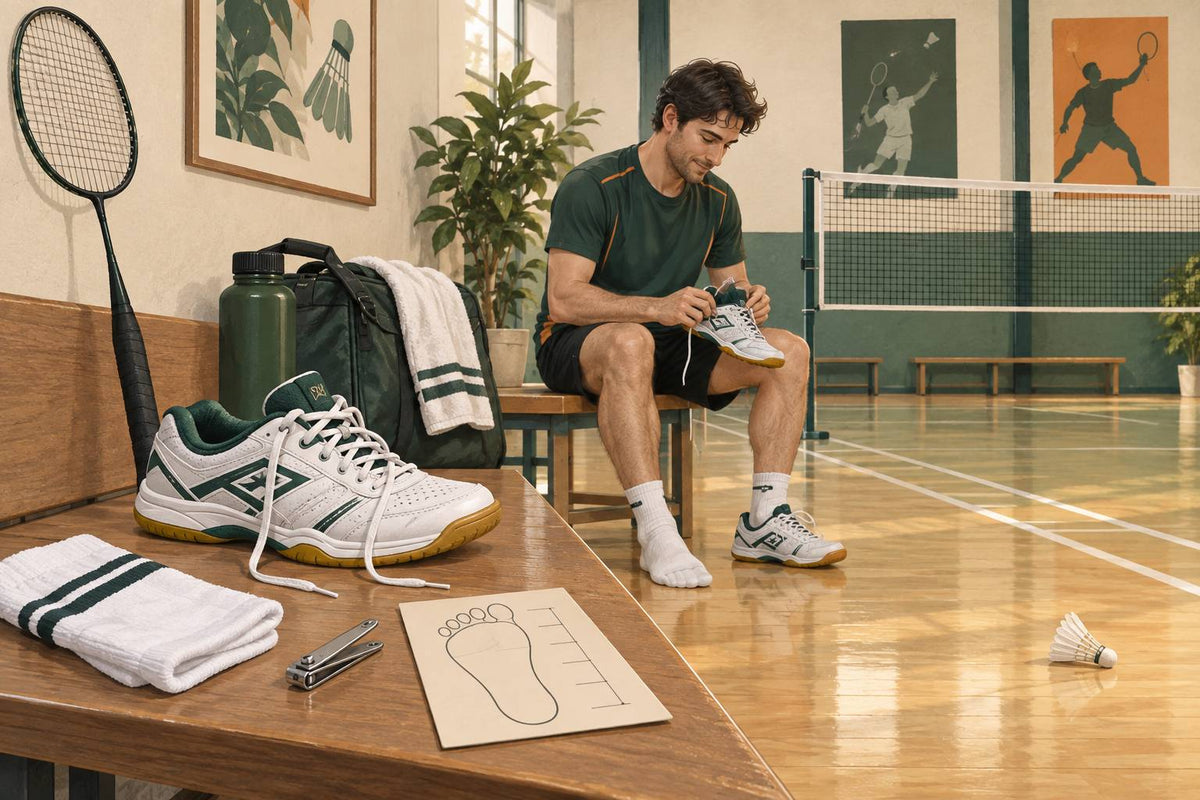
Equipment can support good movement, but it should not be treated as treatment for badminton lower back pain. Stable badminton court footwear helps you plant, brake, and recover with more confidence at the base of your movement pattern, especially compared with soft or unstable shoes that were not designed for indoor court changes of direction. If your shoes are worn down, sliding unpredictably, or letting your foot roll inside the shoe, it is reasonable to check live availability in badminton footwear.
That said, shoes do not correct repeated over-arching on smashes, poor trunk control, skipped recovery, or pain that needs clinical assessment. The main levers stay the same: build trunk endurance, clean up overhead technique, manage training load, and seek medical or physiotherapy advice when symptoms are severe, persistent, radiating, or linked with numbness or weakness.
Which Path Should You Choose?
Use the symptom pattern—not your competitive level—to decide the next step. When in doubt, reduce court load and get assessed.
| Choose this | If your back pain looks like this |
|---|---|
| Short self-care reset | Dull, localized soreness that improves with rest or position changes. |
| Modify smashing load | Pain appears with repeated overhead or jump smashes, where lumbar extension and rotation are highest. |
| Prioritize chain training | Back discomfort shows up with knee or shoulder pain; focus on core control, lower-limb strength, hamstring flexibility, balance, and technique. |
| See a doctor | Any symptom on the red-flag list above is present, or pain has not improved after a few days of self-care. |
| Get urgent care | Bladder, bowel, or saddle numbness, or rapidly worsening leg weakness, appear alongside the back pain—treat this as same-day, not wait-and-see. |
Get 10% off your first order
Join the Badminton House list and we’ll email you a 10% welcome code — plus training guides, technique advice, and badminton updates.
By subscribing, you agree to receive Badminton House emails and can unsubscribe anytime.
We play badminton too, and gear and training load are part of staying pain-free — but we are not clinicians. If any of the red flags above apply to you, see a qualified clinician rather than waiting or asking a gear shop to assess it. For everything else, our team is happy to help with footwear, string tension, and training-load questions.
Questions about footwear or your training setup? We’re happy to help.
Contact Badminton House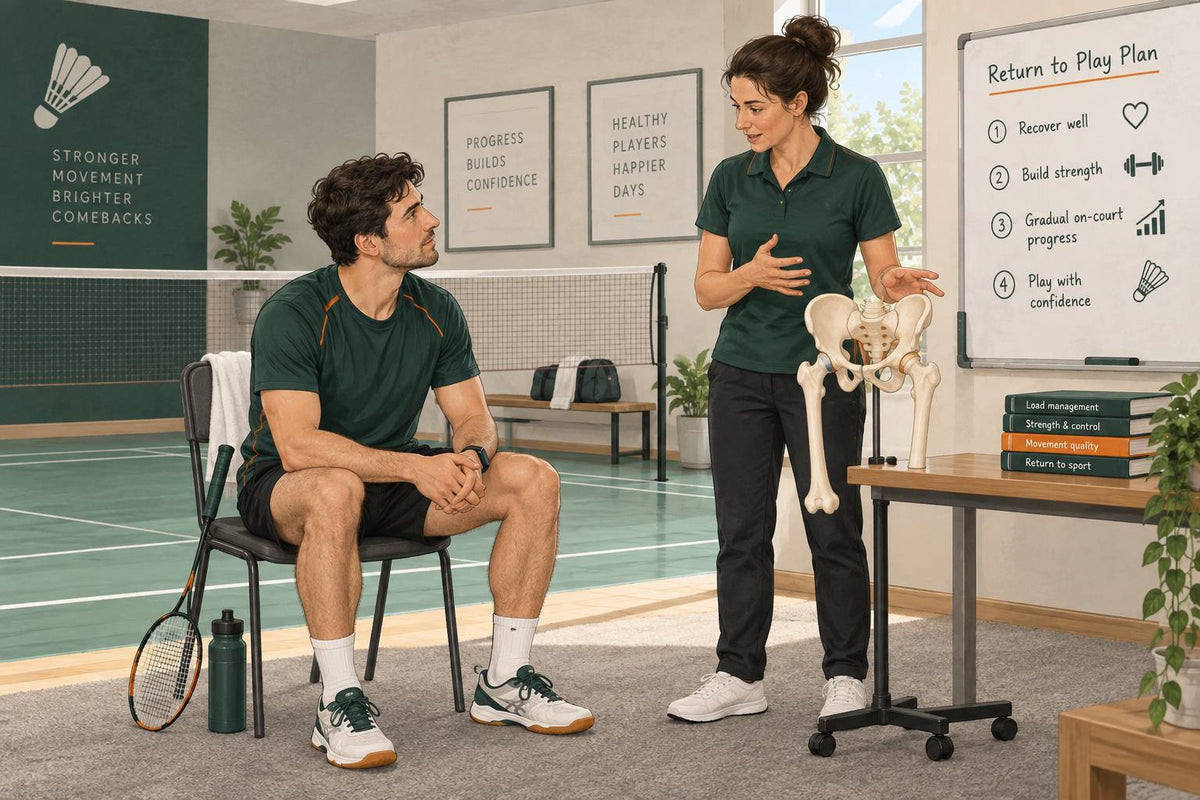

Leave a comment
This site is protected by hCaptcha and the hCaptcha Privacy Policy and Terms of Service apply.