
Last checked: August 2026 · Written by the player-led team at Badminton House
Quick answer
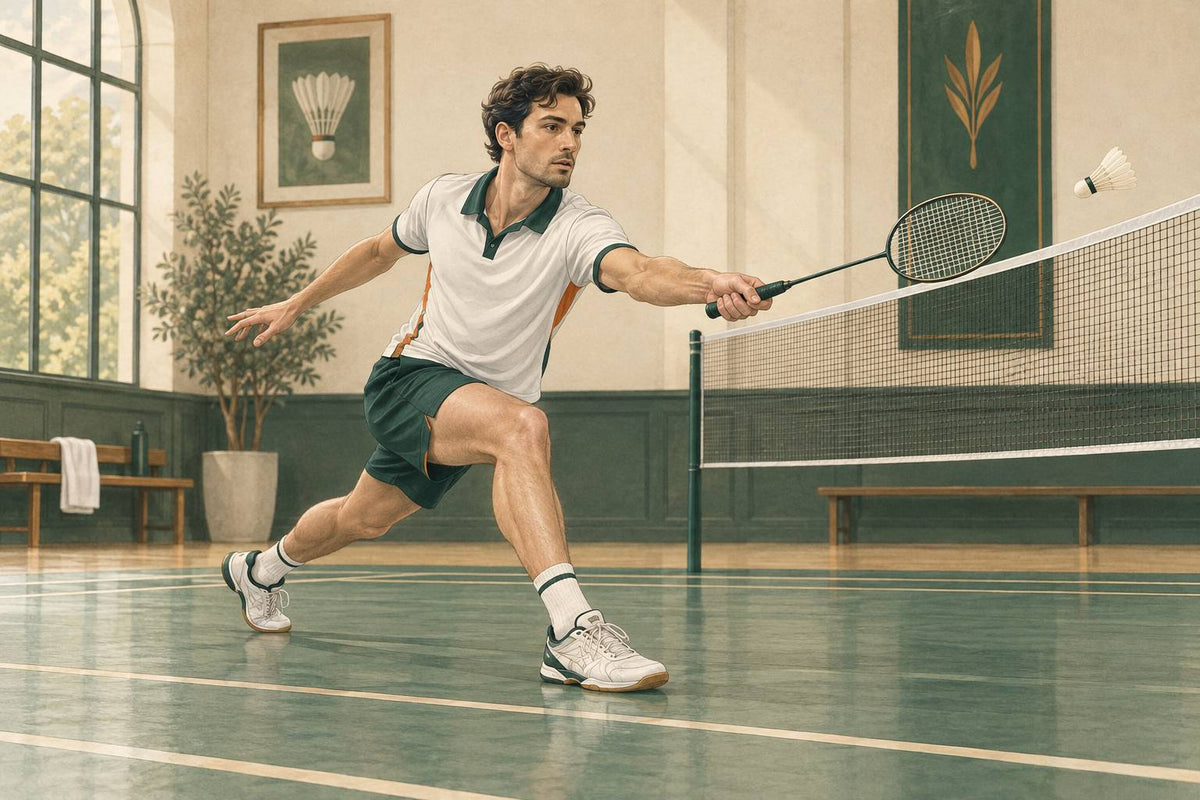
Turn your front foot slightly outward the instant it lands in a lunge, rather than landing straight ahead or turned in. A 2025 badminton biomechanics study found a toe-out landing lowers ankle eversion angle and load, recruits the ankle's main outer stabiliser muscles harder, and shifts stress away from the hindfoot bones toward the front of the foot. Keep the turn moderate (the study tested about 20 degrees) and keep it to the landing itself, not your standing or ready-position stance.
Related reading: This guide covers only the front-foot angle at the moment of landing. For the steps that get you into the lunge, see badminton net approach footwork, and for stopping cleanly once you land, see badminton footwork braking.
Why foot angle changes ankle load
A lunge landing rolls your ankle sideways as it takes your bodyweight, a movement called eversion, and how far it rolls depends partly on which way your front foot points. A 2025 badminton biomechanics study found that toeing the front foot slightly outward on landing measurably lowers that roll and the force driving it.
In a lab test of 30 amateur players landing a standardized forward lunge, researchers compared three front-foot angles: toed in 20 degrees, pointed straight ahead, and toed out 20 degrees. Ankle eversion angle was highest with the foot toed in, lower straight ahead, and lowest toed out, and the eversion moment (the twisting load the ankle resists) fell by about 13 percent from the straight-ahead landing to the toe-out one. Toeing out also worked the peroneus muscles on the outside of the lower leg harder, the ones that brace against further rolling, while toeing in produced extra shin-muscle activity the researchers read as compensation for reduced stability.
A separate stress model of the same landings found the foot angle does not just change how much load the ankle carries. It changes where the load goes. Turning the foot from toed-in toward toed-out steadily moved bone stress away from the heel and midfoot and toward the ball of the foot, and the toe-out landing carried the smallest overall joint load through the whole motion. A habitually toe-in or straight-ahead lunge keeps loading the same vulnerable hindfoot bones, landing after landing, all season.
How much to turn out, and when
Aim for a moderate outward turn on the landing foot only, a small turn away from straight ahead rather than a wide outward angle. The study's own recommendation was for a moderate turn, and the angle it actually tested and got results from was about 20 degrees, not a wide duck-footed stance.
This is a landing shape, not a stance you hold between shots. The research measured the foot only at the moment it plants during a forward lunge, never during standing rallies or the split step. Carrying a fixed toe-out turn into your ready position works against you too: a foot already rotated outward gives your push-off less to drive straight back through and slows the recovery step out of the corner. Save the turn for the instant of landing, then let it reset.
This detail matters more than it looks. A scoping review of badminton lunge research found the lunge itself accounts for more than 15 percent of total game time, and its authors argue that cleaning up lunge mechanics is one of the more direct ways to cut injury risk in the sport. A foot-angle habit you repeat that often on every court session is worth five minutes of deliberate attention.

Check your own lunge in one video
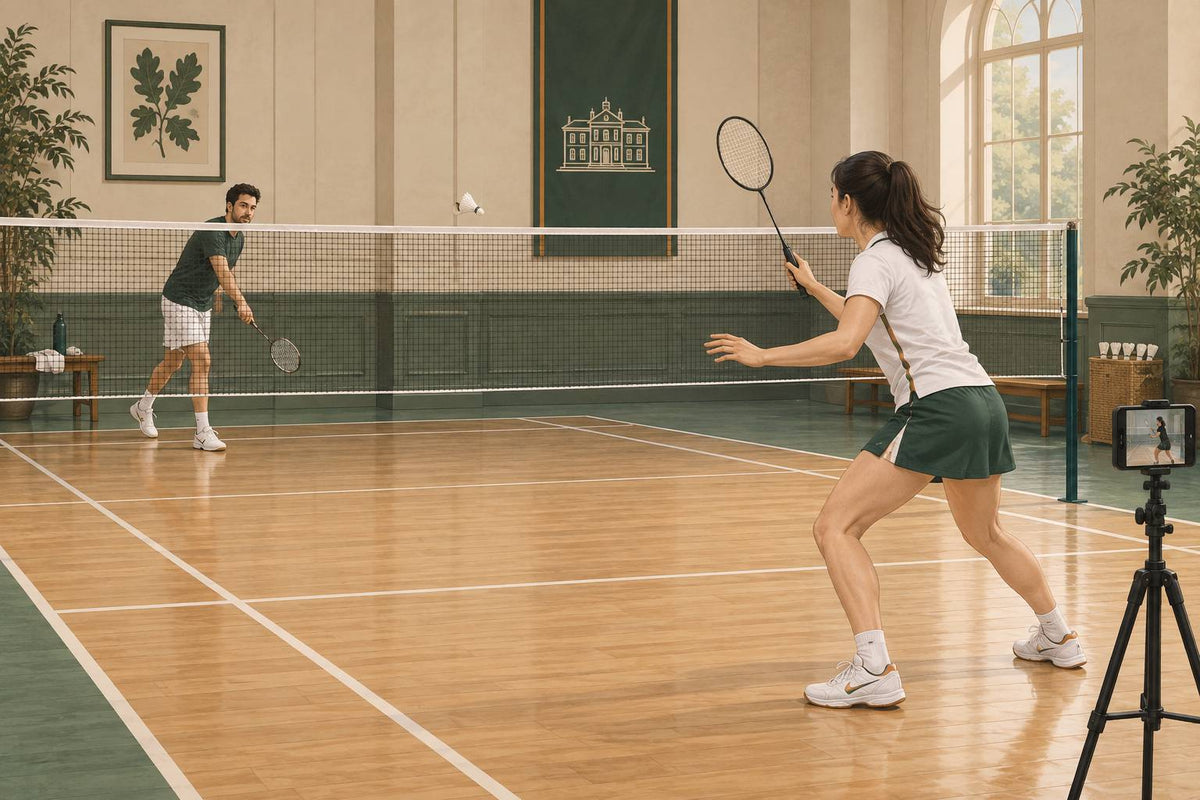
Film one net lunge from directly in front of you, on your phone at normal speed, and you can see your own foot angle without any equipment. Watch the moment the front foot touches down and compare both sides of your movement.
Have a partner feed you a short net shot and hold the phone waist-high, facing you, far enough back to catch the whole lunge. Play it back frame by frame around contact and check two things: where the toe points the instant it touches the floor, and whether the ankle visibly rolls or wobbles outward right after landing. Repeat for a backhand-side lunge and a forehand-side one, since a player's weaker or less-trained side often lands differently from the stronger side without them noticing on court.
If the toe lands pointed straight ahead or turned inward and the ankle wobbles on contact, that is the exact pattern the research associates with higher eversion load. Practice a handful of feeds where you consciously land with the foot turned slightly out, then film again. Most players can feel and see the difference within one short session.
What changes on a slippery floor or worn shoes
A toe-out landing needs grip to work as intended, so a slick floor or a worn-out shoe sole changes the calculation. The same research that found toe-out reduces sideways ankle load also found it raises a different kind of load in the first instant of contact, and that trade-off only shows up when the foot can actually grip the floor.
In the earliest fraction of the landing, before the ankle finishes rolling, the toe-out position produced the greatest front-to-back shear force at the ankle of the three angles tested, while the toe-in position produced the least. On a court with good traction that shear is absorbed quickly through a braced ankle and a stable foot. On a slippery floor or a shoe with a worn, smoothed-out outsole, that same shear has more room to turn into a slide, and a foot that slides while turned outward can roll just as badly as one that lands straight. If the floor feels slick or your shoes are visibly worn smooth underfoot, shorten your lunge and land with a more controlled, slightly less committed step rather than trusting the full toe-out reach.

Leave a comment
This site is protected by hCaptcha and the hCaptcha Privacy Policy and Terms of Service apply.