
Last checked: August 2026 · Written by the player-led team at Badminton House
Quick answer
Disguise a low-serve return by holding one preparation for push, net kill and lift, taking the shuttle as early and as high as you can reach it, changing the racket face only in the last instant, and loading your feet the same way no matter which reply you choose.
Related reading: for stance, racket height and which reply to choose against which serve, start with our badminton doubles return of serve guide. For the general principle behind hiding any shot, see badminton deception technique. This guide is the finishing move: once you have decided to attack a low serve, here is how to hide which attack it is.
Why the Return of Serve Rewards Disguise
The return of serve is decided faster than almost any other moment in badminton, so any preparation cue you leak gets read and punished before your racket has finished moving. Disguising push, net kill and lift is not a flourish. It buys the fraction of a second that decides whether your side attacks first or scrambles to defend.
A frame-by-frame study of return-of-serve footage found skilled players started their return response in a median of 184 milliseconds, against 322 milliseconds for less-skilled players, and picked the right reply far more often (a median of 9 correct calls out of 10, against 6 out of 10) — evidence of just how much skill level changes the speed and accuracy of reading a low serve. Separate badminton anticipation research using pre-contact video occlusion found that expert players extract usable information from an opponent's racket and body motion as early as 40 milliseconds before contact: their prediction-accuracy edge over novices was concentrated in that pre-contact window and closed once the shuttle had already been struck, while experts reacted faster than novices at every stage tested. Most of the useful reading happens before contact, not after.
In doubles-heavy club play, the serve return is the most repeated shot of the night. Every server you face gets several looks at your return in the same match, and a predictable tell gets clocked and punished within a handful of points. The three disguises below (a held preparation, a late racket-face change and neutral footwork) work together: master any one alone and the other two still give you away.
Hold One Preparation for Push, Kill and Lift
Build one crouch, one racket-up position and one backswing size that starts every low-serve return, whether it ends as a push, a net kill or a lift. If a server can tell your reply from your setup before you have swung, the disguise has already failed, no matter how good the shot itself is.
Coaching guidance on disguised forecourt shots describes exactly this approach for a lift: the preparation "should look the same as a net shot," and you hold that posture as long as you can before committing. The same logic applies in reverse for a kill, since the server is watching for the moment your shape breaks toward "aggressive" rather than "safe." If both possibilities stay live from the same starting picture, the server cannot commit early to either.
Reach the shuttle as early and as high as you can. The same coaching source describes taking contact "at the highest possible point," letting the elbow and hand drop while the racket head stays up, so the swing shape looks identical right up until the last fraction of a second. A high, early contact point also keeps all three replies mechanically available: from below net height a downward kill is unavailable, although a net reply or lift may still work, but from above it, push, kill and lift are all still on the table.
Practice progression
- Shadow the crouch and racket-up position with no shuttle until it feels identical every time, regardless of which reply you are imagining.
- Add a live server feeding only tight low serves. Call your reply out loud only after the shuttle has left your strings, never before.
- If you keep calling the reply early, you are deciding (and therefore preparing differently) too soon. Slow the drill down until the call genuinely comes last.
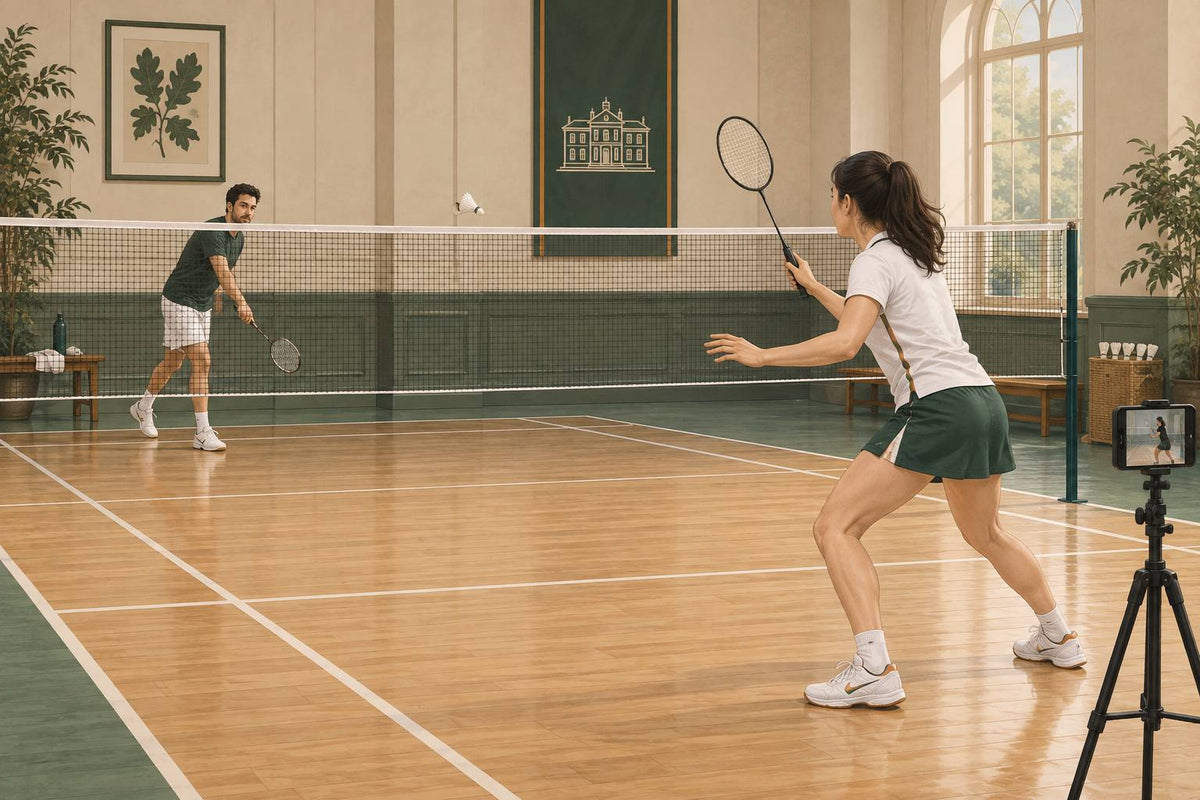
Phone-camera check: prop a phone at net height and film ten returns, mixing push, kill and lift at random. Freeze the frame one moment before contact for each one. If a stranger could sort your ten freeze-frames into push, kill and lift without seeing the outcome, your preparation is not disguised yet.
Delay the Racket-Face Change to the Last Instant
Keep your grip loose through the crouch and the early swing. Let the racket face rotate to its final angle only in the last fraction of a second before contact. A face that opens or closes early is the clearest single tell in a disguised return, because it announces the shot before the shuttle has arrived.
A tight grip locks the face early and makes any late change look abrupt and visible. The same forecourt-deception coaching source describes the late change as dropping and rotating the arm "at the last moment," which only works from a relaxed starting grip; a wrist that is already braced for one specific shot has nowhere left to travel. If your grip pressure is already spoken for by contact minus 100 milliseconds, so is your shot.
The same principle explains why a disguised lift should be flat rather than looping. The same source notes that a flat lift needs less power and "deprives your opponent of time," while a high, slow lift gives them time to recover and see the racket face change along the way. A flat, late-committed lift looks like a push for longer, and by the time it is obviously a lift, the server has less time left to react to it.
Practice progression
- Shadow-swing in slow motion, holding the racket face neutral for as long as you can before rotating it to push, kill or lift angle.
- Add a live server. Keep the grip deliberately loose through the crouch, and only tighten your fingers in the final inches before contact.
- Once the timing feels natural, mix all three replies against random low serves and check that your hand, not your setup, is choosing the shot.
Phone-camera check: film ten returns from the side, slow the playback down, and count how many video frames pass between "racket face still neutral" and "racket face clearly committed." If that gap is only a frame or two on your best reps but several frames longer on others, the longer ones are the reps giving you away.

Keep Your Feet Neutral So They Don't Tell the Story
Load your weight the same way before every reply, so a server watching only your legs cannot guess push, kill or lift before you swing. Footwork is a slower, bigger movement than a wrist or racket-face change, which makes it a far easier tell to spot and a far easier one to fix.
Coaching on front-court anticipation advises players to study "an opponent's footwork, body movement and position on court while they play certain shots," and notes that stronger players are harder to read precisely because they "do not give much away in terms of body language." That is the gap between club-level and advanced disguise: the shot mechanics can be identical, but the legs settle differently, and an attentive server learns your pattern within a set.
Mechanically, the temptation is real: driving through a kill wants forward weight, and generating lift power from a compact swing wants a settled, slightly lower base. The fix is not eliminating those mechanics. Load into the same base before you know which reply you will play, and let the upper body do the differentiating work once the decision comes late. Practice noticing where your weight sits a half-second before contact, not just at contact.
Practice progression
- Have a partner stand where the server would, watching only your feet and hips and never the shuttle. They guess your reply before you hit it.
- Add a live server feeding random low serves. If your partner's guesses stay above chance, your footwork is still telegraphing.
- Retest weekly. Footwork habits fade slower than hand habits, so expect this to take longer to fix than the other two disguises.
Phone-camera check: film from behind and above if you can, so the frame shows your feet clearly. Watch five push returns and five lift returns back to back with the sound off and the top of the frame cropped out. If you can still tell them apart from footwork alone, that is exactly what the server across the net is doing.
| Disguise | Stays identical | Changes last | Camera check |
|---|---|---|---|
| Held preparation | Crouch, racket height, backswing size | Which reply the swing becomes | Freeze-frame one moment before contact across ten returns |
| Late racket-face change | Grip pressure and forearm position | The face angle, in the final frames | Slow playback and count frames before the face commits |
| Neutral footwork | Weight distribution front-to-back | Nothing visible; the legs should not change | Watch feet only, sound off, guess push vs. lift |
Put the disguise to work this week
- Film ten returns against a live server, mixing push, kill and lift at random.
- Score yourself on all three camera checks: freeze-frame, face-change frame count, and feet-only guessing.
- Fix the disguise that failed first before adding speed or match pressure back in.
- Re-film in two weeks. Footwork habits take the longest to change, so judge that one on a longer timeline than the other two.

Leave a comment
This site is protected by hCaptcha and the hCaptcha Privacy Policy and Terms of Service apply.