

Last checked: August 2026 · Written by the player-led team at Badminton House
Quick answer
The Level 1 manual defines a base as fluid rather than a fixed court point for dealing with probable replies. Level 2 gives two rear-court recovery examples, not a universal step-in, hold, or retreat rule: a split-step after a dropshot or smash, and a committed forward movement when the opponent is under pressure and likely to give a weak net reply.
Start with reading the opponent’s probable reply
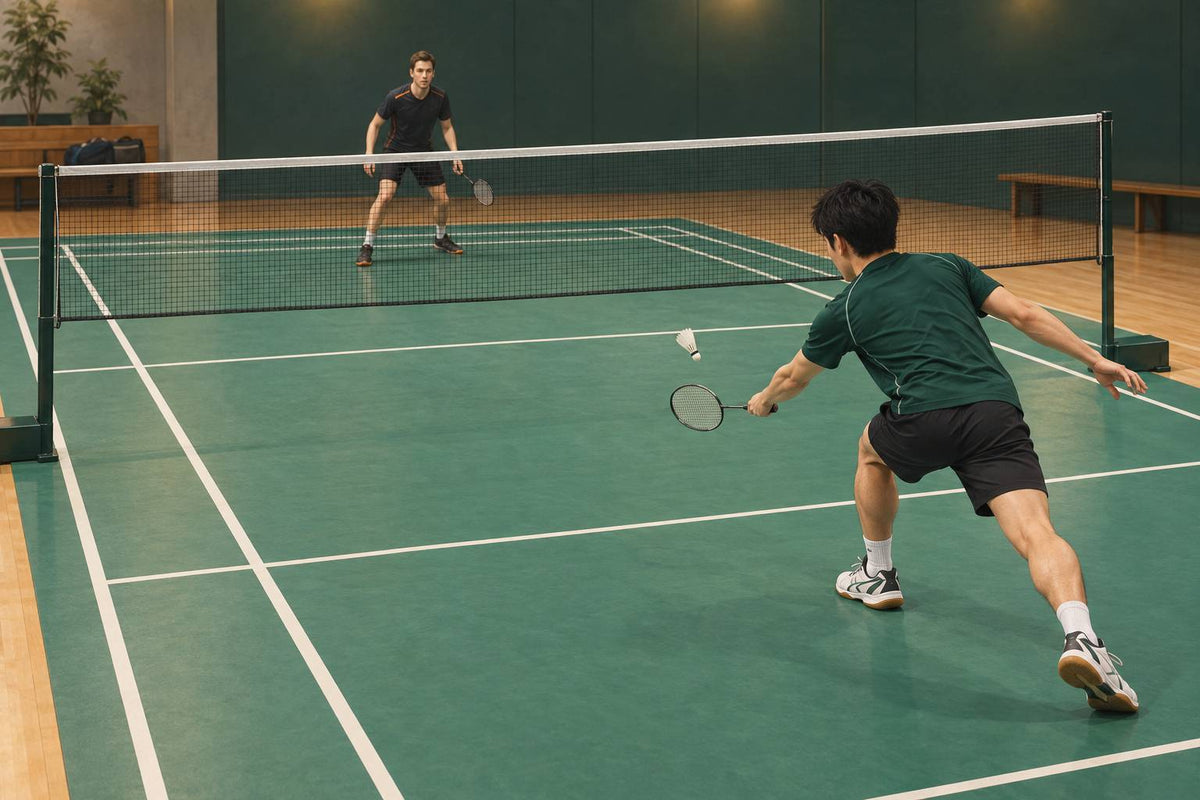
Local practice choice: use one observable opponent-contact cue to discuss the next recovery. The labels pressured, uncertain, and quick reply are a shared language for a practice conversation; they are not BWF categories or permanent court positions.
- Name one contact cue before choosing a recovery option.
- Use the rear-court split-step and committed forward examples only in their cited contexts.
- For an uncertain contact, use a local balanced hold rather than treating it as a BWF category.
- Keep step in, hold, and retreat as local outcome labels, not prescribed responses.
Related reading: Badminton Defense Ready Position Guide — for the defensive ready position before an opponent attacks.
Read the opponent’s probable reply
The Level 1 manual defines the base position as the court position from which a player is best able to deal with an opponent’s probable replies, and says the base is fluid rather than a set point on the court. BWF Level 1 Manual

The same page says the base is where the player performs a split-step timed with the opponent striking the shuttle. It is therefore a moving readiness position at opponent contact, not a painted coordinate to occupy after every shot. The cited page gives no universal midcourt coordinate. BWF Level 1 Manual
Choose step in, hold, or retreat
Level 1 treats tactical awareness as information about space; the player’s position and balance; what an opponent is good at and trying to do; pace; and, in doubles, partner information. Level 2 defines recovery as travel that anticipates the opponent’s reply. Neither cited passage creates a three-state recovery rule. BWF Level 1 Manual and BWF Level 2 Manual

Local practice labels: In a local cue-and-choice activity, “step in”, “hold”, and “retreat” can name outcomes a player noticed after the rally. They are not BWF categories, permanent formations, or prescribed responses to “pressured”, “uncertain”, or “quick-looking” contacts.
Local interpretation of the inputs: Treat those inputs as a court picture, not a checklist that predicts the next shot. In doubles, use partner information only when it changes which space a player can leave open; otherwise keep the note with the opponent’s contact and the player’s recovery.
Keep the recovery decision conditional
Level 2’s rear-court table gives examples rather than a universal answer: a kick-through and split-step after a dropshot or smash, and a committed kick-through, running step and hop when the opponent is under pressure and likely to play a weak return to the net. BWF Level 2 Manual

The first option is linked to a short in-air period before the opponent’s reply, so the immediate split-step can be timed with that hit and help a change of direction. The forward option is committed and can be difficult to reverse if the shuttle is lifted over the player’s head. That source-specific trade-off is more useful than treating every forward move as a generic “step in” label.
Use one local cue-and-choice note
Local practice choice: after a controlled rally, note the shot just played, one observable feature of the opponent’s contact, and the recovery option that followed. For example, record that the opponent was reaching, then note whether the player held, stepped in, or retreated. The note does not rank a contact as universally good or bad.
Keep the next question equally specific: did that option still leave time to cover the anticipated reply? In doubles, add partner coverage only when it materially changes the picture. This produces a comparison of rally cues rather than a search for one fixed midcourt location.
Questions the cited sources do not settle
- A universal three-state taxonomy or fixed midcourt coordinates for singles and doubles.
- A guarantee that stepping in, holding, or retreating will win the next rally.
What to do next
After a few rallies, compare the opponent-contact cue you saw with the recovery choice you made before adding pace.


Leave a comment
This site is protected by hCaptcha and the hCaptcha Privacy Policy and Terms of Service apply.