
Last checked: August 2026 · Written by the player-led team at Badminton House
Quick answer
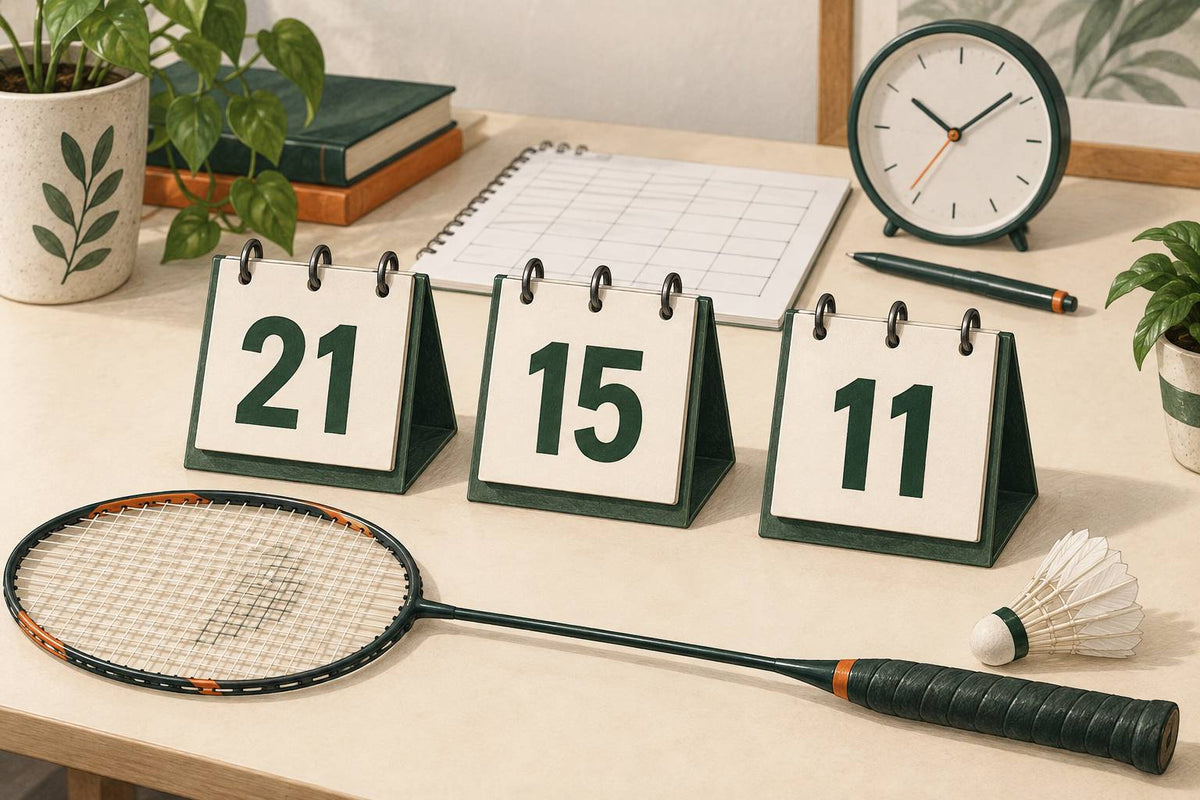
By prior agreement, three alternative scoring formats are sanctioned: a single game to 21, a best-of-three to 15, and a best-of-five to 11 with no deuce at all. The right one depends on how the court time is actually booked.
- One dedicated hour, one match: play the single game to 21.
- A club night with pairs rotating through: play the best-of-three to 15.
- A squad session that wants many short matches: play the best-of-five to 11.
Assumes you know 21-point scoring: this guide compares only the three alternative targets, all permitted because the standard match is best of three games to 21 points "unless otherwise arranged". For serving, faults and the full standard system, see our badminton rules and scoring guide.
The Three Sanctioned Alternative Formats
By prior agreement, BWF's Alternative Laws of Badminton permit exactly three alternatives to a standard match: one game to 21 points, a best-of-three to 15, or a best-of-five to 11. Each replaces a different piece of the standard game, the scoring target, the number of games, or both, while keeping rally-point scoring and normal service.
| Format | Games | How a game is won | Change of ends | Breaks |
|---|---|---|---|---|
| Single game to 21 | 1 | First to 21, win by 2 from 20-all, capped at 30 | Once, when a side first reaches 11 | One 60-second break, at 11 points leading |
| Best of 3 to 15 | Up to 3 | First to 15, win by 2 from 14-all, the 21st point wins from 20-all | Between games, and mid-game 3 at 8 points | 60 seconds per game at 8 points leading; 120 seconds between games |
| Best of 5 to 11 | Up to 5 | First to 11 wins outright. No deuce, no cap | Between games, and mid-game 5 at 6 points | One 60-second break, in game 5 at 6 points; up to four 120-second breaks between games |
The 11-point format is the outlier worth noticing: it drops the two-point-lead rule entirely, so a game can never run past 11 points either way. For the full legal picture behind all three, including why only these are sanctioned and how a club's own single game to 11 or 15 differs from every one of them, see our guide to badminton scoring formats to 11 and 15.
Match the Format to Your Court Time
Court bookings come in fixed blocks, so choose a format that fits your group’s usual match lengths and leave time for changeovers; a point cap does not guarantee a duration. A single continuous match suits one dedicated hour, while a hard per-game cap suits a night where several pairs share one court and need predictable handoffs.
| Session | Best-fit format | Why |
|---|---|---|
| One 60-minute court, four players, one doubles match | Single game to 21 | The whole slot goes to one continuous game. Only the change-of-ends score moves, so nothing else needs planning |
| 90-minute club night, pairs rotating on and off | Best of 3 to 15 | Every game is hard-capped at 21 points, so the match ends inside three short games and the next pair has a predictable point to step on |
| One-day internal tournament, many pairs to get through | Best of 3 to 15 | The same bounded cap protects the day's schedule across many matches, while three games still gives the better side room to show it |
| Squad session: more short matches beat fewer long ones | Best of 5 to 11 | No deuce means no single game can run long, and up to five short games gives every player more turns on court |
A losing side gets a reset only where there is a next game to play. That is nothing in the single-game format, up to two more chances in the 15-point format, and up to four more in the 11-point format, which is the real trade-off behind every row of that table.
How the Shorter Formats Change How You Play
A fixed early deficit costs more in the 15- and 11-point games than in a 21-point game, so the shorter targets leave less room to recover from a cold start. The 11-point format goes furthest: its rules carry no deuce clause at all, so the side that reaches 11 first wins the game outright, whatever the other side's score.
That changes how the closing points feel compared with the other two formats. In the 15- and 21-point games, a side that claws back to a near-tie can still force a two-point-lead battle at the top of the game. In the 11-point format there is no such cushion: the moment either side's score hits 11, the game is over, so grabbing the lead late matters more than fighting back to level.
The 11-point format also carries the most structured breaks of the three. Its only in-game interval comes once, in the fifth game at 6 points, but the rules allow up to four separate 120-second breaks between games, after the first, second, third and fourth, more than either of the other two formats provide. In a squad session, that means up to four chances between games for a coach to reset a player, instead of one 60-second interval inside a single long game.
None of this changes who has to serve or how a let is called. Our badminton rules and scoring guide covers those mechanics once, and every point above builds on the same rally-point system, just cut to a shorter or longer target.
Before you book the court
Match the format to the slot, not the other way round: one continuous game for a single dedicated hour, the 15-point best-of-three for a night where pairs rotate through, and the 11-point best-of-five when the goal is more short matches for more players.

Leave a comment
This site is protected by hCaptcha and the hCaptcha Privacy Policy and Terms of Service apply.