

Last checked: August 2026 · Written by the player-led team at Badminton House
Quick answer: diagnose indoor shuttle drift
Test two sound shuttles with two players, then repeat from the other end. Drift that stays with the hall points first to airflow; drift that stays with one shuttle points to its condition; drift that follows one player points first to contact.
Hall
Same direction: both players and both shuttles bend toward the same part of the building.
Shuttle
Only one shuttle bends, no matter who hits it or which end you use.
Contact
Both shuttles bend only from one player’s racket while the partner’s straight shots stay straight.
One strange flight proves very little. A late contact, a worn feather, an open door, or an inconsistent feed can all appear as “the shuttle moved sideways.” The useful response is to change one variable at a time and look for a repeatable pattern. This guide keeps the test indoors and deliberately separates a practical club diagnosis from an official match decision.
Different job, different guide: for the engineering and elite-event standard behind still air, read why elite badminton controls air conditioning. This page gives club players a short isolation test.
How do you run the two-player, two-shuttle check?
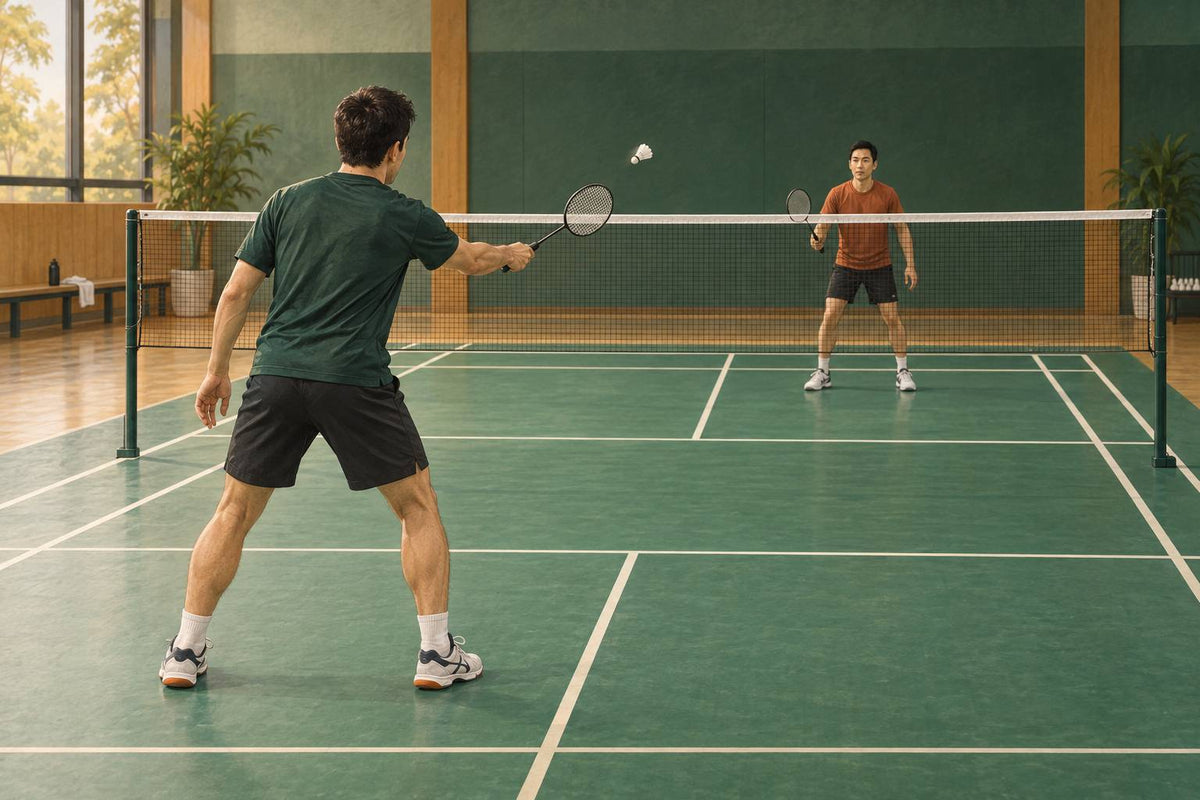
Use a quiet five-minute block before diagnosing anything. Choose two shuttles that look round and even, mark them A and B, and use one straight corridor near a side line. Each player sends several comfortable underhand clears or lifts with Shuttle A, then repeats with Shuttle B. Switch court ends and repeat at the same easy effort.
- Keep the first feed simple. Aim upward and straight rather than trying to hit a line or produce maximum length.
- Change only the player. If both players see the same bend with Shuttle A, the pattern does not yet point to one person’s technique.
- Change only the shuttle. Compare A with B while the same player, end, and corridor remain in use.
- Change the court end. Note whether the curve still points toward the same wall, door, or vent, rather than simply toward the player’s forehand or backhand side.
Write the result as a pattern, not a verdict: “A and B moved toward the entrance for both players,” or “only A bent left from both ends.” If flights alternate unpredictably, the test is inconclusive. Try again with calmer feeds instead of inventing a cause.
Do not confuse this with the official speed test
BWF Law 3 uses a full underhand stroke parallel to the side lines and a landing band 530–990 mm short of the opposite back boundary. That procedure checks overall shuttle pace. It does not provide a published test for sideways drift. Use our shuttle-speed test guide when length, rather than lateral movement, is the problem.
When does the pattern point to hall airflow?
Airflow becomes the leading practical hypothesis when both players and both shuttles repeatedly move toward the same part of the building, including after the players change ends. Check for an open exterior door, a strong supply grille, a fan, or air moving across the court. Ask venue staff before changing building equipment yourself.
The sensitivity is not imagined. Computational shuttle-aerodynamics research describes the shuttle as a high-drag projectile, with its feathers and skirt gaps contributing strongly to that drag. BWF's international-facility specification calls for a draught-free field of play and uses no more than 0.2 m/s in its instrumented international-facility measurement procedure.
That number is not a recreational-hall pass/fail rule. The international-facility procedure uses specialist equipment at multiple heights and locations. At club level, use the repeatable flight pattern to start a conversation: close an obvious door if staff approve, choose a less exposed court, or accept that both sides must play the same conditions. Do not declare every affected rally a let. In organised play, the official or local competition conditions decide what happens.
When does the pattern point to one shuttle?
Suspect the shuttle first when A bends for both players from both ends while B stays acceptably straight. Put A beside B without squeezing or bending the skirt. Look for a loose or missing feather, an uneven tip circle, visible deformation, or a base and skirt that no longer sit squarely together.
BWF Laws 2.2 specify 16 feathers of uniform length, firmly fastened in the base. Published turnover and impact testing also found that the higher-grade feather shuttle in the experiment resisted deformation better and reached steady flight sooner than the lower-grade practice shuttle. That does not identify the cause of every bad flight; it does justify comparing with a sound shuttle before changing your stroke.
Remove a visibly compromised shuttle from the diagnostic set. Do not trim, bend, glue, steam, or otherwise “correct” it. For a detailed condition check, use our loose-feather shuttle guide. During an officiated match, a shuttle change must be fair and the umpire decides whether it happens under the BWF Instructions to Technical Officials.
When should you check the player’s contact?
Contact becomes the first coaching check when both shuttles bend mainly from one player’s racket, the partner can send those same shuttles straight, and the pattern stays with the player after changing ends. Film from behind at an easy pace. The useful frame is the instant of contact: was the intended straight shot met squarely, or did the racket travel across the cork?

Do not rebuild the whole overhead action from this test. Start with short, balanced feeds and one cue: send the cork through the chosen corridor. If slow shots stay straight but faster shots bend, increase pace only until the first repeatable change appears. That gives you a useful technique boundary without claiming that every curve is an accidental slice.
| Pattern | First action | Do not conclude |
|---|---|---|
| Both players, both shuttles, same building direction | Check doors, vents, fans, and another court | That the shuttle model or one player is defective |
| One shuttle, both players and ends | Compare the skirt with a sound shuttle and retire it from the test | A precise glue, feather, or storage failure from appearance alone |
| One player, both shuttles and ends | Film easy straight contacts and increase pace gradually | That the entire stroke must be rebuilt |
| No repeatable pattern | Stop testing and repeat another day | Anything from one or two unusual flights |
If the player pattern is clear, continue with our accidental-slice diagnosis and correction. If it is not clear, keep the conclusion honest: the result is mixed. A good diagnostic narrows the next question; it does not force an answer.

Leave a comment
This site is protected by hCaptcha and the hCaptcha Privacy Policy and Terms of Service apply.