
Last updated: July 2026 · Written by the team at Badminton House
Quick Answer: Badminton Drop Shot Technique
Start with the fast drop as your default: its extra pace gives the opponent less time, while the setup can resemble a clear or smash.
Fast drop
Best default: use a complete overhead swing, contact slightly in front, and send the shuttle down with pace so it lands around the front midcourt or near the short service line.
Slow drop
Use it when you are hitting from nearer the net or when your opponent is late recovering from the rearcourt; if it travels too slowly, they can reach it early and counter at the net.
Pressure
When you are under heavy rearcourt pressure, especially from the backhand corner, play a firmer fast-drop variant into the front midcourt to reduce the chance of giving away a tight spinning net reply.
Dial in your touch before chasing trick shots. If your strings feel dead or inconsistent, Badminton House runs an in-house badminton stringing service to help Canadian players get a cleaner response from their racket.
In This Guide
- What Is a Badminton Drop Shot? Fast vs. Slow Drops
- Set Up Like a Clear or Smash, Then Change at the Last Second
- Why Should Beginners Learn the Fast Drop First?
- When Should You Use a Drop Shot in a Rally?
- Straight, Cross-Court, Middle, and Backhand Drop Options
- Practice Drills for Touch, Balance, and Shuttle Control
- Gear Notes: Footwork, Practice Shuttles, and Stringing
- Which Drop Shot Should You Choose?
What Is a Badminton Drop Shot? Fast vs. Slow Drops

A badminton drop shot is a controlled shot that sends the shuttle from your side toward the opponent’s front court or front midcourt rather than deep to the baseline. Slow drops can land inside the short service line, 1.98 m from the net; faster drops may land around or beyond it. It is one of the most useful techniques in a rally because it can be played from both the forehand and backhand side, and it changes the opponent’s movement pattern from backward or neutral into a forward lunge.
| Drop type | Where it lands | What it does to the opponent |
|---|---|---|
| Slow drop | Lands close to the net in the opponent’s frontcourt. | Can be very hard to return when it falls tight to the net, but it gives the opponent more time to move forward if it is too slow or too high. |
| Fast drop | Travels more steeply and lands farther from the net, often near the short service line or into the midcourt. | Gives the opponent less time and can produce a lower contact, depending on their position and anticipation. |
Practical rule for Canadian club play: if you are still building consistency, make the fast drop your default. It is easier to keep safe under pressure, especially in busy drop-in games where one loose slow drop can get punished quickly.
One common mistake is treating the drop shot as a tiny tap. Even though the shuttle lands short, you still need a complete, convincing swing. The quality comes from reducing the force at contact and controlling the shuttle’s speed, not from poking at it. If your opponent can read your drop early, the shot loses much of its value.
Good drop shots also depend on arriving behind the shuttle with balance. If you are late to the rear court, your drop usually becomes either too high or too predictable. For the movement foundation behind this shot, see our badminton footwork basics guide.
Set Up Like a Clear or Smash, Then Change at the Last Second
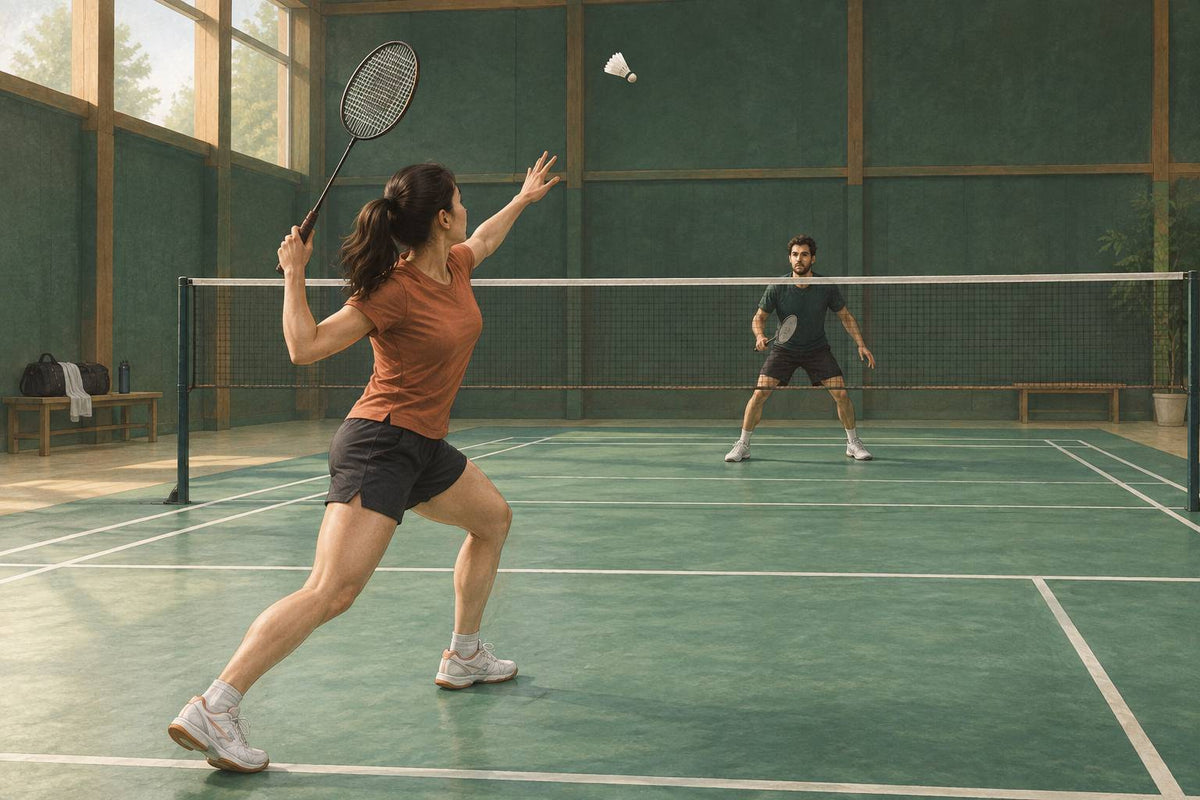
The heart of good badminton drop shot technique is deception. Your opponent should not know you are playing a drop until the shuttle is already leaving your strings. From the rearcourt, prepare as if you are about to hit a clear or smash: turn the body, raise the racket, show the same overhead preparation, and keep the swing looking committed until the final moment.
Then, instead of driving the shuttle deep or powering it downward, use less force so the shuttle loses speed after crossing the net and drops into the front court. That change happens late. If your preparation already looks soft, short, or cautious, the opponent can move forward early and take the shuttle high.
Key warning: do not just tap the shuttle softly. A high-quality drop still uses a complete arm swing; the difference is that you reduce the force at contact instead of stopping the stroke.
That mistake is common because players hear “soft shot” and shorten everything. The result is usually a floaty shuttle with no disguise, no shape, and no pressure. A better drop looks threatening first, then becomes controlled at the last second. Think of it as a full overhead action with a quieter finish, not a poke.
A simple swing sequence
- Prepare like an attacking shot: show the same overhead setup you would use for a clear or smash so the opponent has to respect the rear-court option.
- Reach the shuttle early enough: if you are late, you lose disguise and often end up guiding the shuttle. Good footwork gives you time to make the drop look like another shot. For the movement side, see our badminton footwork basics.
- Keep the arm swing complete: do not freeze the racket or jab at the shuttle. Let the stroke travel through the shuttle with reduced force.
- Change the pace late: the opponent should see clear or smash preparation, then only discover the drop as the shuttle slows and falls.
- For a fast drop, contact slightly in front: this helps send the shuttle down more steeply so it lands further from the net than a slow drop and gives the opponent less time.
If you are also working on your overhead attack, compare the preparation with your smash. The first part of the motion should feel similar enough that your opponent cannot immediately separate the two. Our badminton smash technique guide can help you build that shared overhead base.
What “less force” actually means
That is why the drop is so useful tactically: it punishes an opponent who is waiting deep for a clear, drive, or smash, while still forcing them to move forward under pressure. The better your disguise, the later they move — and the later they move, the harder it is for them to take the shuttle early.
Why Should Beginners Learn the Fast Drop First?
The slow drop looks tempting because a shuttle that lands close to the net is difficult to return. The problem is that weak slow drops are also easy to punish. If the shuttle floats too high or takes too long to cross the net, your opponent can step forward early and tap it down. That is why beginners should build the fast drop first, then add slower, tighter drops once their touch and timing improve.
Beginner checkpoint: what a good fast drop feels like
- Same preparation: raise the racket and turn your body as if you might clear or smash.
- Contact slightly in front: meet the shuttle a little in front of your body so you can guide it steeply downward.
- Full swing, reduced power: do not just poke at the shuttle. Keep a complete overhead action, but take pace off at contact.
- Recover quickly: because the drop brings your opponent forward, be ready for a net reply or lift.
The contact point is the key difference. For a fast drop, take the shuttle slightly in front of you and direct it down with a controlled overhead motion. If contact drifts too far back, the shuttle tends to float, and the shot loses the steep, uncomfortable trajectory that makes the fast drop useful.
This is also why your drop shot and smash should be trained together. Both depend on convincing overhead preparation: the opponent should see the same shoulder turn, racket preparation, and hitting rhythm until the last moment. If your smash preparation is already obvious and rushed, your drop becomes easier to read too. For the shared setup, see our badminton smash technique guide and apply the same preparation discipline before softening the final contact.
When Should You Use a Drop Shot in a Rally?
A drop shot is most dangerous when your opponent is already leaning or recovering toward the backcourt. If they are expecting another clear, smash, or drive-style attacking shot, a well-disguised drop changes the rally from length pressure to movement pressure: they must brake, turn, and lunge forward instead of staying deep.
That does not mean you should drop every time you reach the rear court. A clear gives you more time to recover toward base; a drop gives you less. If your own balance is poor or you are late behind the shuttle, a weak drop can invite a tight net reply and put you under even more pressure.
Simple tactical rule: use the drop when your opponent is deep or late; avoid it when you are late, off-balance, or unable to recover forward after contact.
| Rally situation | Drop-shot decision |
|---|---|
| Opponent is near the backcourt expecting a clear or drive | Good time to drop. You are forcing a long forward movement and testing their first step. |
| Opponent is late recovering from the rearcourt | A slower, tighter drop can work because they may not have time to reach the shuttle early. |
| You are hitting from nearer the net rather than full rearcourt | A slow drop becomes more realistic because the shuttle has less distance to travel before crossing the net. |
| You are late in the rear court or off-balance | Be careful. A clear or a safer fast drop may be better because a soft, slow drop can give the opponent time to take the shuttle high near the net. |
Fast Drops Should Be Your Default Tactical Drop
For most rear-court situations, choose a fast drop. It lands farther from the net than a slow drop, often around the short-service-line area, but it reaches the opponent sooner and can force them to take the shuttle lower. That is usually safer than floating a slow drop that crosses the tape too slowly.
Slow drops are not “better” just because they land tighter to the net. They are better only when the situation supports them: you are closer to the front court, or the opponent is so late from the rear court that they cannot arrive early enough to attack the shuttle.
Recover Immediately After You Drop
The tactical cost of a drop is recovery time. Once you play short from the rear court, your opponent’s next shot can come back quickly to the net, midcourt, or rear court. Your split step and first recovery step matter as much as the shot itself. Because a good drop usually forces a reply at the front, it helps to know your options there in advance; our net play shot selection guide covers how to choose between a net shot, push, or lift once you arrive.
If you often play a decent drop but still lose the next shot, the problem may be your movement after contact. Start with the basics in our badminton footwork guide, then practise choosing between a clear and a drop during Canadian club nights or drop-in games rather than hitting drops in isolation.
Straight, Cross-Court, Middle, and Backhand Drop Options

Once your basic badminton drop shot technique is consistent, the next question is not just fast or slow — it is where you send the shuttle. The same overhead preparation can produce a straight drop, cross-court drop, middle drop, or backhand drop, but each one changes the risk, recovery, and reply your opponent is likely to have.
For most players, the straight drop is the safest starting point. It takes the least time to cross the net, keeps your recovery simpler, and does not open as much court behind you. Cross-court drops can be excellent building shots, especially when your opponent is leaning the wrong way, but they expose your own movement more because the shuttle travels farther across the court. Middle drops are useful when you want to reduce the opponent’s reply angles and avoid giving them a clean sideline target.
| Drop option | Best use | Main risk |
|---|---|---|
| Straight drop | Your default choice when you want a safer drop that crosses the net quickly and lets you recover without a large diagonal move. | If it becomes predictable, your opponent can start moving forward early. |
| Cross-court drop | A strong deception option when your opponent is set for a straight reply or is late shifting across the court. | It exposes your movement more because the shuttle travels farther and your recovery path is less direct. |
| Middle drop | A practical defensive choice when you want to limit the opponent’s reply angles instead of giving them a sharp sideline opening. | If it sits too high, the opponent may still take it early and pressure the net. |
| Backhand fast drop | A useful escape and building shot when your opponent pushes you into the backhand rear corner. | A slow backhand drop is difficult for beginners because it normally requires slicing. |
Straight drop: the reliable pattern
Use the straight drop when you want pressure without unnecessary risk. Because it travels the shortest path over the net, it gives your opponent less time than a wider cross-court option and makes your own recovery cleaner. This matters especially in singles, where a drop shot can apply movement pressure but also gives you less time to return to base compared with a clear.
Cross-court drop: effective, but choose it carefully
The cross-court drop is tempting because it feels deceptive and can move an opponent a long way. It can be one of your best building shots when the opponent is recovering in the wrong direction, but it is not a free trick shot. The shuttle takes a longer route, and if your opponent reads it early, your own recovery is more exposed.
A useful rule: play cross-court drops when your body position is balanced enough to recover. If you are late, falling away, or hitting from deep pressure, the safer straight or middle drop is usually the better percentage choice.
Middle drop: reduce the opponent’s angles
The middle drop is underrated. Instead of aiming tight to a sideline, you drop into the central front area to reduce the opponent’s reply angles. That can be helpful when you are defending, when you are unsure whether your opponent is waiting for the straight drop, or when you simply need to get out of the rear court without opening the full diagonal court.
Think of the middle drop as a control shot, not a winner. Your goal is to make the opponent lift, play upward, or take the shuttle from a lower contact point while you recover into a stronger base position.
Backhand drops: learn the fast version first
When the shuttle is sent to your backhand rear corner, the backhand drop can be a very useful shot. For beginners, the backhand fast drop is the better starting point because it gives the shuttle more pace and does not demand the same fine slicing skill as a slow backhand drop.
Slow backhand drops are harder because they often require slice. That does not mean slice is bad — it is a valuable skill later. Slice can add deception and help you produce better-quality slow drops, but it takes time to control. Until your contact, grip change, and balance are reliable, build your backhand drop around a fast, direct action.
Simple decision rule
- Use straight when you want the safest drop and quickest shuttle path.
- Use cross-court when you are balanced and your opponent is leaning or recovering the wrong way.
- Use middle when you want to reduce the opponent’s reply angles.
- Use backhand fast drop first as a beginner; save slow sliced backhand drops for later.
If your drop angles break down because you arrive late to the shuttle, fix the movement first. Clean rearcourt footwork gives you the time to disguise the shot, hold your balance, and recover after contact. For a movement refresher, see our badminton footwork basics guide.
Practice Drills for Touch, Balance, and Shuttle Control
Build your practice around two targets: a fast drop that lands around the short-service-line or front-midcourt area, often toward the sides, and a slow drop that lands closer to the net when the rally situation gives you enough time. For most players, the fast drop should be the first training priority because it gives the opponent less time and is less risky than trying to feather every drop tight to the tape.
Footwork check: before you worry about slice or deception, make sure your split step, chasse, scissor kick, recovery, and base position are reliable. For a deeper foundation, see our badminton footwork basics guide.
1. Two-Zone Drop Accuracy Drill
Place visual targets in the opponent’s front court: one near the short service line for fast drops, and one closer to the net for slow drops. Feed or self-feed from the rearcourt and alternate between the two zones.
- Fast drop goal: use a full overhead preparation, contact slightly in front, and send the shuttle down with enough pace to land near the short service line or front-midcourt area.
- Slow drop goal: reduce the pace so the shuttle lands nearer the net, but only count it as successful if it crosses safely and does not sit up too high.
- Key habit: keep the same preparation as a clear or smash until late, then change the pace of the shot.
This drill teaches the most important feeling in drop-shot practice: not “soft” versus “hard,” but how much racket speed and follow-through produce each flight path.
2. Rearcourt Footwork + Balanced Contact Drill
Start from base. Move to the rear forehand corner, shadow a full overhead action, then recover. Add the shuttle only after the movement feels stable. The target is to contact the shuttle while your body is controlled, not falling sideways or drifting backward.
- Begin with shadow swings: move, plant, swing, recover.
- Add a feed and play only fast straight drops until the movement stays balanced.
- Once stable, alternate clear, smash action, and drop action so your preparation stays disguised.
If your drop shot improves in standing practice but breaks down in rallies, this is usually the missing piece. Your swing can only be deceptive when your feet get you behind the shuttle early enough.
3. Straight vs Cross-Court Control Drill
Straight drops are generally safer because the shuttle crosses the net sooner and exposes less court. Cross-court drops can be very effective, but they demand more accuracy and stronger recovery because they open bigger angles for your opponent.
| Variation | What to Practise | Success Check |
|---|---|---|
| Straight fast drop | Contact slightly in front and send the shuttle down with pace toward the short-service-line area. | Opponent would need to lift from low contact rather than play an easy tight net shot. |
| Straight slow drop | Reduce pace and aim closer to the net, while keeping the same overhead preparation. | The shuttle lands close enough to pressure the front court without hanging too long near the tape. |
| Cross-court drop | Use it after you can hit the straight drop reliably; focus on recovery immediately after contact. | The shuttle lands accurately and you can still recover to cover the next reply. |
| Middle drop | Aim through the centre channel when you want a safer defensive drop option. | The opponent has fewer sharp reply angles than if you played wide. |
4. Home Touch Work for Days Without Court Time
You do not need a full court to keep your drop-shot feel sharp. Small-space shuttle control helps your hands learn how little force is needed to guide the shuttle, which transfers well to soft-touch overhead shots.
- Keep-ups: tap the shuttle upward repeatedly with a relaxed grip, changing between forehand and backhand faces. The goal is clean contact, not height.
- Controlled wall drives: stand in a safe space and hit gentle, repeatable drives against a wall. Keep the racket face stable and the swing compact.
- Serve or trajectory practice: use a small target and practise sending the shuttle on different arcs. This builds awareness of how racket angle and force change flight.
Simple Practice Progression
Use this order if you are building your badminton drop shot technique from scratch:
- Shadow the movement first: base position, rear-court movement, balanced overhead action, recovery.
- Train fast drops first: aim around the short-service-line or front-midcourt zone and focus on pace plus disguise.
- Add slow drops carefully: practise landing nearer the net without letting the shuttle hang too long.
- Mix with clears and smashes: the drop becomes dangerous when the opponent cannot read it early.
- Finish with recovery: every drop-shot drill should include the next movement, because a drop gives you less time to return to base than a clear.
Coach yourself with one question: did the shuttle land in the intended zone while your body stayed balanced enough to cover the next reply? If not, fix the feet before blaming the racket touch.
Gear Notes: Footwork, Practice Shuttles, and Stringing
A better drop shot starts with technique, not a shopping cart. Your disguise comes from reaching the shuttle early, setting up like a clear or smash, and staying balanced enough to change the shot late. Gear matters when it supports those habits: secure court movement, consistent practice shuttles, and a string setup that gives you a predictable feel.
Gear pointer for Canadian players. The Babolat Shadow Tour Men’s Badminton Shoes – Orange is a non-marking indoor court shoe built for the fast lateral movement a drop shot demands, and it ships across Canada.
Court shoes: the most relevant gear upgrade for drop-shot disguise
That is where proper indoor court shoes help: they support the fast, balanced footwork needed to get behind the shuttle, recover after the drop, and avoid turning a good attacking idea into a loose net reply for your opponent. If you are still using running shoes, read our guide to badminton shoes vs running shoes before upgrading.
If your drop shot breaks down because you arrive late, pair this section with our badminton footwork basics guide. Better shoes can support movement, but they cannot replace split steps, recovery, and clean rearcourt positioning.
Practice shuttles: useful for repetition
The Yonex Mavis 350 Nylon Shuttlecocks are a durable nylon option built for repetitive practice, which suits the kind of repeated drop-shot drilling covered above.
Rackets and strings: do not force the wrong purchase
A control-friendly racket setup can make touch shots feel easier. Browse the badminton racket collection for what is currently available, and note that Astrox-series frames such as the Yonex Astrox 100 ZZ are head-heavy power frames rather than control-specific drop-shot recommendations, so match the frame to your swing rather than buying whatever is available.
For string choice and installation, see the in-house stringing service. String tension affects the power-versus-control feel of your racket, and a consistent stringbed is especially important when you are trying to repeat the same fast drop angle under pressure. For more detail, see our badminton string tension guide.
| Gear area | What it is | Drop-shot relevance |
|---|---|---|
| Court shoes | Babolat Shadow Tour Men’s Badminton Shoes – Orange, a non-marking indoor shoe | Supports the fast, balanced movement needed to reach the rearcourt early and disguise the shot |
| Practice shuttles | Yonex Mavis 350 Nylon Shuttlecocks, a durable practice tube | Useful for repeating fast and slow drop trajectories in practice |
| Rackets | Astrox-series and other frames vary in weight and balance | Match the frame to your swing rather than buying a power frame just because it is available |
| Strings | Check current stringing options and string choices | A consistent string setup helps make touch and control more predictable |
Which Drop Shot Should You Choose?
For most players, the best default is a fast drop: it gives your opponent less time, tends to force a lower contact point, and is easier for beginners to learn than a slow drop. Use the table below to match the shot to the rally situation.
| Choose this | Best when | Why it works | Main risk |
|---|---|---|---|
| Fast drop | You want the safest default drop from the rearcourt, especially as a beginner. | It travels with more pace, lands nearer the short service line, gives the opponent less time, and can force them to take the shuttle near the floor. | If you slow the swing down too much, the shot loses disguise and quality. |
| Slow drop | You are hitting from nearer the net, or your opponent is late recovering from the rearcourt. | A good slow drop lands closer to the net, which can make it difficult to return cleanly. | It takes longer to cross the net, so a ready opponent can arrive early and play a tight net reply or punish a weak shot. |
| Straight drop | You want the safer angle or need the shuttle to cross the net quickly. | Straight drops take the least time to cross the net and expose your own movement less than a wide cross-court option. | If it becomes predictable, your opponent can start moving early. |
| Cross-court drop | You have balance and time, and you want a stronger building shot, especially toward the opponent’s forehand side. | It can move the opponent farther and create pressure when disguised well. | It exposes your own movement more, so avoid it when you are late or off balance. |
| Middle drop | You are defending or want to reduce the opponent’s reply angles. | A middle drop limits the angles available on the next shot. | It is less likely to pull the opponent as wide as a well-timed cross-court drop. |
| Backhand fast drop | Your opponent sends the shuttle to your backhand side, especially when you are under rearcourt pressure. | For beginners, the fast backhand drop is the better backhand option; slow backhand drops require slicing and are difficult to control. | A soft, incomplete swing can sit up and invite an attacking reply. |
| Drive-drop | You are under heavy rearcourt pressure, especially in the backhand corner. | It travels flatter and faster into the front midcourt, landing slightly beyond the short service line to deny a tight spinning net reply. | Because it has extra pace, poor placement can make the next shot easier for your opponent. |
Gear pointer. If your drops fail because you arrive late or off balance, start with footwork and court-shoe support before blaming your racket. The Babolat Shadow Tour men’s badminton shoe is one option to compare for fit, and our badminton footwork basics guide can help you build the movement behind the shot.
Get 10% off your first order
Join the Badminton House list and we’ll email you a 10% welcome code — plus subscriber-only restock alerts, giveaways, and honest gear advice from players.
By subscribing, you agree to receive Badminton House emails and can unsubscribe anytime.
A better drop shot starts with the same habits we work on in our own games: get there early, stay balanced, and make your clear, smash, and drop look identical until the final moment. If you want help choosing court shoes, checking whether your racket setup is helping your control, or planning your next restring, contact Badminton House — we play badminton and we’re happy to point you in the right direction.
Build the footwork, touch, and setup that make your drop shot harder to read.
Shop Badminton GearPlayer-run Canadian badminton specialty shop · Practical gear advice · Stringing support available

Leave a comment
This site is protected by hCaptcha and the hCaptcha Privacy Policy and Terms of Service apply.