
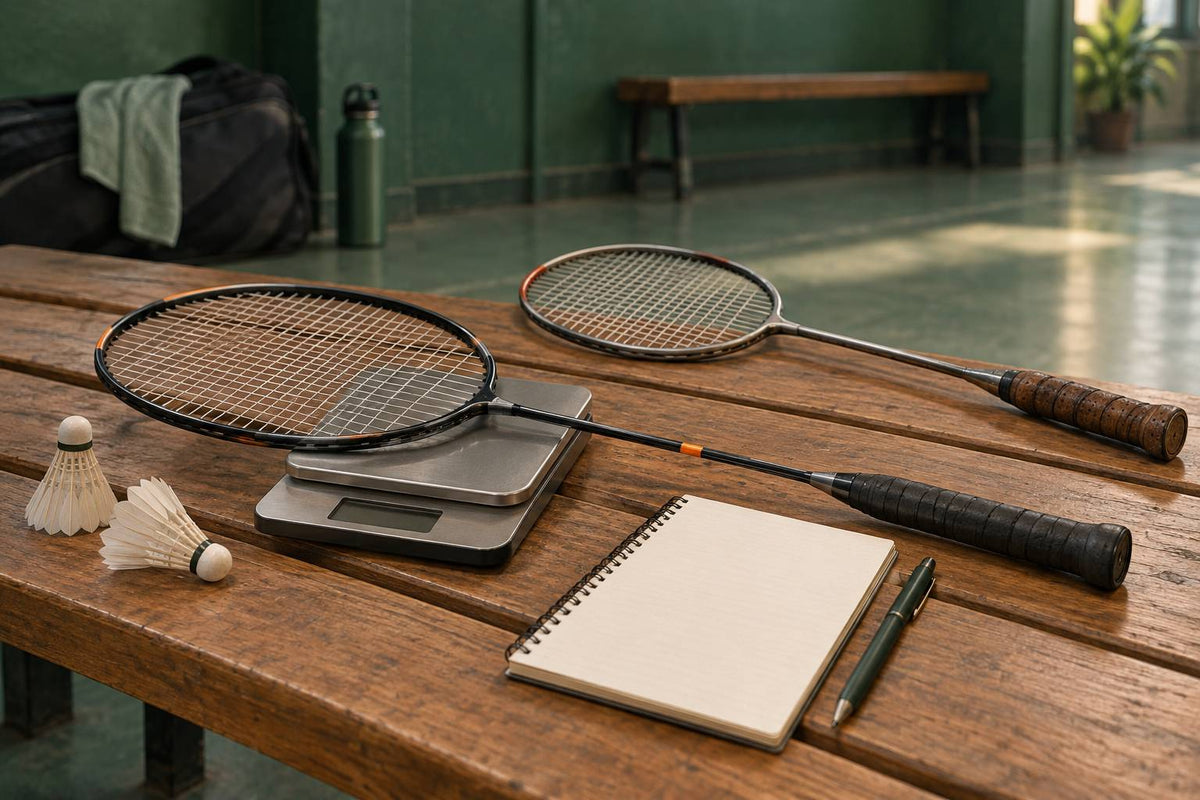
Last updated: July 2026 · Written by the team at Badminton House
Quick Answer: Why Heavy Rackets Cause Arm Fatigue
Heavy rackets cause arm fatigue because every shot has to accelerate, stop, and redirect the frame’s mass: the higher the weight and swingweight, the more work your forearm and shoulder do on every stroke. If your swing feels late and your arm fades early, move to a lighter graphite frame (4U, about 80–84 g unstrung) with an even balance rather than simply buying the most powerful racket.
Default
Best choice: choose a 4U graphite frame with even balance or slightly head-heavy balance and a flexible shaft, especially if you are a beginner or your shoulder gets tired during longer sessions.
Lighter head
If defence, drives, and quick changes feel slow, shift toward an even-balance or head-light feel; balance can make a racket feel demanding even when the listed weight looks light.
Get advice
If fatigue or joint pain keeps coming back after a short adjustment period, the racket may be too heavy, too head-heavy, or too stiff for you; browse badminton rackets and ask for help before upgrading. Canadian orders qualify for free shipping.
If your smash feels late, your defence feels sluggish, and your forearm or shoulder is tired before the session is over, your racket may simply be too demanding for your arm. The common pattern behind badminton racket too heavy arm fatigue is not just “weakness” or poor effort: a heavier frame, or a frame with too much weight in the head, takes more work to start, stop, and whip through fast exchanges.
That extra effort adds up fast in club play, especially in long doubles games full of drives, blocks, and repeated overhead clears. A lighter, better-balanced graphite frame is easier to move, easier to recover, and less tiring over a full night on court.
This guide explains what is happening when your racket feels too heavy, why swingweight matters more than the number printed on the shaft, and when it makes sense to change frames instead of forcing your arm to adapt.
Feeling arm fatigue from your current racket? Browse the live badminton rackets collection for current CAD pricing and options; Badminton House offers free Canadian shipping.
In This Guide
- Is your badminton racket too heavy? The warning signs
- Why does extra swingweight slow the racket down?
- How do weight and balance work together?
- Why do budget metal rackets cause beginner arm aches?
- How does a lighter graphite frame help?
- When should you change rackets or ask for advice?
- Which racket should you choose if your arm gets tired?
Is Your Badminton Racket Too Heavy? The Warning Signs
If your badminton racket is too heavy for you, the first sign is usually timing. The swing feels a fraction late, your defensive blocks and drives feel sluggish, and your arm has to work harder just to get the racket head into position.
That late feeling is not just in your head. Heavier badminton rackets can give more power and stability, but they are harder to swing quickly and can be more strenuous on the arm and wrist. Over a full club night, that extra effort can make the shoulder tire faster, especially on repeated clears, smashes, late forehands, and quick defensive exchanges.
Quick gear check. If your arm gets tired before your legs do, compare your current frame against lighter options in our badminton rackets collection, or use our 3U vs 4U vs 5U racket weight guide to decode the weight label.
For many players, the clearest warning signs are practical ones:
- Late contact: you reach the shuttle slightly behind your ideal hitting point, even when your footwork is reasonable.
- Slow defence: the racket feels hard to lift, turn, or recover after one block or drive.
- Grip tension: you start squeezing the handle early because you feel you need extra strength to control the head.
- Arm and shoulder fatigue: your forearm, wrist, or shoulder feels worked out long before the session ends.
A heavy-feeling racket can also push beginners into compensation habits: muscling the clear, tightening the grip, or using the shoulder too much instead of a relaxed swing and clean forearm rotation. If elbow or wrist discomfort is part of the pattern, read our related guide on badminton elbow and wrist pain as well.
The technical reason is swingweight: how heavy the racket feels when you rotate it from the handle. Higher swingweight has been shown to reduce racket head speed. The key point is simple: if the racket feels slow in your hand and your arm fades quickly, the frame is asking for more strength and timing than your current game can comfortably supply.
This is also why advanced, head-heavy, stiff rackets are not always the right reference point for a tired arm. A frame such as the Yonex Astrox 100 ZZ is listed as head-heavy and stiff, with 4U and 3U versions, which makes it a better example of a demanding power-oriented setup than a comfort-first beginner choice.
Why Does Extra Swingweight Slow the Racket Down?

When players say a badminton racket feels “too heavy,” they often mean it has too much swingweight, not just that it weighs more on a scale. Swingweight is the racket’s resistance to rotation, its moment of inertia around the handle, so a frame with mass concentrated in the head can swing “heavier” than its scale weight suggests.
That matters because badminton is full of short, fast movements: defending a smash, changing from backhand block to forehand drive, recovering after a clear, or taking a shuttle early at the net. A racket with higher swingweight takes more effort to start, stop, and redirect. As noted above, controlled smash testing found that racket head speed drops as swingweight rises, even though the relationship between racket speed and shuttle speed is not always one-to-one.
What this feels like on court
- Your defence is late because the racket head does not come up quickly enough.
- Your drives feel strong at first, then sluggish after a few rallies.
- Your clears and smashes start using more shoulder effort than relaxed forearm rotation.
- Your grip tightens because you are trying to force the racket through the swing.
- Your arm feels tired before your legs or lungs do.
This is why two rackets with similar listed weights can feel completely different. A lighter racket can still feel demanding if much of its mass sits toward the head, while a slightly heavier but better-balanced frame may feel easier to move in fast exchanges.
For the deeper technical version, including how swingweight is different from static weight and balance point, read our full guide: Badminton Racket Swingweight Explained.
Practical fix: if your racket feels slow and your arm fades quickly, look for a lighter or more even-balanced frame before blaming your technique. You can browse current options in our badminton rackets collection; Canadian orders qualify for free shipping.
How Do Weight and Balance Work Together?

A badminton racket can feel tiring even when the listed weight does not look extreme. The reason is balance: where the mass sits matters as much as how many grams the racket weighs.
A head-heavy racket puts more mass toward the top of the frame. That extra head weight can help the racket carry momentum through clears and smashes, but it also takes more effort to start, stop, and redirect. In fast doubles exchanges, defensive blocks, flat drives, and quick net interceptions, that same momentum can make the racket feel slower and more tiring.
The spec-sheet trap: balance point can affect felt weight more than small mass differences. A head-heavy 4U racket can feel more demanding than an even-balanced 3U racket, even though the 4U is lighter on paper.
| What you feel | What may be happening | What to try |
|---|---|---|
| Clears feel easy, but defence feels late | The racket head may be carrying helpful momentum overhead, but slowing your reactions in fast exchanges. | Try a lighter-head or more even-balanced frame. |
| Your shoulder tires before your legs do | Overall weight, head-heavy balance, or both may be adding too much swing effort over a full session. | Compare a lighter weight class and avoid extreme head-heavy setups while your technique develops. |
| The racket feels fine in warm-up but heavy in games | Repeated quick starts, stops, and off-centre contacts reveal the real swing load. | Choose by rally feel, not just by the printed weight code. |
If you are comparing specs, read weight and balance together. The U code tells you the weight class (3U is roughly 85–89 g unstrung, 4U is 80–84 g, and 5U is 75–79 g) while the balance tells you whether that mass sits toward the head, the centre, or the handle. For a deeper breakdown, see our guides to head-heavy vs head-light racket balance and 3U, 4U, and 5U badminton racket weights.
For many Canadian beginners dealing with arm fatigue, the fix is not automatically “buy the lightest racket.” It is usually “find a lighter-feeling frame”: reasonable overall weight, a balance that does not overload the head, and enough manoeuvrability to stay relaxed through a full club night.
Why Do Budget Metal Rackets Cause Beginner Arm Aches?

A lot of beginner arm fatigue starts with a simple gear mismatch: the racket is built to survive, not to swing fast. Many entry-level metal rackets use steel or aluminum because those materials can keep the price down and handle rough recreational use. The tradeoff is feel. Steel is tough, durable, and inexpensive, but it is heavy to play with. Aluminum is common in beginner rackets too, but it is heavier than graphite or carbon and usually feels slower through the air.
That matters because badminton is not just one big swing. A normal session asks your arm to repeat quick clears, lifts, blocks, drives, net kills, and defensive changes of direction. If the frame is heavy or slow to recover after each shot, your forearm, wrist, elbow, and shoulder have to do more work every rally. At first it can feel like you are just “out of shape.” But if the same tired, dragging feeling appears early every time you play, the racket may be adding more load than your technique can handle comfortably.
Quick check. If your racket feels hard to start, hard to stop, or late on defence, do not judge it by total weight alone. The material, balance, and swingweight all affect how demanding it feels in your hand.
Why metal frames can feel tiring
- Steel: durable and low-cost, but heavy to play with. That extra load can make the racket feel sluggish over a full club night.
- Aluminum: lighter than steel in many sporting goods uses, but still heavier than graphite or carbon in badminton rackets. The result is slower swings and less manoeuvrability.
- Graphite or carbon: lighter, strong, and flexible enough for higher-quality badminton frames, which helps the racket whip through the air more easily.
This is why a beginner can borrow a lighter graphite racket and suddenly feel like their timing improved. The player did not become stronger overnight; the racket simply stopped fighting the swing. A lighter, better-balanced frame can make clears easier to repeat, defensive blocks quicker, and late contact less punishing on the arm.
For a deeper breakdown of frame materials, read our full carbon vs aluminum vs steel badminton racket guide. For this fatigue problem, the practical takeaway is straightforward: if your beginner racket is metal, slow, and making your arm ache, upgrading to a lighter graphite or carbon frame is often the cleanest fix.
Canadian players can check the live badminton rackets collection for current options in CAD, with free Canadian shipping.
How Does a Lighter Graphite Frame Help?
The practical fix for a racket that feels slow is usually not to swing harder. It is to reduce how much racket you are trying to move, especially if your arm and shoulder fade during longer club sessions.
A lighter frame is easier to accelerate, stop, and redirect. That matters most in defence, flat drives, fast net exchanges, and late recoveries after a clear or smash. When the racket comes through the air more easily, you can react sooner instead of muscling every shot with your forearm and shoulder.
- Quicker preparation: a lighter racket is easier to lift into ready position between shots.
- Faster reactions: less effort to move the racket helps on blocks, drives, and quick defensive changes.
- Less arm and wrist stress: lightweight rackets are less strenuous over long sessions, especially when your timing is not perfect.
- Cleaner technique under fatigue: when your arm is not fighting the frame, it is easier to stay relaxed and use grip changes, forearm rotation, and recovery footwork.
Graphite and carbon fibre are light, strong, flexible materials commonly used in high-quality badminton rackets. Instead of rehashing the material comparison, the key point here is swing feel: a lighter graphite-style frame can make the same stroke feel easier to start and easier to finish, which is exactly what many beginners and returning players need when arm fatigue shows up early.
Shop by feel, not just grams. Compare current Canadian racket options in our badminton rackets collection, then check weight, balance, and shaft flex together before buying. Orders qualify for free Canadian shipping.
If you are unsure where to start, use the racket’s weight class as a first filter, then confirm the balance. A lighter racket with an extreme head-heavy setup can still feel demanding, while a lighter or more even-balanced frame usually feels easier in fast exchanges. For a deeper breakdown, see our guides to 3U vs 4U vs 5U racket weight and head-heavy vs head-light balance.
Bottom line: if your swing feels late and your arm gets tired before your legs do, a lighter, well-balanced graphite frame is often the simplest equipment change to test.
When Should You Change Rackets or Ask for Advice?
A heavier racket is not automatically wrong. If you have just moved from a lighter frame to a heavier or more head-heavy racket, some arm fatigue can happen while your timing, grip relaxation, and muscles adjust. A typical adaptation period is about 2–4 weeks.
The warning sign is fatigue that does not settle, or discomfort that feels like joint pain rather than normal effort. If your forearm, elbow, wrist, or shoulder keeps getting sore after that adjustment window, the racket may simply be too demanding for your current strength, technique, or playing volume.
Simple rule: if your swing gets slower as the session goes on, your defence feels late, and your arm aches quickly, try moving toward a lighter or less head-heavy frame before blaming your fitness.
Change rackets sooner if pain is involved
Normal muscle tiredness usually feels broad and improves with rest. Joint irritation is different: it may show up around the elbow, wrist, or shoulder, especially after repeated clears, smashes, late backhands, or off-centre hits. A heavy racket and high vibration can send more shock into the arm, and shoulder pain checks often include asking whether the racket is too heavy or the string tension is too high.
- Elbow or wrist symptoms? Read Badminton Elbow Pain in Canada: Is Your Racket to Blame? for the racket, string, and grip factors to check.
- Shoulder symptoms? Read Badminton Shoulder Pain: Causes & Prevention in Canada, especially if overhead clears and smashes are the shots that trigger discomfort.
What to switch to
For many beginners and club players dealing with arm fatigue, the safer direction is a lighter graphite frame with an even balance or only a slight head-heavy feel. That keeps the racket easier to accelerate while still giving enough help on clears and lifts. If your current racket is a budget metal frame, a graphite upgrade can also feel easier to whip through the shuttle because graphite frames are generally lighter and more manoeuvrable than aluminum or steel options.
If you still want power, avoid jumping straight to the stiffest, most head-heavy option. A powerful racket that arrives late to the shuttle will not help your game. The right fit is the racket you can swing cleanly for the whole session, not just for the first few smashes.
Shop Badminton Rackets — Find a Better Fit
Prices in CAD · Free Canadian shipping · Ask Badminton House for racket fit advice
If you are unsure, send Badminton House your current racket model, how long you play per session, where the arm gets tired, and whether you prefer singles, doubles, power, or fast defence. That context is usually more useful than choosing by racket weight alone, because weight, balance, shaft flex, grip size, string tension, and your technique all affect how demanding the racket feels.
Which racket should you choose if your arm gets tired?
Use this as a quick decision check. The goal is not simply to buy the lightest racket possible; it is to match weight, balance, and shaft feel to how fast you can swing without shoulder, wrist, or elbow fatigue.
| Choose this direction | Best fit | Why it helps arm fatigue |
|---|---|---|
| 4U, even-balance or slightly head-heavy, flexible shaft | Most beginners whose shoulder tires quickly | This setup is commonly recommended for beginners because it is more forgiving, helps reduce shoulder fatigue, and supports proper stroke mechanics. |
| Lighter or lighter-headed frame | Players who feel late on defence, drives, or fast doubles exchanges | A lighter swing is easier to repeat over a long session and is less stressful on the arm and wrist. |
| Graphite or carbon frame | Players moving on from a heavy budget racket | Graphite and carbon frames are used in higher-quality rackets and are lighter and more manoeuvrable than aluminum or steel options. |
| Heavier or head-heavy power racket | Stronger players who want more smash and clear momentum | It can add power and stability, but it is harder to swing quickly and can be more strenuous on the arm and wrist. |
| Wait briefly, then reassess | Players who just changed to a heavier racket | Some initial fatigue can happen for 2–4 weeks while muscles adapt; fatigue or joint pain beyond that is a sign to change weight, balance, or ask for advice. |
Shopping note for Canadian players. Start with the live Badminton Rackets collection and look for a manageable weight and balance before chasing maximum power. Orders ship free in Canada.
One useful contrast is the Yonex Astrox 100 ZZ Kurenai: it is a stiff, head-heavy racket with 4U average 83 g and 3U average 88 g options. That kind of spec can suit advanced power players, but if your main problem is arm fatigue, treat it as the demanding end of the spectrum rather than the default beginner fix.
Get 10% off your first order
Join the Badminton House list and we’ll email you a 10% welcome code — plus subscriber-only restock alerts, giveaways, and honest gear advice from players.
By subscribing, you agree to receive Badminton House emails and can unsubscribe anytime.
If your racket keeps making your arm feel slow, tired, or sore, do not just push through and hope it fixes itself. We play badminton too, and we are happy to help you compare weight, balance, flex, grip size, and string setup before you buy. Send us a note through Contact Us and we will point you toward a setup that fits your level and playing style.
Free Canadian shipping · Canadian badminton specialty shop · Ask us for racket advice before you order

Leave a comment
This site is protected by hCaptcha and the hCaptcha Privacy Policy and Terms of Service apply.