
Last updated: July 2026 · Written by the team at Badminton House
Quick Answer: Badminton vs Tennis
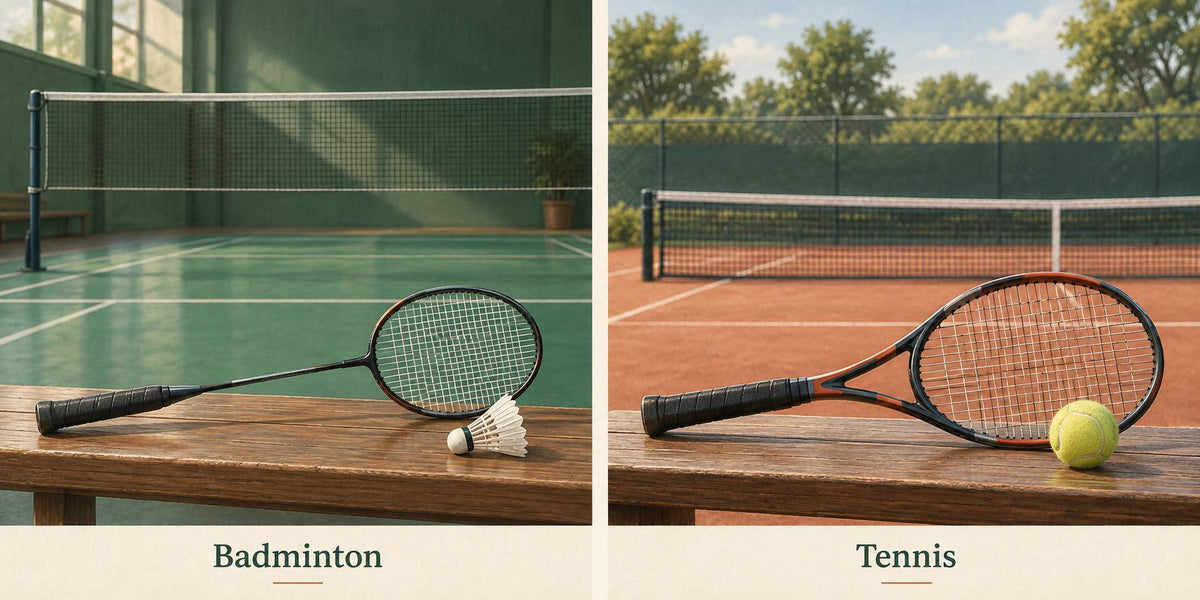
For most Canadian beginners, start with badminton if you want fast rallies, indoor winter-friendly play, lighter equipment, and a lower-cost path into a racket sport. Badminton is played indoors to 21 points on a 13.4 m × 6.1 m court; tennis is scored in games and sets on a 23.77 m × 10.97 m court, indoors or outdoors.
Badminton
Best default: choose it for quick reactions, explosive footwork, indoor court access during Canadian winters, and a more affordable starter setup.
Tennis
Choose it if you prefer longer matches, more outdoor summer play, heavier racket-ball contact, and the endurance challenge of covering a larger court.
Both
Play both if you want variety: both train movement and timing, with different court sizes, projectiles and shot patterns.
Leaning toward badminton? Start with the essentials in our badminton racket collection — Badminton House ships across Canada.
In This Guide
- Badminton vs Tennis: Key Differences at a Glance
- Is Badminton Faster Than Tennis?
- Court Size, Venue, and Canadian Winter Practicality
- Which Is the Better Workout: Badminton or Tennis?
- Is Badminton or Tennis Easier to Learn?
- Which Costs Less to Start: Badminton or Tennis?
- Which Should You Choose: Badminton or Tennis?
Badminton vs Tennis: Key Differences at a Glance
At a glance, badminton and tennis look like close cousins: rackets, nets, singles, doubles, serves, drop shots, and smashes. On court, they feel very different. Badminton is played on a much smaller court, the shuttle cannot bounce, and rallies can turn into quick explosive exchanges. Tennis gives you one bounce, uses a larger court, and is built around sets, games, and longer point construction.
| Category | Badminton | Tennis | What it means for beginners |
|---|---|---|---|
| Court size | Standard court length is 13.40 m; width is 5.18 m for singles and 6.1 m for doubles. | A tennis court is 23.77 m long, 8.23 m wide for singles and 10.97 m wide for doubles. | Badminton gives you less total ground to cover, but the movement is sharper and more stop-start. |
| Venue | Badminton courts are designed for indoor play. | Tennis can be played indoors or outdoors, on surfaces such as hard, grass, and clay. | For Canadian winters, badminton’s indoor setup makes it easier to keep a steady weekly routine. |
| Equipment | Light racket, shuttlecock, and non-marking indoor court shoes. | Heavier, larger racket and a tennis ball designed to bounce. | Badminton equipment feels easier to swing at first, but shoes matter because lunges and side-steps are constant. |
| Bounce rule | The shuttlecock cannot touch the floor. | The ball can bounce once on your side before you return it. | This is the biggest feel difference: badminton rewards fast interception; tennis gives you more time to set up after the bounce. |
| Scoring | Under the current BWF format, games go to 21, win by two, with a cap at 30. | Tennis uses sets and games; points inside a game progress as 15, 30, 40, with 40-40 called deuce. | Badminton scoring is usually quicker for new players to follow. Tennis scoring takes more explanation at the start. |
| Rally feel | Explosive: short reactions, quick changes of direction, jumps, drives, lifts, clears, drops, and smashes. | More endurance-based: larger court coverage, longer running patterns, topspin, slice, volleys, drops, and serves. | Choose badminton if you like fast exchanges and reflex battles. Choose tennis if you enjoy building points over more space. |
Leaning toward badminton? Start with the essentials: a suitable badminton racket, shuttlecocks, and non-marking court shoes. Badminton House ships across Canada.
If you are new to badminton rules, the most important adjustment from tennis is simple: do not wait for a bounce. The shuttle has to be taken out of the air every time. For a deeper walkthrough, see our badminton rules and 21-point scoring guide.
Is Badminton Faster Than Tennis?

The fastest recorded male badminton hit is 565 km/h, achieved by Satwiksairaj Rankireddy in Soka, Saitama, Japan on 14 April 2023. The fastest recorded female badminton hit is 438 km/h, set by Pearly Tan. For comparison, the fastest recorded tennis serve is 263.4 km/h (Sam Groth, 2012), and the fastest ATP-recognized serve is 253 km/h (John Isner, 2016).
The men’s and women’s Guinness records were measured immediately after impact during controlled record attempts on 14 April 2023, not average match rallies.
| Speed marker | Recorded speed | What it tells beginners |
|---|---|---|
| Fastest male badminton hit | 565 km/h | Badminton has a uniquely explosive top-end speed, especially on attacking shots. |
| Fastest female badminton hit | 438 km/h | Elite women’s badminton also reaches speeds far beyond what most new players expect. |
| Fastest tennis serve (Sam Groth, 2012) | 263.4 km/h | Tennis serves are extremely fast, but peak badminton smash speeds are in another category. |
Peak speed is measured immediately after contact, and the shuttle slows rapidly through the air. Record attempts, match shots and tennis serves are measured under different conditions, so the headline numbers are not a direct comparison of rally pace.
The time available to defend depends on distance, shot trajectory and shuttle speed. Read the opponent’s preparation and time your split step to their contact; a single reaction-time number does not describe every rally.
For Canadian beginners choosing between the two sports, this is the biggest reason to try badminton if you enjoy quick hands, explosive first steps, and fast problem-solving. If that speed is what pulls you in, start with the fundamentals: clean badminton footwork, a stable ready position, and simple smash defence before chasing maximum power. You can also work on attacking technique with our badminton smash guide.
Court Size, Venue, and Canadian Winter Practicality

Using doubles boundaries, badminton covers about 81.7 m² (880 sq ft) and tennis about 260.8 m² (2,808 sq ft). Tennis has roughly 3.2 times the marked playing area; this is an area comparison, not a plan for fitting three courts with safe run-off space.
The ITF court specification distinguishes tennis singles and doubles widths.
| Sport | Court dimensions | Playing area | Typical venue setup |
|---|---|---|---|
| Badminton | 13.40 m long; 5.18 m wide for singles or 6.1 m wide for doubles | About 880 sq ft | Indoor sports floor, often sprung wood or a synthetic court surface over a suitable base |
| Tennis | 23.77 m long by 10.97 m wide | About 2,808 sq ft | Can be played indoors or outdoors, with surfaces such as hard, grass, or clay |
For Canadian players, the indoor-versus-outdoor piece is more than trivia. Tennis has the advantage of outdoor summer play, and indoor tennis facilities can extend the season. Badminton, however, is already built around indoor courts, which makes it naturally suited to Canada’s long winters, cold gym starts, and after-work evening sessions when outdoor courts are not practical.
Canadian practicality tip. If you want a sport you can play consistently from November through March, badminton is easier to plan around because the standard playing environment is indoors. Start by checking local club nights, school gyms, recreation centres, and dedicated badminton facilities.
The smaller court does not make badminton easier automatically. Because the shuttle cannot bounce and the court is compact, the game becomes dense: short lunges, recovery steps, jumps, drives, net kills, and quick changes of direction happen with very little downtime. Tennis gives you more open space and a bouncing ball; badminton gives you less space and less time.
Venue choice also changes the social feel. Badminton facilities can place multiple courts side by side, so drop-in nights often rotate players through doubles games quickly. Tennis usually has fewer courts available in the same building footprint, and singles play can occupy a court for longer. If your goal is to meet people, play several games in a session, and get comfortable with doubles, badminton’s court layout is a real advantage.
If you are looking for places to play, Badminton House has city guides for Canadian players, including Toronto, Vancouver, Calgary, Montreal, and Moncton. For winter sessions, also make sure your footwear matches the surface: badminton shoes use non-marking soles, and indoor court traction matters when you are lunging and recovering repeatedly. Our badminton shoes vs running shoes guide explains why that difference matters.
Which Is the Better Workout: Badminton or Tennis?
Both sports combine brief intense movements with recovery between points. Singles or doubles, playing level, rally length and rest time matter more than labelling one sport a sprint and the other a marathon.
Tennis uses a larger court, while badminton demands repeated lunges, jumps and changes of direction in a smaller area. Both can challenge aerobic endurance and repeated explosive effort.
| Activity | 65 kg player calorie example | What it tells you |
|---|---|---|
| Competitive badminton | About 478 kcal/hour (7.0 MET) | Explosive rallies can produce a workload similar to general tennis, even on a smaller court. |
| General tennis | About 464 kcal/hour (6.8 MET) | A strong all-around endurance workout with steady court coverage. |
| Doubles tennis | About 307–410 kcal/hour (4.5–6.0 MET) | Shared court coverage lowers the running load compared with singles. |
| Singles tennis | About 546 kcal/hour (8.0 MET) | The highest estimate in this selected table; it does not rank all possible sessions. |
These are illustrative gross estimates for a 65 kg adult over 60 minutes, using MET × 3.5 × kg ÷ 200 × minutes and the 2024 Adult Compendium; actual activity and rest time change expenditure.
So if you enjoy long rallies, steady pacing, and covering bigger distances, tennis may feel more natural. If you like short explosive points, reflex movement, jumping, and constant stop-start pressure, badminton may be the better fit.
- Choose tennis for endurance: more running, bigger court coverage, and a stronger aerobic emphasis in singles.
- Choose badminton for explosiveness: sharper acceleration, more abrupt direction changes, and repeated jumping/lunging demands.
- Choose based on your body: knees, ankles, calves, shoulders, and recovery habits matter in both sports.
For Canadian players starting badminton after tennis, the big adjustment is usually not “getting fitter” in a generic sense — it is learning to move explosively without arriving late or off-balance. A proper warm-up helps, especially in cold gyms and winter league sessions; start with our badminton warm-up exercise guide before pushing match intensity.
Is Badminton or Tennis Easier to Learn?
For most new players comparing badminton vs tennis, badminton is usually the easier sport to enjoy in the first few sessions. The equipment is lighter, casual rallies are often easier to keep going, and you can have fun before your technique is polished. Tennis can feel less forgiving early because sustaining rallies takes more time, and volleys require more strength and clean racket technique.
| Beginner question | Badminton | Tennis |
|---|---|---|
| Can it bounce? | No. The shuttle cannot touch the floor, so beginners learn to prepare early and keep the racket up. | Yes. The ball can bounce once on your side before you return it, which changes the timing and footwork. |
| How does scoring feel? | Under the current BWF format, a game goes to 21, win by two, capped at 30. | Tennis uses games and sets, so beginners also have to learn the sport’s scoring language while learning to rally. |
| What shots come first? | New players can start with clears, lifts, drives, drops, and simple net play, then add speed and deception later. | Groundstrokes, serves, volleys, and overheads take time to coordinate because the racket and ball contact feel different. |
That does not mean badminton stays easy. Once you move beyond casual rallies, the no-bounce rule makes the game extremely quick: you are reading the shuttle, recovering, and preparing for the next shot almost immediately. Tennis gives you the bounce as an extra timing cue; badminton asks you to intercept the shuttle before it lands.
Beginner takeaway. If your goal is to start rallies quickly and play indoors through Canadian winter, badminton is often the smoother first step. Start with a forgiving racket, durable shuttles, and proper non-marking court shoes from our badminton rackets, shuttlecocks, and footwear collections. Badminton House ships across Canada.
If you want the full point-by-point breakdown before your first drop-in, read our badminton rules and scoring guide. It covers serving, doubles rotation, faults, and the 21-point format in more detail.
Which Costs Less to Start: Badminton or Tennis?

If you are choosing between badminton vs tennis as a beginner, gear is one of badminton’s clearest advantages. Badminton is generally more cost-effective to start, and the first kit is simple: a racket, shuttlecocks, and proper indoor court shoes.
The racket difference is immediate. Badminton rackets are much lighter than tennis rackets, which helps players generate racket speed for clears, drives, drops, and smashes without needing the same swing weight. The projectile is completely different too: instead of a tennis ball, badminton uses a shuttlecock with an open conical shape, a cork base, and 16 feathers or synthetic substitutes.
| Starter item | Badminton beginner notes | Where to start |
|---|---|---|
| Racket | Choose a light, easy-swinging racket before chasing pro-level power. Beginners usually benefit more from comfort and control than from the stiffest, most demanding frame. | Shop badminton rackets |
| Shuttlecocks | Nylon shuttlecocks are a practical first choice for casual play because they are affordable and durable. Feather shuttlecocks are the premium competitive option, but they are not necessary for your first sessions. | Shop shuttlecocks |
| Shoes | Badminton trainers have non-marking soles for indoor courts. This matters for grip, court protection, and quick side-to-side movement. | Shop badminton footwear |
Do not treat shoes as an afterthought. Running shoes are built for forward motion, while badminton demands lunges, split steps, jumps, and sudden direction changes on indoor surfaces. If you are unsure what counts as a safe court shoe, read our full guide: Badminton Shoes vs Running Shoes.
Beginner budget tip: Put your first upgrade money into shoes and a sensible racket, then buy shuttlecocks for the type of play you actually do. Badminton House ships across Canada.
Start With Badminton Gear — Shop Rackets
Ships across Canada · 14-day returns
Which Should You Choose: Badminton or Tennis?
If you are deciding between badminton vs tennis, the right choice depends less on which sport is “harder” and more on what kind of challenge you want. Badminton is the better fit if you want indoor, fast-reaction, affordable play with lighter gear. Tennis is the better fit if you want a larger-court endurance sport with indoor/outdoor options and a stronger running demand.
| Choose based on... | Choose badminton if... | Choose tennis if... |
|---|---|---|
| Winter practicality in Canada | You want a sport built around indoor courts, which fits long Canadian winters well. | You like having both indoor and outdoor options, since tennis can be played inside or outside. |
| Playing style | You enjoy quick changes of direction, jumping, fast hands, and precision under pressure. | You enjoy longer running patterns, larger-court movement, and an endurance-heavy singles game. |
| Beginner enjoyment | You want quicker casual rallies early on with lighter equipment. | You are willing to spend more time building the strength and technique needed to sustain rallies. |
| Fitness goal | You want an explosive “sprint” feel with rapid starts, stops, and reaction demands. | You enjoy movement over a larger court and building points with a bouncing ball. |
| Cost to start | Your local badminton sessions and starter equipment fit your budget. | Your local tennis courts, equipment and lessons fit your budget. |
| Rules preference | You like the pressure of keeping the shuttle off the floor at all times. | You prefer a sport where the ball can bounce once on your side before you return it. |
Leaning badminton? Start with proper indoor court shoes: badminton trainers use non-marking soles and differ from tennis shoes. The Babolat Shadow Tour Men’s Badminton Shoes – Orange is a non-marking option with lateral midfoot support, and Badminton House ships across Canada.
Get 10% off your first order
Join the Badminton House list and we’ll email you a 10% welcome code — plus subscriber-only restock alerts, giveaways, and honest gear advice from players.
By subscribing, you agree to receive Badminton House emails and can unsubscribe anytime.
If you are choosing between badminton vs tennis, our honest take is simple: pick the sport you will actually play consistently. For many Canadian players, badminton wins because it is fast, social, indoor-friendly, and easier to start without a huge gear commitment. We play badminton ourselves, so if you are unsure about rackets, shoes, shuttles, or what to bring to your first club night, contact us for gear advice and we will help you choose the right setup for your level.
Ready to make badminton your indoor court sport?
Shop Badminton ShoesNon-marking indoor court footwear · Ships across Canada

Leave a comment
This site is protected by hCaptcha and the hCaptcha Privacy Policy and Terms of Service apply.