Last updated: June 2026 · Written by the team at Badminton House
Quick Answer: Best Badminton Shoes for Beginners
For most beginners in Canada, start with a real non-marking indoor court shoe in the $80–130 CAD range; our in-stock pick is the Babolat Shadow Tour at $119.99 CAD.
Default
Babolat Shadow Tour — $119.99 CAD: best fit for a first serious badminton shoe if you want an in-stock option from Badminton House with a Michelin non-marking rubber outsole, KPRS-X cushioning, and midfoot Power Straps support.
Budget
ASICS Upcourt tier — about $90 CAD: compare this if keeping cost down is priority; it is a lightweight indoor court-shoe option with good beginner value, but independent review notes visible stitching that may limit durability.
Upgrade
Yonex 65 Z4 — $184.99 CAD: use this as the upgrade reference if you want a more premium 65-series shoe with Power Cushion+, Hexagrip outsole, and Round Sole; it is currently sold out at Badminton House.
If you are searching for the best badminton shoes for beginners, the hard part is not finding the most expensive pair — it is avoiding the wrong first pair. New players often start with whatever indoor shoe they already own, then discover badminton asks for quick stops, lunges, jumps, and side-to-side recovery that ordinary running shoes are not built around.
For a beginner in Canada, the right shoe should feel secure, grip clean indoor courts, use a non-marking outsole, and give enough cushioning and side support without pushing you into flagship pricing before you know your playing style. You do not need an elite speed shoe on day one; you need a dependable court shoe that helps you move safely and confidently while you learn footwork.
Start with badminton-specific footwear. Browse the current Badminton House footwear collection for Canadian court-shoe options before your next club night or drop-in session.
In This Guide
- Why Beginners Should Not Start in Running Shoes
- The Beginner Sweet Spot: $80–130 CAD
- Best In-Stock Pick at Badminton House: Babolat Shadow Tour
- Best Budget Tier to Compare: ASICS Upcourt
- Upgrade Reference: Yonex 65 Series
- Fit, Foot Shape, and When to Replace Beginner Shoes
- Which beginner badminton shoes should you choose?
Why Beginners Should Not Start in Running Shoes
Running shoes are tempting for the first few sessions because you already own them. The problem is that badminton is not straight-line jogging: it is constant lunging and explosive lateral movement, especially when you are reaching for shuttles late or pushing back out of the front court.
That side-to-side load is exactly where running shoes fall short. Badminton court shoes have reinforced sides for lateral lunges; running shoes lack that same support, which can invite ankle rolls and knee strain when your foot slides or tips over the edge during a hard change of direction.
Beginner rule: if you are playing on an indoor badminton court, use indoor court shoes — not running shoes. For the deeper breakdown, read our guide to badminton shoes vs running shoes.
The other beginner mistake is wearing court shoes outdoors. Non-marking gum-rubber soles are made for indoor courts only; outdoor asphalt can destroy them in days. Keep them in your badminton bag, change into them at the gym, and do not use them as everyday walking shoes.
- Use running shoes for: running and general outdoor training.
- Use badminton shoes for: indoor badminton, lateral lunges, quick recovery steps, and court grip.
- Protect the outsole: keep non-marking gum rubber away from asphalt so the grip lasts longer indoors.
The Beginner Sweet Spot: $80–130 CAD
For most new players, the best first badminton shoe is not the cheapest shoe you can find, and it is not a $200+ flagship model either. The smart beginner range is roughly $80–130 CAD: enough to get a proper indoor court outsole, side support, and cushioning, without paying for elite-level features before you know what kind of player you are becoming.
“Start with a mid-range model like the Yonex 65 X or Asics Upcourt. You don’t need elite carbon plates yet; you need comfort and basic grip.”
That quote from a 2026 badminton shoe guide is exactly the beginner logic: prioritize comfort, stable grip, and safe lateral movement first. Once you are playing multiple times per week, know your foot shape, and understand whether you want a lighter, faster, or more cushioned shoe, then the higher-end models start to make more sense.
| Price tier in Canada | What it means for beginners |
|---|---|
|
ASICS Upcourt tier Around $90 CAD |
Budget indoor-court option to compare; ASICS Canada describes the Upcourt 6 as lightweight, flexible, and comfortable. |
|
Babolat Shadow Tour $119.99 CAD at Badminton House |
In-stock first-court-shoe pick that sits squarely inside the $80–130 CAD beginner sweet spot. |
|
Yonex 65 Z4 $184.99 CAD at Badminton House |
Strong upgrade reference in the 65-series family, but currently sold out at Badminton House. |
|
Flagship Eclipsion/Aerus class $200+ CAD |
High-performance tier for players who already know they want maximum speed, support, or premium cushioning. |
The key takeaway: if you are buying your first pair of badminton shoes in Canada, spend enough to get a real non-marking indoor court shoe, but do not feel pressured into the flagship tier. A shoe in the $80–130 CAD band gives beginners the main safety and performance benefits first: court grip, side-to-side stability, and a more locked-in fit than a general athletic shoe.
If you want a Canadian starting point, check the current Badminton House footwear collection and compare what is in stock against this price ladder before you buy.
Best In-Stock Pick at Badminton House: Babolat Shadow Tour
If you want the simplest Badminton House recommendation for a first dedicated court shoe, it is the Babolat Shadow Tour Men's Badminton Shoes – Orange. It is currently the store’s only in-stock court shoe, and at $119.99 CAD sale price, it lands squarely in the $80–130 CAD beginner sweet spot: serious enough for real badminton footwork, without jumping straight into the higher-priced upgrade tier.
Best Badminton House fit for beginners. If your goal is to stop playing in running shoes and get proper indoor-court grip, cushioning, and midfoot support, the Shadow Tour is the clearest in-stock option in our footwear collection.
| Spec | Babolat Shadow Tour Men's Badminton Shoes – Orange | Why it matters for a first badminton shoe |
|---|---|---|
| Price | $119.99 CAD sale price; regular $139.99 CAD; save $20 | Right in the practical first-shoe band: more court-specific than generic footwear, but not a $180+ upgrade purchase. |
| Outsole | Michelin non-marking rubber outsole | A proper indoor-court sole is the first thing beginners should look for when moving away from running shoes. |
| Cushioning | Kompressor dual-density EVA plus KPRS-X cushioning | Useful for repeated stops, split steps, and lunges during club play or beginner lessons. |
| Support | Power Straps midfoot support | Helps the shoe feel more secure through the middle of the foot during lateral movement. |
| Weight | Approximately 295 g in size 9 | Light enough to avoid feeling clunky for new players building footwork habits. |
| Sizes | Men’s sizes 7–11.5 | Check fit carefully: beginners should avoid a loose shoe that lets the foot slide inside during stops and lunges. |
The main reason this shoe fits the beginner recommendation is balance. You are getting a dedicated non-marking badminton shoe with real court features — grip, cushioning, and midfoot support — while staying below the higher upgrade tier represented by models like the Yonex 65 series. For a new club player, that is usually the smarter first move than overspending before you know your foot shape, playing frequency, and support preferences.
Shop Babolat Shadow Tour — $119.99 CAD
In stock · Men’s sizes 7–11.5 · Canadian badminton specialty shop
Canadian shipping note
Badminton House offers free Canadian shipping on orders over $200. A single $119.99 Shadow Tour purchase does not reach that threshold on its own, so if you are already buying shoes, it can make sense to add strings, grips, shuttles, or other accessories you actually need rather than placing a second order later.
If your size is available and your foot shape matches the fit, the Shadow Tour is the cleanest “buy once, start properly” option in the current Badminton House footwear lineup. If you want to compare what is available before choosing, start with the full Badminton House footwear collection rather than assuming every model or size is in stock.
Best Budget Tier to Compare: ASICS Upcourt
If you are shopping for your first indoor court shoes in Canada, the ASICS Upcourt tier is a useful budget benchmark. Equiplix’s 2026 shoe guide rates the ASICS Upcourt 5 as “Best for: Beginners” and describes it as the cheapest solid option; in the same FAQ, it recommends beginners start with a mid-range model like the Yonex 65 X or ASICS Upcourt instead of paying for elite carbon-plate shoes.
That lines up with the beginner price-range comparison above: the Upcourt tier sits at the value end of the $80–130 CAD “first court shoes” band, while the Babolat Shadow Tour at $119.99 CAD is the in-stock Badminton House option in that same band.
- Why beginners notice it: ASICS Canada describes the Upcourt 6 as a lightweight court shoe focused on flexibility, comfortable fit, and broad mesh paneling for a softer, more adaptable fit.
- What it does well: an independent Upcourt 6 review describes it as ASICS’ lowest-price court shoe and notes good grip, which is exactly the baseline a beginner needs before worrying about premium materials.
- The honest caveat: that same review points to visible stitching as a durability limitation. For occasional beginner play, that may be acceptable; for frequent club nights, the better long-term value may be a stronger mid-range badminton shoe.
Our take: use the Upcourt tier as your “minimum sensible court shoe” reference, not as the only correct answer. If you play once a week and want to keep the first purchase as low as possible, it is a reasonable benchmark to compare against. If you are already playing multiple times per week, moving up to a badminton-specific mid-range shoe with stronger cushioning and side support is usually the smarter first upgrade.
Upgrade Reference: Yonex 65 Series
The Yonex 65 family is the upgrade reference I would keep in mind once you know you are playing badminton regularly. It is not the default beginner purchase in this guide, mainly because the specific Badminton House model is above the $80–130 CAD first-shoe sweet spot and is currently sold out.
MetroBadminton’s 2026 shoe guide names the Yonex SHB 65Z4 as its best beginner shoe, pointing to its forgiving fit, Power Cushion, durable grippy outsole, rounded sole, and accessible price point. That is not really a contradiction: external guides may call the 65 Z4 beginner-friendly because it is easy to wear and supportive, while this Canada-focused buying guide treats it as an upgrade because the Yonex SHB65Z4M at Badminton House is $184.99 CAD and currently sold out.
Why it belongs on your upgrade shortlist
- Power Cushion+: the Badminton House SHB65Z4M listing includes Yonex Power Cushion+ cushioning.
- Durable Skin Light upper: a named upper construction on the store product listing.
- Hexagrip outsole: the listed outsole pattern for court traction.
- Round Sole: useful as a reference feature when comparing badminton-specific shoes.
- Approx. 280 g in size 9: lighter than many entry court shoes while still being built as a dedicated badminton shoe.
For a brand-new player, I would still start with the shoe that fits your foot, keeps you stable on lateral lunges, and lands in a sensible first-shoe budget. If the Yonex 65 Z4 comes back in stock and you already know you are committed to club nights, lessons, or league play, it becomes a much more reasonable step up.
You can check current availability in the Badminton House footwear collection. If fit is your main concern, compare the size notes carefully before buying rather than choosing the upgrade model only because it appears in another beginner list.
Fit, Foot Shape, and When to Replace Beginner Shoes
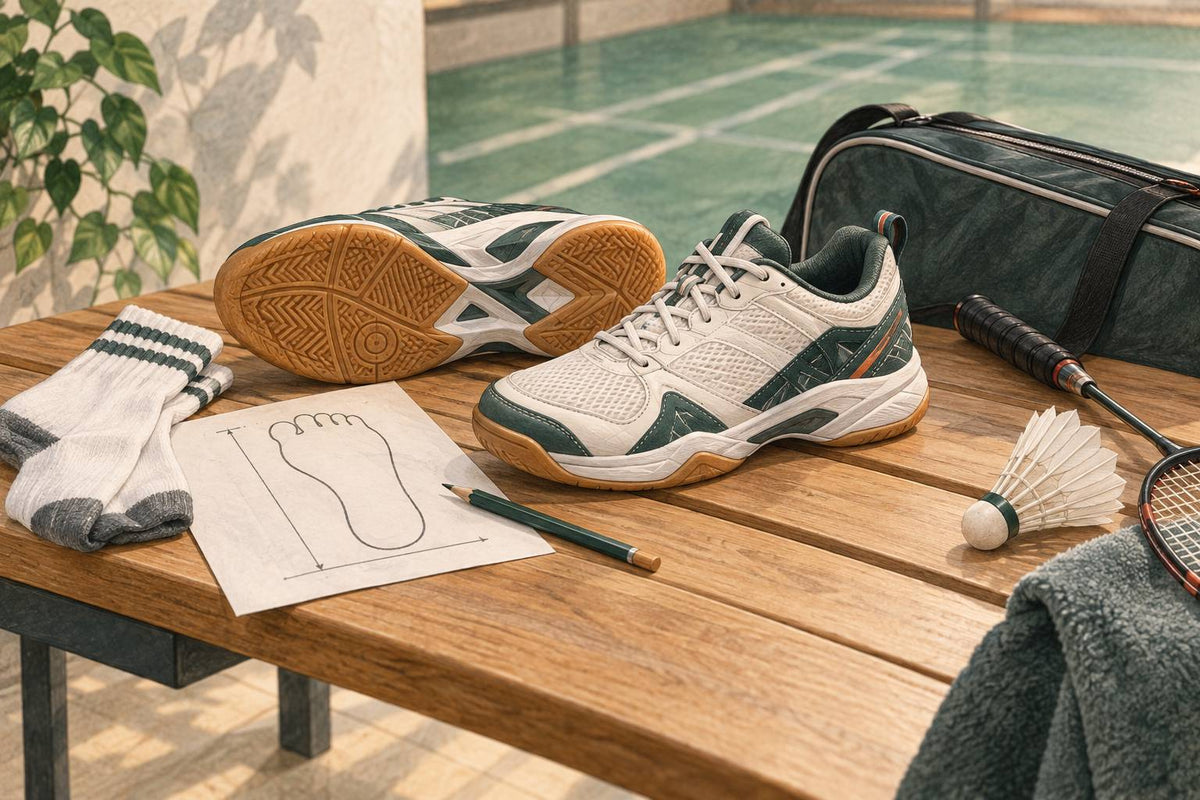
For beginners, the best badminton shoe is the one that keeps your foot locked in during lunges, split steps, and side-to-side recovery. Aim for a snug fit with roughly 5 mm of toe space. That small gap gives your toes room without letting your foot slide around inside the shoe.
Sliding inside the shoe is not harmless: it can cause blisters and waste power because your foot moves before the shoe does. If your heel lifts, your midfoot swims, or your toes hit the front on hard stops, the size or shape is not right.
Beginner fit checklist
- Toe space: about 5 mm at the front, not a full running-shoe gap.
- Heel lock: your heel should feel secure when you push sideways.
- Midfoot hold: the shoe should feel snug through the laces, not loose or baggy.
- No pressure points: snug is good; numbness, pinching, or sharp rubbing is not.
Before ordering, compare your measurements with our size guide.
Foot shape matters as much as shoe size
Two players can wear the same number size and still need different shoes. The toe box, heel shape, and midfoot width all affect whether the shoe feels stable on court.
| Foot shape | What to look for | Beginner note |
|---|---|---|
| Wide feet | Broader toe boxes; Li-Ning and Victor are often better starting points for wider feet. | Do not size up just to get width if it makes your heel loose. Read our wide-feet badminton shoe guide. |
| Narrow feet | Yonex typically fits narrower feet better. | Prioritize heel and midfoot lockdown so your foot does not slide during lunges. |
| Unsure | Start with your measured size and check the shoe shape, not just the number on the box. | A secure court-shoe fit should feel more locked-in than a casual running shoe. |
When should beginners replace badminton shoes?
If you play 2–3 sessions per week, expect to replace badminton shoes about every 6–8 months, especially once the gum rubber hardens or the cushioning bounce disappears. As a broader rule, most quality badminton shoes last about 6–12 months of regular play.
To stretch the life of your first pair, keep them for indoor courts, air them out after sessions, and clean the outsoles when dust builds up. For the full court-shoe explanation, see our guide to badminton shoes vs running shoes.
Fit first, brand second. Browse our current badminton footwear in CAD, then use the size guide and foot-shape notes above to avoid buying a shoe that is technically “your size” but wrong for your foot.
Which beginner badminton shoes should you choose?
If you are buying your first real pair, do not overcomplicate it. Start with an indoor non-marking court shoe that fits securely, supports lateral lunges, and lands in the beginner-friendly price band before jumping to flagship speed models.
| Your situation | Choose this | Short verdict |
|---|---|---|
| Most new players playing indoors regularly |
Mid-range court shoe Babolat Shadow Tour — $119.99 CAD sale, in stock at Badminton House |
The simplest match for the $80–130 CAD first-shoe band: badminton-specific grip and support without premium-shoe pricing. See the in-stock pick section for the full rationale. |
| Lowest upfront budget |
ASICS Upcourt tier Canadian retail around $90 CAD |
Good comparison tier if price matters most and you still want an indoor court shoe instead of running shoes. See the budget tier section. |
| You are already playing 2–3 times per week |
Yonex 65-series upgrade tier SHB65Z4M reference price: $184.99 CAD, currently sold out at Badminton House |
A useful upgrade reference once you know you play often enough to justify spending above the beginner band. See the 65-series upgrade section. |
| Wide feet | Prioritize toe-box width | Fit guidance points wider-foot players toward broader toe boxes such as Li-Ning or Victor. Compare options in our wide-feet badminton shoe guide. |
| Narrow feet | Try a Yonex-style fit first | Yonex typically suits narrower feet better. Whatever brand you choose, aim for a snug, locked-in feel with roughly 5 mm of space at the toes. |
| Tempted by flagship speed shoes | Wait unless you know you need them | Flagship Eclipsion/Aerus-class shoes sit around $200+ in the pricing ladder, and elite speed models are not the default beginner pick. Start with comfort, grip, and lateral support. |
Bottom line. If you want the easiest Canadian starting point, browse our badminton footwear collection. At publication, it is a focused two-shoe lineup: one in-stock Babolat option in the $80–130 CAD first-shoe band and one Yonex 65-series upgrade reference currently sold out. CAD pricing; free Canadian shipping on eligible orders over $200.
Get Canadian badminton gear advice + restock alerts
Join the Badminton House list for buying checklists, restock alerts, and practical gear advice for Canadian players.
By subscribing, you agree to receive Badminton House emails and can unsubscribe anytime.
The right beginner badminton shoe should feel secure on court, not complicated. We play badminton ourselves, so if you are comparing models, unsure about fit, or deciding whether to size up, send us a note before you buy — we are happy to help through our contact page.
"Start with a proper indoor court shoe that fits well, grips cleanly, and supports lateral movement — that is the beginner win."
— Badminton House gear advice
Shop Badminton FootwearCAD pricing · Free Canadian shipping on $200+ · Canadian badminton specialty shop


Leave a comment
This site is protected by hCaptcha and the hCaptcha Privacy Policy and Terms of Service apply.