
Last updated: June 2026 · Written by the team at Badminton House
Quick Answer: Best Budget Badminton Shoes
For most Canadian players, the safest budget move is to buy a real non-marking indoor court shoe first, within the budget you can afford.
Default
Best choice: compare the construction and current listing for the Babolat Shadow Tour, or browse the footwear collection for current availability.
Under $100
If your cap is firm, look for an entry-level badminton or indoor court shoe from Canadian specialty retailers or your local club pro shop; prioritize a non-marking sole, low heel, and side support over brand hype.
Avoid
Avoid using regular running shoes for serious badminton; they are built mainly for forward motion, while badminton demands quick lateral moves, lunges, and stable court grip. See badminton shoes vs running shoes or our beginner shoe guide if you are choosing your first pair.
Badminton House prices are listed in CAD. Ships across Canada.
For a true budget pick, start with the essentials: non-marking indoor court soles, reliable grip, a low-to-the-ground feel, side support, and enough cushioning for jumps and hard stops. Those details matter more than the logo on the shoe box.
Check current Canadian court-shoe availability. Browse our badminton footwear collection for current options in CAD. Badminton House ships across Canada.
In This Guide
- Planning a Court-Shoe Budget in Canada
- Rule #1: Confirm a Non-Marking Outsole
- Prioritize Court Grip Over Running-Shoe Cushion
- Budget Shoe Checklist: Grip, Low Heel, Side Support, Cushioning
- Fit and Durability Caveats Before You Buy
- A Court-Shoe Construction Example
- Which Budget Badminton Shoe Should You Choose?
Planning a Court-Shoe Budget in Canada
For the best budget badminton shoes, think in terms of court-safety features first, not brand prestige. Under $100 CAD is usually the entry-level zone: you are trying to get a proper indoor court shoe with non-marking grip, a lower heel, and enough side support for lunges and lateral recovery.
| Budget range | What to compare | Best buying move |
|---|---|---|
| Under $100 CAD | Look for true indoor court construction: non-marking rubber, a tread pattern made for lateral movement, and a low-profile feel. | Do not buy running shoes just to hit the price. If needed, check Canadian badminton specialty retailers or your local club’s pro shop for entry-level court-shoe lines. |
| $100–$130 CAD | Use this as an example budget band, then compare current listings for indoor grip, fit and support. | One construction example to compare is the Babolat Shadow Tour Men’s Badminton Shoes, a proper indoor court shoe rather than a repurposed running shoe. |
| $180+ CAD | Compare features without assuming a higher price means a better fit. | Only stretch here if the fit and support clearly match your needs; it is not necessary for every beginner or recreational club player. |
Check the footwear selection for current prices; the amounts above are planning examples, not live product prices.
Budget reality check. If you can stretch slightly above $100 CAD, shop the current Badminton House footwear collection first. Shoes may make sense as part of a larger gear order with grips, strings, or shuttlecocks.
Rule #1: Confirm a Non-Marking Outsole

If you are shopping for the best budget badminton shoes, start with the outsole before you look at the brand, colour, or cushioning. A badminton non-marking outsole is the bottom layer designed not to leave residue or scuff marks on indoor flooring. It is commonly made from light-coloured gum rubber or specially formulated synthetic compounds that grip polished gym floors without damaging them.
Check the manufacturer’s non-marking designation and your venue’s footwear requirements; outsole colour or the phrase “indoor court compatible” alone does not establish that the sole will not mark.
Budget rule: a low price is not a good deal if the shoe is not accepted on court. For a deeper explanation of outsole markings, indoor-court rules, and shoe alternatives, read our non-marking badminton shoes guide.
Both coloured and natural-gum outsoles can be non-marking. Confirm the exact shoe specification rather than judging the compound by colour.
| What to check | What it means for badminton |
|---|---|
| “Non-marking rubber” | Best sign that the outsole is intended for indoor gym floors. |
| “Indoor court compatible” | A useful phrase for badminton, squash, volleyball, and similar indoor-court footwear. |
| Light gum sole | Appearance alone cannot establish marking behaviour. |
| Dark-coloured rubber | Colour alone does not establish marking behaviour; check the manufacturer’s designation. |
Prioritize Court Grip Over Running-Shoe Cushion

Running shoes prioritize forward running, while badminton requires lateral support and repeated braking. Compare the actual court-shoe fit and construction; heel height alone cannot establish injury risk.
Budget rule: choose court grip and stability before plush cushioning. For a deeper comparison, read Badminton Shoes vs Running Shoes.
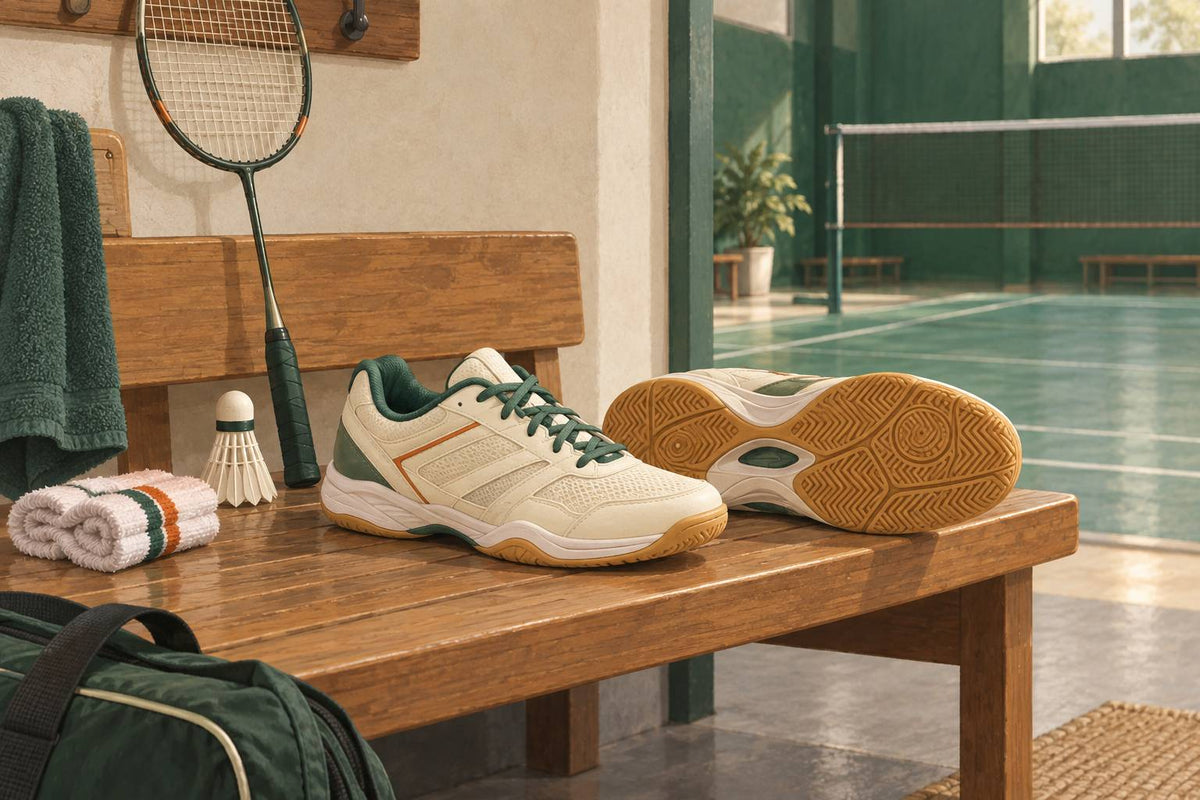
A proper badminton or indoor court shoe usually has a lower profile, better side support, and an outsole designed to grip indoor gym flooring. For budget shoes, look for non-marking rubber, a herringbone or multidirectional tread, and a platform that does not feel tall or wobbly during a gentle fitting check.
| Feature | Running shoe tendency | Budget badminton shoe priority |
|---|---|---|
| Movement support | Mainly forward motion | Sideways, backward, diagonal, and lunge support |
| Heel height | Often higher and more cushioned | Lower profile for balance and court feel |
| Outsole | May not be indoor-court compatible | Non-marking rubber for polished gym floors |
| Tread | Designed for road or general training surfaces | Herringbone or multidirectional grip for quick court changes |
Cushioning still matters. Badminton includes jumps, split-step landings, and repeated lunges, so a shoe with EVA foam, gel-style inserts, or a brand-specific cushioning system can help absorb impact. The key is that cushioning should sit inside a stable court platform, not replace it. A soft running shoe with poor lateral support is not a good budget shortcut.
Try the shoes with your playing socks, lace them normally and check that your heel stays secure and your toes have room during a gentle step and stop. A hand-twist test does not certify support or safety.
For a construction reference, compare the Babolat Shadow Tour Men’s Badminton Shoes, with a Michelin rubber outsole, KPRS-X cushioning, and Active Sculpture technology. You can also compare current options in our badminton footwear collection while keeping the same rule in mind: grip and side support first, cushioning second.
Budget Shoe Checklist: Grip, Low Heel, Side Support, Cushioning

The best budget badminton shoes are not automatically the cheapest shoes on the wall. You do not need the most expensive brand, but you should still choose a shoe built for indoor court sports: grippy outsole, low heel, side support, and enough cushioning for jumps, lunges, and hard stops.
| Checklist item | What to look for | Why it matters |
|---|---|---|
| Grip | Non-marking rubber with herringbone or multidirectional tread. | Badminton requires fast lateral cuts, split steps, and explosive lunges. Smooth or shallow tread can feel sketchy on dusty courts. |
| Low heel | A low-profile court shoe rather than a tall, soft running-shoe platform. | Lower court shoes keep you closer to the floor, which helps balance during lunges and quick changes of direction. |
| Side support | A stable upper, secure midfoot fit, and structure around the outside edge of the shoe. | Badminton shoes are designed for lateral movement and anti-torque protection when your foot loads sideways at speed. |
| Cushioning | Impact-absorbing foam or heel cushioning, such as EVA foam, silicone gel pads, ASICS GEL, or Victor Shock Absorbent Heel. | Cushioning helps absorb impact from jumps and landings, but it should not make the shoe feel tall, unstable, or mushy. |
Simple buying rule. If a budget shoe has court grip, a low heel, side support, and reasonable cushioning, it is a better badminton choice than a more cushioned running shoe that was built mainly for forward motion. For a beginner-specific breakdown, read our best badminton shoes for beginners in Canada guide.
How to judge a budget shoe in 30 seconds
- Flip it over: the outsole should be non-marking and made for indoor courts, not outdoor pavement.
- Press the sidewall: the shoe should resist folding sideways too easily, especially around the midfoot and forefoot.
- Check the heel height: avoid tall, soft platforms that make quick lunges feel wobbly.
- Read the cushioning line: EVA foam, gel pads, and brand-specific heel systems are useful, but only when paired with a stable court base.
- Think indoor-only: soft gum-style court outsoles are meant for wood or rubber indoor surfaces and can wear out quickly on asphalt, gravel, or concrete.
Fit and Durability Caveats Before You Buy
Budget badminton shoes can be a smart buy, but only if the fit and usage match how you actually play. A shoe that saves $20 at checkout is not a good deal if it pinches your forefoot, feels unstable on lunges, or gets destroyed after a few walks to the parking lot.
If you have wide feet, do not assume every brand fits the same
Compare the exact model’s width and toe-box shape. All three major badminton brands offer different fits, so do not assume one brand is consistently wider.
If your toes feel squeezed, your foot spills over the midsole, or you get pressure along the outside edge of your forefoot, move up in width or compare a different brand shape. For a deeper fit breakdown, read our wide-feet badminton shoe guide for Canadian players.
Fit check before you commit. Your heel should feel locked in, your toes should have room to spread slightly, and the shoe should not fold sideways when you push off for a lunge or recovery step.
Keep badminton outsoles indoors
Badminton shoe outsoles are soft because they are built to grip indoor wood or rubber court surfaces. That soft rubber is part of what gives you traction for split steps, side shuffles, lunges, and quick changes of direction.
The tradeoff is durability outside the gym. Wearing badminton shoes on asphalt, gravel, or concrete can wear the outsole down extremely fast. If you want your budget shoes to last, change into them at the court and use a separate pair for walking outside.
- Good use: indoor badminton courts, clean gym floors, wood or rubber sport surfaces.
- Avoid: asphalt, concrete sidewalks, gravel paths, wet parking lots, and outdoor errands.
- Storage tip: carry them in your badminton bag and wipe the sole if dust builds up during play.
A Court-Shoe Construction Example
One court-shoe example is the Babolat Shadow Tour Men’s Badminton Shoes. Check its current price and size options before comparing it with other court shoes.
Construction example: The Babolat Shadow Tour is designed for grip, stability, and comfort on indoor courts.
| Feature | Why it matters for a budget shoe |
|---|---|
| Michelin rubber outsole | Gives you an indoor-court outsole instead of a general running-shoe sole. |
| KPRS-X cushioning | Adds comfort for repeated lunges, jumps, and landings during court play. |
| Active Sculpture technology | Supports the grip and stability you want when changing direction quickly. |
| Size and width | Confirm the exact size options on the current listing. |
Ships across Canada · Canadian badminton specialty shop
Which Budget Badminton Shoe Should You Choose?
Use this decision table when you are trying to stay near or under $100 CAD. The right budget shoe is the one that clears the court-safety basics first: non-marking outsole, reliable indoor grip, low profile, side support, and enough cushioning for jumps and lunges.
| Your situation | Choose this | Why |
|---|---|---|
| You find a true sub-$100 badminton shoe | Buy it only if the product description clearly says non-marking or indoor court compatible. | A good budget shoe should still have indoor-safe rubber and herringbone or multidirectional tread for lateral badminton movement. |
| The sub-$100 option is a running shoe | Skip it for regular play. | For the short version: badminton needs court stability, not just cushioning. If you are comparing shoe types, read Badminton Shoes vs Running Shoes. |
| You can stretch slightly above $100 | Check the current Badminton House footwear collection first. | Compare the current listing for the Babolat Shadow Tour, whose features include a Michelin rubber outsole, KPRS-X cushioning, and Active Sculpture technology. |
| You have wide feet | Prioritize fit before brand or price. | Check each model’s width and toe-box shape rather than assuming a brand-wide fit. |
| You are buying your first badminton shoe | Start with court-shoe fundamentals, then compare price. | You do not need the most expensive brand, but the shoe still needs good grip, a low heel, and side support. For a broader first-pair walkthrough, see Best Badminton Shoes for Beginners in Canada. |
| You need strict sub-$100 CAD pricing | Look for entry-level badminton court lines from Canadian specialty retailers or your local club pro shop. | Keep non-marking court-shoe requirements in the comparison and check current prices. |
Get new badminton guides by email
Join the Badminton House list for occasional emails with new guides, technique tips and news from our club in Moncton.
By subscribing, you agree to receive Badminton House emails and can unsubscribe anytime.
The best budget badminton shoes are not always the cheapest pair on the shelf — they are the pair that keeps you stable, grips indoor courts properly, and fits your foot without forcing you into running-shoe mechanics. We play badminton ourselves, so if you are unsure whether a shoe is right for your level, court surface, or foot shape, contact us and we will help you choose honestly.
Need proper indoor court shoes?
Shop our current badminton footwear options, or ask us for help before you buy.
Shop Badminton FootwearShips across Canada · 14-day returns · Canadian badminton specialty shop

Leave a comment
This site is protected by hCaptcha and the hCaptcha Privacy Policy and Terms of Service apply.