
Last updated: July 2026 · Written by the team at Badminton House
Quick Answer: Feather Shuttlecocks in Canada
If you are buying feather shuttlecocks for regular Canadian club play, start with a 77 or 78 speed shuttle and choose the tier based on how much consistency you need versus how many tubes your group goes through.
Default
Mid-grade goose feather, speed 77–78: the safest starting point for adult club nights because quality depends on feather selection, construction and storage as well as species, while 77 and 78 are useful trial options where the club recommends them, subject to a hall speed test.
Premium
Top-grade goose feather: choose this for tournaments, serious league matches, or players who care most about stable flight, clean feel, and shuttle-to-shuttle consistency.
Value
Duck feather or hybrid: use these for high-volume practice, schools, or clubs trying to control shuttle cost; duck feathers play closer to feather than nylon but typically wear faster than goose.
Test a sample tube in the hall where you play, then compare flight consistency and usable shuttles per session before ordering in quantity.
Feather shuttlecocks are more precise than nylon, but they are also less forgiving to buy casually. Goose versus duck feather, cork quality, speed rating, storage, and club-volume cost all matter. This guide is written for Canadian players choosing between premium match shuttles, mid-tier training tubes, value options, and newer hybrid designs—without assuming the most expensive tube is automatically the best choice for your group.
Need shuttles for your next session? Use this guide to choose the right type and speed, then check live shuttlecock availability before you buy.
In This Guide
- What Makes a Feather Shuttlecock Different?
- Goose vs Duck Feather Shuttlecocks
- Grades and Model Tiers: Premium, Mid, Value, and Hybrid
- Speed Ratings: Choose for the Actual Hall
- How to Check If Your Shuttle Speed Is Right
- Humidification and Winter Care for Canadian Players
- Buying for Yourself vs Buying for a Club
- Which Feather Shuttlecock Should You Choose?
What Makes a Feather Shuttlecock Different?

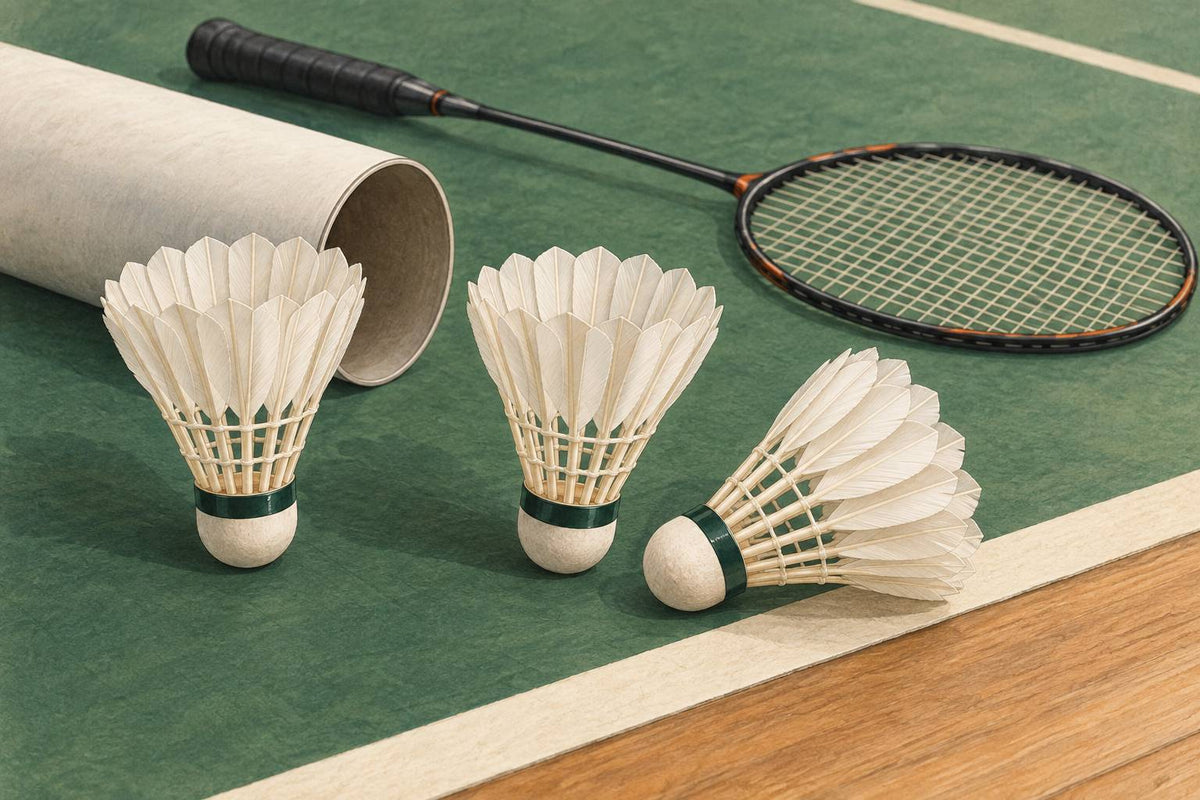
A feather shuttlecock is built to be a very precise flying object, not just a “premium birdie.” Under the BWF Laws of Badminton, a feather shuttle has 16 feathers fixed into a cork base, weighs 4.74 to 5.50 grams, and uses a rounded base that is 25 to 28 mm in diameter. Those small numbers matter: tiny differences in feather shape, weight, cork quality, or speed rating can change how far the shuttle travels and how it feels off the strings.
The basic anatomy looks simple, but every part affects flight:
| Part | What it does | Key spec |
|---|---|---|
| Feather skirt | Creates the drag and spin that make feather shuttlecocks decelerate sharply, tumble naturally at the net, and feel crisp on clean contact. | 16 feathers, each typically 62 to 70 mm from the feather tip to the top of the base |
| Feather circle | Helps keep the shuttle stable in the air instead of wobbling or drifting unpredictably. | Feather tips form a circle of 58 to 68 mm |
| Cork base | The contact point for your racket strings; it affects feel, sound, durability, and consistency from shot to shot. | Rounded bottom, 25 to 28 mm diameter |
| Overall weight | Influences shuttle speed and distance, especially on clears, lifts, and full-court drives. | 4.74 to 5.50 g |
Good feather shuttlecocks are also built with uniform feather construction. The feathers are normally selected from either the left wing or the right wing of a goose or duck, but not mixed together, because mixed feather orientation can make the shuttle less consistent in rotation and flight.
This is the main reason feather shuttlecocks feel different from nylon shuttlecocks. Nylon is more durable and forgiving for casual play, but feather responds more precisely: a clean clear carries with a different arc, a tight net shot can tumble more naturally, and mishits are easier to feel. For Canadian club players moving from nylon to feather, the first surprise is often not speed — it is how much more clearly the shuttle rewards clean technique and exposes off-centre contact.
Still deciding between feather and nylon? Read the full comparison here: Feather vs Nylon Shuttlecocks — What’s the Difference?
Goose vs Duck Feather Shuttlecocks

Most feather shuttlecocks are made with either goose or duck feathers. Both give you the steep drop, touch, sound, and rally feel that players expect from feather shuttlecocks, but they sit in different parts of the buying decision.
Goose and duck feathers are used across different grades; compare the exact model’s construction, consistent flight and usable lifespan rather than treating species as a complete quality rating.
| Feather type | Best fit | What you feel on court | Trade-off |
|---|---|---|---|
| Goose feather | Match play, league nights, tournaments, stronger club groups, and players who care most about flight consistency. | More stable trajectory, better resilience, and a shuttle that usually stays playable longer before the feathers lose shape. | Usually the premium tier, so the upfront tube cost is higher. |
| Duck feather | Training sessions, casual club play, multi-shuttle feeding, and players moving up from nylon without paying premium-feather prices. | Still much closer to real feather play than nylon, with better touch and a more natural drop. | Softer quills tend to split and fray sooner, so flight quality can drop off faster. |
The durability difference matters in Canada because many indoor gyms get dry in winter. Dry feathers become more brittle, so a lower-grade duck shuttle can go from “playable” to “frayed and wobbling” quickly if it has been stored cold or dry. Goose feathers are not immune to poor storage, but their stronger structure gives them a better starting point.
Check specification and condition
Read the manufacturer’s material specification to identify feather type; visual clues alone are not a reliable quality or species test. Inspect the skirt for symmetry and damaged feathers. Then test the shuttle’s flight in the hall. Do not infer species from a generated illustration.
For most club players, the right choice is not automatically “buy the most expensive goose shuttle.” If you are playing competitive doubles, running a league night, or preparing for a tournament, goose feather shuttlecocks are usually the safer performance pick. If you are feeding baskets, coaching beginners, or trying feather for the first time, duck feather can make sense because it keeps the feel of feather play while staying in the value tier.
If you are comparing tubes for an upcoming session, start with the feather type, then check the speed rating for your gym conditions. You can also check live shuttlecock availability before buying for yourself, a club night, or a team order.
Grades and Model Tiers: Premium, Mid, Value, and Hybrid
Feather shuttlecocks are usually easier to choose by tier than by brand alone. A premium goose-feather tube is built for cleaner flight and tighter consistency; a value duck-feather tube is built to keep training costs under control; and hybrid shuttles sit in between for groups that want a more feather-like feel with better wear resistance.
For Canadian players, the best tier also depends on how you use the tube: tournament preparation, weekly club nights, school team training, or high-volume multi-shuttle drills. Use this table as a practical buying map rather than a price list.
| Tier | Examples | What you are paying for | Best fit | Main trade-off |
|---|---|---|---|---|
| Premium goose | Yonex AS40, Yonex AS50 | Compare the exact manufacturer specification and test consistency; a premium model name is not a guarantee for every shuttle in a tube. | Tournaments, serious league play, and players who care most about consistent flight from shuttle to shuttle. | Highest tube cost, so they can feel expensive for casual rallies or high-volume feeding drills. |
| Mid-tier feather | Li-Ning G500, Victor Champion No.1 | A stronger balance of flight quality, durability, and cost control than value tubes. | Most adult club nights, ladder play, and competitive practice where players still want a proper feather feel. | May not feel as crisp or as tightly matched as the very top goose-feather models. |
| Value duck | Victor Champion No.5 and similar duck-feather training tubes | Lower tube cost while still giving the timing, touch, and deceleration pattern of a feather shuttle. | Recreational feather play, beginner-to-intermediate clubs moving up from nylon, and budget-conscious training. | Duck feathers generally wear faster than goose feathers, so flight can drop off sooner once the feathers fray. |
| Hybrid | Victor NCS Pro | Victor describes NCS Pro as a synthetic shuttle, with synthetic feathers and a carbon-fibre stem. | Clubs, schools, and groups that want a more feather-like rally than nylon with improved resistance to wear. | Not the same feel as a full feather shuttle, especially for players who are picky about net touch and slice response. |
Simple buying rule. If you are preparing for matches, start at mid-tier feather or premium goose; if you are feeding drills for a group, value duck or hybrid often makes more sense. For current tube options, check live availability.
The biggest mistake is buying the most expensive tube for every situation. Premium shuttles are excellent when every rally matters, but they are not always the smartest use of budget for multi-shuttle training, junior practices, or casual club nights. Follow the model’s care instructions and test stored stock before a session.
If you are buying for a mixed group, a mid-tier feather shuttle is usually the safest starting point: good enough for serious players to trust the flight, but not so costly that every broken feather changes the mood of the session.
Speed Ratings: Choose for the Actual Hall
Feather shuttlecock speed is not the same thing as quality. It is a flight-distance rating: under the same swing and hall conditions, a faster shuttle travels farther, while a slower shuttle drops shorter.
Most brands use the 75–79 system, where 75 is the slowest and 79 is the fastest. Yonex publishes its own temperature-grade guidance; the comparison below is approximate and is not a universal conversion between manufacturers.
| Common speed | Yonex scale | Relative flight | Canadian buying note |
|---|---|---|---|
| 75 | 1 | Slowest | A slower option to test when the model and hall require it. |
| 76 | 2 | Medium slow | Compare with the model’s guidance and actual hall test. |
| 77 | 3 | Medium | One trial option if recommended by the local club. |
| 78 | 4 | Medium fast | A faster trial option if the current shuttle tests short. |
| 79 | 5 | Fastest | Check suitability against the manufacturer’s guidance and landing test. |
The Canadian pattern comes down to air density. When the hall is colder, the air is denser and the shuttle slows down more quickly, so players often need a faster speed rating to get normal clear length and rally tempo. Choose by measured hall conditions and the standard landing test; Canadian geography alone does not determine the correct speed.
Ask the club which speed it currently uses, then test a small sample; a neighbouring speed may help when a consistent test falls outside the correct landing band.
For club buyers, the mistake is ordering a full box based only on the brand or model tier. Test the speed in your actual hall first. If clears from the back boundary line are consistently falling short, move faster; if routine lifts and clears are drifting long, move slower. For a deeper city-and-season breakdown, use our Badminton Shuttlecock Speed Guide for Canada.
How to Check If Your Shuttle Speed Is Right

The cleanest way to check feather shuttle speed is not by rally feel alone. Use the standard court test: stand behind one back boundary line, contact the shuttle over that line, and hit a full underhand stroke upward in a direction parallel to the sidelines.
Speed Test Target
A shuttle of correct speed should land 530–990 mm short of the opposite back boundary line. In easier court language, you want it to land about 53–99 cm inside the far back line.
- Start behind the back line. The shuttle should be struck from over the back boundary line, not from mid-court.
- Use a full underhand stroke. Do not punch, slice, or half-hit it; the test depends on a full, consistent stroke.
- Send it upward and straight. The flight should travel parallel to the sidelines, not diagonally across the court.
- Check the landing zone. If it lands inside the 530–990 mm window short of the far back line, the speed is suitable for that hall and condition.
| Result | What it usually means |
|---|---|
| Lands more than 990 mm short | The shuttle is playing too slow for the current hall conditions. |
| Lands 530–990 mm short | The shuttle speed is in the correct test window. |
| Lands less than 530 mm short, on the line, or beyond it | The shuttle is playing too fast for the current hall conditions. |
A speed-number change can alter flight distance, but there is no universal thirty-centimetre difference between adjacent numbers across models and conditions.
Canadian hall tip. Test the shuttle in the conditions you will actually play in. Cold winter gyms and strongly air-conditioned halls can change flight distance because colder, denser air slows the shuttle, so a tube that felt right in one venue may not feel right in another.
For club nights, test more than one shuttle from the tube before deciding the whole batch is wrong. If several shuttles land in the same too-short or too-long zone with the same full underhand test, then the speed rating is likely the issue rather than one damaged feather shuttle.
Humidification and Winter Care for Canadian Players
Keep shuttles protected in their tubes and follow the manufacturer’s care instructions; inspect the skirt and test flight before changing speed or buying another batch.
Before adding moisture
Do not assume every feather shuttle needs steaming or a fixed humidification period; construction and care recommendations vary, and this guide does not establish a universal four-hour or two-to-three-day treatment.
Use a controlled care method
If the manufacturer recommends a humidifier, follow its instructions and avoid direct water contact, soaking or visible dampness; compare a small sample before treating club stock.
Where to store feather shuttlecocks in winter
| Do | Avoid |
|---|---|
| Keep tubes in a stable indoor space around room temperature. | Leaving tubes near heaters, radiators, vents, or other heat sources. |
| Store them away from direct sun. | Putting tubes on a sunny windowsill or car dashboard. |
| Bring shuttles into the gym with your racket bag instead of leaving them in the vehicle. | Storing tubes in chilly cars, garages, sheds, or unheated lockers. |
| Remove shuttles gently by twisting them out of the tube. | Forcing or pulling hard on the feathers, which stresses the quills. |
For Canadian clubs buying feather shuttles by the tube or box, this storage routine matters as much as the model tier. A premium goose feather shuttle can still fail early if it sits beside a heater all week or is handled carelessly before league night.
For a broader maintenance routine across shuttles, strings, grips, and shoes, see our badminton gear maintenance checklist.
Buying for Yourself vs Buying for a Club
For most individual players, buying feather shuttlecocks should stay simple: pick a tube or a few tubes, test the speed in your regular gym, and pay attention to feel, feather type, and how well the shuttles survive your normal rallies. You do not need a club-level procurement spreadsheet just to choose shuttles for league night, lessons, or weekend games.
The main difference is decision scale. An individual buyer can adjust quickly after one tube. A club has to think about consistency across courts, player levels, monthly usage, storage, and budget control.
| Buyer type | Best next step | What to focus on |
|---|---|---|
| Individual player | Buy one tube first, then repeat if the speed and durability fit your home court. | Feel off the strings, speed in your gym, goose vs duck feather preference, and whether your care routine keeps the feathers from drying out. |
| Pair or small group | Agree on one speed and one model tier before buying several tubes. | Consistency matters more than chasing the absolute highest grade. If everyone stores tubes differently through a Canadian winter, durability can vary even with the same shuttle. |
| Club organizer or coach | Use the dedicated club guide instead of this individual buyer section: How to Choose Feather Shuttlecocks for Canadian Clubs. | Court volume, player level, model consistency, storage rules, and who controls tube distribution. |
| Treasurer or bulk buyer | Estimate usage and budget with the Badminton Shuttlecock Cost Calculator Canada. | Cost per session, tubes per month, match vs practice allocation, and whether a higher-grade shuttle lasts long enough to justify the spend. |
If you are buying for yourself, start with the shuttle that best matches your regular court conditions, not the one that sounds most premium on paper. A player in a cold, dry prairie hall may end up making a different speed choice than a player in a milder coastal gym, even if both are using feather shuttles for the same level of play.
Need help choosing a tube? Check live availability in our shuttlecocks collection, or contact Badminton House with your city, playing level, and usual gym conditions for practical advice.
Which Feather Shuttlecock Should You Choose?
If you are buying feather shuttlecocks for regular play in Canada, start with the level of play first, then fine-tune speed for your gym. Most players will be choosing between a premium goose feather tube, a mid-tier training tube, a value duck feather tube, or a hybrid shuttle for longer sessions.
| Choose this | Best fit | Why it makes sense | Speed starting point |
|---|---|---|---|
| Premium goose feather | Tournaments, advanced club nights, and players who care most about feel and flight quality. | Best when consistency matters more than tube cost. Examples in this tier include Yonex AS-40 and AS-50. | Use the club’s tested speed and confirm the landing band. |
| Mid-tier feather | League players, school teams, and clubs that want feather feel without always using the top tournament tier. | A practical default for regular training where you still want real feather response. | 77 or 78, then confirm with the standard landing test. |
| Value duck feather | Beginners moving from nylon, casual feather nights, and high-volume drills where cost control matters. | A lower-cost way to learn feather timing, especially if shuttles are shared across a group. | Confirm speed in the actual hall before ordering in quantity. |
| Hybrid shuttle | Training groups that want a feather-like option with better wear resistance than standard duck feather shuttles. | Useful when durability is the main buying pressure but nylon feel is not ideal. | Look for 77 Medium or 78 Fast where available. |
Buying for a Canadian club or team? Start with the tier you can afford to use consistently, then check live availability in the shuttlecocks collection before ordering by the tube or case.
Get new badminton guides by email
Join the Badminton House list for occasional emails with new guides, technique tips and news from our club in Moncton.
By subscribing, you agree to receive Badminton House emails and can unsubscribe anytime.
If you are buying feather shuttlecocks for club nights, team training, or tournament-style play, the right tube depends on your hall temperature, local humidity, player level, and how quickly your group goes through birds. We play badminton ourselves, so if you are unsure whether to choose speed 77 or 78, goose or duck, or feather versus nylon for your group, contact us and we will help you narrow it down.
Need shuttlecocks for your next Canadian club night?
Check Shuttlecock AvailabilityCanadian badminton specialty shop; check current shipping and return terms.


Leave a comment
This site is protected by hCaptcha and the hCaptcha Privacy Policy and Terms of Service apply.