
Last updated: July 2026 · Written by the team at Badminton House
Quick Answer: Rear Court Rotation in Doubles
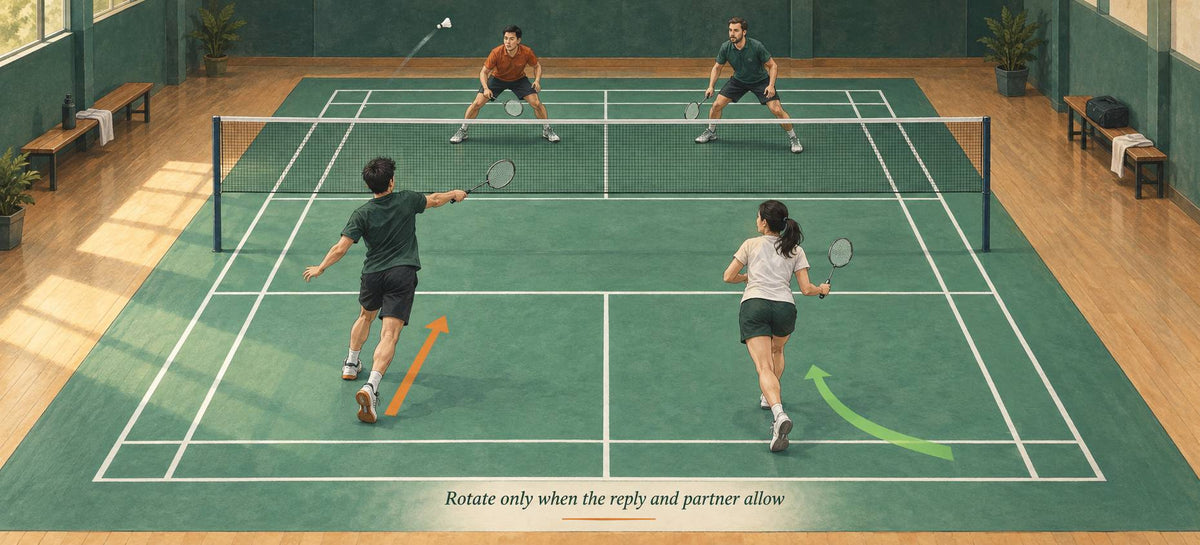
Rotate forward only when a straight or middle attack makes the reply predictable and your partner releases behind you. Stay rear when your angle opens space. After a clear or lift, reset side-by-side.
Rotate forward
Best choice: use after a straight or middle drop or steep attack that keeps the likely reply short.
Stay rear
Use after cross-court or wide attacks that your partner cannot cover safely.
Reset defence
Use after a clear or forced lift; split side-by-side before the next attack.
If you keep smashing from the back and your legs feel like the rally is happening to you, the problem is usually not effort — it’s rotation. In good doubles, the rear player is not supposed to live there. Your shot either protects a forward escape or tells you to stay and cover the next reply.
Think of rear court rotation in badminton doubles as a handoff with conditions, not a random swap. Hit down and your pair can stay in attack; get forced to lift and you reset side-by-side. This guide focuses on the awkward middle: which rear-court shots invite your partner’s takeover, which ones trap you behind, and how to spot the failed handoff before both players chase the same shuttle.
In This Guide
Rear court rotation in badminton doubles starts with the shot trigger
Rear court rotation in badminton doubles is not decided by a pre-planned pattern; it is decided by the shot you just played. The simple rule is: if your shot travels downward, you can keep the front/back attack. If you are forced to lift or clear, the pair should recover side-by-side for defence.
Safe forward handoffs usually start from straight or middle rear-court attacks. Those placements reduce the reply angle and make the most likely return more predictable for the front player. A rear-court drop can create a rotation opportunity, but move forward only when your partner releases behind you and the reply gives you time.
Be more cautious after wide or cross-court attacks; those often leave you responsible for the opened space. The safest exception is a steep, sharp finish that gives opponents little chance to return. If the kill is flatter, keep it straight so you can still cover a possible net reply. For broader placement choices, see the doubles shot placement guide.
Shots that require the hitter to stay in the rear court
Not every rear-court shot is a rotation invitation. A clear is the simplest example: once you lift or clear under pressure, your pair has usually given up the attack, so the correct response is to reset into side-by-side defence rather than trying to swap front and back.
The more deceptive trap is the cross-court smash. It feels aggressive, but it often opens the opposite side, gives the defenders more time because the shuttle travels farther, and reduces the front player’s ability to intercept. That means the rear hitter has created a reply lane that belongs to them, not to their partner.
Classic error: smashing cross-court, then drifting forward as if it were a straight attack. If you choose the cross-court smash, stay rear and be ready for the cross-court block, drive, or lift. The shot has cancelled the handoff.
The curved forward recovery and the partner’s timed takeover
Think of the handoff as a curved chase, not a straight sprint to a fixed “base.” The rear player follows the shuttle forward only when the reply lands short enough, or the attacking shot is deep and straight enough, that the partner has time to move behind and protect the rear court. The curve matters: recover through the middle channel, arriving ready for the next net or midcourt shuttle without drifting into your partner’s lane.
Often, the front player triggers the rotation. They cannot look back during the exchange, but the rear player can see them, so the front player must physically move to show intent. If the front player drops back, the rear player can continue forward; if the front player holds, the rear player should stay responsible for the back.
When pulled into a wide rear corner, balance the gap your partner leaves instead of racing to a memorized spot. For deeper movement detail, see our rear-court footwork distance guide.

Failed-handoff diagnostics: why the rear player gets trapped
If the rear player feels chained to the back, diagnose the handoff before blaming fitness. Most failed rotations show up as one of these patterns:
- Both players in the same zone: one player must rebalance the court instead of chasing the same shuttle.
- The switch happens too early or too late: rotate only when the shot has created time and a predictable reply.
- The rear player lunges forward for interceptions: the front player should own loose net and midcourt replies.
- Passive front-court body language: keep the racket up and show intent to attack the next shuttle.
- The cross is not cut off: if the front player leaves that lane open, the rear player gets dragged into a defensive scramble.
Film one game from high behind the backcourt. You will see the gaps, late switches, and duplicate coverage immediately. Add simple calls: “mine” to claim, “yours” to hand off.
Which Choice Should You Make?
Use the shot result, not hope, to choose the rotation. If the next reply is likely to be short or predictable, rotate. If your shot opens angles or gives up attack, protect the back first.
| Choice | Choose this when... | Partner cue |
|---|---|---|
| Rotate forward | You attack straight or middle, play a drop you can follow, or finish steep enough that the reply is under pressure. | Front player releases backward early enough to take the next lift. |
| Stay rear | You smash cross-court, get pulled wide, or create a reply that can pass the front player. | Front player holds the net or midcourt gap instead of drifting into your lane. |
| Reset side-by-side | You are forced to lift or clear and the pair has given up the attack. | Both players move out of front/back shape and prepare to defend. |
Get 10% off your first order
Join the Badminton House list and we’ll email you a 10% welcome code — plus training guides, technique advice, and badminton updates.
By subscribing, you agree to receive Badminton House emails and can unsubscribe anytime.
Rear-court rotation is easier when both players know what the shot allows: follow safe straight pressure, stay when the angle leaves your partner exposed. We play badminton ourselves, so if your pair keeps getting stuck in the back, send us a note through our contact page and we’ll help you think through the pattern.
Explore footwear for quick stops, balanced recoveries, and doubles rotation work.

Leave a comment
This site is protected by hCaptcha and the hCaptcha Privacy Policy and Terms of Service apply.