
Last checked: August 2026 · Written by the player-led team at Badminton House
Good small-sided badminton games make one useful decision easier to see. Pick a rally problem, reduce the space or choices enough for players to meet it, then change one constraint after watching the group. U11 and U13 are squad labels here, not automatic prescriptions for court size or difficulty.
Quick answer: start with 1v1 in a compact lane and one clear objective. If the shuttle rarely crosses the net, simplify the feed or shorten the playable length. If rallies are stable but decisions are automatic, add one destination or a second player. Change one dial at a time.
This is a readiness-based game card for indoor squads, not a BWF age curriculum. For court rotation and waiting-time logistics, use our guide to badminton games for large groups.
Choose the behaviour before the game
The BWF Shuttle Time teachers’ manual asks teachers to adapt activities and equipment to players’ needs, ability and progress. It also describes shortening a court so it is easier to cover and illustrates half-court 2v2 and 2v1 work. That supports adjustment; it does not supply one compulsory U11 or U13 setup.
Write one sentence before play: “This game should reveal whether players can ______.” Use an observable action such as recover after a net reply, keep the racket available in a drive exchange, choose between front and back space, or reconnect with a partner.
| What you see | Change one dial | Keep constant |
|---|---|---|
| The rally ends before the target decision appears | Use an easier feed, fewer destinations or a shorter playable length | The behaviour you are observing |
| The rally continues but every choice is obvious | Add one legal destination or remove the predictable feed | Court orientation and player roles |
| One player takes nearly every shuttle | Add a connection condition or switch to 2v1 | Rally speed |
Five small-sided badminton games
These five cards are Badminton House adaptations of BWF constraint, differentiation and progression principles. They are not validated protocols or prescribed age-group doses. Run a short block that gives several chances to make the target decision, then observe before changing it.

1. Front-box keep-alive
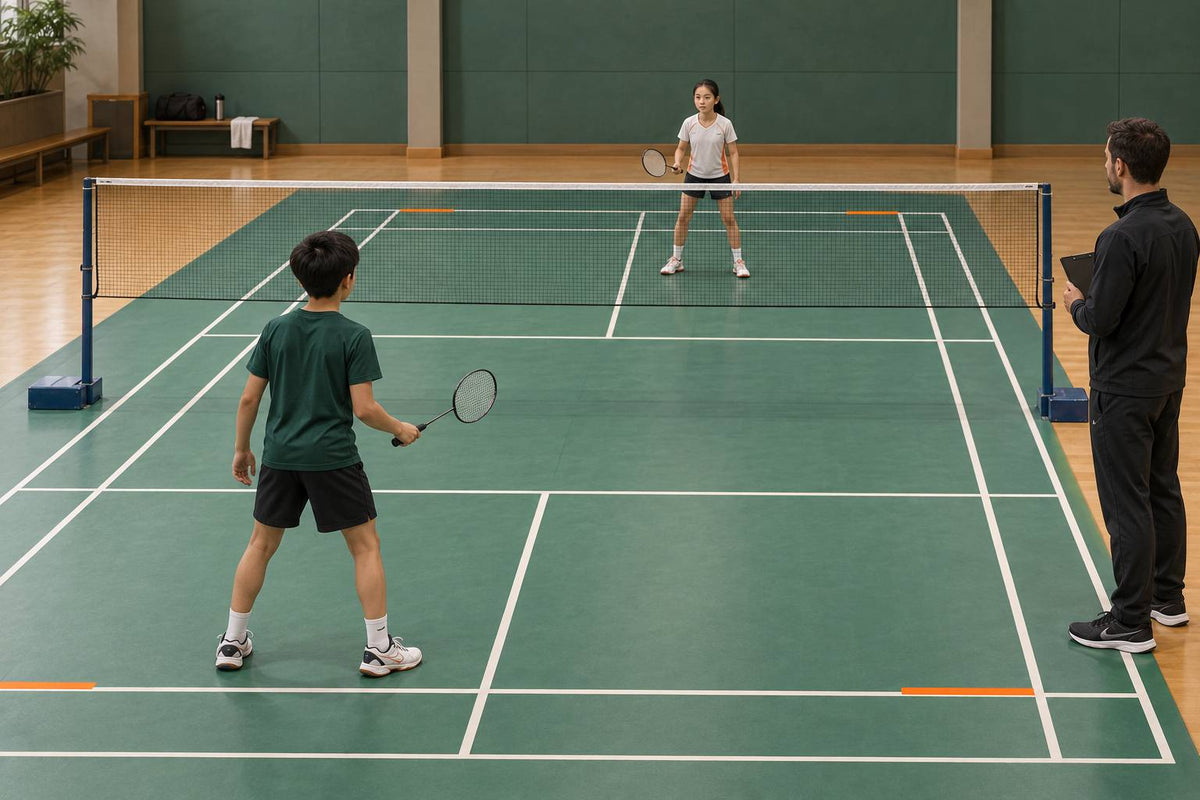
Set up: play 1v1 on a half court with only the forecourt and nearby midcourt in. Begin with an underhand feed. Target behaviour: control a soft reply, recover enough to see the opponent and continue the rally. One adjustment: if control is fragile, allow a catch-and-toss feed; if it is stable, let either player lift into one marked rear target.
2. Midcourt drive lane
Set up: play 1v1 in one parallel half-court lane, with the forecourt and deep rear court out. Feed flat at a manageable pace. Target behaviour: recover the racket between contacts and keep balance through a changing forehand/backhand exchange. One adjustment: widen the legal area only after players can redirect without swinging into the next court.
3. Short-court singles
Set up: play 1v1 in a court shortened from the rear, using tape or an existing line that everyone can see. Target behaviour: recover to a useful position and create space instead of winning only through distance. One adjustment: move the rear boundary back when both players can sustain the rally and still reach the next shuttle under control. For more shared-court options, see our half-court badminton drills.
4. Two-depth choice
Set up: keep 1v1 but mark one front target and one rear target. A rally point counts normally; award one additional practice point when a player reaches either target with a legal shot. Target behaviour: look at opponent position and choose depth. One adjustment: begin with a predictable feed, then let the feeder alternate freely once the player is reading rather than rehearsing.
5. Connect-two 2v1
Set up: put two players on one half court against one player opposite. The pair earns an additional practice point if both partners make a contact during the rally before it ends. Target behaviour: recover into complementary space and leave a playable next shot for a partner. One adjustment: rotate the solo player often, or remove the extra point if it makes players force low-quality touches.
Adjust U11 and U13 sessions by response, not label
The BWF Coach Education Level 1 manual progresses practice from simple to complex, slow to fast and predictable to unpredictable, while recognizing that players in one group may need different levels. Use that progression inside either squad.
| Squad check | If the answer is not yet | If the answer is consistently yes |
|---|---|---|
| U11: can players start safely, sustain the basic exchange and name the game’s one objective? | Slow the feed, reduce the choice or shorten the playable length | Make the feed less predictable or add one destination |
| U13: can players keep the rally task while recovering, choosing space or sharing responsibility? | Return to one clear role and a predictable opening | Open more court or move from a pattern into conditioned play |
These are coaching questions, not claims about what every child at that age should do. If movement quality is the current bottleneck, pair the game with a focused junior coordination activity rather than adding another scoring rule.
What junior studies show—and what they do not
Two studies support testing modified environments, but neither isolates a universally best court size.
| Study | What changed | Boundary |
|---|---|---|
|
2020 U11 comparison 28 players; 8,888 strokes; 42 matches per condition |
Standard: 13.40 m × 5.18 m, 1.55 m net, game to 21. Mini: 11.88 m × 5.18 m, 1.30 m net, game to 15. | Play patterns changed, but stroke-effectiveness and rally findings did not establish a simple universal benefit. Several constraints changed together. |
|
2026 crossover study 30 right-handed boys; one Malaysian academy; mean age 13.17 ± 0.83 |
Standard: 6.1 m × 13.4 m, 1.55 m net, standard scoring. Modified: 5.41 m × 11.86 m, 1.38 m net, bonus/deduction scoring. | The modified package produced more successful and winning strokes and fewer unforced errors in that sample. Retention and transfer were not tested, and carryover could not be ruled out. |
The practical conclusion is modest: modified space and rules can change the game players experience. Observe the result of the whole package; do not credit one line, net height or bonus rule when several changed at once.
Keep the small game physically separate
The BWF Shuttle Time safety guidance tells teachers to clear loose shuttles, leave enough space between pairs and right-/left-handed swings, position feeders safely and secure net posts. The teacher also controls intensity and frequency for the group and individual.
- Mark each live area clearly and keep waiting players outside it.
- Stop every court before collecting shuttles.
- Reduce feed pace or court traffic before asking for faster decisions.
- End or change a task when control breaks down; the score is never more important than spacing.
The one-change review
- Name the behaviour you wanted to see.
- Describe what actually happened without judging the player.
- Change one constraint: space, feed, choice, player number or scoring.
- Run it again and keep the change only if the target decision becomes clearer.
That loop makes the game fit the squad in front of you. The useful question is not “Which game belongs to this age?” It is “Which version gives these players a safe, repeatable chance to solve today’s badminton problem?”


Leave a comment
This site is protected by hCaptcha and the hCaptcha Privacy Policy and Terms of Service apply.