
Last updated: July 2026 · Written by the team at Badminton House
Quick Answer: How to Hold a Badminton Racket
Start with a relaxed forehand “handshake” grip, then switch to thumb-based backhand or bevel grips when the shuttle moves to your non-dominant side.
Default
Forehand grip: hold the racket like a handshake, keep a small V between thumb and index finger, and stay loose so your wrist can move for clears, drops, drives, and smashes.
Backhand
Put your thumb on the flat side of the handle for leverage for backhand drives, lifts, serves and defensive shots taken in front of you.
Panhandle
Use a panhandle grip mainly for quick front-court taps, net kills, and fast interceptions — not as your all-purpose beginner grip.
If you are new to badminton, the problem usually is not that you are weak — it is that the racket is sitting in your hand the wrong way. A tight, panhandle-style hold can make clears feel heavy, backhands feel powerless, and fast grip changes feel almost impossible during a rally.
Grip technique is only one part of racket feel. If your strings feel dead or uneven, Badminton House offers a Canada-wide badminton stringing service to help keep your racket match-ready.
In This Guide
- Why Does Your Badminton Grip Matter?
- Forehand Grip: The Handshake Starting Point
- Backhand Grip: Use Your Thumb for Leverage
- Bevel Grip: For Backhands Behind You
- Panhandle Grip: Useful Near the Net, Not for Everything
- How Tightly Should You Hold a Badminton Racket?
- Practice Drills and Gear Next Steps
- Which Grip Should You Choose?
Why Does Your Badminton Grip Matter?
Your grip is not just where your hand sits on the handle. It changes the racket face angle, how freely your wrist can move, how much leverage you can create, and how quickly you can adjust between forehand, backhand, bevel, and panhandle positions during a rally.
For beginners, the forehand grip is the starting point because it is the foundation for most forehand shots, including clears, drops, drives, and smashes. A good forehand grip gives you flexible wrist movement instead of forcing every shot with your arm.
The important detail is that one grip does not cover every situation. Players switch between grips depending on where the shuttle is, whether the shot is forehand or backhand, and whether they need power, control, or a quick net interception. If you hold the racket too tightly, those small grip changes become much harder mid-rally.
Gear note for Canadian players. If you are choosing a racket, handle size and grip build-up affect how easily you can relax, rotate, and switch grips. You can browse our badminton rackets. Check the current listing for specifications and availability.
Forehand Grip: The Handshake Starting Point

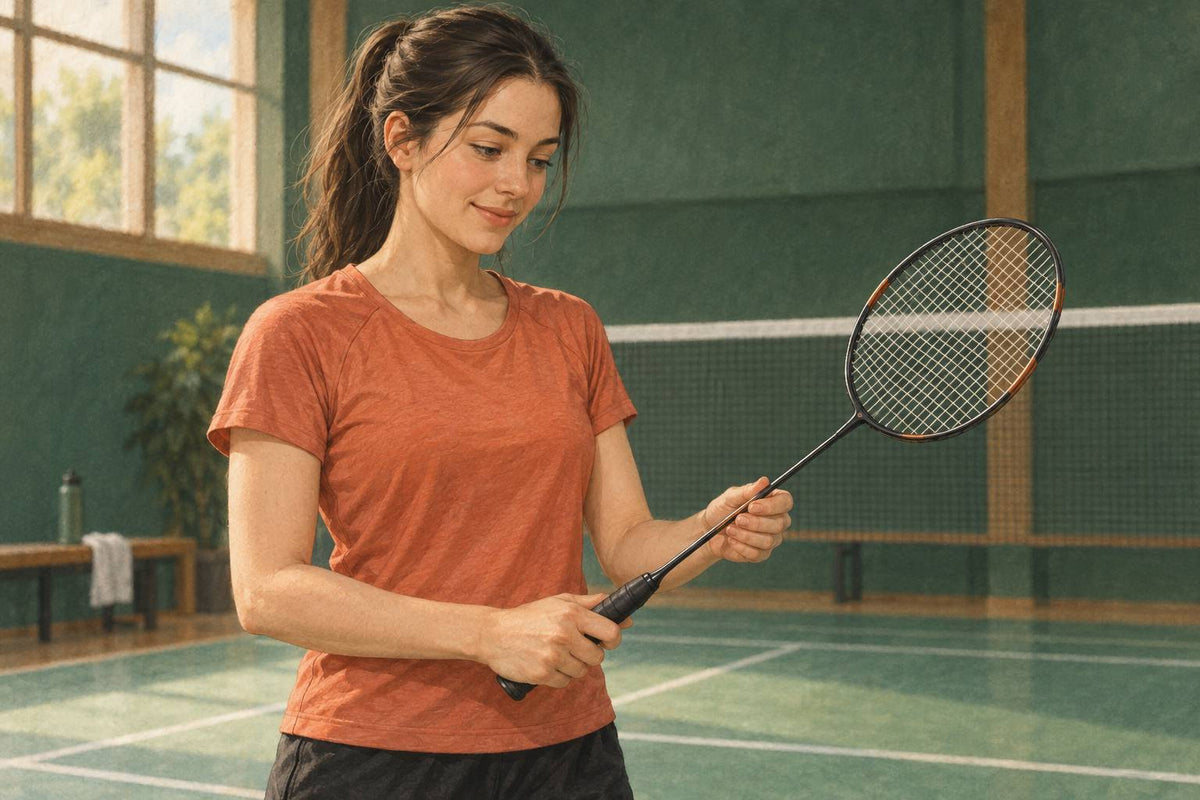
The forehand grip — hold the racket as if shaking hands with the handle, with a V shape between thumb and index finger — is the default badminton grip and the foundation for forehand clears, drops, drives, and smashes. The handle sits naturally in your fingers, your hand stays relaxed, and with the racket held forward at waist height, its string plane is upright and the narrow edge faces the floor during this setup.
Forehand Grip Check
- Hold the racket as if you are shaking hands with it.
- Hold the racket forward with the string plane upright while you find the handshake grip.
- Let your thumb and index finger form a clear V shape on the handle.
- Leave a little space between your index and middle fingers instead of squeezing all your fingers tightly together.
- Keep the hold relaxed so your wrist can move freely.
That V shape is the easiest visual cue. If the V disappears because your hand has rolled too far around the handle, the racket face will usually point the wrong way at contact. If all four fingers are clamped together, the grip often becomes too tense and makes it harder to adjust during a rally.
Beginner photo tip. Take one close-up photo from above the handle to check the V between your thumb and index finger, then another from the side to check the relaxed space between your index and middle fingers. If your grip feels too bulky or too small, compare handle setup options in our badminton grip size guide.
Backhand Grip: Use Your Thumb for Leverage

To change from forehand grip to backhand grip, start from your handshake position and rotate the handle so the racket face is parallel to the floor. Then place your thumb on the flat side of the handle, in line with the racket face.
Backhand grip checkpoint
- Start in your forehand handshake grip.
- Rotate the handle until the racket face is parallel to the floor.
- Put your thumb on the flat side of the handle, aligned with the racket face.
- Keep the fingers relaxed until you are ready to hit.
The thumb is the key. On backhand shots, pressing with the thumb gives you leverage through the handle, so you are not trying to lift or block the shuttle using only your wrist. That thumb pressure helps with control and power on non-dominant-side backhands, including drives, lifts and defensive blocks taken in front of you.
A good beginner test is to hold the racket in backhand grip and make a short pushing motion forward. If your thumb is sitting on the flat side, the racket face should feel stable as you push through the shot. If the racket twists in your hand, you are probably holding too loosely at contact, placing the thumb on the wrong bevel, or squeezing the handle from the start instead of tightening at the hit.
Use this backhand thumb grip when the shuttle is level with you or in front of you on the backhand side. If the shuttle has already travelled behind you, do not force the same thumb position — that is where the bevel grip comes in next.
Bevel Grip: For Backhands Behind You

The bevel grip is the beginner-friendly answer to a very specific problem: a backhand shuttle that has already travelled behind your body. If you try to use a standard backhand thumb grip from that position, the racket face often points the wrong way and the shot feels jammed. The bevel grip lets the racket face sit at a more useful angle for rear-court backhand clears, drops, and smashes.
Start with the racket held forward in the thumb grip, then roll the handle until your thumb pad rests on the adjoining narrow diagonal bevel. The string plane now sits diagonally rather than flat to the floor. Adjust for the contact position rather than treating 45 degrees as a fixed playing angle.
Simple decision rule
If the shuttle is level with you or in front of you, use the standard backhand grip with the thumb on top. If the shuttle is behind you, especially on a rear-court backhand, rotate into the bevel grip.
When to use the bevel grip
| Shuttle position | Better grip choice | Why it helps |
|---|---|---|
| Level with your body | Standard backhand grip | Your thumb can press through the flat side of the handle for leverage and control. |
| In front of your body | Standard backhand grip | You do not need the extra racket-face angle because the shuttle is still reachable in front. |
| Behind your body | Bevel grip | The diagonal racket face makes rear-court backhand clears, drops, and smashes more natural. |
A good way to test this is with slow shadow swings. Set up as if the shuttle has gone past your non-racket shoulder, rotate from backhand to bevel, and make a controlled backhand clear motion. Do not squeeze the handle early. Keep the grip relaxed so your fingers can turn the racket, then tighten only as you would make contact.
If your bevel grip still feels awkward, check two things before blaming your racket: first, whether your thumb is truly on the bevel instead of flat on the back; second, whether the racket face is actually diagonal. Many beginners think they have changed grips, but only move the wrist while the handle stays in the same place. The handle should rotate in your fingers.
For more on how handle thickness affects grip changes, see our badminton grip size guide. If you are also maintaining an older racket, our gear maintenance checklist can help you decide when strings, grips, shoes, and shuttles need attention.
Panhandle Grip: Useful Near the Net, Not for Everything
The panhandle grip gets its name because it looks like you are holding a frying pan. Instead of the racket sitting slightly slanted like a normal forehand grip, the racket face is held more squarely so it is directly parallel to the net.
That position can be useful in the front court. When the shuttle is close to the tape and you only need a short, direct movement, the panhandle grip works well for quick taps, net kills, fast interceptions, pushes, and kill shots.
Beginner warning: many new players naturally hold the racket in a panhandle grip for every shot. Use it as a front-court tool, not as your default grip for clears, drops, drives, smashes, and backhands.
| Situation | Grip choice | Why |
|---|---|---|
| Shuttle is tight to the net and in front of you | Panhandle | Best for short, fast front-court actions like taps, interceptions, pushes, and net kills. |
| Forehand clear, drop, drive, or smash | Forehand grip | The forehand grip is the foundation for most forehand shots and allows flexible wrist movement. |
| Backhand in front of you or level with you | Backhand thumb grip | Your thumb on the flat side gives leverage and control for backhand shots. |
| Backhand shuttle is behind you | Bevel grip | The bevel grip is used when the shuttle is behind you, especially for rear-court backhand situations. |
A simple self-check: hold your racket out in front of you. If the strings are facing the net flat-on like a frying pan, you are in panhandle. That is fine near the net. If you notice you are still holding that shape for every rally shot, reset to your forehand grip first, then switch only when the shot demands it.
If the racket keeps twisting in your hand while you practise switching grips, the issue may be grip size or grip build-up rather than technique alone. See our badminton grip size guide and overgrip vs replacement grip guide for the gear side of the fix.

How Tightly Should You Hold a Badminton Racket?
Hold the racket loosely for most of the rally and tighten your fingers only at the moment of contact. The biggest beginner mistake is not usually choosing the wrong grip — it is squeezing the handle too hard, because a tight hand makes it harder to switch between forehand, backhand, bevel, and panhandle positions during a rally.
Think of the racket handle as something your fingers can adjust, not something your palm has to clamp. Stay relaxed while you prepare, then tighten only as you swing into the shuttle. Finger pressure supports the wider swing and forearm action; the relative contribution changes with the stroke.
Beginner cue: loose fingers before the shot, firm fingers at contact, relaxed again after the shot. If your hand stays tense the whole rally, your grip changes will feel slow and your shots will usually feel forced.
| Moment | What your hand should do | Why it helps |
|---|---|---|
| Ready position | Keep the fingers relaxed around the handle. | You can rotate quickly into forehand, backhand, bevel, or panhandle as the shuttle changes direction. |
| During the swing | Begin tightening as the racket accelerates. | A relaxed start allows a smoother swing path instead of a stiff push. |
| At contact | Firm the fingers as part of the stroke’s coordinated action. | This gives a sharper hit without needing to squeeze the racket for the whole rally. |
| After contact | Relax the hand again. | You are ready to switch grips for the next shot instead of staying locked in one position. |
A relaxed hold between contacts makes grip changes easier; it is not a treatment or prevention guarantee for elbow pain. If your elbow or wrist already gets sore after badminton, see our guide to badminton elbow and wrist pain before blaming only your racket.
A simple check: if you cannot change from forehand grip to backhand grip without peeling your whole hand off the handle, you are probably holding too tightly. Loosen the last few fingers, let the handle turn slightly in your hand, then tighten only when the shuttle is about to meet the strings.
Practice Drills and Gear Next Steps
You do not need a shuttle to build better grip habits. The best beginner practice is slow, quiet, and repetitive: shadow swings and shadow badminton help you rehearse the forehand and backhand swing paths, follow-through, form, and grip changes before a rally speeds everything up.
Simple no-shuttle grip practice
- Forehand shadow swings: start in your handshake grip, keep the hand relaxed, swing slowly through an imaginary clear or drive, and finish with a clean follow-through.
- Backhand shadow swings: start from your forehand grip, rotate into your backhand thumb grip, then push through the imagined contact point with your thumb providing leverage.
- Grip-switch reps: move from forehand to backhand to bevel grip without squeezing the handle. The goal is smooth switching, not maximum force.
- Shadow badminton: add footwork and pretend rally situations. Move to the shuttle, set the correct grip, swing, recover, and repeat.
For gear setup, the next two details are grip size and grip material. If the handle feels too bulky or too thin, read the G4, G5, and G6 badminton grip size guide. If you are deciding between an overgrip, replacement grip, or towel grip, use the badminton grip type guide.
Racket care. Check current listings for grip supplies. For maintenance beyond grips, see our badminton stringing service.
Which Grip Should You Choose?
The short answer to how to hold a badminton racket: start loose in a forehand grip, then switch based on where the shuttle is and which side of your body you are hitting from. Use this table as your on-court decision helper.
| Situation | Choose this grip | Why it fits | Beginner mistake to avoid |
|---|---|---|---|
| Most forehand shots: clears, drops, drives, and smashes | Forehand grip | It is the foundation grip and allows flexible wrist movement for common forehand shots. | Do not squeeze the handle tightly from the start; keep the fingers relaxed so you can switch grips quickly. |
| Backhand shots on your non-dominant side when the shuttle is level with or in front of you | Backhand thumb grip | The thumb on the broad flat face supports backhand drives, lifts and blocks taken in front. | Do not leave your hand in a forehand position and try to flick the shuttle without thumb support. |
| Backhand rear-court shots, especially when the shuttle is behind you | Bevel grip | With the thumb further around on the bevel and the racket face tilted diagonally, it suits rear-court backhands and stretched defensive situations. | Do not use the standard backhand thumb position when the shuttle has already gone behind you. |
| Quick taps, net kills, push shots, and fast interceptions near the front court | Panhandle grip | It positions the racket face more directly toward the net, which helps on short, fast front-court contacts. | Do not use panhandle for every shot; many beginners fall into that habit and lose forehand and backhand versatility. |
| Attacking overhead shots such as jump smashes | Forehand grip with a brief firming of the fingers | Coordinate the overhead swing and forearm rotation, firming the fingers through contact. | Do not lock the hand into a rigid fist or treat wrist snap alone as the source of power. |
Handle feel matters too. If the racket feels too thick, too thin, or hard to rotate in your fingers, compare G4, G5, and G6 grip sizes and read our overgrip vs replacement grip vs towel grip guide before changing your setup.
As you practise switching grips, also pay attention to grip pressure: stay relaxed before contact, then tighten as you hit. If your racket also needs maintenance while you are tuning your setup, Badminton House offers a Canada-wide stringing service.
Get 10% off your first order
Join the Badminton House list and we’ll email you a 10% welcome code — plus subscriber-only restock alerts, giveaways, and honest gear advice from players.
By subscribing, you agree to receive Badminton House emails and can unsubscribe anytime.
Grip changes feel awkward at first, but they get cleaner with relaxed hands, simple repetition, and honest feedback. We play badminton ourselves, so if you are not sure whether your grip problem is technique, handle size, strings, or racket setup, contact us and we will help you think it through like a fellow player at the club.
Build a setup that feels right in your hand.
Start with the right racket shape, grip feel, and maintenance plan so your technique can improve without fighting your gear.
Browse Badminton RacketsCanadian badminton specialty advice from players who understand the game.

Leave a comment
This site is protected by hCaptcha and the hCaptcha Privacy Policy and Terms of Service apply.