
Last checked: August 2026 · Written by the player-led team at Badminton House
Quick answer: measure, repeat, then compare
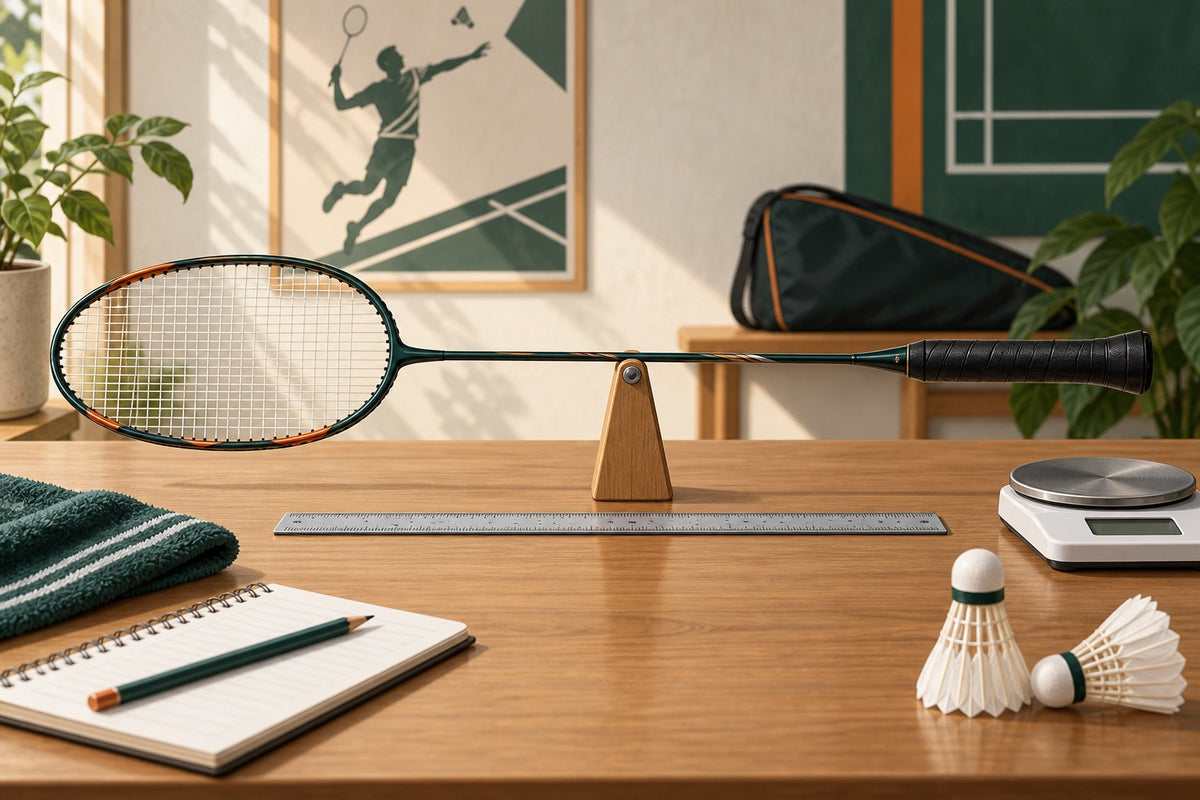
Measure the complete racket as you play with it. Weigh it, balance it on a stable narrow edge, measure from the butt cap to that pivot, and repeat the full setup. For a matched pair, compare repeated ranges only after strings, grips and accessories are equivalent.
Setup
Compare like with like: record strings, grip layers and every attached accessory before measuring.
Repeat
Lift and reset the racket between readings instead of repeatedly nudging one position.
Compare
Judge the pair from its reading ranges, not from one attractive number or a universal balance category.
This is particularly useful when Racket A feels natural and Racket B feels late even though both carry the same model name. Measuring first prevents you from changing grips, strings or frame weight before you know what already differs.
Related reading: If you need the basic measuring procedure, start with our balance-point and weight guide. This companion focuses on repeat-reading spread and diagnosing two same-model frames. If a static match still feels different, use our swingweight guide.
What does badminton racket balance point tell you?
Balance point is the location where the complete racket rests level on a narrow pivot, recorded as the distance from the butt cap. It describes static mass distribution. It does not measure how strongly the racket resists rotation during a swing, so it cannot predict the whole playing feel.
GRSA’s 2024 racket-matching guide defines static balance through a balance board, pencil or similar pivot and measures the location from the butt cap. The same guide treats total weight, balance and swingweight as three separate matching measurements.
Total weight tells you how many grams the complete setup places on the scale. Balance point tells you where that mass balances along the racket. Neither number alone tells you how the mass is distributed on both sides of that balance point.
That missing distribution matters. In a badminton experiment published in Scientific Reports, researchers prepared equal-mass rackets with the same grip, string and tension but different swingweights. Equal total weight therefore did not produce equal rotational inertia.
Use balance point to compare controlled setups, not to force every racket into one universal head-light or head-heavy band. A number becomes useful when you know exactly how the racket was configured and can reproduce the reading.
How do you measure balance point repeatably at home?
Use one scale, one stable pivot and one measuring tool for every reading. Measure each racket in the exact configuration you want to compare, lift it completely between attempts, and repeat the full procedure. The useful result is the pattern of readings, not a single carefully nudged number.
Gather a kitchen scale that reads in grams, a small container that fits securely on its platform, a ruler or tape measure, and a narrow pivot. A secured round pencil or the thin edge of a ruler can work. The pivot must stay in one place instead of rolling as you move the racket.
- Record the setup. Note the racket identifier, string model and gauge, reference tension, grip and overgrip layers, and any attached accessories.
- Weigh the whole racket. Put the container on the scale, tare it, then rest the racket entirely on the container. Neither end should touch the bench. Record the displayed value without inventing extra decimal places.
- Find the pivot. Lay the shaft across the secured narrow edge. Slide the racket in small increments until it can rest level without your hand supporting either end.
- Measure from a fixed origin. Measure along the racket from the flat end of the butt cap to the centre of the pivot. Do not measure from an overgrip tail that extends past the cap.
- Reset the test. Lift the racket clear, move it away, and place it again. This makes the next attempt independent of the last position.
- Keep every reading. Record three complete attempts and the full range. If they spread widely, improve the setup before drawing a conclusion.
NIST’s measurement terminology defines repeatability around successive measurements made with the same procedure, observer, instrument, location and short time interval. At home, that means one person, one bench and one set of tools in the same session.
Three readings are a practical check for this procedure, not an official badminton accuracy standard. If the values continue to wander, do not average the movement away. Secure the pivot, confirm the ruler origin and run the set again.

How can you tell whether your home readings separate two rackets?
Compare each racket’s repeated readings before interpreting the gap. If the ranges overlap, your home method did not resolve a difference. If they remain separate, report a repeatable reading difference under this setup, not a verified true gap or a universal feel threshold.
Read total weight and balance point separately. Two rackets can share one result while differing on the other, and a stable pair of ranges tells you more than either racket’s middle reading by itself.
| What you recorded | What you can safely conclude | Next action |
|---|---|---|
| One racket’s readings wander between attempts | The current setup is not repeatable enough for comparison. | Secure the pivot and repeat the complete set. |
| The two balance-point ranges overlap | Your home method did not resolve a static-balance difference. | Record the result as unresolved instead of ranking the rackets. |
| The ranges remain separate after stable repeats | The readings stayed separate under this home setup; that suggests a static-balance difference but does not quantify the true gap. | Recheck the setup notes before changing either frame. |
| Balance overlaps but total weight differs | The pair does not match in total mass. | Keep weight and balance as separate findings. |
| Weight and balance both repeat closely | You have a useful static match, not proof of identical swing feel. | Check stringbed variables and swingweight next. |
A 5 mm or 10 mm gap is a measurement result, not a universal sensation. Interpret it against your own repeat range, tool resolution and controlled setup. The same numeric gap should not be assigned a fixed on-court feel for every racket or player.
How do you compare and match two same-model rackets?
To compare two same-model rackets, standardize their as-played setups before measuring. Use the same string model and gauge, equivalent grips and overgrips, and no unmatched accessories. Then record total weight and repeated balance point for both frames on one sheet.
- Prepare the pair. Give each frame a notebook identifier. Match the installed setup where practical, or document every difference rather than pretending the comparison is controlled.
- Measure without modifying. Weigh and balance both rackets with the same tools, operator and session. Keep the individual readings instead of recording only an average.
- Compare both measurements. Check whether total weight separates first, then whether the repeated balance ranges overlap. Do not collapse them into one “matched” score.
- Choose the correct next branch. If a static difference repeats, change only one setup variable before remeasuring. If the static data align but feel still differs, investigate strings and swingweight instead of forcing a balance adjustment.
A useful pair log includes the date, racket identifier, string model and gauge, reference tension, grip layers, accessories, all weight readings, all balance readings and a short playing note. Keep the record with the rackets so a later regrip or restring does not get confused with a frame difference.
If the readings show a repeatable static difference and you decide to tune one frame, read our racket-balance lead tape guide before adding material. Measure first, choose a clear target, adjust one variable, then run the same procedure again.
Keep this matched-pair baseline
- Save the full setup and repeated readings for both rackets.
- Change one variable at a time and repeat the same measurements.
- Treat matching weight and balance as a strong static baseline, not a guarantee of identical swing feel.



Leave a comment
This site is protected by hCaptcha and the hCaptcha Privacy Policy and Terms of Service apply.