
Last checked: August 2026 · Written by the player-led team at Badminton House
Quick answer
Recent five-event evidence puts event-average badminton rallies at roughly five to ten seconds, but event, age, level, and match context change both work and recovery. Use the rows below as evidence boundaries, not universal training targets.
Adult evidence
6.5–9.7 seconds across event averages; source-study means reached 5.3–13.9 seconds.
Junior evidence
5.03–7.32 seconds across 124 Pan-American junior matches.
Training
Use your own median rally and rest times; no universal ratio.
This guide explains how to read the numbers and run a quick audit of your own games. It ends with compact examples, not another full workout. For three timer-ready court sessions, use our badminton interval training guide built from rally lengths.
How long is an average badminton rally by event?
Competitive event averages generally sit between five and ten seconds, but there is no clean rule that all singles rallies are long and all doubles rallies are short. Men’s doubles and mixed doubles were shortest in recent summaries, while women’s doubles produced averages similar to singles.
The most useful broad source is a 2025 systematic review of match-play data across all five events. It included 34 studies using the current scoring system. Most evidence came from men and world-class players; only one included study examined recreationally active players. The figures below are descriptive averages assembled from heterogeneous studies, not universal norms or a personal prescription.
| Event | 2025 review: descriptive mean of study means | 2026 Pan-American junior study: mean of match-level rally averages | Junior rest between rallies |
|---|---|---|---|
| Men’s singles | 8.8 seconds | 6.91 seconds | 13.99 seconds |
| Women’s singles | 9.3 seconds | 7.32 seconds | 14.79 seconds |
| Men’s doubles | 6.5 seconds | 5.03 seconds | 13.71 seconds |
| Women’s doubles | 9.7 seconds | 6.48 seconds | 13.87 seconds |
| Mixed doubles | 6.8 seconds | 5.58 seconds | 13.78 seconds |
These columns use different summary units. The review did not pool individual rallies, while the junior study treated each match as the unit of analysis. They are useful descriptive comparisons, not directly interchangeable population estimates.
The junior column comes from a 2026 analysis of 124 Pan-American junior matches, covering 9,847 rallies across U13 to U19 events played in 2019. It offers a consistent five-event comparison, but it does not represent every adult club, national league, or current elite match.
Which rally measurements matter for training?
Rally duration describes the work window, but rest time, strokes per rally, and total rally count explain what surrounds it. Two matches can share the same average rally length while demanding different movement speeds, shot volumes, recovery patterns, and total work. Record several measures before copying one number into a timer.
- Rally time: time from the serve until the shuttle is dead. This is the clearest starting point for a work interval.
- Rest time: time from the end of one rally to the next serve. It includes retrieving the shuttle, preparing to serve, and natural match delays.
- Strokes per rally: the number of shuttle contacts. More strokes inside the same duration usually mean a faster exchange, not simply more time working.
- Rallies per game: the game’s total point volume. A longer or deuce game adds repeated efforts even if its average rally remains unchanged.
The junior study makes the distinction visible. Its rally averages ranged from 5.03 to 7.32 seconds, while strokes per rally ranged from 6.21 to 7.69. Men’s doubles had the shortest average rallies but the highest shot frequency. Shorter did not mean slower or easier.
For your own games, record the median as well as the average. A single 35-second rally can pull the average upward, while the median shows the middle rally in the sample. Keep the longest rally separately rather than letting it disappear inside one summary number.

Why is there no universal badminton work-to-rest ratio?
A ratio can describe one sample, but it cannot cover every event or rally. Players take time to retrieve the shuttle, change it, towel, prepare a serve, or reset after an unusual exchange. Tournament pace, umpiring, score, tactics, and player habits all change the gap before the next serve.
The junior event means paired about 14 seconds of rest with 5.03 to 7.32 seconds of rally time. That corresponds to event-specific rest-to-work ratios of roughly 2.0:1 to 2.7:1, with the overall means near 2.2:1. Those are descriptions of this Pan-American junior dataset, not prescribed training ratios. The broader review found enough variation that its authors could not run a conventional meta-analysis.
Long rallies also deserve their own line in a training log. One study of elite men’s and women’s singles separated ordinary rallies averaging about 6.3 to 6.5 seconds from long-rally clusters averaging about 20 to 21 seconds. Those long rallies were a minority and varied with match context.
Do not make every repetition twenty seconds because long rallies exist. Build most work around the middle of the range you actually play, then include occasional longer efforts as a separate tail. Recovery after those efforts should preserve the purpose of the next repetition rather than obey a ratio copied from a different event.
How do you build intervals from your own rally range?
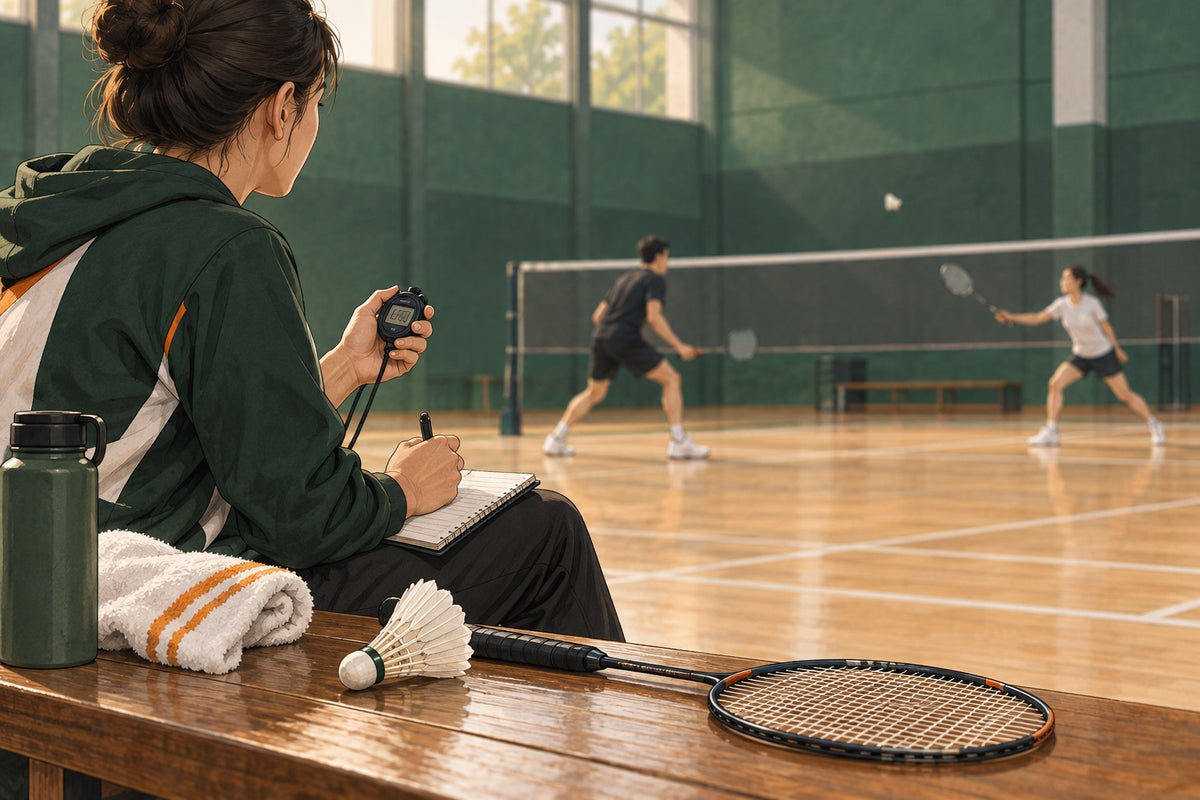
Film at least twenty consecutive rallies from the event and level you play, measure rally and rest times, and choose a timer close to the medians. Include every rally when estimating match play. If you deliberately exclude immediate serve or return errors to design a movement drill, set that rule before sampling and label the result a training-only estimate.
- Measure: record rally time, the following gap, strokes, and the longest rally for at least twenty consecutive points.
- Summarize: find the median rally and median gap; keep the average and longest rally as context.
- Translate: use the median rally as the work window and the measured gap as a starting reset, then choose a court or bodyweight task.
- Check: compare the first and last repetitions. If braking, balance, stroke placement, or feeding quality falls apart, the timer no longer represents the intended task.
| Worked example | Compact translation | Quality check |
|---|---|---|
| Club sample: 7-second rally median, 15-second gap median | Four-corner shadow for 7 seconds, walk and reset for 15, then repeat six times. | The sixth repetition still has controlled braking and a clear return toward base. |
| Singles sample: 9-second rally median, 18-second gap median | Two-point feed for 9 seconds, stop fully for 18, then repeat five times. | The feeder and player can reproduce the same pace and placement. |
| No court data yet | Choose a 6-to-10-second work window for fast feet plus alternating lateral reaches, then allow enough reset for clean posture. | Label it a starting estimate and replace it after measuring your own rallies. |
These are transparent examples, not optimal ratios. A 2023 study of internationally ranked players compared 10-, 30-, and 50-second multifeed bouts at the same one-to-one ratio. Longer bouts changed metabolic demand and reduced distance and running velocity. It did not validate any one work-to-rest setting as optimal.
Use the broader badminton stamina and fitness guide to place these intervals alongside general aerobic work. If your event is mainly doubles, use our doubles conditioning guide.

Leave a comment
This site is protected by hCaptcha and the hCaptcha Privacy Policy and Terms of Service apply.