
Last updated: August 2026 · Badminton House
Quick answer
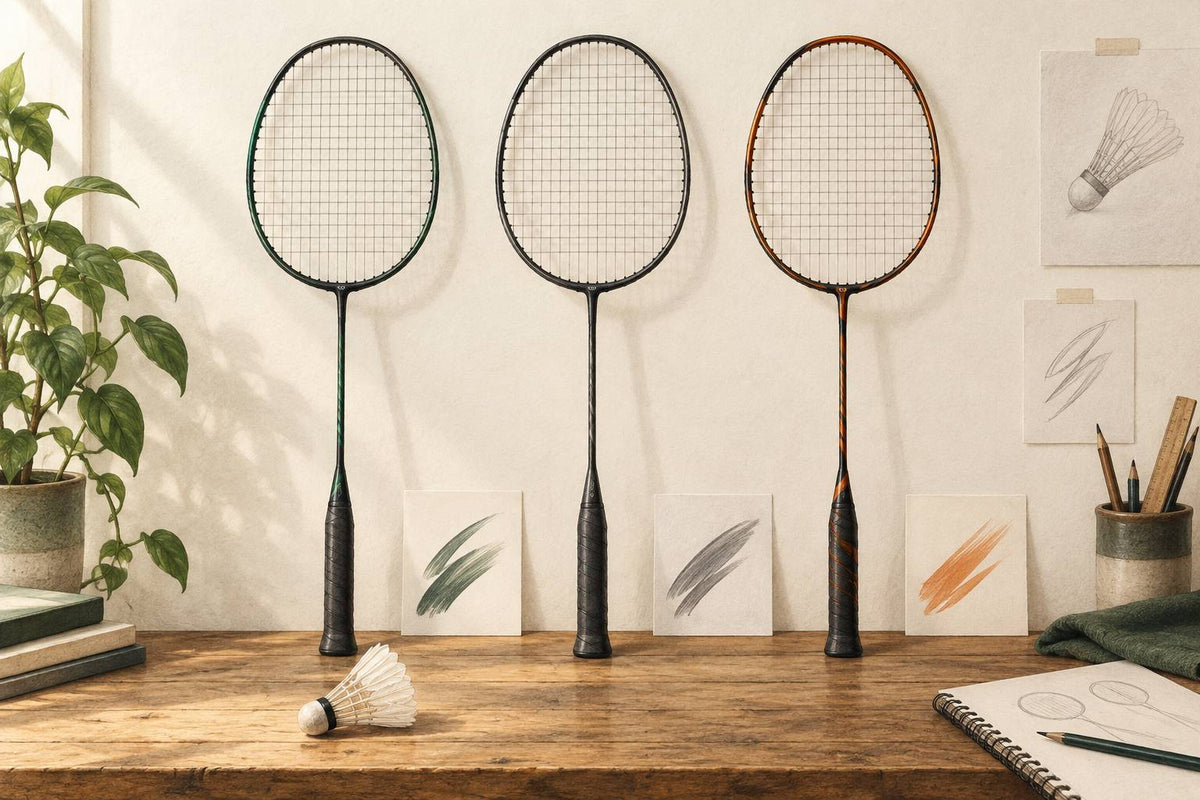
Astrox — power
Head-heavy. You finish rallies from the back with the smash.
Arcsaber — control
Even balance. You win by putting the shuttle exactly where you meant to.
Nanoflare — speed
Head-light. You win the flat exchange before the smash ever happens.
If you cannot choose: compare manageable models across the series. An even-balance Arcsaber is one useful starting point, but its flex and weight still need to suit you.
In this guide
The Three Series Compared
| Astrox | Arcsaber | Nanoflare | |
|---|---|---|---|
| Yonex calls it | Power | Accuracy | Speed |
| Balance | Head heavy | Even | Head light |
| Signature technology | Rotational Generator System | Pocketing Booster | Sonic Flare System |
| What it does for you | Head-heavy attacking emphasis; swing speed and contact still determine the shot | Shuttle-hold and placement emphasis in the manufacturer’s design | Fast-handling and shuttle-acceleration emphasis; exact model matters |
| Best shot | Smash from the rear court | Drop, slice, and tight net play | Flat drives, blocks, net interceptions |
| Weakest at | Heavier-feeling models may require more effort in fast resets | Model-specific trade-offs; no series is equally suited to every player | Assess rear-court response yourself; head-light does not mean powerless |
| Top tier | Astrox 100ZZ, Astrox 99 Pro | Arcsaber 11 Pro | Nanoflare 1000 Z |
Yonex markets Nanoflare as head-light and powerful. Balance alone does not decide which player will hit a faster smash: the full setup, swing and contact matter.

The Current 2026 Models, by Tier
Pro, Tour, Game and Play indicate positions within model families, not universal flex or skill rules. For example, the 2026 Yonex catalogue lists Arcsaber 7 Pro and Tour as Medium, but Arcsaber 11 Pro and Tour as Stiff. Compare the exact listing and regional availability.
| Suffix | What it means |
|---|---|
| Pro / ZZ / Z | Higher specification within its family; not every flagship is stiff or restricted to advanced players. |
| Tour | An alternative specification within the family; flex and value vary by model. |
| Game | Often a more accessible specification, but check the exact flex and weight. |
| Play | Entry positioning; confirm stringing, flex and weight before buying. |
| Tier | Astrox | Arcsaber | Nanoflare |
|---|---|---|---|
| Flagship | Astrox 100ZZ, 99 Pro, 88D Pro, 88S Pro | Arcsaber 11 Pro, 7 Pro | Nanoflare 1000 Z, 800 Pro, 700 Pro |
| Tour | Astrox 100 Tour | Arcsaber 11 Tour, 7 Tour | Nanoflare 1000 Tour, 800 Tour, 700 Tour |
| Game | Astrox 100 Game | — | Nanoflare 1000 Game, 800 Game, 700 Game |
| Play / entry | Astrox 88 Play, Astrox 99 Play | Arcsaber 11 Play, 7 Play, Arcsaber 2 Ability | Nanoflare 1000 Play, Nanoflare Nextage |
This is a selection of model families, not every regional listing. The 88 D and S naming means Dominate and Skill; those design emphases do not assign permanent court positions to the player.
Head-to-Head Model Pairings
If you are cross-shopping two specific rackets rather than three series, these are the comparisons that actually come up.
| Matchup | Choose the first if | Choose the second if |
|---|---|---|
| Astrox 100ZZ vs Nanoflare 1000 Z | You finish rallies from the rear court in singles | Your points come from flat speed and interceptions |
| Astrox 88D Pro vs Nanoflare 800 Pro | You play the back of a doubles pair | You play the front and need fast hands |
| Astrox 88D Pro vs 88S Pro | Rear-court emphasis — D stands for Dominate | Front court — S is for the skill player |
| Arcsaber 11 Pro vs Arcsaber 7 Pro | You are advanced and want the stiffer, more demanding frame | You prefer the Arcsaber 7 Pro’s Medium flex after trying it |
| Arcsaber 11 Pro vs Astrox 99 Pro | You prefer the Arcsaber 11 Pro’s all-court handling | You prefer the Astrox 99 Pro’s attacking response after comparing handling |
| Arcsaber 11 Play vs Nanoflare Nextage | First proper racket, want the most forgiving option | First proper racket, but you already like a light, fast feel |
For the flagship power comparison in depth, see our Nanoflare 800 vs Astrox 100ZZ guide, the Astrox 100ZZ review, and Astrox 88D vs 88S.
Astrox vs Nanoflare
Compare Astrox’s attacking emphasis with Nanoflare’s fast-handling emphasis, then test the particular models on the same shots.
Head-heavy models can feel more demanding during quick direction changes, but their handling also depends on total mass, flex and construction.
A head-light setup may suit fast exchanges, but it does not automatically improve defence or reduce smash speed for every player.
Which has more power? Series names cannot decide that for you. Compare rear-court depth, attacking contact and recovery with a suitable string setup.
Arcsaber vs Nanoflare
Arcsaber emphasizes accuracy and Nanoflare speed, while each family contains models with different flex and handling.
Compare placement and touch with Arcsaber, then quick drives and recovery with Nanoflare; use both on all of those tasks before deciding.
A useful comparison includes clears, drops, blocks and drives. A placement error or late contact can be technical, so neither symptom alone identifies the right series.
Astrox vs Arcsaber
Astrox’s attacking emphasis and Arcsaber’s all-court positioning offer different starting points for a trial.
Choose the model that feels manageable across your actual game, including defence and recovery. A series cannot guarantee a higher smash ceiling or eliminate weak shots.
Singles and Doubles: A Direct Answer
Doubles players rotate through attacking and defensive positions. The table gives possible starting points by preference, not fixed jobs or mandatory equipment.
| You play | Series | Why |
|---|---|---|
| Singles | Astrox or Arcsaber | Rallies are long and you create your own openings. Mass helps; so does placement. |
| Doubles — rear court | Astrox | Your job is to hit down hard and keep the pressure on. |
| Doubles — front court | Nanoflare | Your job is interceptions and net kills. Racket speed is everything. |
| Doubles — you rotate | Arcsaber | Compare all-court handling while practising both front and rear roles. |
| Mixed | Nanoflare at the front, Astrox at the back | Choose for the tasks you actually perform; both partners need to cover changing situations. |
Common Questions
Which is better, Arcsaber or Astrox?
Neither is universally better. Compare an Arcsaber if you like its balanced handling and an Astrox if you prefer its attacking response, then check exact model, flex and weight.
Which is better, Astrox or Nanoflare?
Astrox and Nanoflare emphasize attack and fast handling respectively. Those labels do not guarantee smash, defence or drive performance.
Which Yonex series is best for beginners?
A manageable Play or other accessible model can be a starting point; compare weight, balance and flex rather than treating a series as a skill level.
Is Astrox only for singles?
No. The 88D Pro is specifically a doubles rear-court racket. Astrox is about attacking, not about format.
Can an Arcsaber smash hard?
Yes. Contact, swing speed and technique determine the smash; an Arcsaber label does not make its trajectory inherently flatter or weaker.
What is the safest choice if I am unsure?
Try a manageable Arcsaber Play or a model with suitable flex. The 7 Tour is Medium and 11 Tour Stiff in the cited catalogue; there is no Arcsaber Game tier in that table.
Which Should You Choose?
| If this is you | Series and tier |
|---|---|
| First proper racket | Arcsaber, Play or Ability tier |
| Improving club player, plays everything | Arcsaber 7 Tour or a manageable Play model |
| Doubles rear court, hits hard | Astrox 88D, Tour or Pro tier |
| Doubles front court or mixed net player | Nanoflare 700 or 800, Game or Tour tier |
| Advanced singles, attacking game | Astrox 100ZZ or 99 Pro |
| You keep getting beaten in flat exchanges | Compare a manageable Nanoflare alongside timing and technique work |
Still stuck between two? Tell us your level, main format and current racket through our contact page, or browse the rackets collection.
Whichever series you pick, the shaft flex matters more than the badge — see our stiff vs flexible shaft guide and head-heavy vs head-light guide. Comparing across brands? See Yonex vs Li-Ning vs Victor.

Leave a comment
This site is protected by hCaptcha and the hCaptcha Privacy Policy and Terms of Service apply.