
Last updated: July 2026 · Written by the team at Badminton House
Quick Answer: Where to Hit Against a Taller Player
Keep the shuttle low and prioritize the front court rather than feeding the higher contact point in the rear court.
Non-racket front
Default target: make them bend low and rotate into the reply.
Racket front
Repeat it when their recovery leaves that corner exposed.
Body
Use flat drives to crowd long arms at chest or throat height.
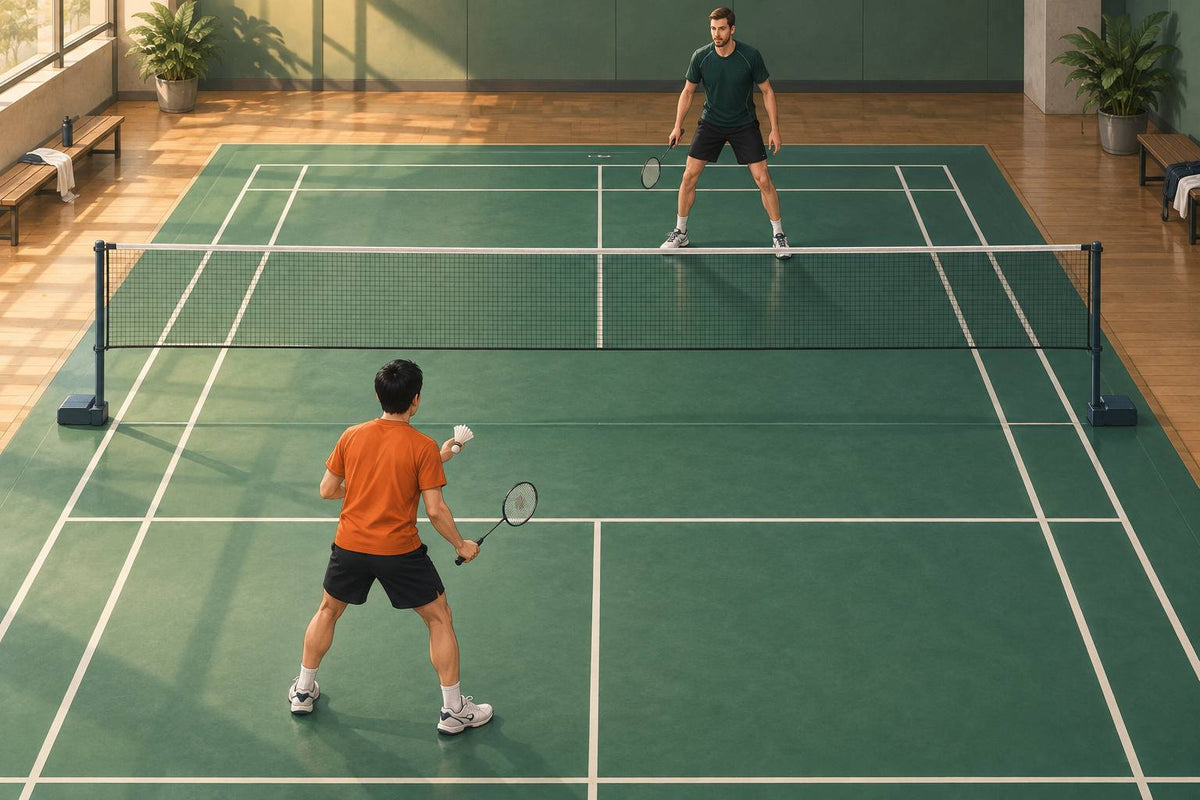
Facing a taller badminton player can feel unfair: their higher contact point creates steeper attacking angles, and their reach can make ordinary placement look harmless. If you keep sending comfortable lifts, you repeatedly give them the overhead contact they want. But height is an advantage at contact—not an automatic answer to every rally—and trying to beat them with harder smashes usually plays into their strengths.
The practical adjustment is to make the rally lower, earlier, and less comfortable. Your movement matters more than matching their reach: recover promptly, arrive balanced, and take the shuttle before it drops. The goal is not to expose a universal weakness in tall players; it is to test the areas where bending, rotating, and defending close to the body may be less natural, then keep using what produces a late or weak reply.
In This Guide
How to Play Against a Taller Badminton Player: Use Three Targets
Height is an advantage at contact, not a verdict on ability. A higher contact point can produce steeper attacking angles and preserve more straight or cross-court options, but movement, timing, technique and decisions still determine who controls the rally.

When you play against a taller badminton player, aim primarily at three places: the two front corners and the body. The front corners make the opponent lower their centre of mass and reach below their preferred contact zone; the body crowds long levers and makes a clean swing harder.
Prioritize the non-racket-side front corner. For a right-hander, that is the left front corner. Reaching a low shuttle there demands a lunge, grip adjustment, forearm rotation and stable body position at once. Use the other targets to prevent anticipation, then return to this demanding corner.
In the 2012 French Open final, 1.78 m Liew Daren beat 1.94 m Viktor Axelsen 21–18, 21–17. Liew repeatedly made Axelsen bend near the net and twist to play shuttles behind him, limiting Axelsen’s attacking game.
Build These Two Shot Patterns
1. Front Corner, Recover, Repeat
Play a drop or net shot into the non-racket-side front corner, then recover early instead of admiring the shot. If the reply allows it, send the shuttle back to the same corner. Repetition is the point: the opponent must stop their recovery, reverse momentum and lunge forward again. Time your first movement with the opponent’s contact; the badminton split-step guide explains that timing in detail.
2. Body First, Front Corner Next
Use a flat drive or push toward the body to limit comfortable use of long arms. Recover immediately, then take the next shuttle early and direct it into whichever front corner opens. Do not turn “flat” into an automatic punch clear or flat lift from a neutral position—a tall opponent may intercept it early. That faster rear-court ball becomes useful only after the opponent is late recovering and cannot meet it from a balanced base.
Stop Using the Automatic High Lift
The habit to remove is the automatic lift from smash defence or the forecourt. It may rescue the current shot, but it also returns the shuttle to the taller player’s preferred pattern: high contact followed by a steep attack.

Instead, defend from a lower, wider stance with your racket in front. Split-step just before the opponent contacts the shuttle, then guide a controlled block toward the short service line. Do not make it excessively soft or loopy; extra height and hang time let the attacker reach the forecourt comfortably. After a straight smash, the more demanding cross-court block is valuable because it makes the opponent cover greater distance and change direction.
Use a defensive drive selectively, not automatically. It is best against a flatter smash when you can place the reply into open space. If the shuttle rises through the net area, a taller opponent may meet it above net height and drive downward, leaving you under pressure again.
The Reverse Plan: If You Are the Taller Player
Your advantage is not simply power; it is the higher contact point that creates steeper angles and more placement options. Build patiently with clears and drops instead of forcing a full smash from the baseline. Attack when a weak reply lets you meet the shuttle farther forward, where your reach can turn height into a sharper downward angle.
At the forecourt, prepare as though you will play a net shot and hold that shape for as long as control allows. From the same preparation, either guide the shuttle tightly over the net or flick it past an opponent who has started moving forward. The late decision matters more than an exaggerated fake.
Avoid settling into prolonged low, flat exchanges around your body or close to the net. Those contacts make you bend, reduce the value of your reach, and deny you the high hitting position that makes your attack difficult to defend. Reset the rally until you can contact higher and farther in front.
Which Target Should You Choose Against a Taller Player?
Choose from the same three targets by reading the opponent’s recovery. Repeating a front corner is often correct while they are still reversing their momentum; change the target when they recover early or begin anticipating it.
| Target | Choose it when | Purpose |
|---|---|---|
| Non-racket-side front corner | They are upright, late leaving base or still recovering from that corner. | Combine a low reach with an awkward racket-face rotation, then keep the corner live if their recovery remains late. |
| Racket-side front corner | They lean toward the non-racket side or recover across their base. | Force another deep bend and a direction change instead of returning the shuttle toward their movement. |
| Body | Their reply is flat and your drive can clear the net without floating upward. | Crowd long arms around the chest or throat; follow into open space rather than sustaining a neutral drive exchange. |
Get 10% off your first order
Join the Badminton House list and we’ll email you a 10% welcome code — plus training guides, technique advice, and badminton updates.
By subscribing, you agree to receive Badminton House emails and can unsubscribe anytime.
Height changes the geometry, not the fundamentals. We play badminton too, and we know that a clear plan becomes useful only when it survives real rallies. If you want help adapting these ideas to your movement, level, or usual opponents, contact us for practical advice.
Build the tactic on confident movement into every front corner. The plan is all first-step and lunge work — shoes matter.
Explore Badminton FootwearCheck live availability and choose for secure court movement.

Leave a comment
This site is protected by hCaptcha and the hCaptcha Privacy Policy and Terms of Service apply.