
Last updated: July 2026 · Written by the team at Badminton House
Quick Answer: Is My Badminton Racket Legal?
Measure the frame and string bed; weight, balance and tension are not legality tests.
Standard
Usually legal: frame no longer than 680 mm or wider than 230 mm; flat, crossed string bed within 280 × 220 mm.
Modified
Dampeners, lead tape and grip layers may be legal when reasonably sized and placed, but the frame must remain within 680 mm.
Unusual
Check every dimension; throat extensions permit a 330 mm string-bed length only when the extended width is no more than 35 mm.
Last updated: July 2026
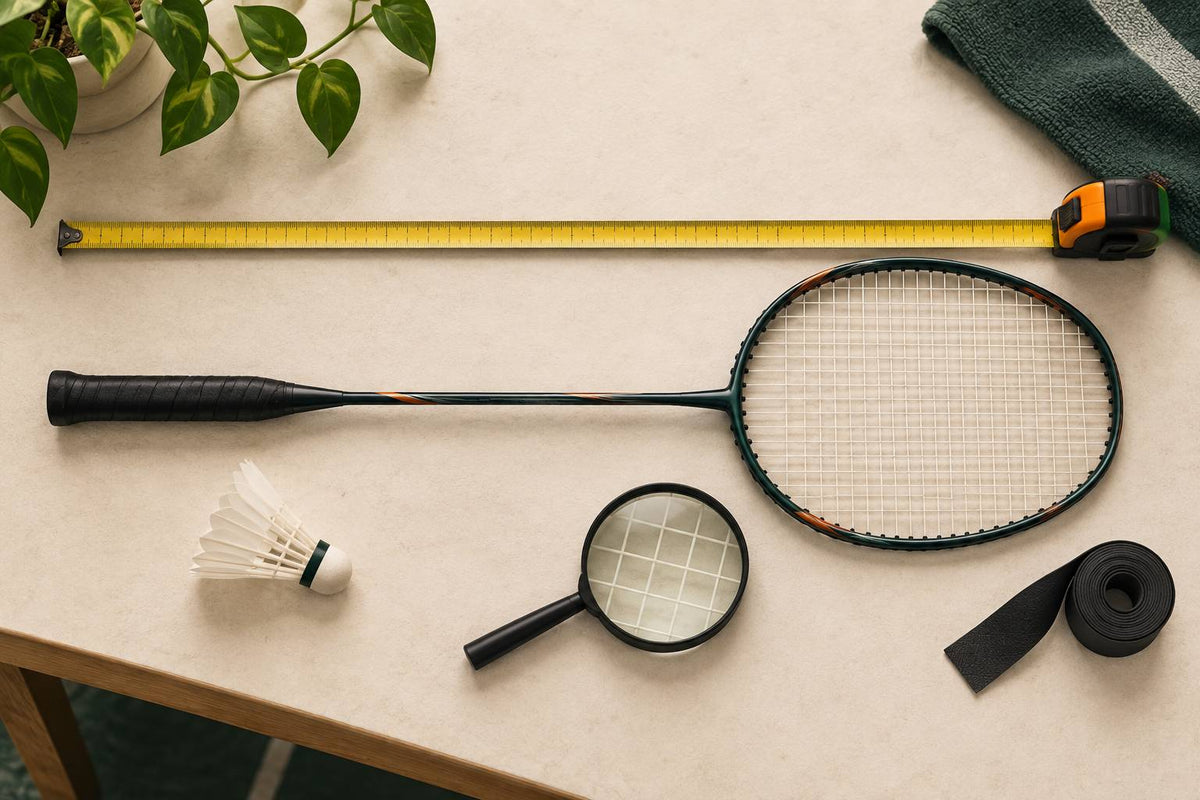
If you’re holding a cheap, extra-long, novelty or heavily modified racket, don’t judge legality by the logo, head shape, weight or string tension. Start with a tape measure and inspect what has been added to the frame. Under the BWF Laws, racket legality turns on specific frame and stringed-area dimensions, the construction of the string bed, and whether attachments serve a permitted purpose without becoming unreasonable. There is no BWF approved-racket list to settle the question for you. The checks below separate harmless customization from a genuine rules problem and show when an unusual frame should be put in front of the tournament referee before your first match.
In This Guide
Is My Badminton Racket Legal? Start With These Dimensions
Start with the distinction in the Laws: Law 4 governs the racket itself, while Law 5 governs equipment compliance. In other words, Law 4 defines the permitted construction and dimensions; Law 5 covers rulings on whether equipment meets those specifications.

Measure the racket at its widest and longest points. The frame must not exceed 680 mm in overall length or 230 mm in overall width. Within it, the stringed area must not exceed 280 mm long or 220 mm wide.
Diagram C names the relevant parts as the frame, head, stringed area, throat, shaft and handle. The head bounds the stringed area, the shaft connects the handle to the head, and the throat—if present—connects the shaft to the head. A throat is therefore optional.
Current Law 4 sets no separate limit for head length, racket weight, balance, shaft stiffness, grip size or string tension. Those characteristics may affect fit and performance, but they are not standalone racket-legality tests.
What the Current String Bed Rule Actually Requires


Under current Law 4.2.1, the stringed area must be flat and consist of crossed strings that are either alternately interlaced or bonded where they cross. In practical terms, an ordinary woven string bed complies; a deliberately non-crossed or otherwise unconventional grid may not.
Ignore the old density test. The former wording requiring a “generally uniform” pattern that was “not less dense in the centre” was removed in May 2019. It is not part of the current rule.
Normal string patterns remain permissible, as do hybrid setups and different gauges for the mains and crosses, provided the crossed-string construction meets Law 4.2.1. String tension is not restricted by Law 4; use the frame’s limits and see the string tension guide. For questions about oval and squared-off frames, see isometric versus conventional racket heads.
Are Dampeners, Lead Tape and Extra Grip Layers Legal?
Law 4.3.1 does not ban every attachment. It permits reasonably sized and placed objects used specifically to prevent wear, reduce vibration, distribute weight or secure the handle to the player’s hand with a cord. In practical terms, that can cover:
- a vibration dampener;
- lead tape used to adjust balance;
- frame or grommet protection tape; and
- a wrist cord.
The important test is whether the attachment is reasonable for its stated purpose. For placement guidance, see the racket lead-tape balance guide.
Extra grip layers or a butt extension are not automatically illegal, but any build-up that lengthens the frame beyond 680 mm makes the racket non-compliant. Law 4.3.2 also prohibits a device that lets the player materially change the racket’s shape, ruling out adjustable or variable-geometry mechanisms.
The 60-Second Check for a Cheap, Unusual or Extra-Long Racket
Set a tape measure beside the racket and check these limits:
- Frame length: no more than 680 mm.
- Frame width: no more than 230 mm.
- Stringed area: no more than 280 mm long and 220 mm wide.
- Strings entering the throat: overall stringed length no more than 330 mm, with the extension no wider than 35 mm.
Extra-long novelty frames, oversized heads and stringing that runs into the throat are the practical failure points. There is no BWF approved-racket list. Show a doubtful frame to the tournament Referee before playing; a party with a bona fide interest can also seek a Law 5 compliance ruling from the BWF.
The racket clauses are unchanged between the current 26 April 2025 V5.0 Laws and V6.0, effective 4 January 2027.
If your frame is non-compliant, browse tournament-legal badminton rackets and check live availability.
Which Legality Check Should You Choose?
Choose the check that matches the racket in front of you: a standard commercial frame needs less scrutiny than a modified, unusually shaped or prototype racket.
| Condition | Choose this check |
|---|---|
| Standard | No action needed beyond a quick tape-measure check of frame and stringed area. |
| Modified | Confirm each attachment serves a permitted purpose and is reasonable in size and placement; re-measure overall frame length after adding grips or a butt extension. |
| Unusual | Measure every dimension, then show the racket to the tournament Referee before play; prototypes can be referred to the BWF under Law 5.1. |
A familiar appearance is not formal approval: rackets are not part of the BWF Equipment Approval Scheme. If doubt remains before a competition, ask the Referee rather than relying on packaging or marketing language.
Get 10% off your first order
Join the Badminton House list and we’ll email you a 10% welcome code — plus training guides, technique advice, and badminton updates.
By subscribing, you agree to receive Badminton House emails and can unsubscribe anytime.
We play badminton and know how small frame modifications or unusual designs can create last-minute uncertainty. If your measurements are close to a limit, ask the tournament referee before play. For practical help checking your setup, contact us and we’ll help you interpret the rule without guesswork. Bring the racket and your measurements so the question can be settled before your first match.
If your frame turns out to be non-compliant, browse tournament-legal rackets.
Browse Badminton Rackets

Leave a comment
This site is protected by hCaptcha and the hCaptcha Privacy Policy and Terms of Service apply.