Buying Guide

Strung vs Unstrung Badminton Rackets: Which to Buy

Two badminton rackets comparing a factory-strung racket with an unstrung frame ready for custom stringing.

Last updated: June 2026 · Written by the team at Badminton House

Quick Answer: Strung vs Unstrung Badminton Racket

For most Canadian club players, the best value is an unstrung or custom-strung racket because the string and tension can match your level, shuttle type, and frame limit.

Unstrung

Best choice: Pick this for mid-tier, high-performance, or weekly club play; you can choose the string and tension instead of accepting a generic factory setup.

Strung

Best for first rackets and casual play: factory pre-strung rackets usually arrive around 19–20 lbs, which is beginner-friendly and ready for the gym.

Restring

If you already bought a pre-strung racket and want better feel, restring it within the manufacturer’s recommended tension range; going above the frame maximum increases breakage risk.

If you are comparing rackets online and see one listed as strung while another is unstrung, it can feel like the unstrung racket is somehow incomplete. In badminton, that is not usually the case. A strung racket comes ready to play; an unstrung racket arrives without string so you can choose the string and tension before your first session.

That choice matters more than many players realize. The stringbed changes how the racket feels on clears, drives, blocks, smashes, and touch shots. For beginners, a ready-to-play strung racket can be the simple answer. For improving club players, league players, and anyone buying a better frame, an unstrung racket can be the better starting point because the string setup is matched to your game instead of chosen for everyone.

This strung vs unstrung badminton racket guide explains what each label means, why better frames often ship without strings, how to think about the real CAD cost after stringing, and how to choose tension without pushing the frame beyond its recommended range.

Need your racket game-ready in Moncton? Badminton House offers professional badminton racket stringing in the Greater Moncton area with 2–3 day turnaround and no appointment needed through our stringing service.


Strung vs Unstrung Badminton Racket: What Each Means

Two badminton rackets side by side: one with a full stringbed labelled strung and ready to play, one bare frame with no strings labelled unstrung and must be strung first.
Strung rackets arrive ready to play; unstrung frames let you pick the string and tension first.

When you see strung vs unstrung badminton racket while shopping, it is not a tiny product-detail footnote. It tells you whether the racket can go straight into your bag for tonight’s drop-in, or whether it needs a string job before the first shuttle.

Term What it means Can you play immediately?
Strung The racket already has strings installed. It may be factory strung or strung as part of a shop service. Yes, assuming the grip and string tension feel suitable for you.
Unstrung The racket arrives as a bare frame with no stringbed. It must be strung before use. No. You need to choose a string and tension first.

A strung racket is the simpler buying path. For a new player, school program, casual family player, or someone who needs a racket quickly, “strung” usually means fewer decisions at checkout: buy it, bring it to court, and start playing.

An unstrung racket is different. It is not defective, incomplete, or missing a part by accident. It is intentionally sold without strings so the player can choose the string model and tension that match their level, shuttle type, and playing style. Until that frame is strung, it is not playable.

Shopping tip: when browsing badminton rackets, check whether the product is listed as strung, unstrung, or frame-only before comparing value. A racket that looks cheaper may still need stringing before it is court-ready.

The practical difference is timing and choice. Strung gives you convenience. Unstrung gives you control. Neither is automatically “better” for every player; the right choice depends on whether you want a ready-to-play setup or a custom stringbed from the start.


What “Factory Strung” Usually Means

A factory-strung badminton racket is convenient: you can take it out of the cover, head to the gym, and play right away. But “strung” does not usually mean the stringbed was selected for your game.

In practice, factory-strung rackets are commonly around 19–20 lbs. Many factory-strung rackets are 20 lbs or less, and manufacturers may not specify the exact tension. That lower tension can be friendly for many beginners because it gives a softer, more forgiving feel and helps produce easy length without perfect timing.

Quick check: factory strung vs custom strung

Option What you get Best fit
Factory strung Ready to play, usually around 19–20 lbs, with limited or no choice of string model. Beginners, casual gym play, and players who want the simplest start.
Custom strung You choose the string and tension to match your level, shuttle type, and feel preference. Improving club players, league players, and anyone who already knows what they like.

The key point: factory stringing is a starting point, not a performance fitting. If you are still learning clears, serves, and basic timing, a lower factory tension may be perfectly usable. If you are choosing a racket for control, smash timing, doubles speed, or a specific feel at impact, the string and tension become part of the racket setup.

For a deeper tension breakdown, see our beginner badminton string tension guide. If you are in Greater Moncton, you can also use our badminton racket stringing service to have the racket matched to your game before you play.


Why Better Badminton Rackets Often Ship Unstrung

A higher-end badminton racket is usually sold as a frame first because the stringbed is part of the performance setup, not just a finishing detail. Advanced players often choose a specific string and tension based on how they hit: doubles drives, steep smashes, net control, durability needs, feather versus nylon shuttles, and how often they restring.

That is why an unstrung racket is not “missing” something in the same way a shoe without laces would be. It is more like a high-performance frame waiting for the player’s setup. Factory stringing is usually aimed at broad beginner use; custom stringing lets the racket match the player.

Performance logic in plain English

  • String choice changes feel. A thicker string can be chosen for durability, while thinner performance strings are often chosen for a sharper response.
  • Tension changes response. Lower tension gives more trampoline effect; higher tension gives a firmer, more controlled feel.
  • Better players notice the difference. If you play regularly, the same racket can feel very different with a different string and tension.
  • Higher-end frames are built for customization. They are aimed at players who are more likely to string within a chosen performance range instead of accepting a generic factory setup.

The Yonex Astrox 100 ZZ is a good example of why this matters. It is listed at $299.99 CAD, with stiff flex, head-heavy balance, and recommended tension of 20–28 lbs in 4U or 21–29 lbs in 3U. At that level, the string and tension are part of the racket’s identity on court.

The Yonex Astrox 100VA Game shows the same idea in an intermediate-to-advanced frame. It is listed at $349.99 CAD and carries the same recommended tension range: 20–28 lbs in 4U or 21–29 lbs in 3U. Availability can change, so check the product page before planning a custom setup.

Racket example Listed price Recommended tension Why unstrung makes sense
Yonex Astrox 100 ZZ $299.99 CAD 4U: 20–28 lbs
3U: 21–29 lbs
A stiff, head-heavy performance frame should be matched to the player’s preferred string and tension.
Yonex Astrox 100VA Game $349.99 CAD 4U: 20–28 lbs
3U: 21–29 lbs
An intermediate-to-advanced racket is exactly the kind of frame where a generic factory stringbed may not suit the player.

For Canadian players comparing strung vs unstrung badminton racket options, the important question is not “why am I paying for a racket without strings?” It is: if the racket arrived with generic factory strings, would I keep those strings anyway?


The CAD Cost Math: Frame Price Plus Stringing

In a strung vs unstrung badminton racket comparison, the fair number is not “racket price versus racket price.” For an unstrung frame, compare the frame price plus stringing.

Across Canada, independent stringers commonly advertise around $15 CAD for labour if you bring your own string, or about $25–$27 CAD with common Yonex strings included. Canadian pro-shop stringing is generally framed higher, roughly $35–$60 CAD depending on the string and service package.

Stringing route Typical CAD math What it means
Independent labour only Around $15 CAD labour, plus your string Good if you already know the exact string you want and have a trusted local stringer.
Independent string + labour About $25–$27 CAD with common Yonex strings Often the lowest all-in path to a custom-strung setup.
Canadian pro-shop package Roughly $35–$60 CAD Higher cost, but convenient when you want string advice, service accountability, and a game-ready racket.

Example: the Yonex Astrox 100 ZZ is listed at $299.99 CAD. Add roughly $25–$45 CAD for string plus labour, and the practical custom-strung total lands around $325–$345 CAD.

Simple rule. If the racket is a serious upgrade, budget for custom stringing at the same time. A lower sticker price on a pre-strung racket is only a real saving if you will actually play that stringbed; as covered above, factory tension is set for beginners, so many club players end up restringing soon anyway.

That is why an unstrung high-end frame is not “missing” value. You are choosing the stringbed instead of paying for a generic one first and then paying again to replace it.

For Canadian online orders, remember the cart total too: a $299.99 CAD racket clears Badminton House’s free Canadian shipping threshold on orders over $200, so the meaningful comparison is the custom-strung setup cost, not just the bare frame price.


Choosing Tension Without Risking the Frame

Two badminton stringbeds compared: a lower-tension stringbed flexing inward under a shuttlecock for trampoline power, and a higher-tension firm stringbed for control.
Lower string tension flexes more for power; higher tension stays firm for control.

Once you choose an unstrung badminton racket, the next question is not “what is the highest tension I can use?” It is “what tension gives me clean contact, useful power, and a safe margin for the frame?” For most Canadian club players, that answer is lower than they expect.

Player level Typical tension range How it usually feels
Beginner 17–20 lbs More forgiving, easier length, and more free power from the trampoline effect.
Intermediate 20–24 lbs A balanced range for players with cleaner timing who want more feedback without giving up too much power.
Advanced 24–27 lbs More control and a crisper response, but less help on off-centre hits.
Professional 27–30+ lbs Maximum precision for elite timing and technique; not a shortcut to power.

Rule of thumb: lower tension usually gives more power because the stringbed rebounds like a trampoline; higher tension gives more control and a sharper feel, but it does not automatically make your smash harder. For a deeper breakdown, use our badminton string tension guide as the main reference before choosing your setup.

If you mostly play with plastic shuttles at school gyms, rec centres, or casual drop-ins, consider going 2–3 lbs lower than you would with feather shuttles. Plastic shuttles are harder on strings, and the slightly lower tension can improve durability while keeping the racket easier to use.

The frame-safety warning is simple: the manufacturer’s recommended maximum tension is a limit, not a target. Stringing above that maximum increases the chance of frame breakage. Even if a racket lists a high maximum tension, that does not mean every player should string it there.

A safer choice is to start in the range that matches your level, then move up gradually only if you consistently hit the sweet spot and want a firmer, more controlled response. If you are between two tensions, choose the lower one first; it is usually easier on your arm, your strings, and your frame.


Moncton Players: Get It Strung Before You Play

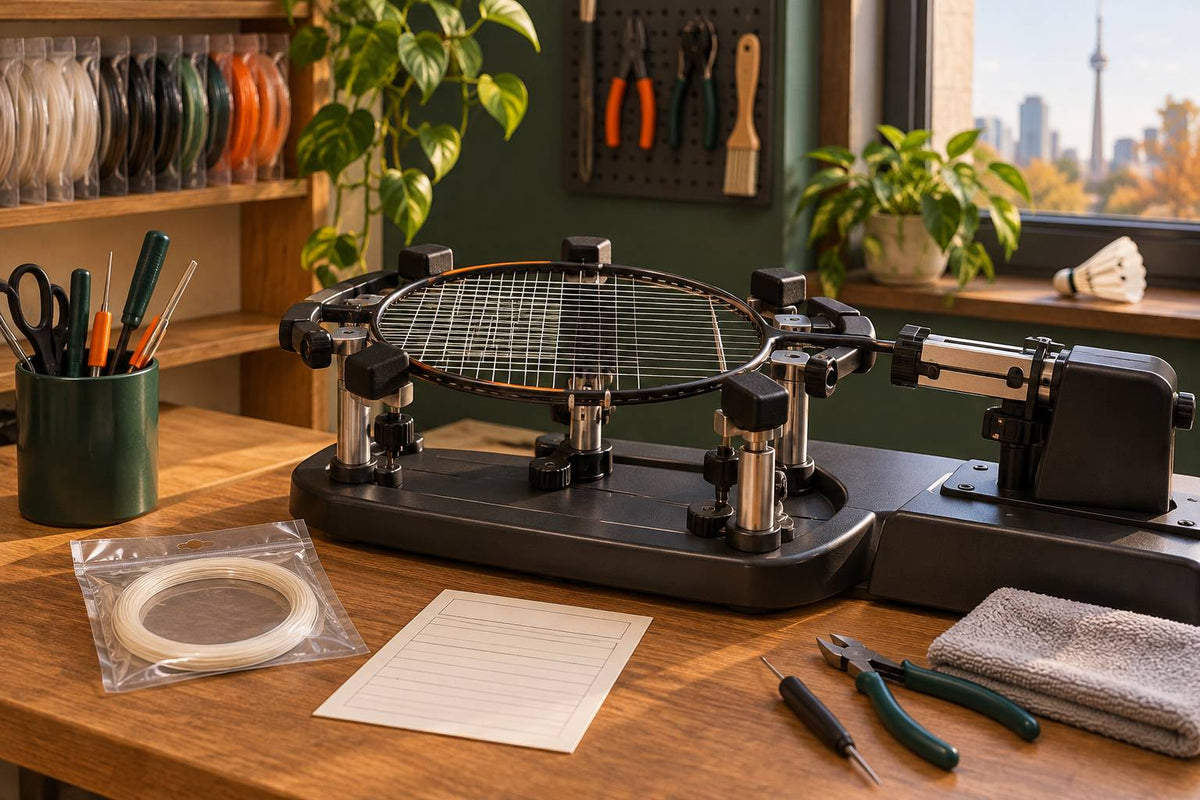
If your racket arrives unstrung, do not take it straight to the gym “just to try it.” It needs a proper string job first. Badminton House offers professional badminton racket stringing in the Greater Moncton area with a 2–3 day turnaround and no appointment needed.

Greater Moncton racket stringing: drop off your racket, choose the string and tension that fits your game, and pick it up game-ready in 2–3 days.

Book or view the Badminton House stringing service

The available Yonex string lineup covers the common needs most players ask for: BG65, BG80, BG66 Ultimax, Exbolt 65, Aerosonic, and hybrid Aerobite. BG65 is listed at 0.70 mm and is a beginner-friendly option; Aerosonic is listed at 0.61 mm for players who want a very thin string feel.

String option Good to know
Yonex BG65 0.70 mm; a beginner-friendly starting point.
Yonex BG80 A popular upgrade option when you want your string choice to match your playing style.
Yonex BG66 Ultimax Available for players who prefer this Yonex string in a custom setup.
Yonex Exbolt 65 Part of the Yonex string lineup available through the service.
Yonex Aerosonic 0.61 mm; a very thin string option.
Yonex Aerobite Hybrid string option for players who want a different main-and-cross string feel.

For regular players, stringing is not a one-time purchase. If you play 2+ times per week, plan to restring every 2–3 months because strings lose tension over time, even if they have not snapped yet. That gradual tension loss is one reason an old stringbed can start feeling flat before it looks damaged.

If you are unsure what tension to choose, keep it sensible and stay within the racket manufacturer’s recommended range. The goal is not to hit the biggest number on the frame; the goal is to get a stringbed that feels good, protects the frame, and suits how you actually play.

Get Your Racket Strung in Moncton

2–3 day turnaround · No appointment needed · Free Canadian shipping on $200+ gear orders

Looking for a place to test the new setup? See our local guide to where to play badminton in Moncton.


Which Should You Choose: Strung or Unstrung?

If you are buying your first badminton racket, a strung racket is usually the simpler choice because it arrives ready to play. If you already know you care about string feel, tension, durability, or control, an unstrung frame gives you the cleaner starting point.

Choose Best fit Why it makes sense Watch for
Strung racket New players, school players, casual drop-in players, and anyone who wants to start playing immediately. It comes ready to play, and the beginner-friendly factory tension covered earlier is often forgiving enough while you learn timing and contact point. Factory strings are often the first performance upgrade once you start noticing control, repulsion, or feel.
Unstrung racket Intermediate, advanced, and competitive players who already have preferences or want the racket matched to their game. You choose the string and tension instead of accepting a generic factory setup, which is why many higher-end rackets are sold frame-first. Do not guess high on tension. Use the frame’s recommended range and the safety guidance in the tension section.
Buy strung, then restring Players upgrading from casual play who found a racket they like but want better feel than the stock stringbed. Replacing factory strings can be one of the earliest ways to improve feel and performance without changing the frame. You may effectively pay for stringing twice, especially if you restring soon after buying.
Ask before buying Anyone unsure about string type, tension, or whether their next racket should be strung or unstrung. String choice depends on feel, durability, control, and playing style, not just the racket model. For a deeper string comparison, see our badminton string guide.

Product example: A premium frame like the Yonex Astrox 100 ZZ Kurenai/Dark Navy is listed at $299.99 CAD with stiff flex and a head-heavy balance, so the stringbed is not an afterthought — it is part of the racket’s final feel.

Simple rule: choose strung when convenience matters most; choose unstrung when you want the racket set up around your game. If you are near Moncton, the local stringing section below covers how to get a frame game-ready before you play.

Get Canadian badminton gear advice + restock alerts

Join the Badminton House list for buying checklists, restock alerts, and practical gear advice for Canadian players.

By subscribing, you agree to receive Badminton House emails and can unsubscribe anytime.

Still deciding whether to buy strung or unstrung? We play badminton ourselves, so if you want a second opinion on frame choice, string type, or safe tension for your level, contact us and tell us how often you play, whether you use feather or nylon shuttles, and what you want more of: power, control, or durability.

Choose the racket first — then make the stringbed fit your game.

Browse badminton rackets from a Canadian specialty shop, and ask us if you need help matching the frame to the right string and tension.

Browse Badminton Rackets

10% off first order · Free shipping on $200+ · 14-day returns · Canadian badminton specialty shop

Reading next

Illustration of a badminton racket being prepared for restringing on a warm indoor court

Leave a comment

This site is protected by hCaptcha and the hCaptcha Privacy Policy and Terms of Service apply.