
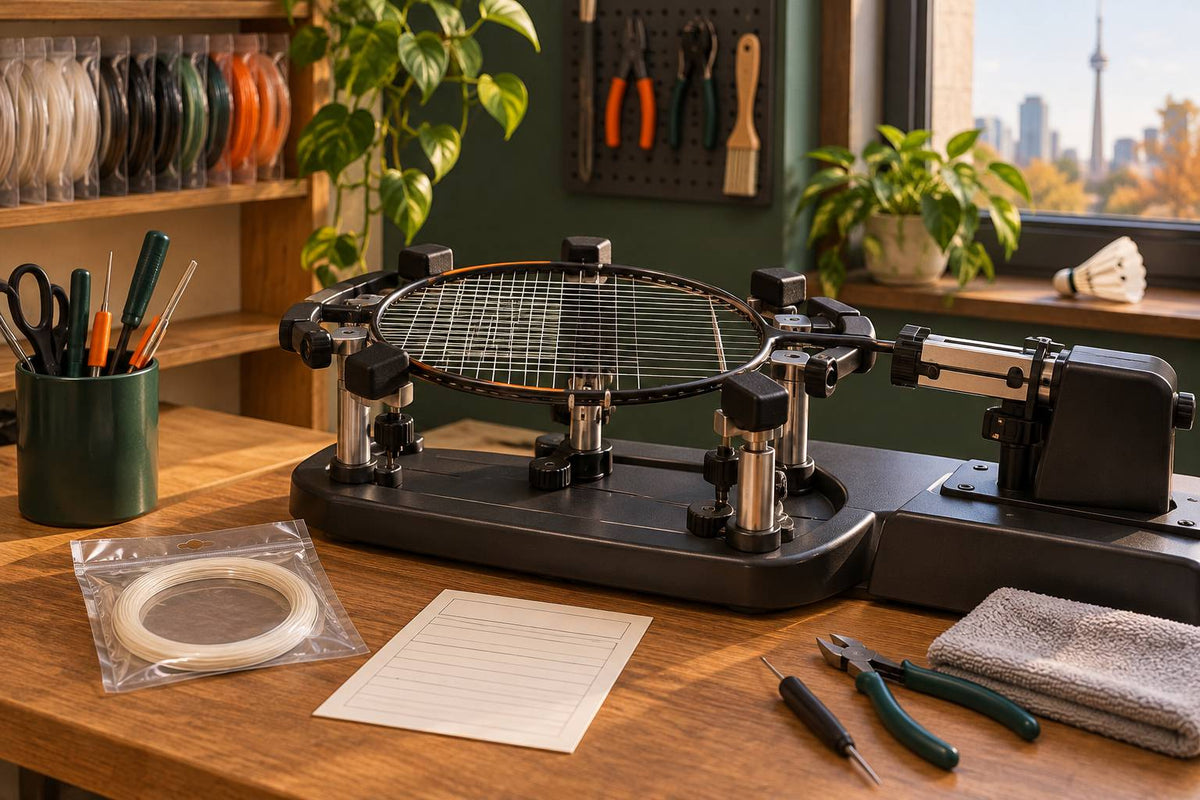
Badminton House stringing starts at $35 CAD, with string and labour included. Drop off at a club session in Moncton and collect at the next session. Elsewhere in Canada, compare the full job: a labour-only price and a string-included price describe different services.
This guide explains what to compare and what to tell your stringer before a first restring. Prices below describe our current local service, not a national average. A provider’s final charge can depend on the string, frame work, taxes and collection arrangements.
What does a badminton restring include?
A restring replaces the string bed. The work includes removing the old strings, inspecting the frame and grommets, mounting the racket, installing and tensioning the new string, and checking the finished knots and string bed. Ask whether damaged grommets or other extra work are included before agreeing to the job.
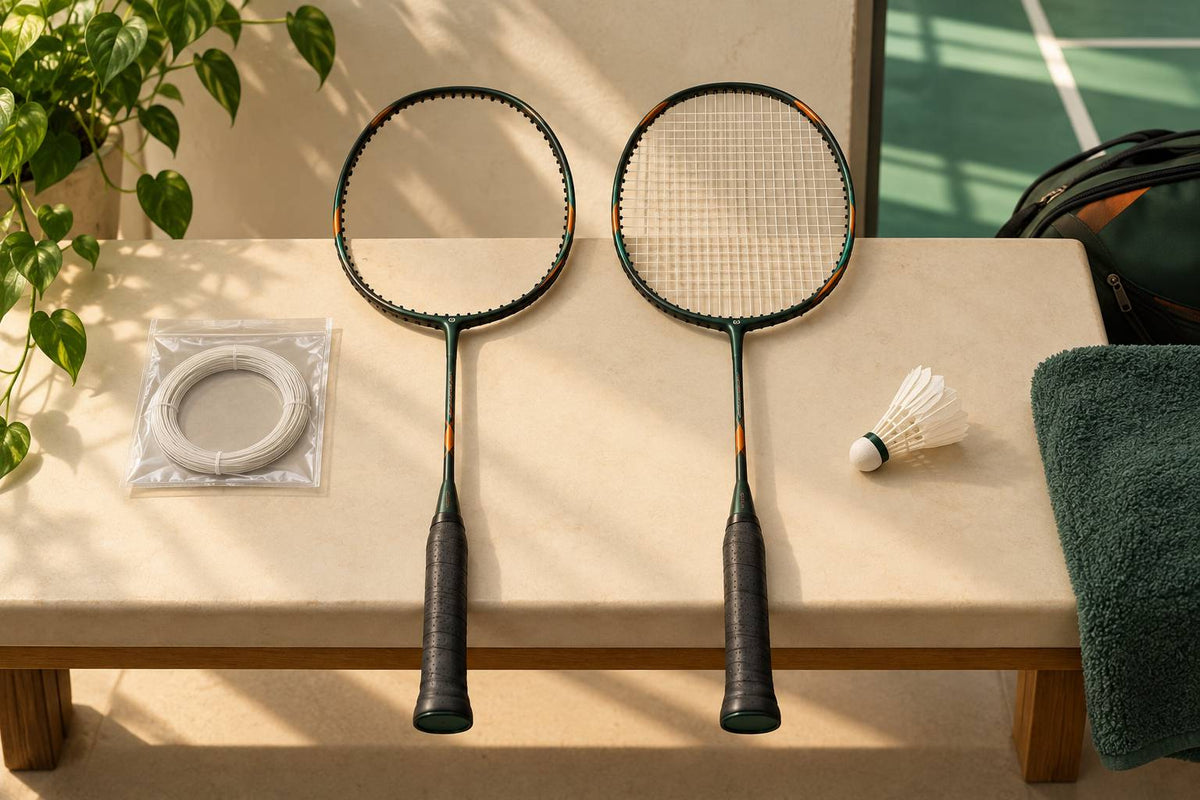
- Labour only: you supply the string and pay for installation. Confirm the required length and packaging with the stringer.
- String and labour: the provider supplies the agreed string and installs it. Ask which model the advertised starting price includes.

How much should you budget?
For a standard restring at Badminton House, budget from $35 CAD. A durable Yonex string and labour are included. Premium strings cost more; if you bring your own sealed set, labour is charged separately. We confirm the price at drop-off and take cash or e-transfer at pickup. The stringing service page carries the current terms.
For another Canadian provider, write down the exact string model, labour charge, any agreed extras and the final payable total. Confirm whether tax is included. A low advertised labour price can become a higher total once a string set is added; a starting price for one string does not establish the price for every model.
Why does the string choice change the price?
The replacement string is part of the bill, so compare like with like. If you want to repeat a setup you enjoyed, bring the previous string name and tension. If you do not know them, describe the result you want: longer life, a firmer response, or easier length on clears. Let the stringer explain the available choices and their prices.
You do not need to choose a premium model for a first restring. Our badminton string comparison explains the differences between common models. Use it to prepare questions, then confirm availability at drop-off.
Choose tension for your racket and your game
Give the stringer the racket’s exact model and any tension marking on the frame. Mention past clashes, repairs or suspected cracks before work starts. A requested number is not permission to exceed the frame’s rated range, and a damaged frame may need assessment before restringing.
Say which shuttles you normally use and what you liked or disliked about the old setup. “My clears keep falling short” is useful information; “give me a professional’s tension” is not a clear description of your needs. The string tension guide can help you discuss the choice. If the previous setup worked, recording it gives you a repeatable starting point.
Drop-off and pickup in Moncton
Bring your racket to Lewisville Middle School, 45 McAuley Drive, Moncton, during a Badminton House club session: Fridays, 7–9 pm, or Sundays, 2–4 pm. No stringing appointment or quote request is needed. You do not need to book a playing session just to drop off a racket. Ask for the organizer and hand over the racket.
Collect it at the next club session and pay then. Under the regular timetable, a Friday drop-off is collected on Sunday, and a Sunday drop-off on the following Friday. If you cannot attend that session, collect at a later one. Check the dated club schedule before travelling, including for cancellations.
If you need a racket before a particular match, plan around that pickup session. Do not assume a same-day or mail-in service. For other providers, confirm both the completion time and when you can actually collect the racket; any rush charge should be agreed before the work starts.
Your first-restring checklist
You can save this list on your phone and use it at handover. Unknown details can stay unknown—do not guess an old tension.
- Racket: exact model, frame tension marking and any known damage.
- Previous setup: string name, tension and restring date, if known.
- Your play: how often you play, feather or plastic shuttles, and the main thing you want to improve about the feel.
- Agreed work: new string model, tension with units, grommet work and whether you supplied a sealed set.
- Collection: total price, payment method and pickup session or date.

A useful first conversation: “I play weekly with plastic shuttles. I do not know the old tension. I would like a durable setup, and I want to confirm the total and pickup session before you start.” That gives the stringer something concrete to work with without requiring you to know stringing terminology.
When is a restring worth considering?
Broken strings, deep notches or a response that has changed noticeably are reasons to have the racket checked. A restring does not repair a cracked frame and it does not guarantee a technical problem will disappear. Explain what changed so the stringer can separate the condition of the strings from the condition of the racket.
Read when to restring for the signs to watch, and what to check after a restring for your first hit afterward. Keep a note of the setup and what you notice over the next few sessions; that makes the next decision easier.
Choose the service you can compare clearly
For a first restring, start with an agreed string-included service and a clear pickup arrangement. Bring your own string when you already have a sealed set and the provider accepts it. In Greater Moncton, bring your racket to a Badminton House session for stringing from $35 CAD; you can drop it off without staying to play.

Leave a comment
This site is protected by hCaptcha and the hCaptcha Privacy Policy and Terms of Service apply.