Last updated: June 2026 · Written by the team at Badminton House
Quick Answer: How to Choose Badminton String
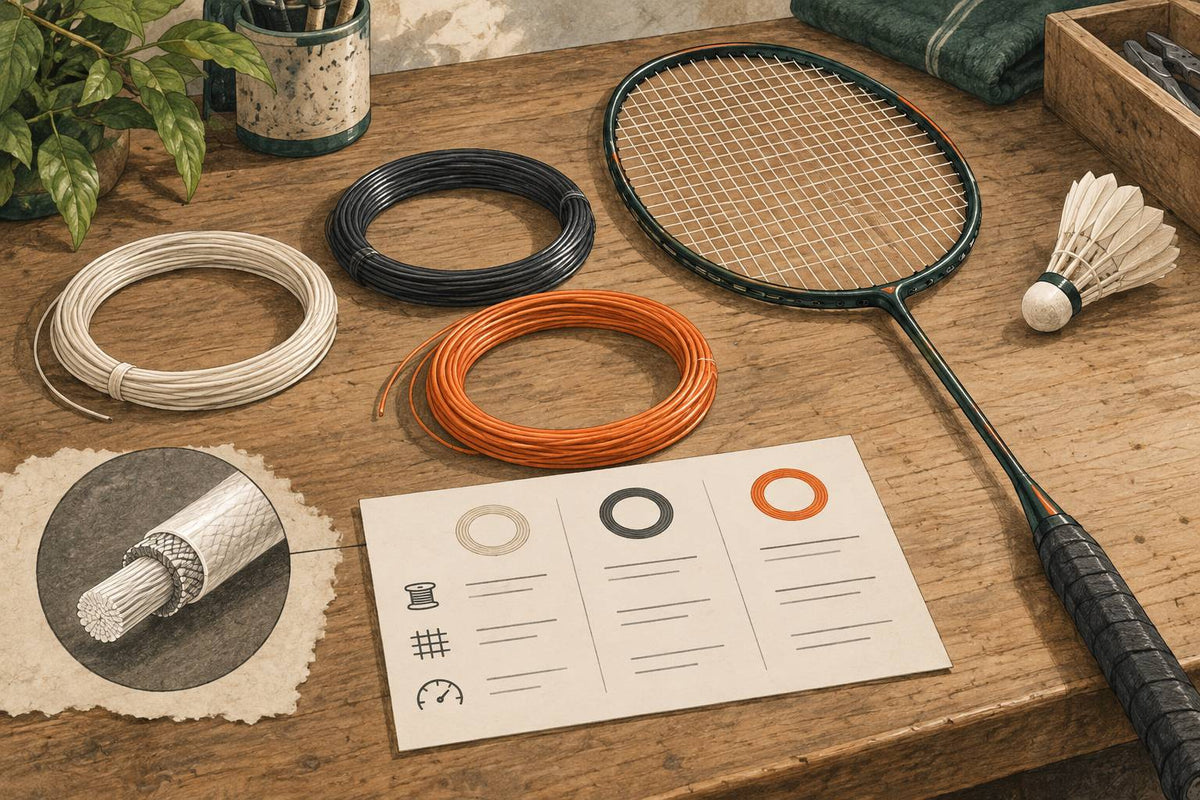
If you are unsure, start with BG65 for durability; move to BG80 for a crisper attacking feel, or Exbolt 65 when you want a modern all-round string with quick bite and controlled feel.
BG65
Best default: 0.70 mm, soft, and durable — the safest pick for beginners, all-rounders, frequent club players, or players breaking strings more often in Canadian winter conditions.
BG80
Choose this if you are an intermediate-to-advanced attacker who wants a 0.68 mm string with crisp feedback, rougher shuttle bite, and stronger repulsion than a durability-first setup.
Exbolt 65
Pick this for an all-round 0.65 mm option when you want quick bite and controlled response without going straight to the thinnest, most fragile feel-focused strings.
Once you choose the string, match it with the right tension using our badminton string tension guide.
Choosing badminton string is frustrating because every option sounds like an upgrade: more power, more feel, more control, better durability. In real club play, though, you are always trading one benefit for another. A string that feels lively on clean hits may punish mishits. A string that survives winter club nights may not give the same sharp feedback at the net.
This guide is for Canadian players trying to answer the practical question: how to choose badminton string without wasting a restring on the wrong setup. We’ll use familiar Yonex benchmarks like BG65, BG80, and the Exbolt family, then map the same ideas to common Victor and Li-Ning alternatives so you can talk confidently with your stringer.
The short version: start with your breakage rate, playing style, and usual club conditions. If you break strings often, durability matters more than chasing the thinnest feel. If your strings last forever but your shots feel dull, it may be time to move toward a more responsive option.
Need a fresh restring in Moncton? Badminton House offers racket stringing in Moncton, NB with 2–3 day turnaround and no appointment needed. See the stringing service page for current service details.
In This Guide
- Start With the Three Trade-Offs: Durability, Repulsion, and Control
- BG65 and BG65 Ti: The Durable Baseline
- BG80 and BG80 Power: Crisp Repulsion for Aggressive Players
- Exbolt 63, 65, and 68: Modern Repulsion With More Durability Options
- Nanogy, Victor, and Li-Ning Equivalents to Know
- Canadian Club Conditions, Winter Breakage, and CAD Restring Costs
- Which Badminton String Should You Choose?
Start With the Three Trade-Offs: Durability, Repulsion, and Control

If you are trying to learn how to choose badminton string, do not start with the most popular string name. Start with what you actually want to feel on court: longer life, easier repulsion, or more shuttle bite.
Badminton string gauge commonly runs from roughly 0.61 mm to 0.75 mm. In general, thicker strings around 0.70 mm and above are more durable and forgiving, while thinner strings at 0.68 mm and below tend to give more repulsion, feel, and control. Textured or hybrid control strings add extra grip on the shuttle for slices, holds, and spinning net shots.
That does not mean thin strings are “better.” A 0.65 mm string can feel amazing on a clean sweet-spot hit, but it is less forgiving if you clip the shuttle near the frame. For many Canadian club players, the best string is the one that matches both your swing and your real playing conditions: drop-in games, plastic or feather shuttles, winter gym air, and how often you are willing to restring.
| Trade-off | What it usually means | Best fit | Watch for |
|---|---|---|---|
| Durability | Thicker gauges, often around 0.70 mm or above | Beginners, intermediates, frequent mishitters, players who want fewer breaks | Usually less lively than very thin repulsion strings |
| Repulsion | Thinner power strings, typically 0.68 mm or below | Attacking singles players, rear-court doubles players, clean hitters | Smaller margin for mishits and more breakage risk |
| Control / bite | Textured finishes or hybrid setups that grip the shuttle | Front-court doubles, net players, players who use slice and hold shots | Feel is more specific; not every control string suits every swing |
Why mishits matter more than players think
A lot of string breaks happen because the shuttle is struck outside the sweet spot, especially near the frame. That off-centre impact puts sharp stress on a small section of string. This is why durability strings are commonly recommended for beginners: not because beginners do not deserve performance, but because their contact point is still becoming consistent.
Gauge is not the only cause of breakage. Worn grommets, strings sliding out of alignment, tension that is too high, and poor stringing technique can also contribute. If you keep breaking strings in the same area near the frame, the issue may be your contact point or racket condition rather than the string model itself.
Tension changes the same string completely
String choice and tension work together. Lower tension gives a larger sweet spot, more trampoline-like repulsion, and a more forgiving feel. Higher tension gives more direct feedback and control, but the sweet spot gets smaller and mishits become less forgiving. Tension also starts to drop from the day the racket is strung, so the number you choose is only the starting point.
As a general starting range, beginners often sit around 17–20 lbs, intermediates around 20–24 lbs, advanced players around 24–27 lbs, and professional-level setups can reach 27–30+ lbs. If you mainly play with plastic shuttles, reducing tension by 1–2 lbs is commonly recommended because plastic shuttles do not respond like feathers. For a deeper setup walkthrough, see our badminton string tension guide.
| If you feel... | Try this first | Why |
|---|---|---|
| You need to swing too hard for length | Lower tension before switching to a thinner string | Lower tension increases the sweet spot and adds easier bounce |
| Your shots feel vague or floaty | Consider slightly higher tension or a crisper string | Higher tension gives more direct feel and control when your timing is clean |
| You break strings often on off-centre hits | Move thicker or drop tension slightly | Thicker gauges and lower tension are more forgiving under mishit stress |
| You want more bite on net shots | Look at textured or hybrid control strings | A grippier string surface can hold the shuttle better for slice, spin, and touch |
With those trade-offs in mind, the simplest baseline is BG65: a durable 0.70 mm string that gives beginners and all-round club players a reliable reference point before moving into crisper or thinner options.
BG65 and BG65 Ti: The Durable Baseline
If you are learning how to choose badminton string and want the safest starting point, BG65 is the reference string for a reason. It is a 0.70 mm durability-focused Yonex string with a soft feel, and it is a practical choice for beginners, developing players, and all-rounders who would rather play consistently than chase the sharpest possible repulsion.
BG65 Ti sits beside it as the firmer option: still 0.70 mm, still built around durability, but with a harder feel and titanium coating for a sharper impact sensation. If BG65 feels too muted but you do not want to move down into a thinner 0.68 mm or 0.65 mm string yet, BG65 Ti is the natural next comparison.
| String | Gauge | Feel | Best fit |
|---|---|---|---|
| BG65 | 0.70 mm | Soft | Beginners, all-rounders, and players who prioritize durability and forgiveness |
| BG65 Ti | 0.70 mm | Harder / crisper | Hard hitters who want a sharper impact feel without giving up the durability of a thicker gauge |
Choose BG65 if you want fewer surprises
BG65 is the classic “keep me on court” choice. The thicker 0.70 mm gauge gives you more margin when your contact point is not perfect, which matters a lot for newer players and for club nights where you may be playing fast doubles, defending smashes, and taking shuttles late. It will not feel as lively as a very thin repulsion string, but that is the trade-off: more durability and a bigger comfort zone, less instant pop.
It is also a smart reset string. If you are not sure what you like yet, start with BG65 at a sensible tension, then use it as your baseline. If it feels too dull, compare BG65 Ti, BG80, or Exbolt 65 later. If it breaks too quickly, the issue may not be the model of string at all.
Choose BG65 Ti if BG65 feels too soft
BG65 Ti keeps the same 0.70 mm durability profile but changes the feedback. The harder feel and titanium coating create a sharper strike than regular BG65, which can appeal to players who hit with a compact, punchy swing or who want clearer feedback on drives and smashes.
The important expectation: BG65 Ti is not a thin, high-repulsion string in disguise. If you want the crisp bite of BG80 or the modern snap of Exbolt, those are different families. BG65 Ti is best understood as the more direct-feeling version of the durable baseline.
If you still break BG65, check the racket and conditions
A common frustration is: “I chose the durable string, so why did it break?” BG65 reduces risk, but it cannot protect against every break cause. As covered above, quick failures often come from mishits near the frame, worn grommets, string misalignment, tension that is too high for your contact consistency, or poor stringing technique.
The Canada-specific piece is temperature. Cold conditions can make strings more brittle, and cold, dry winter environments are a real factor for players moving rackets between cars, gyms, schools, and club bags. If your strings keep breaking in winter, consider a thicker gauge, a slightly lower tension, and better storage habits rather than immediately jumping to a livelier thin string.
For the maintenance side, see our badminton racket care guide, especially if your breaks happen close to the frame or after the racket has been left in cold conditions.
BG80 and BG80 Power: Crisp Repulsion for Aggressive Players
BG80 is the classic step up when BG65 starts feeling too muted. At 0.68 mm, it sits on the thinner side of the common club-player range, with a hard feel, rougher texture, and crisp feedback that many competitive players like for attacking badminton. It gives you a more immediate response off the string bed than a thick durability-first string, but it also asks more from your timing.
That last point matters. BG80 rewards clean contact. If you hit the sweet spot consistently, the hard feel and shuttle bite can make drives, steep half-smashes, and full rear-court attacks feel sharper. If you often catch the shuttle near the frame, a 0.68 mm string at higher tension will usually be less forgiving than BG65 or another durability-focused option.
Player-fit shortcut: choose BG80 if you want crisp repulsion and feedback; choose BG80 Power if your setup and playing style are built around heavier rear-court pressure and smashes.
| String | Gauge / feel | Best fit | Watch-out |
|---|---|---|---|
| BG80 | 0.68 mm · hard feel · rough texture · repulsion-focused | Intermediate to advanced players who want crisp feedback, shuttle bite, and a sharper response than BG65. | Less forgiving on off-centre hits than thicker durability strings. |
| BG80 Power | 0.68 mm · positioned for explosive power | Aggressive smashers who want a powerful, attacking string bed and stronger impact feel. | Not the first choice if your main problem is frequent string breakage. |
How BG80 fits a smash-focused racket setup
BG80 and BG80 Power make the most sense when the rest of your setup is also attack-oriented: a racket you can accelerate confidently, a tension you can control, and a swing that contacts the shuttle cleanly. On head-heavy or power-oriented rackets, these strings can sharpen the feeling of a steep smash or fast punch clear because the string bed gives firmer feedback at impact.
If you are choosing a new racket at the same time, start with the racket first, then tune the string. A powerful racket with too-demanding a string setup can feel great for ten minutes and tiring for a full club night. A more manoeuvrable racket with BG80 can still feel crisp without making every defensive exchange feel heavy. You can browse our badminton rackets collection for current listings; inventory changes, and the rackets recorded during research for this guide were marked sold out.
Who should avoid BG80 for now?
- Newer players with frequent mishits: a thicker durability string such as BG65 is usually the safer baseline while your timing improves.
- Players using very high tension too early: higher tension gives more control and feel, but it also reduces the sweet spot and can make power harder to generate.
- Winter string breakers: cold, dry conditions can make strings more brittle, so a thicker gauge or slightly lower tension may be more practical during Canadian winter club play.
For most attacking club players, the choice is simple: BG80 if you want the crisp competitive feel, BG80 Power if your game is built around rear-court pressure and you want the more smash-focused option. If you are unsure where to set the tension, use our badminton string tension guide before you restring.
Badminton House offers BG80 and BG80 Power through our Moncton, NB racket stringing service. For players outside New Brunswick, the same decision framework still applies: match the string to your contact quality, racket style, and how often you are willing to restring.
Exbolt 63, 65, and 68: Modern Repulsion With More Durability Options

Yonex’s Exbolt line is the modern alternative to the classic BG65/BG80/Nanogy decision tree. The simple way to read it: Exbolt 63 is the speed option, Exbolt 65 adds more hold and control, and Exbolt 68 is the durability play for players who still want a crisper, more modern feel than old-school thick strings.
Availability note for Canadian players. Badminton House currently strings Exbolt 65 only; if you want Exbolt 63 or Exbolt 68, you can request availability through our contact page or join the newsletter for gear updates and 10% off your first order.
All three Exbolt strings use Yonex’s FORGED FIBER construction, described by Yonex as fibres reconstructed at the molecular level for stronger bonds. The family also has a clear release timeline: Exbolt 63 launched in 2021, Exbolt 65 followed in 2022, and Exbolt 68 arrived in March 2024.
| String | Best read | What it means on court |
|---|---|---|
| Exbolt 63 | Speed string | The Exbolt choice if your first priority is quick response and fast shuttle release. |
| Exbolt 65 | Repulsion with more control | Adds an Elasticity Outer layer over FORGED FIBER, which Yonex says increases hold and improves overall control. |
| Exbolt 68 | Durable modern option | Despite its 0.68 mm gauge, Yonex positions Exbolt 68 as the most durable string in its entire badminton string lineup. |
Where Exbolt 65 fits
Exbolt 65 is the safest Exbolt starting point for many club players because it does not go all-in on one extreme. It gives you the modern, quick-biting Exbolt feel while adding a little more hold than the pure speed option. If you are coming from BG80 and want a lively all-rounder, or from BG65 and want more response without jumping straight to an ultra-thin string, Exbolt 65 is the one to ask about through our contact page.
Why Exbolt 68 matters for BG65 players
Exbolt 68 is interesting because it gives durability-focused players a newer path than simply staying with BG65, BG65 Ti, or Nanogy 95. A hands-on reviewer comparison found that Exbolt 68 had better feel and bite than BG65, BG65 Ti, and Nanogy 95, while also noting that it had less instant repulsion than super-thin strings.
That is exactly the trade-off to understand. If you love the trampoline-like snap of very thin strings, Exbolt 68 may not feel as instantly explosive. But if you are a frequent string breaker, a winter club player dealing with colder Canadian conditions, or a BG65 user who wants more bite without abandoning durability, Exbolt 68 is worth knowing.
For more on choosing tension alongside the string itself, see our badminton string tension guide. If you are breaking strings often, also check the racket care guide before blaming the string alone.
Nanogy, Victor, and Li-Ning Equivalents to Know
Once you understand BG65, BG80, and Exbolt, most other string questions get easier. The key is not to memorize every model name — it is to ask what role the string plays: durability, repulsion, control, or a balanced mix. That is the practical way to answer how to choose badminton string when a clubmate recommends Nanogy, Victor, or Li-Ning instead of the Yonex strings you already know.
Treat the strings below as useful comparisons, not identical copies. Gauge, feel, coating, and tension choice still matter. A 0.65 mm repulsion string will usually feel livelier than a 0.70 mm durability string, but it will also ask more from your timing and mishit consistency.
| String | Known role / gauge | Closest practical use case |
|---|---|---|
| Yonex Nanogy 95 | 0.69 mm · medium feel · durability type | A durability-first option for players who want something slightly thinner than BG65 but still more forgiving than very thin repulsion strings. |
| Victor VBS-63 | 0.63 mm · high-resilience / repulsion family | For players asking for a fast, lively power string. Think repulsion first, durability second. |
| Victor VBS-66 Nano | 0.66 mm · control-balance comparison point | For all-round players who want more touch and response than a thick durability string without going all-in on ultra-thin feel. |
| Victor VBS-70 | 0.70 mm · durability family | The Victor durability lane — useful if you are breaking strings often, mishitting near the frame, or want a BG65-style starting point. |
| Li-Ning No.1 | 0.65 mm · repulsion string | A lively option for players who prioritize shuttle speed off the string bed and are comfortable with thinner-gauge trade-offs. |
| Li-Ning N65 | 0.65 mm · BG80 rival | For players who like the idea of a crisp, attacking string in the BG80 conversation but are comparing Li-Ning options. |
| Li-Ning No.7 | 0.70 mm · durability option | The thicker Li-Ning durability lane — the type of string to consider when breakage matters more than maximum bite or instant repulsion. |
| Li-Ning N68 | 0.68 mm · repulsion option | A middle-gauge repulsion comparison for players who want a quicker response than 0.70 mm durability strings. |
What this means if you string with Badminton House in Moncton
Badminton House’s Moncton racket stringing service currently carries Yonex strings only. On the service page, the listed options include BG65, BG65 Titanium, Nanogy 95, BG80, BG80 Power, BG66 Ultimax, Exbolt 65, Aerosonic, and Aerobite.
So if you are comparing Victor or Li-Ning strings, use the table above to translate your preference into a Yonex service-menu choice. For example, a player asking about VBS-70 or Li-Ning No.7 is probably describing a durability need; a player asking about Li-Ning No.1 or VBS-63 is probably asking for livelier repulsion.
For local service questions, tension advice, or a current restring quote, use the contact page. For tension ranges by level, pair this section with our badminton string tension guide so you are choosing both the string and the tension together.
Want Exbolt 63, Exbolt 68, Victor, or Li-Ning options?
Join the Badminton House list for restock alerts, gear-request updates, and Canadian badminton buying help — plus 10% off your first order. For retail gear orders, free Canadian shipping is available on $200+.
Bottom line: if you are unsure, choose by problem first. Breaking strings too often? Stay near the 0.69–0.70 mm durability lane. Want a crisper, faster response and accept shorter life? Look at the 0.63–0.68 mm repulsion lane. Playing through Canadian winter conditions or carrying your racket between cold cars and dry gyms? Revisit our racket care guide before pushing tension or dropping to a very thin string.
Canadian Club Conditions, Winter Breakage, and CAD Restring Costs
Choosing badminton string in Canada is not only about BG65 vs BG80 vs Exbolt. It is also about where you play, how cold your racket gets between sessions, and how dry your club feels in winter. Cold temperatures can make strings more brittle, and winter temperature swings are a common reason players suddenly start breaking strings even when they have not changed racket or tension.
The biggest Canadian habit to fix is cold-car transport. If your racket sits in a freezing trunk, then goes straight into a warm gym and gets used at full pace, the string bed is dealing with a sharp temperature change before you even hit your first clear. That is especially rough on thinner strings: strings around 0.65 mm or thinner are the most cold-sensitive, so BG66 Ultimax, Exbolt 63, Exbolt 65, Aerosonic, and similar thin-gauge choices need more care in January than they do in July.
Winter rule of thumb: if you are breaking strings more often in cold months, drop your tension by 1–2 lbs and move toward a thicker or more durable string. For racket storage habits, see our badminton racket care guide.
Winter adjustments by string type
| If you use... | Winter concern | Practical adjustment |
|---|---|---|
|
BG65 / BG65 Ti 0.70 mm durability strings |
Still affected by cold, but more forgiving than thin gauges. | Stay with this family if you value durability. Consider dropping 1–2 lbs if winter breakage increases. |
|
BG80 / BG80 Power 0.68 mm crisp repulsion strings |
More responsive feel, but less margin for off-centre winter mishits than BG65. | Keep it if you want hard feedback, but avoid over-tensioning and inspect notching more often. |
|
Exbolt 63 / Exbolt 65 thin modern repulsion strings |
The thin-gauge category is more cold-sensitive, especially around 0.65 mm or thinner. | Drop 1–2 lbs in cold conditions, warm the racket gradually, or move to a thicker option if you keep snapping strings. |
|
Exbolt 68 0.68 mm durability-focused Exbolt |
A stronger durability choice than the thinner Exbolt options, but not immune to cold-car abuse. | A good upgrade path for players who like modern response but need more winter durability than very thin strings. |
Club conditions matter too
Cold, dry gyms can change both shuttle flight and string feel. If your club changes shuttle speeds by season, or your feathers feel slow and heavy in one gym but fast in another, do not treat string choice in isolation. Start with the environment: our guide to choosing feather shuttlecocks for Canadian clubs explains how temperature, venue conditions, and shuttle speed affect play.
For restring timing, the better question is not only “did the string break?” but “has the string bed gone dead?” If you play two or more sessions per week, visible notching, mushy feel, or needing to swing harder for the same length are signs to plan a restring before match night. For a full schedule by playing frequency, see how often to restring a badminton racket.
What restringing costs in Canada
As a Canadian benchmark, one published Richmond, BC stringing menu lists string-plus-labour prices from $29 CAD for BG65 up to $37.95 CAD for Exbolt 68. In the same benchmark, BG65 Ti is listed at $30 CAD, BG80 at $35 CAD, BG80 Power at $36 CAD, Exbolt 63 at $35.95 CAD, and Exbolt 65 at $36.95 CAD.
| String | Published Canadian benchmark | How to interpret it |
|---|---|---|
| BG65 | $29 CAD | Lowest-cost durable baseline in the benchmark. |
| BG65 Ti | $30 CAD | A small step up for a crisper 0.70 mm feel. |
| BG80 | $35 CAD | Typical jump for a more aggressive, crisp repulsion string. |
| BG80 Power | $36 CAD | For players who want the BG80 family with a more explosive power emphasis. |
| Exbolt 63 | $35.95 CAD | Speed-focused Exbolt option; more care needed in winter because of the thin gauge. |
| Exbolt 65 | $36.95 CAD | Modern repulsion/control choice for all-round players who like quick bite. |
| Exbolt 68 | $37.95 CAD | Highest listed Yonex price in this benchmark, but also the durability-focused Exbolt choice. |
Badminton House offers racket stringing in Moncton, NB with a 2–3 day turnaround and no appointment needed for drop-off. Pricing is quoted by contact, so the best next step is to use the Badminton House stringing service page and tell us your current string, tension, playing frequency, and whether you are breaking strings more often in winter.
For non-stringing gear orders, Badminton House also offers free Canadian shipping on orders over $200, which helps when you are restocking grips, shuttles, shoes, or other badminton essentials alongside your next service visit.
Which Badminton String Should You Choose?
The practical answer to how to choose badminton string is to start with the problem you are trying to solve: too many breaks, not enough bite, not enough repulsion, or a string bed that feels dead. Use this table as a club-player decision helper, then match the string with an appropriate tension from our badminton string tension guide.
| Choose this if... | Best string direction | Why it fits | Watch out for |
|---|---|---|---|
| You are a beginner, newer club player, or you mishit near the frame | BG65 | BG65 is a 0.70 mm soft-feeling durability string and is flagged as a beginner-friendly choice. Thicker strings are generally more durable and more forgiving for players who do not always hit the sweet spot. | If BG65 starts feeling too muted once your timing improves, move toward BG80 or Exbolt 65 for more bite and response. |
| You like BG65 durability but want a firmer, sharper impact | BG65 Ti | BG65 Ti keeps the 0.70 mm gauge but has a harder feel and titanium-coated construction for a sharper impact while staying in the durability lane. | It is still a durability-first string, not the most lively option if your main goal is repulsion. |
| You are an intermediate or advanced attacker who wants crisp feedback | BG80 | BG80 is a 0.68 mm hard-feeling repulsion string with a rough texture and strong feedback, making it a strong match for aggressive play. | It is thinner than BG65, so mishits and very high tension can punish durability. |
| You are a power smasher and want the punchiest BG80-family option | BG80 Power | BG80 Power is a 0.68 mm string positioned for explosive power and aggressive smashers, with higher tension retention listed in the research. | Do not choose it just because it sounds powerful; if you break strings often, a thicker durability string may save frustration. |
| You are an all-round club player who wants modern repulsion with more control | Exbolt 65 | Exbolt 65 is a 0.65 mm string with FORGED FIBER construction and an Elasticity Outer layer that increases hold and improves overall control. Badminton House lists it as an all-round quick-bite option. | Strings at 0.65 mm or thinner are the most cold-sensitive in winter conditions, so frequent breakers may need a thicker string or a 1–2 lb tension drop. |
| You are a BG65 user who wants more bite without abandoning durability | Exbolt 68 | Yonex positions Exbolt 68 as the power-centric Exbolt option and states that, despite its 0.68 mm gauge, it is the most durable string in the Yonex lineup. One reviewer preferred its feel and bite over BG65, BG65 Ti, and Nanogy 95. | It may not feel as instantly repulsive as super-thin strings. Check availability before planning a restring. |
| You play touch shots, net exchanges, and want maximum feel | BG66 Ultimax or Aerosonic | BG66 Ultimax is listed as a 0.65 mm ultra-responsive finesse string, while Aerosonic is a 0.61 mm maximum-feel option. | These are not the safest choices for frequent mishits, cold gyms, or players who want maximum durability. |
| You play doubles and care about net control, shuttle bite, and spin | Aerobite-style hybrid | Hybrid strings use thicker or rougher mains with thinner crosses for control. Because mains usually break first, the thicker main can add durability compared with a full thin-gauge string bed. | The feel is more specialized. If you mostly clear, lift, and smash from the rear court, BG80 or Exbolt may be easier to judge. |
| You play through Canadian winter, use cold gyms, or your racket sits in a cold car | BG65, BG65 Ti, or Exbolt 68 | Cold temperatures make strings more brittle, and cold-condition advice is to string looser and thicker. Dropping tension by 1–2 lb and choosing a more durable gauge can reduce winter breakage risk. | Avoid cold-car storage when possible; our racket care guide covers cold-weather string and frame habits. |
Need a local restring in Moncton? Badminton House offers racket stringing with 2–3 day turnaround and no appointment needed. Exbolt 65 is on the posted menu; ask about Exbolt 63/68 availability before drop-off. For the current quote, contact us.
Get Canadian badminton gear advice + restock alerts
Join the Badminton House list for buying checklists, restock alerts, and practical gear advice for Canadian players.
By subscribing, you agree to receive Badminton House emails and can unsubscribe anytime.
If you are still torn between BG65, BG80, Exbolt 65, or another string, ask us before you restring. We play badminton ourselves, and we can help you match string, tension, and durability to your level, shuttle type, and club conditions. For personalized advice or a Moncton stringing quote, contact Badminton House.
Need strings, grips, shuttles, or racket advice from a Canadian badminton specialty shop?
Choose gear with help from players who understand Canadian club conditions.
Browse Badminton GearFree Canadian shipping on orders $200+ · Moncton, NB stringing service · Canadian badminton specialty shop


Leave a comment
This site is protected by hCaptcha and the hCaptcha Privacy Policy and Terms of Service apply.