
Last checked: August 2026 · Written by the player-led team at Badminton House
If the second racket is emergency insurance, match the first as closely as practical. If it is a tension experiment, keep the frame, string, grip, and stringing process alike and change only requested tension. A 1–2 lb split is a conservative editorial test step, not an official rule or a guaranteed performance threshold.
True backup
Match it: same frame variant, string, requested tension, grip build, and familiar feel.
Tension test
Control it: hold other variables close and compare 1–2 lb apart over several sessions.
Different build
Name it honestly: a whole-racket option, not evidence that tension caused the difference.
Whichever path you choose, both tensions must stay inside the manufacturer's recommendation for the exact frame and weight variant. The spare also has to be played, labelled, and maintained before it earns a place as your match backup.
First decide what the second racket is for
The right setup follows the job. Players often mix three different goals, then wonder why switching rackets feels disruptive.

| Goal | Setup priority | Honest conclusion |
|---|---|---|
| Continue after a string break | Reduce surprises by matching the complete setup. | This is your true backup. |
| Compare two tensions | Change one planned variable and repeat the test. | This is an A/B pair, not identical insurance. |
| Carry another frame option | Pre-test the whole racket for a named situation. | Any difference belongs to the complete build. |
For most tournament insurance, the first row is the useful default. A string break is already a disruption; it is a poor moment to discover a different grip size, string feel, frame balance, or tension response.
If you have not chosen a sensible baseline yet, use the full badminton string tension guide first. This page begins after that decision and shows how to duplicate or test it.
How do you build a matched backup?
Match what you can verify: exact model code, weight and grip variant, string model and gauge, requested main/cross setup, grip layers, and stringing shop or technician. Have both jobs done close together when practical, then play each racket before competition.
- Frame identity: record the full item code and the printed weight/grip code, not only the family name.
- Stringbed: use the same string, gauge, pattern, and requested tension.
- Handle build: match replacement grip, overgrip, overlap, finishing tape, and grip height.
- Process: use the same qualified stringer and machine when possible, and record the date.
- Reality check: rotate the rackets through normal drills, defence, serving, and full games.
A matching name is not an individual measurement. Yonex, for example, lists the current NANOFLARE 1000 Z as 4U at an average 83 g and 3U at an average 88 g. It also gives different stringing advice: 20–28 lbs for 4U and 21–29 lbs for 3U. That is an example of why you must match the exact variant and read its own range, not a recommendation for this model.
Weigh each finished racket with strings and grip on the same scale. You can also record the balance point from the butt cap using the same simple method for both. These are screening notes, not a full dynamic measurement; the badminton swingweight explainer covers that distinction, while the 3U, 4U, and 5U guide explains the category codes.
How should you test two different tensions?
Start with the same frame variant and string, then set Racket A at your established baseline and Racket B only 1–2 lb away. That interval is our conservative testing suggestion. It is not a BWF law, a manufacturer rule, or a promise that every player will notice the same change.
VICTOR's official string-and-tension explainer describes a lower-tension stringbed as more elastic and user-friendly and a higher-tension bed as stiffer. It also says tension is not simply a skill number and recommends gradual adjustment to the player's needs. Treat those as broad manufacturer descriptions, then judge your own complete setup rather than assuming a result.
- Choose one question: for example, which setup gives you the more repeatable clear length and net height during a normal session?
- Keep the comparison paired: same shuttles, hall, drill, warm-up, and similar fatigue point.
- Alternate the order: do not always test A fresh and B after a full game.
- Write observations, not slogans: record misses, length, touch, and comfort without declaring “higher equals control” in advance.
- Repeat: one good rally or one poor night is not enough to choose the permanent setup.
If both rackets change frame, weight variant, grip build, string, and tension together, you have not run a tension test. You have compared two complete rackets. That can still help you choose what to play, but tension does not get sole credit or blame.
Which tension limit applies to the spare?
The limit printed for the exact spare applies to that spare. Do not copy a range from your first racket, a different weight variant, another generation, or a racket with a similar name. If the two ranges differ, the usable comparison window is only where both exact recommendations overlap.
Example of an overlap check
If Racket A is marked 20–28 lbs and Racket B is marked 21–29 lbs, 21–28 lbs is the shared window. This arithmetic does not make the frames equivalent; it only identifies tensions that sit inside both printed ranges.
Yonex's badminton safety guidance says to string around the racket's recommended tension while retaining its original frame shape, and warns that excess tension or shape distortion can cause damage. That safety boundary outranks the desire to create a dramatic A/B difference.
If either frame has a crack, damaged section, badly worn grommet, or uncertain history, stop the experiment and have it inspected. A printed range is not permission to string a damaged racket.
Label the rackets so the test survives a busy session
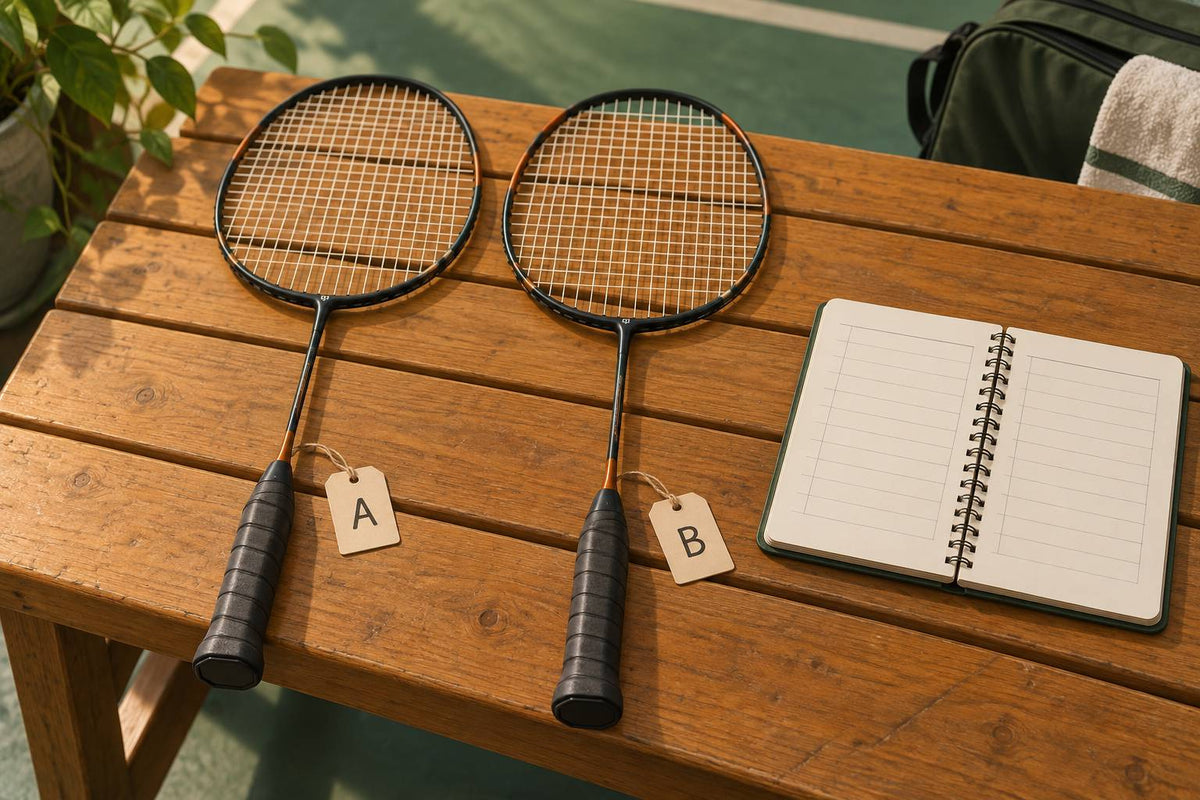
Call the rackets A and B, then put the information somewhere you can retrieve it without guessing. A small removable label on the cone or a phone note is enough.
| Record | Why it belongs |
|---|---|
| Model code and variant | Confirms which printed tension recommendation applies. |
| String and requested tension | Prevents the A/B identity from becoming a memory test. |
| Stringing date and stringer | Keeps service history visible when you plan the next paired job. |
| Finished mass and balance point | Flags a complete-setup mismatch worth investigating. |
| Grip build | Explains a handle difference before tension gets blamed. |
Rotate both rackets during ordinary training even after you settle on a favourite. The goal is not equal use for its own sake; it is knowing that the spare's grip, strings, and response remain familiar.
When should you switch to the spare?
Switch when the first racket is no longer safe or playable, not because one rally went badly. A broken string is the clearest trigger. A grip that has become slippery or damaged is another reason to stop relying on that racket until the grip is corrected.
Yonex's global product-safety guidance says to inspect for cracks and other irregularities before use. It also warns that worn grommets can damage strings and that a worn or slippery grip can let the racket leave the hand. Those checks apply to the spare as much as the primary.
After a string breaks, Yonex advises removing the broken string promptly because leaving it in the frame disrupts tension balance and can cause damage. Put the intact, pre-tested spare into play, then deal with the broken stringbed rather than carrying the damaged frame as if it were ready.
Two-racket readiness loop
- Assign the job: true backup, tension test, or different build.
- Verify each exact frame's range and condition.
- Match variables or state clearly which one you changed.
- Label, log, and play both setups.
- Service damage before either racket returns to the ready slot.
The useful second racket is not the one with the cleverest tension theory. It is the one whose purpose, limits, setup, and on-court response you already know.

Leave a comment
This site is protected by hCaptcha and the hCaptcha Privacy Policy and Terms of Service apply.