
Last updated: August 2026 · Badminton House
Quick answer
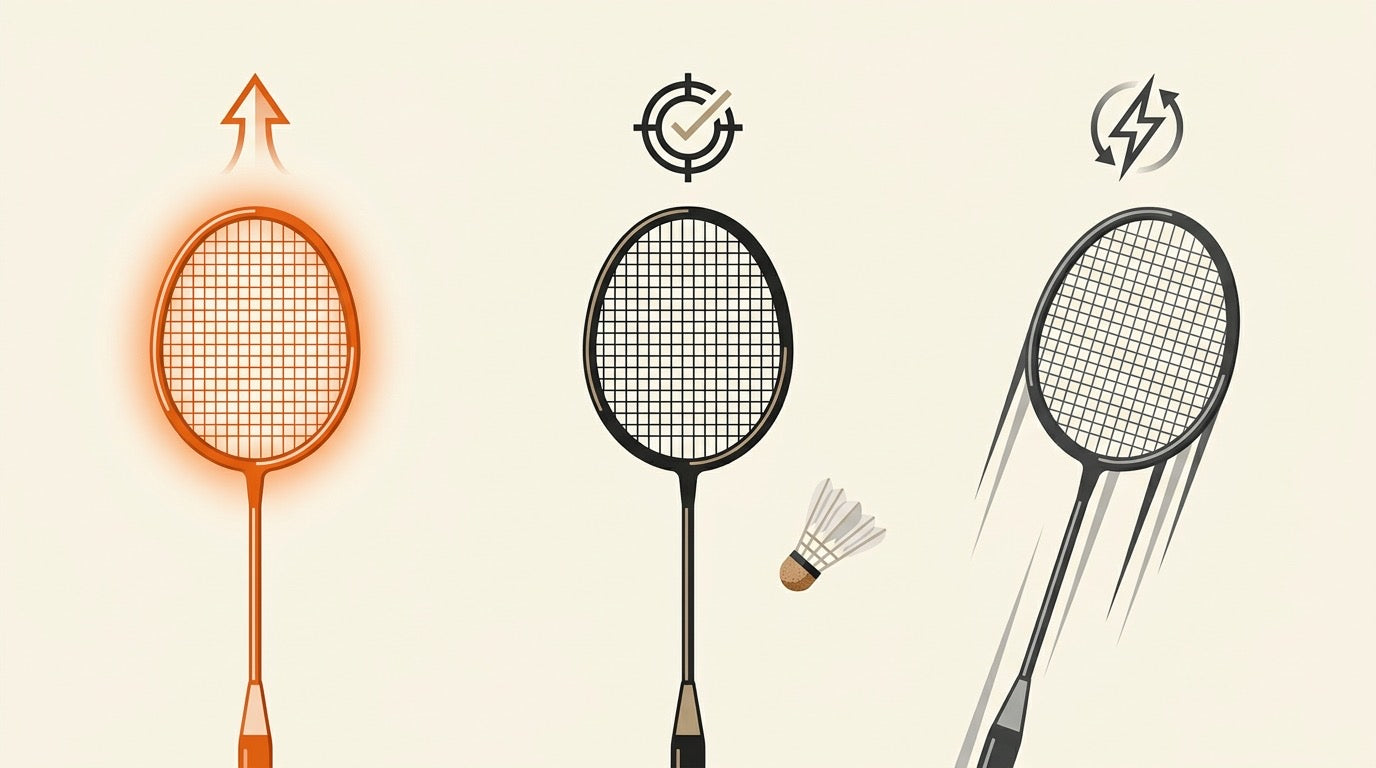
Astrox — power
Head-heavy. You finish rallies from the back with the smash.
Arcsaber — control
Even balance. You win by putting the shuttle exactly where you meant to.
Nanoflare — speed
Head-light. You win the flat exchange before the smash ever happens.
If you cannot choose: Arcsaber. An even-balance racket is the least punishing of the three and suits the widest range of situations.
In this guide
The Three Series Compared
| Astrox | Arcsaber | Nanoflare | |
|---|---|---|---|
| Yonex calls it | Power | Accuracy | Speed |
| Balance | Head heavy | Even | Head light |
| Signature technology | Rotational Generator System | Pocketing Booster | Sonic Flare System |
| What it does for you | Loads mass behind the shuttle for a steep, heavy smash | Holds the shuttle on the bed fractionally longer for precise placement | Cuts swing weight and air resistance so the racket gets there first |
| Best shot | Smash from the rear court | Drop, slice, and tight net play | Flat drives, blocks, net interceptions |
| Weakest at | Defence and fast resets | Nothing badly — and nothing outstandingly | Weight of smash from the back |
| Top tier | Astrox 100ZZ, Astrox 99 Pro | Arcsaber 11 Pro | Nanoflare 1000 Z |
One caveat worth stating, because Yonex says so itself: Nanoflare is not a low-power series. Yonex markets it as head-light and powerful, and the 1000 Z in particular is built to accelerate the shuttle rather than just move quickly. The difference is where the power comes from — racket speed rather than racket mass.
The Current 2026 Models, by Tier
Yonex uses a consistent suffix ladder across all three series, which makes the range far easier to read once you know it. Same frame concept, descending price and specification.
| Suffix | What it means |
|---|---|
| Pro / ZZ / Z | Flagship. Stiffest shaft, best materials, usually made in Japan. Advanced players only. |
| Tour | Near-flagship at a lower price. The value pick for strong club players. |
| Game | Softer flex, more forgiving. Where most improving players should actually shop. |
| Play | Entry tier, usually pre-strung. A genuinely good first racket. |
| Tier | Astrox | Arcsaber | Nanoflare |
|---|---|---|---|
| Flagship | Astrox 100ZZ, 99 Pro, 88D Pro, 88S Pro | Arcsaber 11 Pro, 7 Pro | Nanoflare 1000 Z, 800 Pro, 700 Pro |
| Tour | Astrox 100 Tour | Arcsaber 11 Tour, 7 Tour | Nanoflare 1000 Tour, 800 Tour, 700 Tour |
| Game | Astrox 100 Game | — | Nanoflare 1000 Game, 800 Game, 700 Game |
| Play / entry | Astrox Attack 9, Astrox Nextage | Arcsaber 11 Play, 7 Play, Arcsaber 2 Ability | Nanoflare 1000 Play, Nanoflare Nextage |
Lineups shift year to year, so check the current listing before buying — but the ladder itself has been stable for several generations and is the fastest way to place any Yonex racket you come across.
Head-to-Head Model Pairings
If you are cross-shopping two specific rackets rather than three series, these are the comparisons that actually come up.
| Matchup | Choose the first if | Choose the second if |
|---|---|---|
| Astrox 100ZZ vs Nanoflare 1000 Z | You finish rallies from the rear court in singles | Your points come from flat speed and interceptions |
| Astrox 88D Pro vs Nanoflare 800 Pro | You play the back of a doubles pair | You play the front and need fast hands |
| Astrox 88D Pro vs 88S Pro | Rear court — D is for the driver | Front court — S is for the skill player |
| Arcsaber 11 Pro vs Arcsaber 7 Pro | You are advanced and want the stiffer, more demanding frame | You are a solid intermediate — the softer flex will suit you better |
| Arcsaber 11 Pro vs Astrox 99 Pro | You want an all-court racket with no weak shot | You want a genuinely bigger smash and accept worse defence |
| Arcsaber 11 Play vs Nanoflare Nextage | First proper racket, want the most forgiving option | First proper racket, but you already like a light, fast feel |
For the flagship power comparison in depth, see our Nanoflare 800 vs Astrox 100ZZ guide, the Astrox 100ZZ review, and Astrox 88D vs 88S.
Astrox vs Nanoflare
This is the classic Yonex decision, and it comes down to one question: do you win points by hitting harder, or by getting there first?
Astrox puts mass in the head. That mass is doing work for you on the smash and against you everywhere else — you feel it when you are pushed back and have to reset quickly.
Nanoflare takes the mass out and gives you racket speed instead. You get to the shuttle earlier, block better, and drive faster, and you give up some weight of shot from the back.
Which has more power? Astrox, on the smash. But Nanoflare wins more points for players whose rallies are decided before a smash is available.
Arcsaber vs Nanoflare
Both are easier to handle than Astrox, so this is really a choice between precision and speed.
Arcsaber’s even balance and shuttle-holding feel make it the better racket when placement wins you rallies — deceptive drops, tight net shots, drawing an opponent out of position. Nanoflare’s head-light build makes it the better racket when the rally is fast and the deciding factor is whether your racket is up in time.
A useful test: if you lose points because your shot went where you did not intend, Arcsaber. If you lose points because you were still moving when the shuttle arrived, Nanoflare.
Astrox vs Arcsaber
Power against all-court balance. Astrox raises your ceiling on one shot; Arcsaber raises your floor on all of them.
The practical version: Astrox is the better racket if you are already good enough to create attacking opportunities regularly. Arcsaber is the better racket if your game is still varied, or if you play a mix of singles, doubles and mixed and cannot specialise. For most club players, that makes Arcsaber the more sensible buy and Astrox the more exciting one.
Singles and Doubles: A Direct Answer
Doubles is not one job, which is why generic advice fails. It depends where you stand.
| You play | Series | Why |
|---|---|---|
| Singles | Astrox or Arcsaber | Rallies are long and you create your own openings. Mass helps; so does placement. |
| Doubles — rear court | Astrox | Your job is to hit down hard and keep the pressure on. |
| Doubles — front court | Nanoflare | Your job is interceptions and net kills. Racket speed is everything. |
| Doubles — you rotate | Arcsaber | You need to do both jobs adequately rather than one brilliantly. |
| Mixed | Nanoflare at the front, Astrox at the back | Mixed has the most defined roles of any format, so specialise. |
Common Questions
Which is better, Arcsaber or Astrox?
Arcsaber for most players. It is even-balanced and forgiving across every shot. Astrox is better only if your game is built on attacking from the rear court and you have the technique to use a head-heavy frame.
Which is better, Astrox or Nanoflare?
Astrox if you win points with the smash, Nanoflare if you win them with speed. Astrox has the bigger smash; Nanoflare has better defence, drives and net play.
Which Yonex series is best for beginners?
Arcsaber, at the Play or Ability tier. Even balance and a softer shaft let you build technique instead of compensating for the racket.
Is Astrox only for singles?
No. The 88D Pro is specifically a doubles rear-court racket. Astrox is about attacking, not about format.
Can an Arcsaber smash hard?
Yes, just not as heavily as an equivalent Astrox. The mass is distributed differently, so the smash is flatter and faster rather than steep and heavy.
What is the safest choice if I am unsure?
An Arcsaber in the Tour or Game tier. Even balance suits the widest range of situations, and the mid tiers have a shaft you can actually load.
Which Should You Choose?
| If this is you | Series and tier |
|---|---|
| First proper racket | Arcsaber, Play or Ability tier |
| Improving club player, plays everything | Arcsaber, Game or Tour tier |
| Doubles rear court, hits hard | Astrox 88D, Tour or Pro tier |
| Doubles front court or mixed net player | Nanoflare 700 or 800, Game or Tour tier |
| Advanced singles, attacking game | Astrox 100ZZ or 99 Pro |
| You keep getting beaten in flat exchanges | Nanoflare, any tier — this is exactly what it is for |
Still stuck between two? Tell us your level, main format and current racket through our contact page, or browse the rackets collection.
Whichever series you pick, the shaft flex matters more than the badge — see our stiff vs flexible shaft guide and head-heavy vs head-light guide. Comparing across brands? See Yonex vs Li-Ning vs Victor.

Leave a comment
This site is protected by hCaptcha and the hCaptcha Privacy Policy and Terms of Service apply.