
Last updated: July 2026 · Written by the team at Badminton House
Quick Answer: Badminton Hold Shot Carry Fault
Legal hold-shot deception happens before contact: disguise the choice, set the racket face late, then strike once. It becomes a fault when the shuttle is caught, held, and slung; the Laws give no millisecond limit. A separate second hit is different from one-stroke head-and-strings contact.
Late decision
Best choice: legal when disguise ends before one clean strike.
Carry/sling
Fault when the shuttle is caught, held, then slung.
Double hit
Fault for two successive hits, not one-stroke head-and-strings contact.
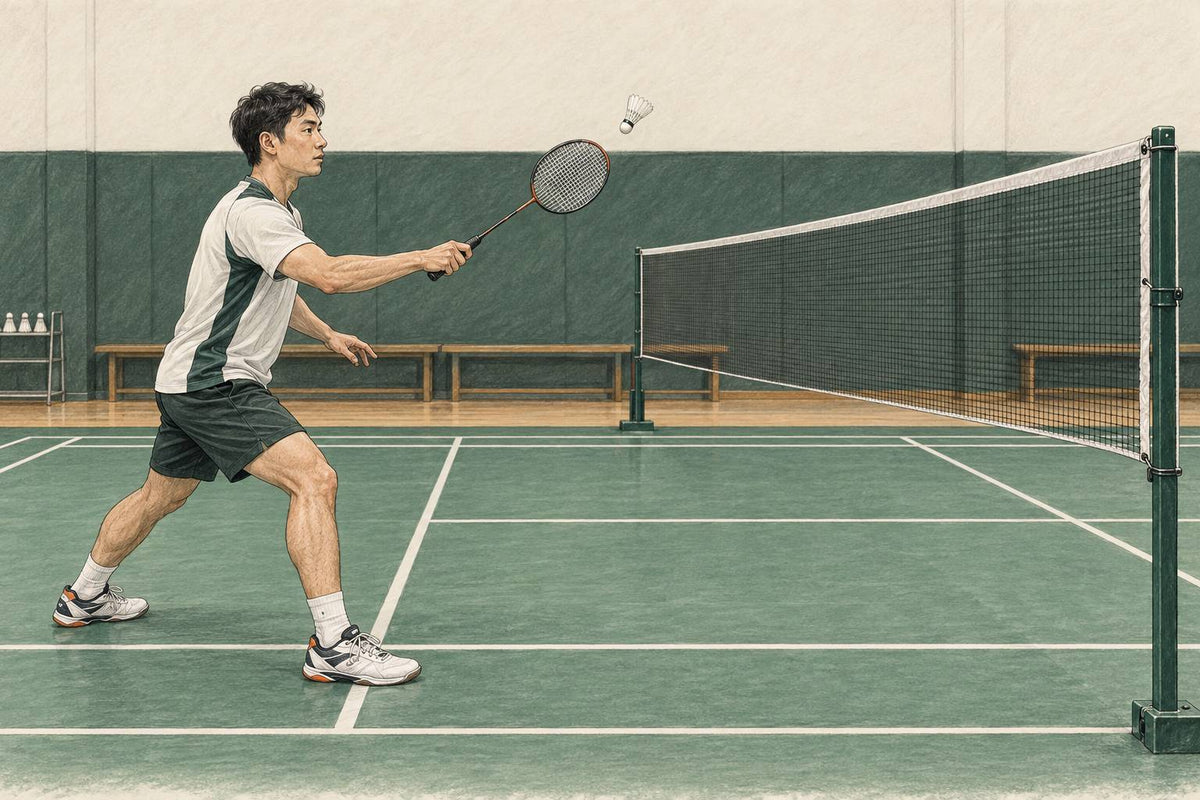
A good hold shot should freeze your opponent, not make the shuttle look like it stuck to your strings. The tricky part is that both can happen in the same forecourt situation: you arrive early, show one option, then change the racket face late. That is useful deception. But if the shuttle is caught, dragged, scooped, or slung instead of struck cleanly, the rally can end as a badminton hold shot carry fault.
In This Guide
What the BWF Law Says About a Badminton Hold Shot Carry Fault
The badminton hold shot carry fault starts with one sentence in the BWF Laws of Badminton. Under Law 13.3.6, it is a fault if the shuttle “is caught and held on the racket and then slung during the execution of a stroke.” That is the official boundary: the problem is not that the racket was slow, soft, or deceptive; it is that the shuttle was caught, held, and then thrown or slung from the racket.
The current Laws do not give a millisecond contact-time limit. Instead, the governing definition of a stroke is “a movement of the player’s racket with an intention to hit the shuttle.” So legality is judged by the action: was it visibly caught and held and then slung, or struck once in a continuous stroke?
Legal Deception: Late Racket Decision, Not Holding the Shuttle
The key distinction in a badminton hold shot carry fault is timing: legal deception happens before impact. You show a false message with your body, shoulder, grip, or racket path, then make the real shot choice late. The shuttle is still struck once, cleanly, and released immediately from the strings.
That is why a deceptive “pause” is not automatically a carry. Peter Gade’s described pause was about waiting until he was very close to the shuttle before choosing the shot, not trapping the shuttle on the racket. Likewise, a forecourt backhand fake-push followed by a real drop is legal technique context when the fake action ends before contact and the real action is one clean hit.
Think of deception as false preparation plus real contact. If you want the broader shot-disguise framework, read our guide to badminton deception technique.

Where Clean Contact Ends: Carry, Double Hit, and Follow-Through
A carry is not the same fault as every awkward contact. Under Law 13.3.7, it is a fault if the same player hits the shuttle twice in succession. But the law also protects a normal mishit: if the shuttle contacts the racket head and the stringed area during one stroke, that is not a double-hit fault.
That exception matters because the racket is not only strings floating in space. The stringed area is the part intended for hitting the shuttle, but real impacts can brush the frame or head on the way through. The key boundary is whether there was one hitting action, not a second separate push, scoop, or redirection after contact.
Follow-through is another separate issue. Law 13.4.2 allows your racket to continue over the net after you strike the shuttle on your own side; the fault is reaching across to make contact before the shuttle crosses. For the full boundary, see Can Your Racket Cross the Net in Badminton?
How to Play Close to the Line Without Carrying the Shuttle
To flirt with a hold shot legally, make the “pause” happen before contact, not during it. Show the false action with your body, shoulder, wrist, and racket path, then let the shuttle rebound from one clean stroke. A catching or scooping sensation is a reason to review the contact with a coach; the legal test is whether the shuttle was actually caught, held and then slung.
The safer technical tool is slicing. With an angled racket face, you brush across the shuttle for a glancing blow, so the pace or direction changes without the shuttle staying on the strings. That is why slice drops and tight net cuts can look deceptive while still feeling like a hit. Pair that with stable racket face angle control: relaxed preparation, brief squeeze at impact, immediate release.
If called, expect clear terminology: “You slung the shuttle” is different from “You hit the shuttle twice.” A carry is a fault against the striker, not a let.
Which Call Fits the Shot?
| Choose this if... | Best ruling | What to look for |
|---|---|---|
| The player waits, disguises, then hits once. | Legal deception | The pause happens before contact; the shuttle is still struck in one clean stroke. |
| The shuttle appears caught, held, then thrown or slung. | Carry/sling fault | There is no legal time threshold; the issue is whether contact became a caught-held-slung action. |
| The same player hits the shuttle twice in succession. | Double-hit fault | Do not confuse this with one stroke where the shuttle contacts the racket head and strings. |
| Contact is on the hitter’s side, then the racket continues over the net. | Legal follow-through | The key checkpoint is the first point of contact, not where the racket finishes. |
Get 10% off your first order
Join the Badminton House list and we’ll email you a 10% welcome code — plus training guides, technique advice, and badminton updates.
By subscribing, you agree to receive Badminton House emails and can unsubscribe anytime.
Clean deception should feel sharp, not sticky. If you are unsure whether your hold shot is turning into a carry, ask a coach or send us a note — we play badminton and can help you think through grip pressure, racket angle, and cleaner contact. Contact us for advice.
Practice clean contact with a racket that suits your control game.
Browse Badminton RacketsCheck live availability before your next practice session.


Leave a comment
This site is protected by hCaptcha and the hCaptcha Privacy Policy and Terms of Service apply.